Washington: Right-of-way and turning — Part 1 Practice Test
Questions in this part include: “When might you temporarily travel on the left side of the road?” · “At an intersection, state law requires you to turn into which lane?”
Independent educational site · not affiliated with any government agency or DMV
Ready? Test yourself
Answer to start, or tap Start below:
When might you temporarily travel on the left side of the road?
- Instant feedback with an explanation
- Every answer cites its source in the manual
- Your best score is saved on this device
- Keyboard: press 1 to 4 to answer and Enter for the next question
Questions are original and based on the official manual "Washington Driver Guide" (© 2025), Washington State Department of Licensing (DOL).
All 17 questions in this practice test
Take the test above first, then use this list to study. Tap “Show answer” to see the correct answer and explanation.
Show the questions and answersHide the questions
-
When approaching an intersection, what does the guide say to pay close attention to?
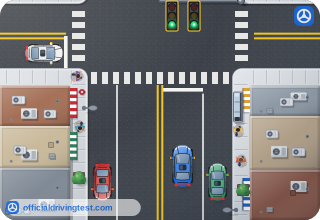
- Only vehicles approaching from straight ahead, since they are the closest
- Vehicles, pedestrians, and cyclists approaching from the left and right
- Only vehicles coming from your right side, because they have the right of way
- Only the vehicle directly in front of you and the traffic light
Show answer
Correct answer: Vehicles, pedestrians, and cyclists approaching from the left and right
The guide says to pay close attention to vehicles, pedestrians, and cyclists coming from both sides at intersections.
Source: Washington Driver Guide (© 2025), page 88 · Open this page in the manual (Manual page 88)
-
What does the guide say to do before turning to check for bicyclists or pedestrians who might be alongside you or about to cross the street?
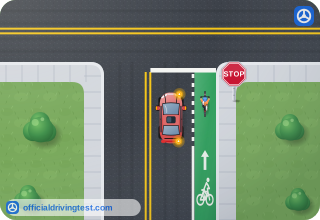
- Check your side mirrors and do an over-shoulder check
- Check only your rearview mirror and then turn
- Honk your horn to warn people nearby
- Flash your headlights to signal other road users
Show answer
Correct answer: Check your side mirrors and do an over-shoulder check
The guide says to check your side mirrors and do an over-shoulder check before turning.
Source: Washington Driver Guide (© 2025), page 88 · Open this page in the manual (Manual page 88)
-
When might you temporarily travel on the left side of the road?
- When safely and legally passing on a two-lane road
- When the right side of the road is crowded with traffic
- When approaching a curve with limited visibility
- When you are driving slower than other traffic
Show answer
Correct answer: When safely and legally passing on a two-lane road
The only time you might temporarily travel on the left is when safely and legally passing another vehicle on a two-lane road.
Source: Washington Driver Guide (© 2025), page 108 · Open this page in the manual (Manual page 108)
-
What is an intersection?
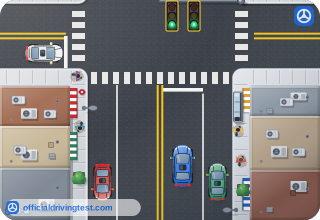
- Any place where two or more roads come together
- Only a place where two paved roads cross each other
- Only a place that has a traffic signal or stop sign
- Only a place where a marked crosswalk crosses a road
Show answer
Correct answer: Any place where two or more roads come together
The guide defines an intersection as any place where two or more roads come together, including driveways and parking lot entrances.
Source: Washington Driver Guide (© 2025), page 121 · Open this page in the manual (Manual page 121)
-
Before you enter an intersection, what should you do about pedestrians and traffic already in it?
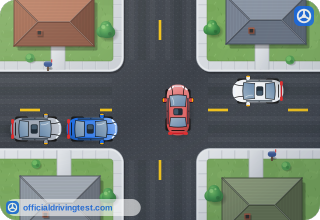
- Honk to warn them and continue slowly
- Go around them if there is room
- Speed up to clear it before they reach you
- Stop and yield to them
Show answer
Correct answer: Stop and yield to them
You stop and yield to pedestrians and traffic that are in the intersection before you enter.
Source: Washington Driver Guide (© 2025), page 121 · Open this page in the manual (Manual page 121)
-
Before you enter an intersection, what should you check with your side mirrors and over your shoulder?
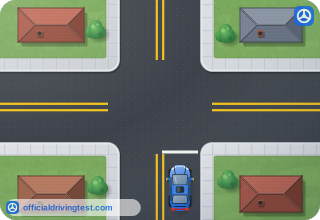
- That no vehicle is parked within 30 feet of the corner you approach
- That no cyclist, motorcyclist, or pedestrian is coming into your path
- That the traffic signal has not been changed recently
- That your turn signal is working on both sides
Show answer
Correct answer: That no cyclist, motorcyclist, or pedestrian is coming into your path
Checking mirrors and over your shoulder helps you spot a cyclist, motorcyclist, or pedestrian coming into your path.
Source: Washington Driver Guide (© 2025), page 121 · Open this page in the manual (Manual page 121)
-
Your view of the cross street is blocked when you stop on the stop line. What should you do?
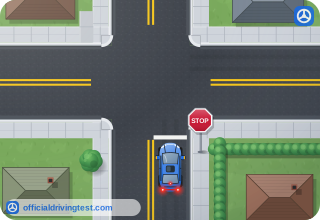
- Stay on the line and wait until the view clears
- Back up and stop farther from the intersection
- Edge forward slowly until you can see
- Honk and go when the other drivers stop
Show answer
Correct answer: Edge forward slowly until you can see
Edging forward slowly lets crossing drivers see the front of your vehicle and gives them a chance to slow down and warn you.
Source: Washington Driver Guide (© 2025), page 121 · Open this page in the manual (Manual page 121)
-
Before you enter an intersection, what should you make sure of about the space around it?
- That there is enough space to cross or turn without blocking the intersection
- That there is enough space to stop beside the crosswalk
- That there is room for several vehicles to follow you through behind you
- That no vehicles are behind you
Show answer
Correct answer: That there is enough space to cross or turn without blocking the intersection
You should not enter unless you have room to cross or turn without blocking the intersection.
Source: Washington Driver Guide (© 2025), page 122 · Open this page in the manual (Manual page 122)
-
What do right-of-way rules determine at an intersection?
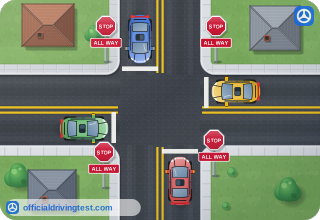
- The order in which vehicles move through it
- The speed limit that applies to each lane
- Which vehicles may park nearby
- Which lane is used for passing
Show answer
Correct answer: The order in which vehicles move through it
Right-of-way rules set the order vehicles go through an intersection, and the law decides who must yield.
Source: Washington Driver Guide (© 2025), page 122 · Open this page in the manual (Manual page 122)
-
At an intersection controlled by stop signs, which vehicle is the first to go?
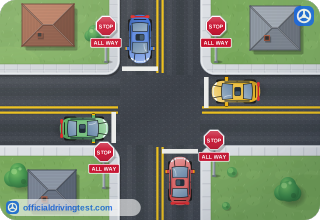
- The vehicle that is going straight
- The largest vehicle
- The first vehicle to arrive
- The vehicle on the left
Show answer
Correct answer: The first vehicle to arrive
At a four-way stop, the first vehicle to arrive is the first to go.
Source: Washington Driver Guide (© 2025), page 122 · Open this page in the manual (Manual page 122)
-
At a four-way stop, two vehicles arrive at approximately the same time. Which one goes first?
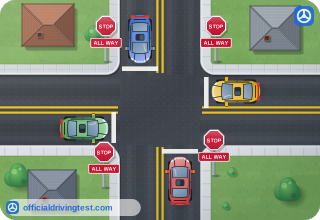
- The one on the left
- The one on the right
- The faster one
- The one turning left
Show answer
Correct answer: The one on the right
When two vehicles arrive together at a stop-sign intersection, you yield to the one on your right.
Source: Washington Driver Guide (© 2025), page 122 · Open this page in the manual (Manual page 122)
-
At a four-way stop, any vehicle turning left must yield the right-of-way to which vehicles?
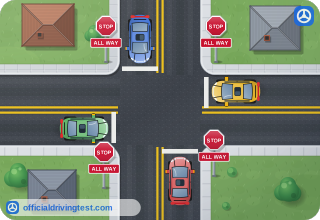
- Only vehicles that are also turning left
- Only vehicles that arrived after it
- No other vehicles, because a left turn goes first
- Vehicles going straight or turning right
Show answer
Correct answer: Vehicles going straight or turning right
At a four-way stop, a left-turning vehicle yields to vehicles going straight or turning right.
Source: Washington Driver Guide (© 2025), page 122 · Open this page in the manual (Manual page 122)
-
At a two-way stop, which vehicle has the right-of-way?
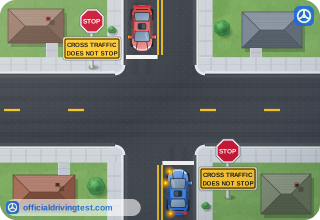
- The vehicle turning left
- The vehicle turning right
- The vehicle going straight
- The vehicle that arrived first
Show answer
Correct answer: The vehicle going straight
At a two-way stop, turning vehicles must yield to the vehicle going straight.
Source: Washington Driver Guide (© 2025), page 122 · Open this page in the manual (Manual page 122)
-
At an intersection, state law requires you to turn into which lane?
- The lane closest to the direction you are coming from
- The lane with the least traffic after the turn
- Whichever lane is farthest from the curb
- The lane that lets you turn at the highest speed
Show answer
Correct answer: The lane closest to the direction you are coming from
State law says a turn must end in the lane nearest to the side you came from. You may move to another lane once the turn is finished.
Source: Washington Driver Guide (© 2025), page 123 · Open this page in the manual (Manual page 123)
-
If an intersection has more than one turn lane, what should you do as you turn?
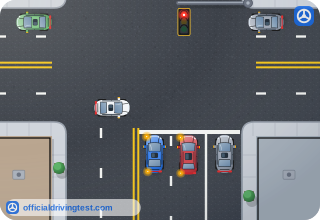
- Move to the outside turn lane before you finish turning
- Drift into the lane with the least traffic
- Stay in your original lane as you turn
- Change lanes halfway through the turn
Show answer
Correct answer: Stay in your original lane as you turn
With several turn lanes you keep to your own lane through the turn, and you plan the turn so you do not veer into another lane.
Source: Washington Driver Guide (© 2025), page 123 · Open this page in the manual (Manual page 123)
-
When may you change to another lane after turning at an intersection?
- Never; you must stay in the lane you turned into
- Once you have completed your turn
- Only when a sign allows it
- Only after you reach the next intersection
Show answer
Correct answer: Once you have completed your turn
The guide says you can change lanes after the turn is complete if you need to.
Source: Washington Driver Guide (© 2025), page 123 · Open this page in the manual (Manual page 123)
-
How far before a turn across oncoming traffic should you put on your turn signal?
- At least 50 feet before the turn
- At least 300 feet before the turn
- Right as you begin the turn
- At least 100 feet before the turn
Show answer
Correct answer: At least 100 feet before the turn
The guide tells drivers to signal at least 100 feet before turning left or right across oncoming traffic.
Source: Washington Driver Guide (© 2025), page 123 · Open this page in the manual (Manual page 123)