Washington: Right-of-way and turning — Part 2 Practice Test
Questions in this part include: “Where should you avoid making a U-turn because you cannot see clearly in all directions?” · “At a Y-intersection where a minor road connects with a major road, who has the right-of-way?”
Independent educational site · not affiliated with any government agency or DMV
Ready? Test yourself
Answer to start, or tap Start below:
Where should you avoid making a U-turn because you cannot see clearly in all directions?
- Instant feedback with an explanation
- Every answer cites its source in the manual
- Your best score is saved on this device
- Keyboard: press 1 to 4 to answer and Enter for the next question
Questions are original and based on the official manual "Washington Driver Guide" (© 2025), Washington State Department of Licensing (DOL).
All 17 questions in this practice test
Take the test above first, then use this list to study. Tap “Show answer” to see the correct answer and explanation.
Show the questions and answersHide the questions
-
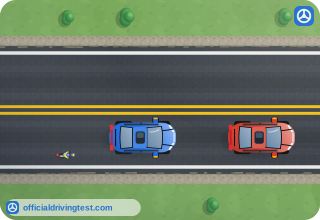
Before you make a turn, what should you do about bicyclists behind you?
- Sound your horn so they can slow down
- Speed up to finish the turn ahead of them
- Turn first, since cars have priority over bicycles
- Check behind you for them and yield to them
Show answer
Correct answer: Check behind you for them and yield to them
Bicyclists may be moving faster than you expect, so you check behind and yield to them before turning.
Source: Washington Driver Guide (© 2025), page 123 · Open this page in the manual (Manual page 123)
-
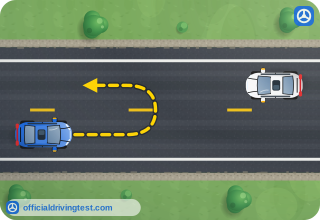
What must you have before making a U-turn?
- A green arrow signal
- Clear visibility in all directions
- A solid yellow line beside you
- A median to turn around in
Show answer
Correct answer: Clear visibility in all directions
A U-turn is only safe when you can see clearly in every direction.
Source: Washington Driver Guide (© 2025), page 124 · Open this page in the manual (Manual page 124)
-
Where should you avoid making a U-turn because you cannot see clearly in all directions?
- On a flat, straight stretch of road
- In an open area with a clear view all around
- On a curve or when approaching the crest of a hill
- At the end of a long, straight, empty road
Show answer
Correct answer: On a curve or when approaching the crest of a hill
Visibility is poor on a curve or near a hill crest, so the guide says not to U-turn there.
Source: Washington Driver Guide (© 2025), page 124 · Open this page in the manual (Manual page 124)
-
In Washington, when is a U-turn generally not allowed?
- When a sign is posted telling you a U-turn is not allowed
- At every intersection that has a traffic signal
- Whenever the road has a double yellow centerline
- On any road that has more than two lanes
Show answer
Correct answer: When a sign is posted telling you a U-turn is not allowed
U-turns are generally allowed in Washington unless a sign prohibits them.
Source: Washington Driver Guide (© 2025), page 124 · Open this page in the manual (Manual page 124)
-
What is a cross-intersection?
- A junction where two roads meet at a railroad crossing with gates
- A two-way junction controlled only by traffic lights
- A four-way junction with one or more lanes traveling in each direction
- A junction that has a stop sign on every approach
Show answer
Correct answer: A four-way junction with one or more lanes traveling in each direction
A cross-intersection is a four-way junction and may be marked with traffic lights, street signs, or road markings.
Source: Washington Driver Guide (© 2025), page 124 · Open this page in the manual (Manual page 124)
-
What is a T-intersection?
- A three-way junction where a road ends and intersects with a through road
- A junction where two through roads cross at an angle around a center island
- A four-way junction where all traffic must stop before entering
- A junction where a road ends at a railroad crossing or tunnel
Show answer
Correct answer: A three-way junction where a road ends and intersects with a through road
A T-intersection has three directions: one road ends and meets a through road.
Source: Washington Driver Guide (© 2025), page 124 · Open this page in the manual (Manual page 124)
-
At a Y-intersection where a minor road connects with a major road, who has the right-of-way?
- Cars on the minor road
- Whichever car reaches the junction first
- Whichever car is turning left
- Cars on the major road
Show answer
Correct answer: Cars on the major road
The guide states that cars on major roads have the right-of-way at a Y-intersection.
Source: Washington Driver Guide (© 2025), page 124 · Open this page in the manual (Manual page 124)
-
What is a traffic calming circle?
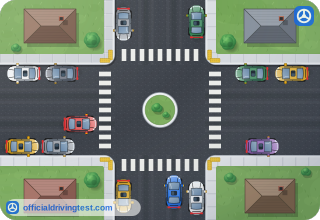
- An intersection with a painted or raised center island that traffic flows counterclockwise around
- An intersection with a painted or raised center island that traffic flows clockwise around
- A raised median that separates traffic traveling in opposite directions
- A roundabout where all vehicles must come to a full stop before entering
Show answer
Correct answer: An intersection with a painted or raised center island that traffic flows counterclockwise around
A traffic calming circle is an intersection built around a painted or raised center island, with traffic going counterclockwise.
Source: Washington Driver Guide (© 2025), page 125 · Open this page in the manual (Manual page 125)
-
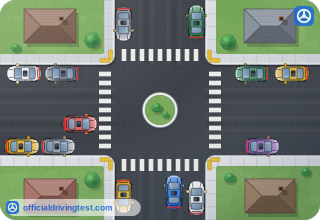
Which statement about signs at a traffic calming circle is correct?
- Every approach always has a yield sign, and no stop signs are used
- Signs are used only on the approaches where a traffic signal is installed
- Stop or yield signs may be on all, some, or none of its approaches
- Stop signs are required on every approach of a three-way circle
Show answer
Correct answer: Stop or yield signs may be on all, some, or none of its approaches
Traffic calming circles can have stop or yield signs on all, some, or none of their approaches.
Source: Washington Driver Guide (© 2025), page 125 · Open this page in the manual (Manual page 125)
-
What right-of-way rules apply at a traffic calming circle?
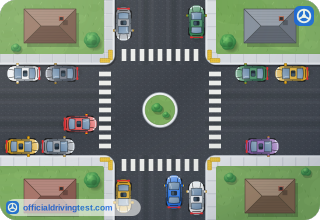
- The same rules as at any other intersection
- Special circle rules that replace normal right-of-way laws
- Vehicles inside the circle must yield to vehicles entering
- None; drivers decide among themselves who goes first
Show answer
Correct answer: The same rules as at any other intersection
The guide says to apply the same right-of-way rules you would use at any other intersection.
Source: Washington Driver Guide (© 2025), page 125 · Open this page in the manual (Manual page 125)
-
What should you be aware of when a large vehicle is using a traffic calming circle?
- It must always enter before passenger vehicles
- It is not allowed to use the circle at all
- It might have to go clockwise to get through the circle
- It will always stay on the outside of the circle
Show answer
Correct answer: It might have to go clockwise to get through the circle
Calming circles are meant for passenger vehicles, so large vehicles may go clockwise to get through; give them plenty of space.
Source: Washington Driver Guide (© 2025), page 125 · Open this page in the manual (Manual page 125)
-
What must all approaching vehicles do on entering a roundabout?
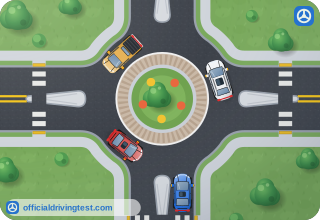
- Stop completely
- Yield
- Speed up to merge
- Follow a traffic signal
Show answer
Correct answer: Yield
In a roundabout all approaching vehicles yield on entry and then travel counterclockwise around the center island.
Source: Washington Driver Guide (© 2025), page 126 · Open this page in the manual (Manual page 126)
-
Roundabouts are designed for what range of speeds?
- 5 to 10 mph
- 30 to 35 mph
- 35 to 45 mph
- 15 to 25 mph
Show answer
Correct answer: 15 to 25 mph
The guide says roundabouts are designed for speeds between 15 and 25 mph, so you slow down when approaching.
Source: Washington Driver Guide (© 2025), page 127 · Open this page in the manual (Manual page 127)
-
What does the lane choice sign at a roundabout show you?
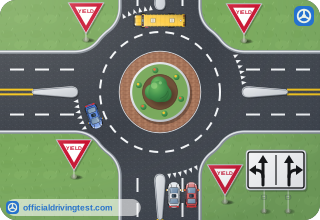
- Which lanes have the right-of-way over traffic already in the circle
- Which lanes large trucks may use to cross the truck apron
- Which lanes are reserved for bicyclists and pedestrians
- Which lanes are used for right turns, straight through travel, and left turns
Show answer
Correct answer: Which lanes are used for right turns, straight through travel, and left turns
The lane choice sign tells you which lane to pick for a right turn, straight travel, or a left turn.
Source: Washington Driver Guide (© 2025), page 127 · Open this page in the manual (Manual page 127)
-
After you pick a lane on the approach to a roundabout, what should you do?
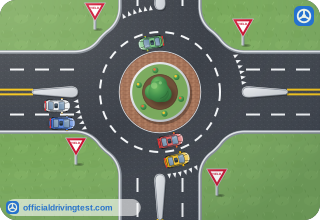
- Change lanes inside the circle to reach your exit
- Stay in that lane until you exit the roundabout
- Switch to the inner lane once you are in the circle
- Move to the outer lane just before your exit
Show answer
Correct answer: Stay in that lane until you exit the roundabout
The guide says to keep to the chosen lane all the way until you exit.
Source: Washington Driver Guide (© 2025), page 127 · Open this page in the manual (Manual page 127)
-
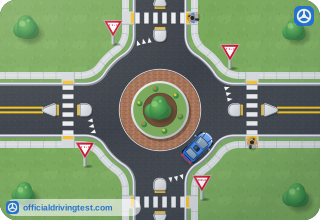
When must you stop for pedestrians and bicyclists in crosswalks at a roundabout?
- Only when you enter the roundabout, not when you leave it
- Only when you exit the roundabout, not when you enter it
- When you enter and when you exit the roundabout
- Only when no vehicles are already in the circle
Show answer
Correct answer: When you enter and when you exit the roundabout
Crosswalks are at both the entry and the exit, and you stop for people in them at both.
Source: Washington Driver Guide (© 2025), page 127 · Open this page in the manual (Manual page 127)
-
As you approach a roundabout, which way should you look to yield to traffic already in it?
- Left
- Right
- Straight ahead only
- Behind you
Show answer
Correct answer: Left
Traffic already in the roundabout has the right-of-way, and the guide says to look left for it before entering.
Source: Washington Driver Guide (© 2025), page 127 · Open this page in the manual (Manual page 127)