Vermont: Right-of-way, turning and passing — Part 3 Practice Test
Questions in this part include: “When turning left at an intersection, how should you treat an oncoming bicyclist?” · “When may a driver pass another vehicle on the right?”
Independent educational site · not affiliated with any government agency or DMV
Ready? Test yourself
- Instant feedback with an explanation
- Every answer cites its source in the manual
- Your best score is saved on this device
- Keyboard: press 1 to 4 to answer and Enter for the next question
Questions are original and based on the official manual "Vermont Driver's Manual" (2025 edition (VN-007 07/2024)), Vermont Department of Motor Vehicles.
All 20 questions in this practice test
Take the test above first, then use this list to study. Tap “Show answer” to see the correct answer and explanation.
Show the questions and answersHide the questions
-
When turning left at an intersection, how should you treat an oncoming bicyclist?
- Turn first, because bicycles are slower than cars
- Honk and turn ahead of the bicyclist
- Wait only if the bicyclist signals first
- Yield, just as you would to an oncoming motorist
Show answer
Correct answer: Yield, just as you would to an oncoming motorist
Bicyclists may be traveling faster than you realize, so you yield and give them space.
Source: Vermont Driver's Manual (2025 edition (VN-007 07/2024)), page 41 · Open this page in the manual (Manual page 41)
-
When checking traffic to turn at an intersection, what should you predict about a motorcycle that looks far away?
- It is farther away than it looks
- It is closer than it looks
- It is going slower than it looks
- It is about to turn
Show answer
Correct answer: It is closer than it looks
A motorcycle may look farther away than it is.
Source: Vermont Driver's Manual (2025 edition (VN-007 07/2024)), page 42 · Open this page in the manual (Manual page 42)
-
Before pulling out to pass a vehicle ahead, which signal should you give?
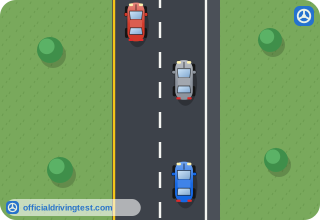
- A left signal
- A right signal
- No signal until you are alongside the vehicle
- A signal only if it is dark
Show answer
Correct answer: A left signal
You signal left to tell other drivers you will be pulling out to pass.
Source: Vermont Driver's Manual (2025 edition (VN-007 07/2024)), page 51 · Open this page in the manual (Manual page 51)
-
In general, on which side should you pass vehicles and bicycles?
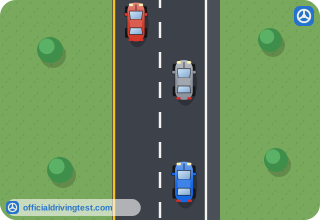
- On the right
- On the shoulder
- On the left
- On whichever side has more room
Show answer
Correct answer: On the left
The manual says to pass vehicles and bicycles on the left.
Source: Vermont Driver's Manual (2025 edition (VN-007 07/2024)), page 52 · Open this page in the manual (Manual page 52)
-
At night, what might be necessary to warn the driver in front of you that you intend to pass?
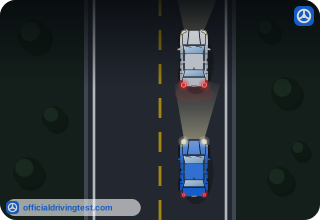
- Keeping your headlights on high beam while you pass
- Blinking your headlights from low to high to low beam
- Turning your headlights off for a moment
- Switching to your parking lights
Show answer
Correct answer: Blinking your headlights from low to high to low beam
At night you may blink your headlights from low to high to low beam to warn the driver ahead that you intend to pass.
Source: Vermont Driver's Manual (2025 edition (VN-007 07/2024)), page 51 · Open this page in the manual (Manual page 51)
-
If you are passing while towing a trailer, what should you be especially careful to do?
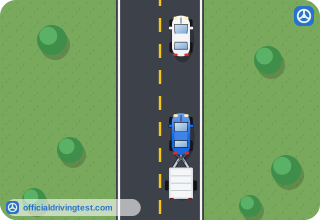
- Pass only on the right side of the vehicle
- Pull back as soon as the trailer clears the vehicle ahead
- Speed up as much as the vehicle can safely manage
- Be well past it before pulling back into its lane
Show answer
Correct answer: Be well past it before pulling back into its lane
With a trailer, make sure you are well past the vehicle or bicycle before moving back into its lane.
Source: Vermont Driver's Manual (2025 edition (VN-007 07/2024)), page 51 · Open this page in the manual (Manual page 51)
-
After passing, how far beyond the vehicle or bicycle should you go before returning to your lane?
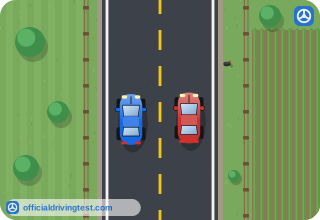
- Far enough that it is no longer visible in your side mirror
- Far enough to see its entire front in your inside rearview mirror
- Far enough to be one full car length in front of it
- Far enough to be next to the next intersection ahead
Show answer
Correct answer: Far enough to see its entire front in your inside rearview mirror
You should see the entire front of the vehicle or the bicyclist in your inside rearview mirror before returning.
Source: Vermont Driver's Manual (2025 edition (VN-007 07/2024)), page 52 · Open this page in the manual (Manual page 52)
-
When returning to the right side of the road after passing, what should you do?
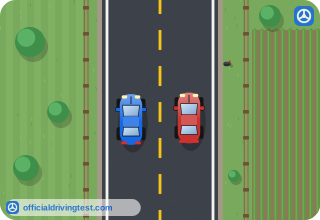
- Use your left signal and check the left blind spot
- Sound your horn and move over right away
- Use your right signal and check the right blind spot
- Flash your headlights and move over right away
Show answer
Correct answer: Use your right signal and check the right blind spot
After passing, signal right, check the right blind spot over your shoulder, and return to the right side of the road.
Source: Vermont Driver's Manual (2025 edition (VN-007 07/2024)), page 52 · Open this page in the manual (Manual page 52)
-
What should you do when another vehicle is passing you?
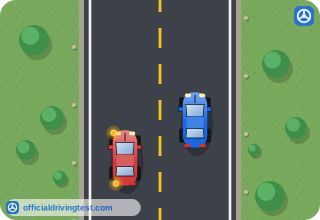
- Slow a little and keep right
- Speed up to stay even with it
- Move toward the center of the road
- Hold your speed and stay in the center of your lane
Show answer
Correct answer: Slow a little and keep right
Slowing a little and keeping right lets the other driver pass more safely.
Source: Vermont Driver's Manual (2025 edition (VN-007 07/2024)), page 52 · Open this page in the manual (Manual page 52)
-
When may a driver pass another vehicle on the right?
- On a multilane road
- On a two-lane road when the vehicle ahead is going straight
- Whenever the driver ahead is going slowly
- On a curve if no traffic is coming
Show answer
Correct answer: On a multilane road
A driver may pass on the right of another vehicle on a multilane road.
Source: Vermont Driver's Manual (2025 edition (VN-007 07/2024)), page 52 · Open this page in the manual (Manual page 52)
-
On a road that is not multilane, when may a driver pass on the right of a vehicle or bicycle?
- When it is traveling straight ahead below the speed limit
- When it is stopped for a pedestrian at a crosswalk
- When it is turning or preparing to turn left, if there is room
- When it is turning or preparing to turn right
Show answer
Correct answer: When it is turning or preparing to turn left, if there is room
On roads that are not multilane, passing on the right is allowed only when the vehicle or bicycle is turning or preparing to turn left and there is room.
Source: Vermont Driver's Manual (2025 edition (VN-007 07/2024)), page 52 · Open this page in the manual (Manual page 52)
-
May a motor vehicle be passed by driving off the pavement or main traveled part of the road?
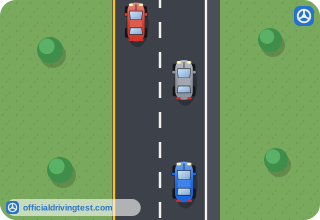
- Yes, if the shoulder is wide enough
- No, under no conditions
- Yes, when the vehicle ahead is moving slowly
- Yes, but only in daylight
Show answer
Correct answer: No, under no conditions
The manual says that under no conditions can a motor vehicle be passed by driving off the pavement or main traveled part of the road.
Source: Vermont Driver's Manual (2025 edition (VN-007 07/2024)), page 52 · Open this page in the manual (Manual page 52)
-
At which of these locations should you not pass?
- On a straight, level road
- On a multilane road
- Where a broken line is in your lane
- At an intersection
Show answer
Correct answer: At an intersection
The manual lists hills, curves, railroads, intersections, and a changed path ahead as places where you do not pass.
Source: Vermont Driver's Manual (2025 edition (VN-007 07/2024)), page 52 · Open this page in the manual (Manual page 52)
-
In the turning-around procedure on the road test, how far from the curb or edge of the road do you stop after driving just past the side street?
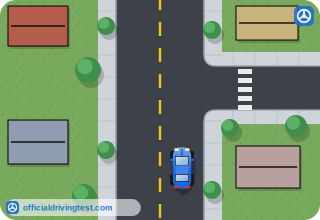
- About 6 inches
- About 5 feet
- About 18 inches
- About 10 feet
Show answer
Correct answer: About 18 inches
The manual says to stop about 18 inches from the curb or edge of the road, just past the side street.
Source: Vermont Driver's Manual (2025 edition (VN-007 07/2024)), page 56 · Open this page in the manual (Manual page 56)
-
In the turning-around procedure, in which direction do you look mostly while backing into the side street?
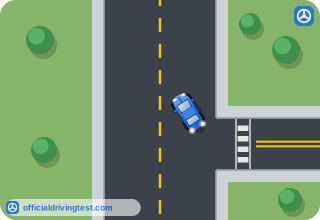
- At your side mirrors
- Through the rear window
- Over your right shoulder only
- At the curb beside you
Show answer
Correct answer: Through the rear window
The manual says to look mostly through the rear window while backing, and to keep on your own side of the street.
Source: Vermont Driver's Manual (2025 edition (VN-007 07/2024)), page 56 · Open this page in the manual (Manual page 56)
-
In the turning-around procedure, when do you stop backing into the side street?
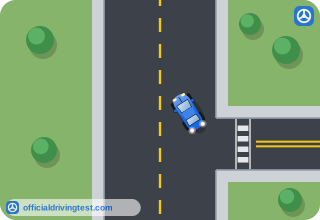
- When the front of your vehicle clears the crosswalk
- When your rear bumper reaches the first driveway
- As soon as the vehicle is off the main road
- When the vehicle is beyond any crosswalks or stop lines
Show answer
Correct answer: When the vehicle is beyond any crosswalks or stop lines
You stop backing once the vehicle is entirely in the side street beyond any crosswalks or stop lines.
Source: Vermont Driver's Manual (2025 edition (VN-007 07/2024)), page 57 · Open this page in the manual (Manual page 57)
-
In the turning-around procedure, which signal do you give before turning back out onto the street?
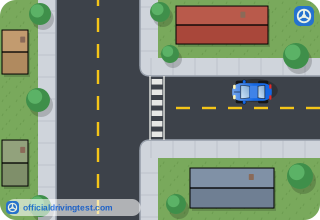
- Signal right
- Signal left
- Turn on your hazard lights
- Give no signal
Show answer
Correct answer: Signal left
Before turning back out, you signal left and shift to drive, then make a proper left turn when no vehicles are coming.
Source: Vermont Driver's Manual (2025 edition (VN-007 07/2024)), page 57 · Open this page in the manual (Manual page 57)
-
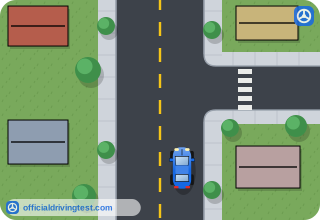
What does the manual say about backing across an intersection?
- It is allowed if you sound your horn
- It is allowed when traffic is light
- It is allowed at night with your lights on
- Never back across an intersection
Show answer
Correct answer: Never back across an intersection
The manual states you should never back across an intersection.
Source: Vermont Driver's Manual (2025 edition (VN-007 07/2024)), page 57 · Open this page in the manual (Manual page 57)
-
When you are backing your vehicle, who are you responsible for?
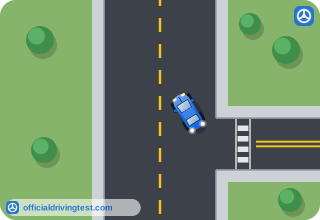
- Traffic in all directions
- Only traffic behind you
- Only traffic on your own side
- Only pedestrians
Show answer
Correct answer: Traffic in all directions
The manual says that when backing, you are responsible for traffic in all directions.
Source: Vermont Driver's Manual (2025 edition (VN-007 07/2024)), page 57 · Open this page in the manual (Manual page 57)
-
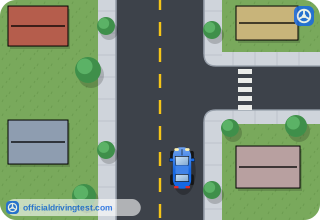
Which option does the manual call the safest way to turn your vehicle around?
- Backing into a side street
- Turning around in the middle of the road
- Going around the block or using a parking lot
- Backing across an intersection
Show answer
Correct answer: Going around the block or using a parking lot
The manual says going around the block or using a parking lot is the safest option for turning around.
Source: Vermont Driver's Manual (2025 edition (VN-007 07/2024)), page 57 · Open this page in the manual (Manual page 57)