Vermont: Right-of-way, turning and passing
Who yields at intersections and roundabouts, left and right turns, turnabouts, and when and where you may pass. Split into 3 shorter tests so you're not stuck in one long quiz.
Independent educational site · not affiliated with any government agency or DMV
Choose a part
Right-of-way, turning and passing — Part 1
Questions in this part include: “When making a left turn, how close to the centerline should you position your vehicle if it is safe to do so?”
StartRight-of-way, turning and passing — Part 2
Who yields at intersections and roundabouts, left and right turns, turnabouts, and when and where you may pass. — Part 2
StartRight-of-way, turning and passing — Part 3
Questions in this part include: “When turning left at an intersection, how should you treat an oncoming bicyclist?”
StartAll 61 Right-of-way, turning and passing questions with answers
Choose a part above to take a practice test, or study every question and answer here.
Show the questions and answersHide the questions
-
On a multilane road, where should you be well in advance of a left turn?
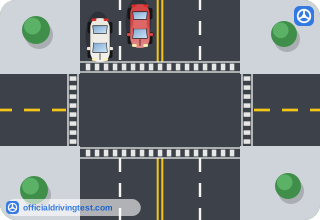
- In the right lane
- In the left lane
- In the lane with the most traffic
- In the center of the road
Show answer
Correct answer: In the left lane
On a multilane road you should be in the left lane well before a left turn and never move suddenly from the right lane to the left.
Source: Vermont Driver's Manual (2025 edition (VN-007 07/2024)), page 26 · Open this page in the manual (Manual page 26)
-
When making a left turn, how close to the centerline should you position your vehicle if it is safe to do so?
- Within two feet
- Within five feet
- Within ten feet
- Within one foot
Show answer
Correct answer: Within one foot
For a left turn the manual says to position the vehicle within one foot of the centerline when it is safe.
Source: Vermont Driver's Manual (2025 edition (VN-007 07/2024)), page 26 · Open this page in the manual (Manual page 26)
-
Why should you keep your wheels straight until you are ready to make a left turn?
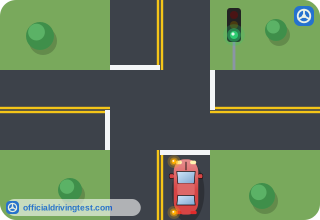
- So you are not pushed into oncoming traffic if hit from behind
- So the driver behind you can tell that you plan to turn
- So your turn signal does not switch off during the turn
- So you can turn more quickly once the road is clear
Show answer
Correct answer: So you are not pushed into oncoming traffic if hit from behind
Straight wheels keep your vehicle from being pushed into oncoming traffic if another vehicle hits you from behind.
Source: Vermont Driver's Manual (2025 edition (VN-007 07/2024)), page 26 · Open this page in the manual (Manual page 26)
-
When the road is clear and you make a left turn, where should you keep your vehicle?
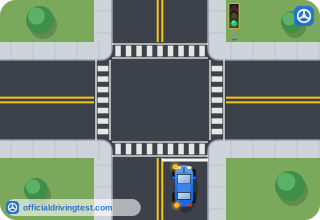
- Across the center line
- To the right of the center line
- On the center line
- Along the far right curb of the new street
Show answer
Correct answer: To the right of the center line
During a left turn you keep to the right of the center line.
Source: Vermont Driver's Manual (2025 edition (VN-007 07/2024)), page 26 · Open this page in the manual (Manual page 26)
-
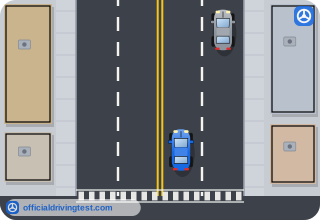
What should you do after completing a turn?
- Move to the edge of the lane and signal that the turn is complete
- Speed up at once to the posted limit without checking behind
- Check your blind spot for several seconds before moving on
- Check your rearview mirror and center your vehicle in the lane
Show answer
Correct answer: Check your rearview mirror and center your vehicle in the lane
After a turn you check the rearview mirror and center the vehicle in the lane.
Source: Vermont Driver's Manual (2025 edition (VN-007 07/2024)), page 27 · Open this page in the manual (Manual page 27)
-
Before starting a left turn, in which order does the manual say to search the intersection?
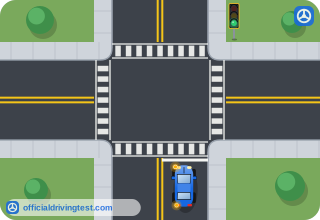
- Right, front, and left
- Left, front, and right
- Front, left, and right
- Left, right, and front
Show answer
Correct answer: Right, front, and left
For a left turn the search is right, front, and left before you begin the turn.
Source: Vermont Driver's Manual (2025 edition (VN-007 07/2024)), page 27 · Open this page in the manual (Manual page 27)
-
At the approach to a right turn, about how far from the right side of the road should the vehicle be?
- About one foot
- About six feet
- About three feet
- About ten feet
Show answer
Correct answer: About three feet
The manual says the vehicle should be about three feet from the right side of the road when approaching a right turn.
Source: Vermont Driver's Manual (2025 edition (VN-007 07/2024)), page 27 · Open this page in the manual (Manual page 27)
-
What should you not do before turning right?
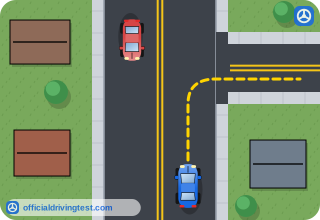
- Slow down gradually
- Swing your vehicle to the left
- Check the mirror for the vehicle behind you
- Search the intersection left, front, and right
Show answer
Correct answer: Swing your vehicle to the left
The manual says not to swing the vehicle to the left before turning right.
Source: Vermont Driver's Manual (2025 edition (VN-007 07/2024)), page 27 · Open this page in the manual (Manual page 27)
-
After searching the intersection left, front and right before a right turn, what does the manual's checklist add just before you start the turn?
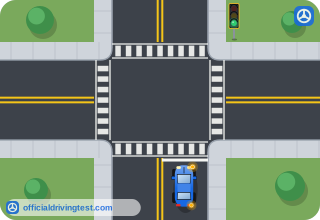
- Look right a second time
- Look over your shoulder to the rear
- Look at the sidewalk on the left
- Quickly look left again
Show answer
Correct answer: Quickly look left again
The right-turn checklist ends the search with a quick look to the left again just before you start the turn.
Source: Vermont Driver's Manual (2025 edition (VN-007 07/2024)), page 27 · Open this page in the manual (Manual page 27)
-
Where in your lane should you make a right turn?
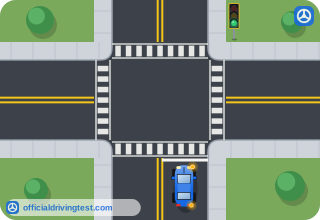
- In the center of your lane
- Close to the left side of your lane
- Close to the right side of your lane
- Wherever there is the most room
Show answer
Correct answer: Close to the right side of your lane
A right turn is made close to the right side of the lane.
Source: Vermont Driver's Manual (2025 edition (VN-007 07/2024)), page 27 · Open this page in the manual (Manual page 27)
-
If you are turning into a street with more than one lane going in your direction, which lane should you turn into?
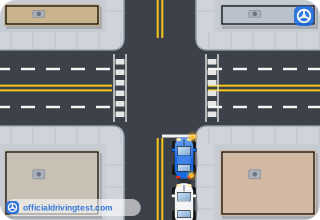
- The farthest lane
- The nearest lane
- The center lane
- Whichever lane has the least traffic
Show answer
Correct answer: The nearest lane
When turning into a multilane street, turn into the nearest lane.
Source: Vermont Driver's Manual (2025 edition (VN-007 07/2024)), page 27 · Open this page in the manual (Manual page 27)
-
What is the basic rule of driving on a multilane road?
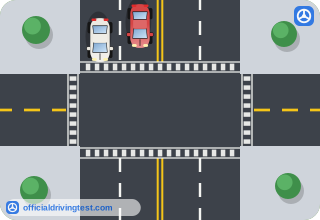
- Drive in the left lane unless you are exiting
- Drive in whichever lane is moving fastest
- Drive in the center lane unless you are passing
- Drive to the right unless you are passing or turning
Show answer
Correct answer: Drive to the right unless you are passing or turning
The basic multilane rule is to stay to the right except when passing or turning.
Source: Vermont Driver's Manual (2025 edition (VN-007 07/2024)), page 27 · Open this page in the manual (Manual page 27)
-
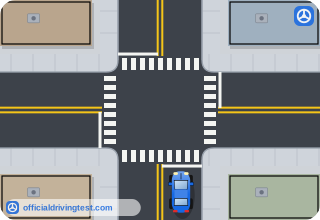
Who must a driver on any road yield the right-of-way to?
- Only vehicles that are coming from your right at the intersection
- Only vehicles that are larger than yours or traveling faster than you
- Pedestrians, bicyclists and other traffic already in the intersection
- Only vehicles in the lane directly to your left at that moment
Show answer
Correct answer: Pedestrians, bicyclists and other traffic already in the intersection
A driver must yield to pedestrians, bicyclists and other traffic already in the intersection.
Source: Vermont Driver's Manual (2025 edition (VN-007 07/2024)), page 28 · Open this page in the manual (Manual page 28)
-
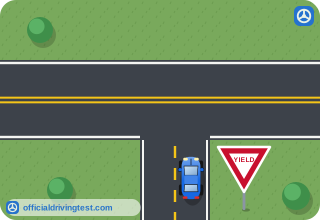
When nearing an intersection marked with a "yield right-of-way" sign, what are you required to do?
- Stop completely every time before you enter the intersection ahead
- Travel slowly enough to stop if necessary and enter only when the way is clear
- Keep your speed the same whenever no other vehicles are in sight ahead
- Enter right away if you reached the intersection before other vehicles
Show answer
Correct answer: Travel slowly enough to stop if necessary and enter only when the way is clear
At a yield sign you must be slow enough to stop if needed and enter only when the way is clear.
Source: Vermont Driver's Manual (2025 edition (VN-007 07/2024)), page 28 · Open this page in the manual (Manual page 28)
-
At a four-way stop, which vehicle should have the right-of-way?
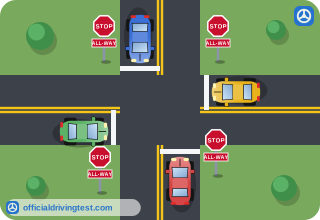
- The largest vehicle
- The vehicle going straight
- The vehicle in the left lane
- The first vehicle to arrive
Show answer
Correct answer: The first vehicle to arrive
At a four-way stop the first vehicle to arrive should have the right-of-way.
Source: Vermont Driver's Manual (2025 edition (VN-007 07/2024)), page 28 · Open this page in the manual (Manual page 28)
-
Two vehicles approach a four-way stop at about the same time from different directions. Which driver should yield?
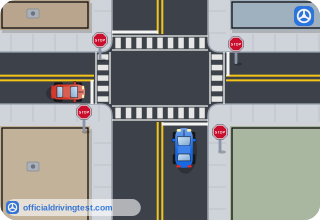
- The driver on the left yields to the driver on the right
- The driver on the right yields to the driver on the left
- The driver in the smaller vehicle yields
- The driver going straight yields to the one turning
Show answer
Correct answer: The driver on the left yields to the driver on the right
When two vehicles arrive together from different directions, the driver on the left yields to the driver on the right.
Source: Vermont Driver's Manual (2025 edition (VN-007 07/2024)), page 28 · Open this page in the manual (Manual page 28)
-
If you are turning left, what must you do about oncoming traffic?
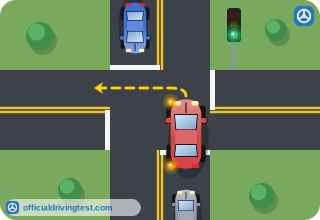
- Yield only to oncoming motor vehicles, not bicyclists
- Turn first if you have already signaled
- Yield to all oncoming traffic
- Turn first if you are in the left lane
Show answer
Correct answer: Yield to all oncoming traffic
A driver turning left must yield to every oncoming vehicle, whether a motor vehicle or a bicyclist.
Source: Vermont Driver's Manual (2025 edition (VN-007 07/2024)), page 28 · Open this page in the manual (Manual page 28)
-
A driver approaching the road from a driveway, alley or parking lot must yield the right-of-way to whom?
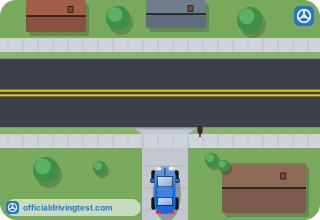
- Only traffic coming from the left
- All traffic on the road
- Only pedestrians
- Only vehicles that are moving faster
Show answer
Correct answer: All traffic on the road
A driver entering the road from a driveway, alley, parking lot or T-intersection must yield to all traffic on the road.
Source: Vermont Driver's Manual (2025 edition (VN-007 07/2024)), page 28 · Open this page in the manual (Manual page 28)
-
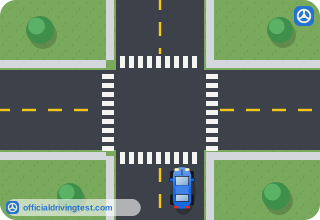
Before entering any intersection, what must you always do?
- Come to a complete stop and wait for other drivers to signal you on
- Sound your horn to warn other drivers that you are entering
- Look only in the direction of oncoming traffic before you enter
- Search in all directions and be sure you have a clear path
Show answer
Correct answer: Search in all directions and be sure you have a clear path
Before entering an intersection you must search in all directions and have a clear path.
Source: Vermont Driver's Manual (2025 edition (VN-007 07/2024)), page 28 · Open this page in the manual (Manual page 28)
-
In which direction does traffic proceed in a roundabout?
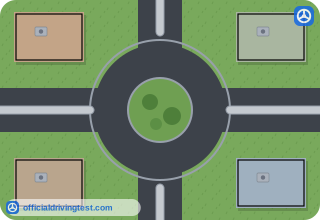
- Clockwise
- Whichever way is shorter
- Counter clockwise
- Toward the side with the least traffic
Show answer
Correct answer: Counter clockwise
Traffic in a roundabout proceeds in a counter clockwise direction.
Source: Vermont Driver's Manual (2025 edition (VN-007 07/2024)), page 29 · Open this page in the manual (Manual page 29)
-
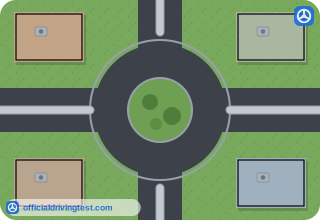
How does traffic enter and exit a roundabout?
- Only through left turns
- Only through right turns
- Through left or right turns
- Straight across the center
Show answer
Correct answer: Only through right turns
The manual says traffic enters and exits a roundabout only through right turns.
Source: Vermont Driver's Manual (2025 edition (VN-007 07/2024)), page 29 · Open this page in the manual (Manual page 29)
-
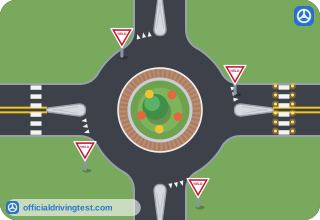
In most situations, how do roundabouts compare with stop signs or traffic signals in handling motor vehicles, pedestrians and bicyclists?
- They handle them less safely
- They handle them about as safely
- They handle them safely only at low traffic volumes
- They handle them more safely
Show answer
Correct answer: They handle them more safely
The manual says that in most situations roundabouts handle vehicles, pedestrians and bicyclists more safely than stop signs or signals.
Source: Vermont Driver's Manual (2025 edition (VN-007 07/2024)), page 30 · Open this page in the manual (Manual page 30)
-
How should vehicle speeds be approaching, within and exiting a roundabout?
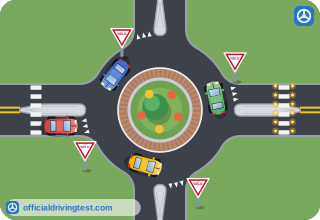
- Slow
- Equal to the speed on the approach road
- As fast as the posted limit allows
- Slow only inside the circle
Show answer
Correct answer: Slow
Speeds approaching, within and exiting a roundabout should be slow.
Source: Vermont Driver's Manual (2025 edition (VN-007 07/2024)), page 30 · Open this page in the manual (Manual page 30)
-
Who has the right of way at a roundabout between traffic already in the roundabout and a driver entering?
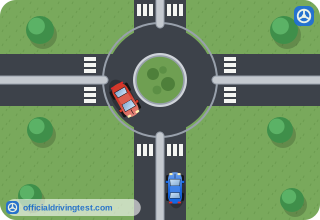
- The driver entering the roundabout
- The vehicle that is larger
- Traffic in the roundabout
- The vehicle on the right
Show answer
Correct answer: Traffic in the roundabout
Drivers must yield the right of way to traffic in the roundabout.
Source: Vermont Driver's Manual (2025 edition (VN-007 07/2024)), page 30 · Open this page in the manual (Manual page 30)
-
When should you enter a roundabout?
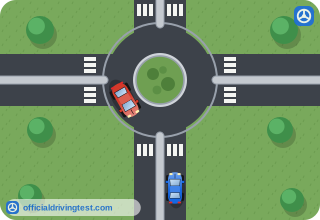
- As soon as the first vehicle in the circle passes
- Only when there is a safe gap in traffic
- When you are driving faster than traffic in the circle
- Whenever you have signaled a right turn
Show answer
Correct answer: Only when there is a safe gap in traffic
You enter only when there is a safe gap in traffic.
Source: Vermont Driver's Manual (2025 edition (VN-007 07/2024)), page 30 · Open this page in the manual (Manual page 30)
-
Which people must you yield to when entering or exiting a roundabout?
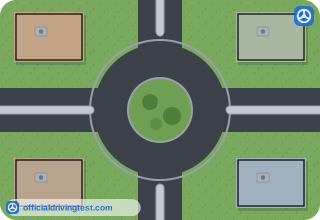
- Only pedestrians in marked crosswalks
- Only vehicles already in the roundabout
- No one, since traffic in the roundabout has priority
- Pedestrians and bicyclists
Show answer
Correct answer: Pedestrians and bicyclists
As at all intersections, you must yield to pedestrians and bicyclists when entering or exiting a roundabout.
Source: Vermont Driver's Manual (2025 edition (VN-007 07/2024)), page 30 · Open this page in the manual (Manual page 30)
-
What should you always do to show that you are leaving a roundabout?
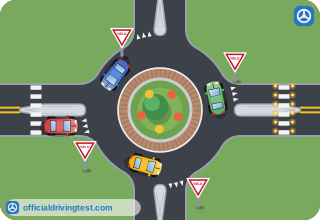
- Use your signal
- Flash your headlights
- Sound your horn
- Slow to a stop
Show answer
Correct answer: Use your signal
The manual says to always use your signal to show your intention to exit.
Source: Vermont Driver's Manual (2025 edition (VN-007 07/2024)), page 30 · Open this page in the manual (Manual page 30)
-
Before entering a multi-lane roundabout, what must you pay special attention to in order to choose the proper lane?
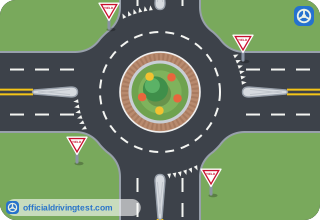
- The speed of the vehicles behind you
- The color of the vehicles in the circle
- Lane assignment signs and pavement markings
- The position of the sun and shadows
Show answer
Correct answer: Lane assignment signs and pavement markings
Multi-lane roundabouts require attention to lane assignment signs and pavement markings before entering so you select the proper lane.
Source: Vermont Driver's Manual (2025 edition (VN-007 07/2024)), page 30 · Open this page in the manual (Manual page 30)
-
Once you are in a multi-lane roundabout, what may drivers NOT do?
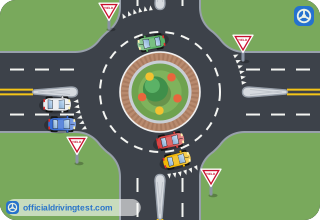
- Use a turn signal
- Change lanes
- Yield to pedestrians
- Check their mirrors
Show answer
Correct answer: Change lanes
The manual states that drivers may not change lanes once in the roundabout.
Source: Vermont Driver's Manual (2025 edition (VN-007 07/2024)), page 30 · Open this page in the manual (Manual page 30)
-
Before exiting the inside lane of a multi-lane roundabout, what must drivers use?
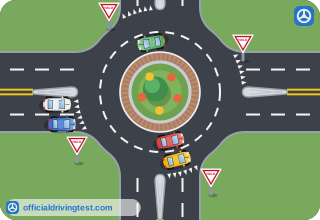
- Their horn and their hazard lights
- Only their turn signal and horn
- A complete stop at the exit lane
- Proper mirror and blind spot checks
Show answer
Correct answer: Proper mirror and blind spot checks
Drivers must make proper mirror and blind spot checks before leaving the inside lane.
Source: Vermont Driver's Manual (2025 edition (VN-007 07/2024)), page 30 · Open this page in the manual (Manual page 30)
-
In a two-lane roundabout with no signs or arrows, which movements may be made from the left lane?
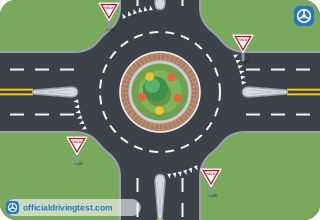
- Left turns or through movements
- Left turns only
- Right turns only
- Right turns or through movements
Show answer
Correct answer: Left turns or through movements
With no signs or arrows, the left lane may make left turns or through movements.
Source: Vermont Driver's Manual (2025 edition (VN-007 07/2024)), page 30 · Open this page in the manual (Manual page 30)
-
What should you do a short distance before your left turn when a two-way left turn lane is available?
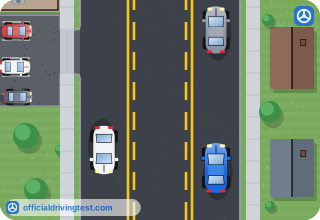
- Signal and carefully move into the turning lane
- Stop in the travel lane and wait for traffic to clear
- Speed up and move into the turning lane quickly
- Move into the turning lane first and signal at the turn
Show answer
Correct answer: Signal and carefully move into the turning lane
You signal and carefully move into the turning lane a short distance before the turn.
Source: Vermont Driver's Manual (2025 edition (VN-007 07/2024)), page 34 · Open this page in the manual (Manual page 34)
-
When you wait to turn left from a two-way left turn lane, how much of your vehicle should be in the turn lane so that you do not block traffic?
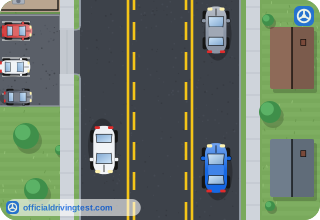
- Only the front wheels
- About half of it
- All of it
- Only the rear of it
Show answer
Correct answer: All of it
All of the vehicle should be inside the turn lane so it does not block traffic.
Source: Vermont Driver's Manual (2025 edition (VN-007 07/2024)), page 34 · Open this page in the manual (Manual page 34)
-
When turning right from one road onto a multiple lane road with a choice of lanes, which lane must you turn into?
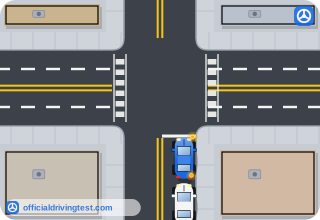
- The left lane
- Whichever lane has less traffic
- The center lane
- The right lane
Show answer
Correct answer: The right lane
Right turning drivers must turn into the right lane when there is a choice of lanes.
Source: Vermont Driver's Manual (2025 edition (VN-007 07/2024)), page 34 · Open this page in the manual (Manual page 34)
-
A driver turning left onto a multiple lane road with a choice of lanes must first turn into which lane?
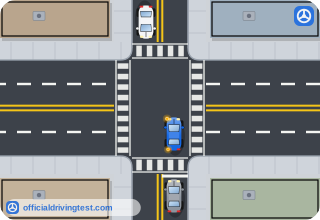
- The left lane
- The right lane
- Whichever lane has fewer vehicles
- The lane closest to the curb
Show answer
Correct answer: The left lane
Left turning drivers must first turn into the left lane.
Source: Vermont Driver's Manual (2025 edition (VN-007 07/2024)), page 34 · Open this page in the manual (Manual page 34)
-
When two lanes are turning in the same direction, what must each turning lane do?
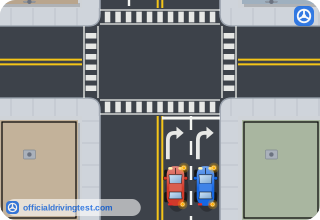
- Merge into the outer path as soon as the turn begins
- Let the inner lane cross into the outer path
- Stay in its own turning path throughout the turn
- Take turns using the same path during the turn
Show answer
Correct answer: Stay in its own turning path throughout the turn
Each turning lane must stay in its own turning path from the start to the end of the turn.
Source: Vermont Driver's Manual (2025 edition (VN-007 07/2024)), page 34 · Open this page in the manual (Manual page 34)
-
When may multiple lanes turn in the same direction at the same time?
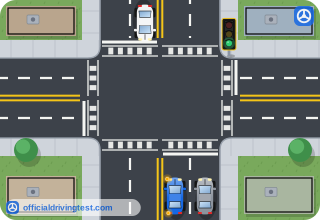
- Whenever traffic is light enough for the lanes to share the turn
- When lane use control signs or pavement markings permit it
- Only when a police officer is directing traffic at the intersection
- Whenever every driver in both lanes uses a turn signal
Show answer
Correct answer: When lane use control signs or pavement markings permit it
Several lanes may turn in the same direction at the same time when lane use control signs or pavement markings permit it.
Source: Vermont Driver's Manual (2025 edition (VN-007 07/2024)), page 34 · Open this page in the manual (Manual page 34)
-
How long should you remain in the designated lane when turning?
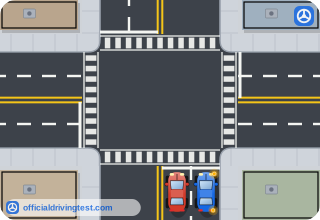
- Until you have entered the intersection
- Until you have passed the first crosswalk
- Until you reach the speed limit of the new road
- Until after the turn has been completed
Show answer
Correct answer: Until after the turn has been completed
You stay in your designated lane until the turn is finished, and change lanes only afterward.
Source: Vermont Driver's Manual (2025 edition (VN-007 07/2024)), page 34 · Open this page in the manual (Manual page 34)
-
What does the manual say about changing lanes while turning?
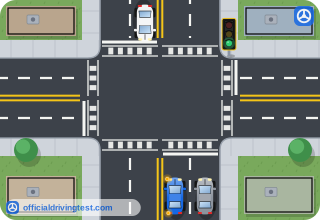
- It is an illegal maneuver that leads to crashes
- It is allowed when you signal first
- It is allowed when the road is empty of other traffic
- It is allowed on roads that have two lanes turning together
Show answer
Correct answer: It is an illegal maneuver that leads to crashes
Changing lanes during a turn is illegal and leads to crashes.
Source: Vermont Driver's Manual (2025 edition (VN-007 07/2024)), page 35 · Open this page in the manual (Manual page 35)
-
A driver in a lane marked with a straight arrow reaches the intersection. What does the manual say about turning right or left from that lane?
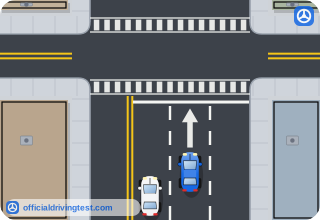
- It is allowed if no vehicles are nearby
- It is allowed if you signal early
- It is illegal and unsafe
- It is allowed only at a red light
Show answer
Correct answer: It is illegal and unsafe
Drivers must follow the direction shown for their lane, so turning from a straight-arrow lane is illegal and unsafe.
Source: Vermont Driver's Manual (2025 edition (VN-007 07/2024)), page 35 · Open this page in the manual (Manual page 35)
-
If you are in the wrong lane at an intersection, what does the manual say is safer than a sudden lane change?
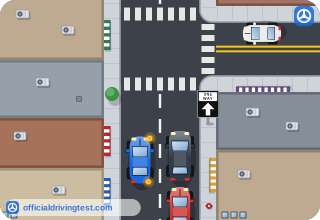
- Stopping in the lane until the traffic around you clears
- Driving around the block and finding an alternate route
- Backing up to the previous intersection and starting again
- Slowing down and cutting across the lanes to the turn
Show answer
Correct answer: Driving around the block and finding an alternate route
A sudden lane change raises the risk of a crash, so driving around the block is safer.
Source: Vermont Driver's Manual (2025 edition (VN-007 07/2024)), page 35 · Open this page in the manual (Manual page 35)
-
When turning left at an intersection, how should you treat an oncoming bicyclist?
- Turn first, because bicycles are slower than cars
- Honk and turn ahead of the bicyclist
- Wait only if the bicyclist signals first
- Yield, just as you would to an oncoming motorist
Show answer
Correct answer: Yield, just as you would to an oncoming motorist
Bicyclists may be traveling faster than you realize, so you yield and give them space.
Source: Vermont Driver's Manual (2025 edition (VN-007 07/2024)), page 41 · Open this page in the manual (Manual page 41)
-
When checking traffic to turn at an intersection, what should you predict about a motorcycle that looks far away?
- It is farther away than it looks
- It is closer than it looks
- It is going slower than it looks
- It is about to turn
Show answer
Correct answer: It is closer than it looks
A motorcycle may look farther away than it is.
Source: Vermont Driver's Manual (2025 edition (VN-007 07/2024)), page 42 · Open this page in the manual (Manual page 42)
-
Before pulling out to pass a vehicle ahead, which signal should you give?
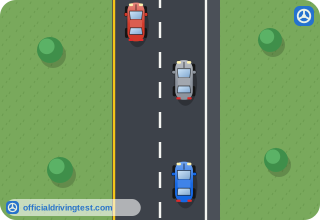
- A left signal
- A right signal
- No signal until you are alongside the vehicle
- A signal only if it is dark
Show answer
Correct answer: A left signal
You signal left to tell other drivers you will be pulling out to pass.
Source: Vermont Driver's Manual (2025 edition (VN-007 07/2024)), page 51 · Open this page in the manual (Manual page 51)
-
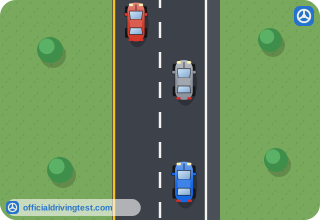
In general, on which side should you pass vehicles and bicycles?
- On the right
- On the shoulder
- On the left
- On whichever side has more room
Show answer
Correct answer: On the left
The manual says to pass vehicles and bicycles on the left.
Source: Vermont Driver's Manual (2025 edition (VN-007 07/2024)), page 52 · Open this page in the manual (Manual page 52)
-
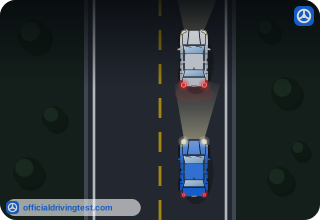
At night, what might be necessary to warn the driver in front of you that you intend to pass?
- Keeping your headlights on high beam while you pass
- Blinking your headlights from low to high to low beam
- Turning your headlights off for a moment
- Switching to your parking lights
Show answer
Correct answer: Blinking your headlights from low to high to low beam
At night you may blink your headlights from low to high to low beam to warn the driver ahead that you intend to pass.
Source: Vermont Driver's Manual (2025 edition (VN-007 07/2024)), page 51 · Open this page in the manual (Manual page 51)
-
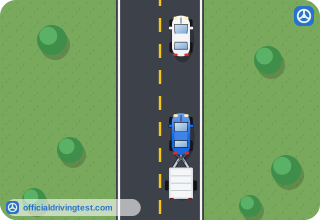
If you are passing while towing a trailer, what should you be especially careful to do?
- Pass only on the right side of the vehicle
- Pull back as soon as the trailer clears the vehicle ahead
- Speed up as much as the vehicle can safely manage
- Be well past it before pulling back into its lane
Show answer
Correct answer: Be well past it before pulling back into its lane
With a trailer, make sure you are well past the vehicle or bicycle before moving back into its lane.
Source: Vermont Driver's Manual (2025 edition (VN-007 07/2024)), page 51 · Open this page in the manual (Manual page 51)
-
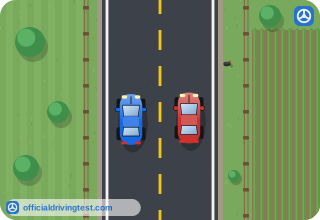
After passing, how far beyond the vehicle or bicycle should you go before returning to your lane?
- Far enough that it is no longer visible in your side mirror
- Far enough to see its entire front in your inside rearview mirror
- Far enough to be one full car length in front of it
- Far enough to be next to the next intersection ahead
Show answer
Correct answer: Far enough to see its entire front in your inside rearview mirror
You should see the entire front of the vehicle or the bicyclist in your inside rearview mirror before returning.
Source: Vermont Driver's Manual (2025 edition (VN-007 07/2024)), page 52 · Open this page in the manual (Manual page 52)
-
When returning to the right side of the road after passing, what should you do?
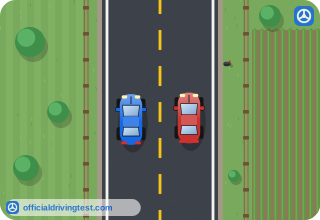
- Use your left signal and check the left blind spot
- Sound your horn and move over right away
- Use your right signal and check the right blind spot
- Flash your headlights and move over right away
Show answer
Correct answer: Use your right signal and check the right blind spot
After passing, signal right, check the right blind spot over your shoulder, and return to the right side of the road.
Source: Vermont Driver's Manual (2025 edition (VN-007 07/2024)), page 52 · Open this page in the manual (Manual page 52)
-
What should you do when another vehicle is passing you?
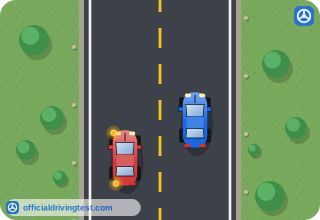
- Slow a little and keep right
- Speed up to stay even with it
- Move toward the center of the road
- Hold your speed and stay in the center of your lane
Show answer
Correct answer: Slow a little and keep right
Slowing a little and keeping right lets the other driver pass more safely.
Source: Vermont Driver's Manual (2025 edition (VN-007 07/2024)), page 52 · Open this page in the manual (Manual page 52)
-
When may a driver pass another vehicle on the right?
- On a multilane road
- On a two-lane road when the vehicle ahead is going straight
- Whenever the driver ahead is going slowly
- On a curve if no traffic is coming
Show answer
Correct answer: On a multilane road
A driver may pass on the right of another vehicle on a multilane road.
Source: Vermont Driver's Manual (2025 edition (VN-007 07/2024)), page 52 · Open this page in the manual (Manual page 52)
-
On a road that is not multilane, when may a driver pass on the right of a vehicle or bicycle?
- When it is traveling straight ahead below the speed limit
- When it is stopped for a pedestrian at a crosswalk
- When it is turning or preparing to turn left, if there is room
- When it is turning or preparing to turn right
Show answer
Correct answer: When it is turning or preparing to turn left, if there is room
On roads that are not multilane, passing on the right is allowed only when the vehicle or bicycle is turning or preparing to turn left and there is room.
Source: Vermont Driver's Manual (2025 edition (VN-007 07/2024)), page 52 · Open this page in the manual (Manual page 52)
-
May a motor vehicle be passed by driving off the pavement or main traveled part of the road?
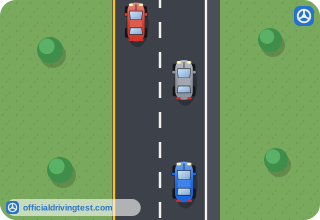
- Yes, if the shoulder is wide enough
- No, under no conditions
- Yes, when the vehicle ahead is moving slowly
- Yes, but only in daylight
Show answer
Correct answer: No, under no conditions
The manual says that under no conditions can a motor vehicle be passed by driving off the pavement or main traveled part of the road.
Source: Vermont Driver's Manual (2025 edition (VN-007 07/2024)), page 52 · Open this page in the manual (Manual page 52)
-
At which of these locations should you not pass?
- On a straight, level road
- On a multilane road
- Where a broken line is in your lane
- At an intersection
Show answer
Correct answer: At an intersection
The manual lists hills, curves, railroads, intersections, and a changed path ahead as places where you do not pass.
Source: Vermont Driver's Manual (2025 edition (VN-007 07/2024)), page 52 · Open this page in the manual (Manual page 52)
-
In the turning-around procedure on the road test, how far from the curb or edge of the road do you stop after driving just past the side street?
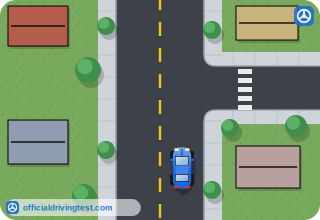
- About 6 inches
- About 5 feet
- About 18 inches
- About 10 feet
Show answer
Correct answer: About 18 inches
The manual says to stop about 18 inches from the curb or edge of the road, just past the side street.
Source: Vermont Driver's Manual (2025 edition (VN-007 07/2024)), page 56 · Open this page in the manual (Manual page 56)
-
In the turning-around procedure, in which direction do you look mostly while backing into the side street?
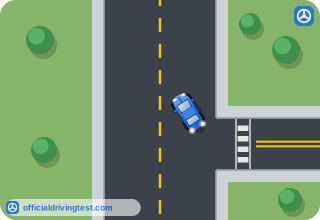
- At your side mirrors
- Through the rear window
- Over your right shoulder only
- At the curb beside you
Show answer
Correct answer: Through the rear window
The manual says to look mostly through the rear window while backing, and to keep on your own side of the street.
Source: Vermont Driver's Manual (2025 edition (VN-007 07/2024)), page 56 · Open this page in the manual (Manual page 56)
-
In the turning-around procedure, when do you stop backing into the side street?
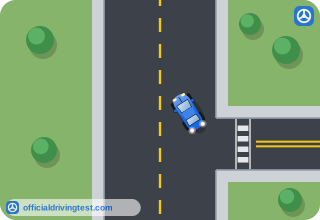
- When the front of your vehicle clears the crosswalk
- When your rear bumper reaches the first driveway
- As soon as the vehicle is off the main road
- When the vehicle is beyond any crosswalks or stop lines
Show answer
Correct answer: When the vehicle is beyond any crosswalks or stop lines
You stop backing once the vehicle is entirely in the side street beyond any crosswalks or stop lines.
Source: Vermont Driver's Manual (2025 edition (VN-007 07/2024)), page 57 · Open this page in the manual (Manual page 57)
-
In the turning-around procedure, which signal do you give before turning back out onto the street?
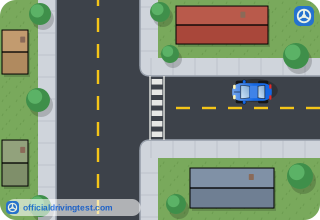
- Signal right
- Signal left
- Turn on your hazard lights
- Give no signal
Show answer
Correct answer: Signal left
Before turning back out, you signal left and shift to drive, then make a proper left turn when no vehicles are coming.
Source: Vermont Driver's Manual (2025 edition (VN-007 07/2024)), page 57 · Open this page in the manual (Manual page 57)
-
What does the manual say about backing across an intersection?
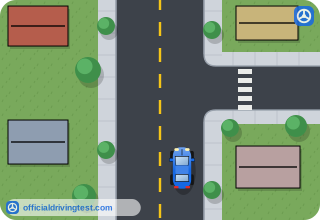
- It is allowed if you sound your horn
- It is allowed when traffic is light
- It is allowed at night with your lights on
- Never back across an intersection
Show answer
Correct answer: Never back across an intersection
The manual states you should never back across an intersection.
Source: Vermont Driver's Manual (2025 edition (VN-007 07/2024)), page 57 · Open this page in the manual (Manual page 57)
-
When you are backing your vehicle, who are you responsible for?
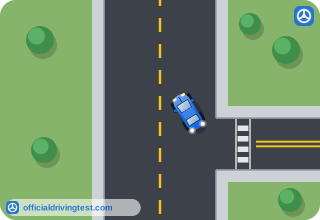
- Traffic in all directions
- Only traffic behind you
- Only traffic on your own side
- Only pedestrians
Show answer
Correct answer: Traffic in all directions
The manual says that when backing, you are responsible for traffic in all directions.
Source: Vermont Driver's Manual (2025 edition (VN-007 07/2024)), page 57 · Open this page in the manual (Manual page 57)
-
Which option does the manual call the safest way to turn your vehicle around?
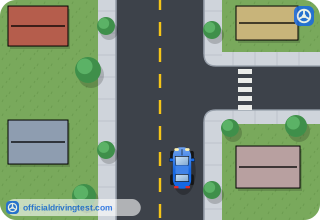
- Backing into a side street
- Turning around in the middle of the road
- Going around the block or using a parking lot
- Backing across an intersection
Show answer
Correct answer: Going around the block or using a parking lot
The manual says going around the block or using a parking lot is the safest option for turning around.
Source: Vermont Driver's Manual (2025 edition (VN-007 07/2024)), page 57 · Open this page in the manual (Manual page 57)