Vermont: Railroad crossings Practice Test
Crossbuck signs, flashing lights and gates, where to stop, vehicles that must stop at every crossing, and a car stuck on the tracks.
Independent educational site · not affiliated with any government agency or DMV
Ready? Test yourself
- Instant feedback with an explanation
- Every answer cites its source in the manual
- Your best score is saved on this device
- Keyboard: press 1 to 4 to answer and Enter for the next question
Questions are original and based on the official manual "Vermont Driver's Manual" (2025 edition (VN-007 07/2024)), Vermont Department of Motor Vehicles.
All 18 questions in this practice test
Take the test above first, then use this list to study. Tap “Show answer” to see the correct answer and explanation.
Show the questions and answersHide the questions
-
A circular sign shows a large X and the letters RR. What does it indicate?
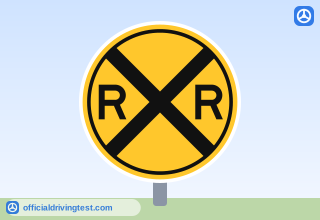
- A road closed ahead
- A railroad crossing ahead
- A reduced speed zone ahead
- A rest area ahead
Show answer
Correct answer: A railroad crossing ahead
Circular signs with a large X and the letters RR indicate there is a railroad crossing ahead.
Source: Vermont Driver's Manual (2025 edition (VN-007 07/2024)), page 32 · Open this page in the manual (Manual page 32)
-
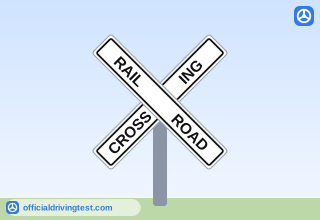
Where are crossbuck signs found?
- Only at crossings with gates
- Only at crossings with flashing lights
- Only at crossings on public roads
- At all railroad crossings
Show answer
Correct answer: At all railroad crossings
Crossbuck signs are at all railroad crossings and show where the tracks are.
Source: Vermont Driver's Manual (2025 edition (VN-007 07/2024)), page 33 · Open this page in the manual (Manual page 33)
-
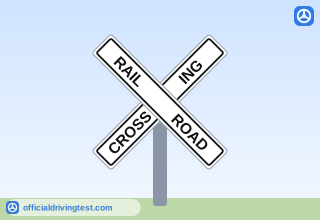
What do crossbuck signs indicate?
- Where the tracks are
- That a train is coming
- That you must stop
- The speed limit at the crossing
Show answer
Correct answer: Where the tracks are
The manual says crossbuck signs indicate where the tracks are.
Source: Vermont Driver's Manual (2025 edition (VN-007 07/2024)), page 33 · Open this page in the manual (Manual page 33)
-
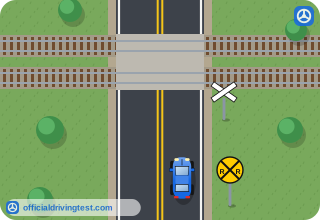
What should you do when you approach a crossbuck sign?
- Stop and wait for a train to pass before you cross
- Speed up to cross before a train can arrive
- Slow down, look both ways and listen for trains before crossing
- Look only in the direction of the nearest warning signal
Show answer
Correct answer: Slow down, look both ways and listen for trains before crossing
At a crossbuck you slow down, look both ways and listen for trains before crossing.
Source: Vermont Driver's Manual (2025 edition (VN-007 07/2024)), page 33 · Open this page in the manual (Manual page 33)
-
What do the smaller signs below a crossbuck indicate?
- How fast trains travel at the crossing
- How many tracks there are at the crossing
- The distance to the next crossing
- Whether the crossing has gates
Show answer
Correct answer: How many tracks there are at the crossing
The smaller signs below the crossbuck show the number of tracks at the crossing.
Source: Vermont Driver's Manual (2025 edition (VN-007 07/2024)), page 33 · Open this page in the manual (Manual page 33)
-
Why should you take extra care at a crossing with 2 or more tracks?
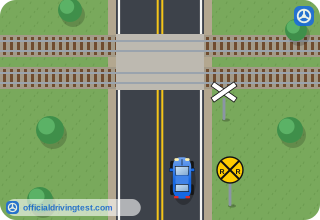
- Trains on multiple tracks cannot stop in time
- The gates close more slowly on crossings with two tracks
- The signals flash for the wrong track
- One train passing might hide a train coming the other way
Show answer
Correct answer: One train passing might hide a train coming the other way
With 2 or more tracks, one passing train might hide a train coming the other way.
Source: Vermont Driver's Manual (2025 edition (VN-007 07/2024)), page 33 · Open this page in the manual (Manual page 33)
-
It is against the law to do which of these at a closed railroad gate?
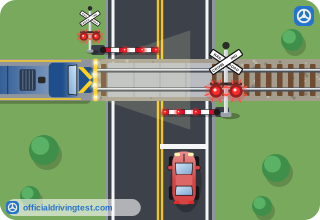
- Drive around it
- Wait in your vehicle until the train has passed
- Stop not less than 15 feet from the nearest rail
- Remain stopped until the gate has been raised
Show answer
Correct answer: Drive around it
The law forbids driving through, around, or under a closed railroad gate.
Source: Vermont Driver's Manual (2025 edition (VN-007 07/2024)), page 37 · Open this page in the manual (Manual page 37)
-
What does the manual say about passing another vehicle at a railroad crossing?
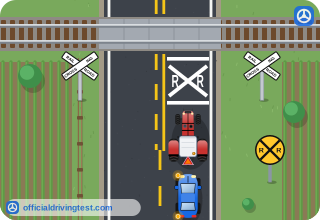
- It is allowed if no train is visible
- It is allowed if the gates are up
- It is against the law
- It is allowed on roads with a broken center line
Show answer
Correct answer: It is against the law
Passing another vehicle at a railroad crossing is against the law.
Source: Vermont Driver's Manual (2025 edition (VN-007 07/2024)), page 37 · Open this page in the manual (Manual page 37)
-
How must the driver of every vehicle approach and cross any public or private railroad grade crossing?
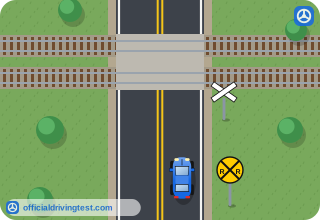
- At the posted speed limit
- At a safe, reduced speed
- At the same speed as nearby traffic
- At the speed of the vehicle ahead
Show answer
Correct answer: At a safe, reduced speed
Every driver must drive at a safe, reduced speed when approaching and crossing a railroad grade crossing.
Source: Vermont Driver's Manual (2025 edition (VN-007 07/2024)), page 37 · Open this page in the manual (Manual page 37)
-
When drivers must stop at a railroad crossing, how close to the nearest rail may they stop?
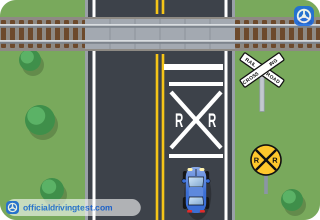
- Not closer than 5 feet
- Not closer than 10 feet
- Not closer than 25 feet
- Not closer than 15 feet
Show answer
Correct answer: Not closer than 15 feet
By law, drivers must stop not less than 15 feet from the nearest rail in the situations the manual lists.
Source: Vermont Driver's Manual (2025 edition (VN-007 07/2024)), page 37 · Open this page in the manual (Manual page 37)
-
In which situation must you stop not less than 15 feet from the nearest rail?
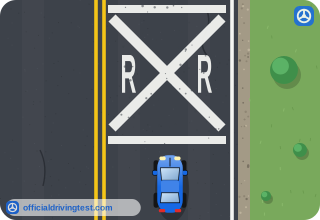
- Flashing lights, lowered gates, or a flagman signal the approach of a train
- A crossbuck sign is posted but there are no signals and no train is in sight
- The pavement near the crossing is wet
- The road beside the crossing has a low speed limit
Show answer
Correct answer: Flashing lights, lowered gates, or a flagman signal the approach of a train
Flashing lights, lowered gates, or a flagman signaling a train require you to stop at least 15 feet from the nearest rail.
Source: Vermont Driver's Manual (2025 edition (VN-007 07/2024)), page 37 · Open this page in the manual (Manual page 37)
-
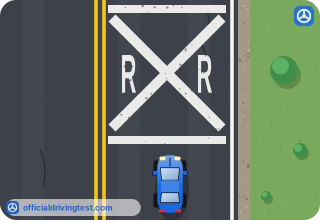
Which of these requires you to stop not less than 15 feet from the nearest rail?
- You see a crossbuck sign with no signals and no train in sight
- The road surface near the tracks is wet
- You hear a train whistle
- You are driving on a road with a low speed limit
Show answer
Correct answer: You hear a train whistle
Seeing a train or hearing its whistle requires you to stop at least 15 feet from the nearest rail.
Source: Vermont Driver's Manual (2025 edition (VN-007 07/2024)), page 37 · Open this page in the manual (Manual page 37)
-
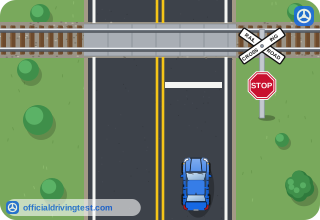
You come to a railroad crossing that has a STOP sign. What must you do, according to the manual?
- Slow down and cross when no train is in sight
- Stop not less than 15 feet from the nearest rail
- Stop only if you can see a train on the tracks
- Stop within 5 feet of the nearest rail
Show answer
Correct answer: Stop not less than 15 feet from the nearest rail
A STOP sign at a crossing is one of the cases where you must stop at least 15 feet from the nearest rail.
Source: Vermont Driver's Manual (2025 edition (VN-007 07/2024)), page 37 · Open this page in the manual (Manual page 37)
-
After a required full stop at a railroad crossing, when may you drive across the tracks?
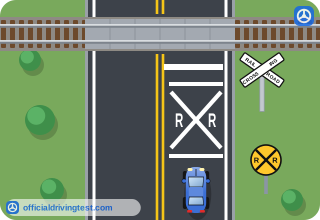
- Only after another vehicle has crossed first
- Only after waiting one full minute
- Immediately, because you have already stopped
- When it is safe to do so
Show answer
Correct answer: When it is safe to do so
After the required stop, you may cross when it is safe to do so.
Source: Vermont Driver's Manual (2025 edition (VN-007 07/2024)), page 37 · Open this page in the manual (Manual page 37)
-
Who besides motor vehicle drivers must also observe railroad warning signals?
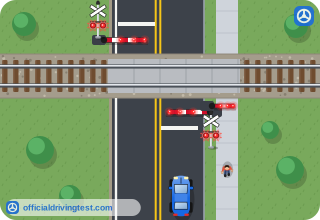
- Pedestrians, bicyclists, and moped riders
- Only pedestrians
- Only bicyclists and moped riders
- No one else; the signals apply only to motor vehicles
Show answer
Correct answer: Pedestrians, bicyclists, and moped riders
Pedestrians, bicyclists, and moped riders must also obey railroad warning signals and not cross until it is safe.
Source: Vermont Driver's Manual (2025 edition (VN-007 07/2024)), page 37 · Open this page in the manual (Manual page 37)
-
What should you do if a dangerous condition exists at a rail crossing?
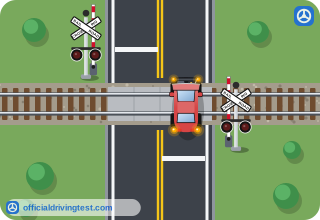
- Try to remove the hazard from the tracks yourself
- Wait at the crossing until the hazard clears on its own
- Call the number listed on the emergency sign
- Drive around the hazard on the shoulder
Show answer
Correct answer: Call the number listed on the emergency sign
Calling the number on the emergency sign reports the hazard to the rail company.
Source: Vermont Driver's Manual (2025 edition (VN-007 07/2024)), page 37 · Open this page in the manual (Manual page 37)
-
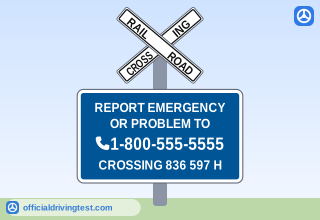
What does calling the number on the railroad emergency sign allow the rail company to do?
- Send a tow truck to your vehicle right away
- Stop or reroute approaching rail traffic until the hazard is removed
- Raise the crossing gates for the drivers who are waiting nearby
- Close the road and post a detour for all of the drivers
Show answer
Correct answer: Stop or reroute approaching rail traffic until the hazard is removed
The call lets the rail company stop or reroute trains until the hazard is gone.
Source: Vermont Driver's Manual (2025 edition (VN-007 07/2024)), page 37 · Open this page in the manual (Manual page 37)
-
What should you give when you report a dangerous condition at a rail crossing?
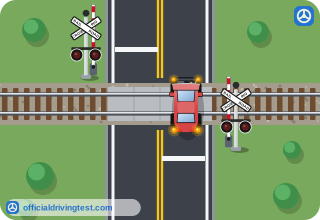
- Your driver’s license number
- Your vehicle registration number
- The railroad’s train schedule
- The posted crossing number
Show answer
Correct answer: The posted crossing number
Giving the posted crossing number lets the rail company identify the hazard correctly.
Source: Vermont Driver's Manual (2025 edition (VN-007 07/2024)), page 37 · Open this page in the manual (Manual page 37)