Vermont: Right-of-way, turning and passing — Part 2 Practice Test
Who yields at intersections and roundabouts, left and right turns, turnabouts, and when and where you may pass. — Part 2
Independent educational site · not affiliated with any government agency or DMV
Ready? Test yourself
- Instant feedback with an explanation
- Every answer cites its source in the manual
- Your best score is saved on this device
- Keyboard: press 1 to 4 to answer and Enter for the next question
Questions are original and based on the official manual "Vermont Driver's Manual" (2025 edition (VN-007 07/2024)), Vermont Department of Motor Vehicles.
All 20 questions in this practice test
Take the test above first, then use this list to study. Tap “Show answer” to see the correct answer and explanation.
Show the questions and answersHide the questions
-
In most situations, how do roundabouts compare with stop signs or traffic signals in handling motor vehicles, pedestrians and bicyclists?
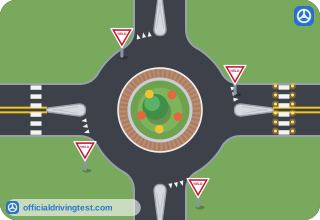
- They handle them less safely
- They handle them about as safely
- They handle them safely only at low traffic volumes
- They handle them more safely
Show answer
Correct answer: They handle them more safely
The manual says that in most situations roundabouts handle vehicles, pedestrians and bicyclists more safely than stop signs or signals.
Source: Vermont Driver's Manual (2025 edition (VN-007 07/2024)), page 30 · Open this page in the manual (Manual page 30)
-
How should vehicle speeds be approaching, within and exiting a roundabout?
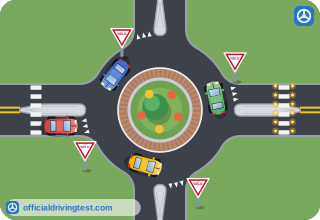
- Slow
- Equal to the speed on the approach road
- As fast as the posted limit allows
- Slow only inside the circle
Show answer
Correct answer: Slow
Speeds approaching, within and exiting a roundabout should be slow.
Source: Vermont Driver's Manual (2025 edition (VN-007 07/2024)), page 30 · Open this page in the manual (Manual page 30)
-
Who has the right of way at a roundabout between traffic already in the roundabout and a driver entering?
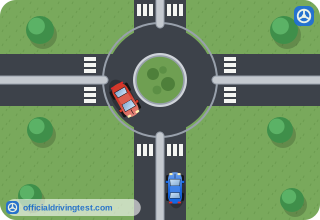
- The driver entering the roundabout
- The vehicle that is larger
- Traffic in the roundabout
- The vehicle on the right
Show answer
Correct answer: Traffic in the roundabout
Drivers must yield the right of way to traffic in the roundabout.
Source: Vermont Driver's Manual (2025 edition (VN-007 07/2024)), page 30 · Open this page in the manual (Manual page 30)
-
When should you enter a roundabout?
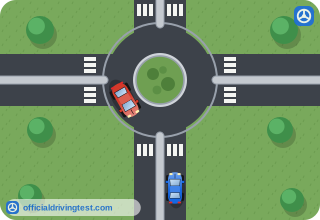
- As soon as the first vehicle in the circle passes
- Only when there is a safe gap in traffic
- When you are driving faster than traffic in the circle
- Whenever you have signaled a right turn
Show answer
Correct answer: Only when there is a safe gap in traffic
You enter only when there is a safe gap in traffic.
Source: Vermont Driver's Manual (2025 edition (VN-007 07/2024)), page 30 · Open this page in the manual (Manual page 30)
-
Which people must you yield to when entering or exiting a roundabout?
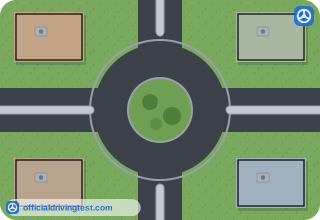
- Only pedestrians in marked crosswalks
- Only vehicles already in the roundabout
- No one, since traffic in the roundabout has priority
- Pedestrians and bicyclists
Show answer
Correct answer: Pedestrians and bicyclists
As at all intersections, you must yield to pedestrians and bicyclists when entering or exiting a roundabout.
Source: Vermont Driver's Manual (2025 edition (VN-007 07/2024)), page 30 · Open this page in the manual (Manual page 30)
-
What should you always do to show that you are leaving a roundabout?
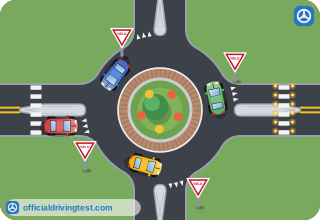
- Use your signal
- Flash your headlights
- Sound your horn
- Slow to a stop
Show answer
Correct answer: Use your signal
The manual says to always use your signal to show your intention to exit.
Source: Vermont Driver's Manual (2025 edition (VN-007 07/2024)), page 30 · Open this page in the manual (Manual page 30)
-
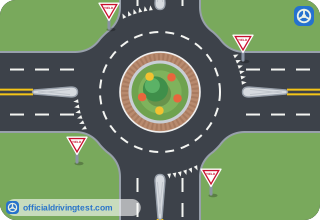
Before entering a multi-lane roundabout, what must you pay special attention to in order to choose the proper lane?
- The speed of the vehicles behind you
- The color of the vehicles in the circle
- Lane assignment signs and pavement markings
- The position of the sun and shadows
Show answer
Correct answer: Lane assignment signs and pavement markings
Multi-lane roundabouts require attention to lane assignment signs and pavement markings before entering so you select the proper lane.
Source: Vermont Driver's Manual (2025 edition (VN-007 07/2024)), page 30 · Open this page in the manual (Manual page 30)
-
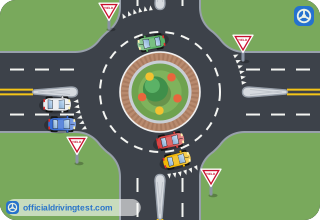
Once you are in a multi-lane roundabout, what may drivers NOT do?
- Use a turn signal
- Change lanes
- Yield to pedestrians
- Check their mirrors
Show answer
Correct answer: Change lanes
The manual states that drivers may not change lanes once in the roundabout.
Source: Vermont Driver's Manual (2025 edition (VN-007 07/2024)), page 30 · Open this page in the manual (Manual page 30)
-
Before exiting the inside lane of a multi-lane roundabout, what must drivers use?
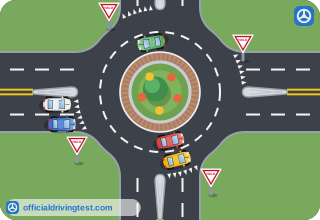
- Their horn and their hazard lights
- Only their turn signal and horn
- A complete stop at the exit lane
- Proper mirror and blind spot checks
Show answer
Correct answer: Proper mirror and blind spot checks
Drivers must make proper mirror and blind spot checks before leaving the inside lane.
Source: Vermont Driver's Manual (2025 edition (VN-007 07/2024)), page 30 · Open this page in the manual (Manual page 30)
-
In a two-lane roundabout with no signs or arrows, which movements may be made from the left lane?
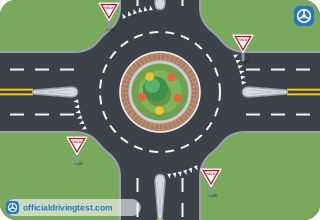
- Left turns or through movements
- Left turns only
- Right turns only
- Right turns or through movements
Show answer
Correct answer: Left turns or through movements
With no signs or arrows, the left lane may make left turns or through movements.
Source: Vermont Driver's Manual (2025 edition (VN-007 07/2024)), page 30 · Open this page in the manual (Manual page 30)
-
What should you do a short distance before your left turn when a two-way left turn lane is available?
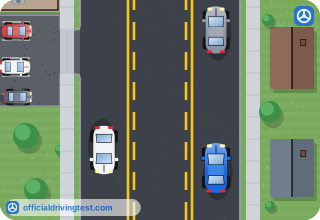
- Signal and carefully move into the turning lane
- Stop in the travel lane and wait for traffic to clear
- Speed up and move into the turning lane quickly
- Move into the turning lane first and signal at the turn
Show answer
Correct answer: Signal and carefully move into the turning lane
You signal and carefully move into the turning lane a short distance before the turn.
Source: Vermont Driver's Manual (2025 edition (VN-007 07/2024)), page 34 · Open this page in the manual (Manual page 34)
-
When you wait to turn left from a two-way left turn lane, how much of your vehicle should be in the turn lane so that you do not block traffic?
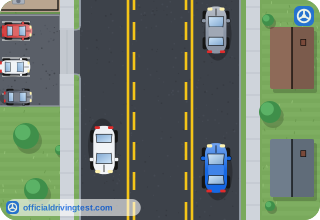
- Only the front wheels
- About half of it
- All of it
- Only the rear of it
Show answer
Correct answer: All of it
All of the vehicle should be inside the turn lane so it does not block traffic.
Source: Vermont Driver's Manual (2025 edition (VN-007 07/2024)), page 34 · Open this page in the manual (Manual page 34)
-
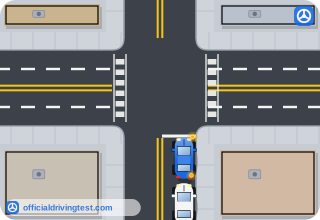
When turning right from one road onto a multiple lane road with a choice of lanes, which lane must you turn into?
- The left lane
- Whichever lane has less traffic
- The center lane
- The right lane
Show answer
Correct answer: The right lane
Right turning drivers must turn into the right lane when there is a choice of lanes.
Source: Vermont Driver's Manual (2025 edition (VN-007 07/2024)), page 34 · Open this page in the manual (Manual page 34)
-
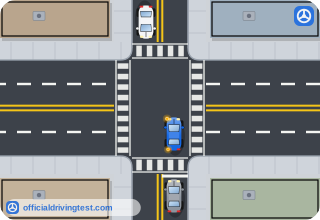
A driver turning left onto a multiple lane road with a choice of lanes must first turn into which lane?
- The left lane
- The right lane
- Whichever lane has fewer vehicles
- The lane closest to the curb
Show answer
Correct answer: The left lane
Left turning drivers must first turn into the left lane.
Source: Vermont Driver's Manual (2025 edition (VN-007 07/2024)), page 34 · Open this page in the manual (Manual page 34)
-
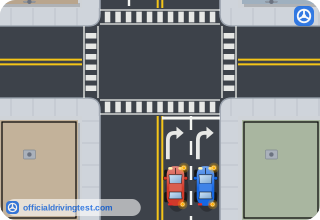
When two lanes are turning in the same direction, what must each turning lane do?
- Merge into the outer path as soon as the turn begins
- Let the inner lane cross into the outer path
- Stay in its own turning path throughout the turn
- Take turns using the same path during the turn
Show answer
Correct answer: Stay in its own turning path throughout the turn
Each turning lane must stay in its own turning path from the start to the end of the turn.
Source: Vermont Driver's Manual (2025 edition (VN-007 07/2024)), page 34 · Open this page in the manual (Manual page 34)
-
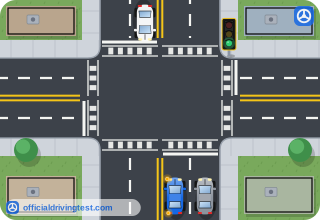
When may multiple lanes turn in the same direction at the same time?
- Whenever traffic is light enough for the lanes to share the turn
- When lane use control signs or pavement markings permit it
- Only when a police officer is directing traffic at the intersection
- Whenever every driver in both lanes uses a turn signal
Show answer
Correct answer: When lane use control signs or pavement markings permit it
Several lanes may turn in the same direction at the same time when lane use control signs or pavement markings permit it.
Source: Vermont Driver's Manual (2025 edition (VN-007 07/2024)), page 34 · Open this page in the manual (Manual page 34)
-
How long should you remain in the designated lane when turning?
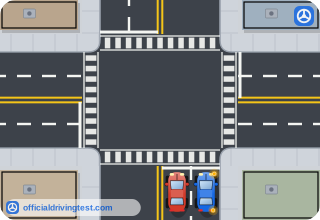
- Until you have entered the intersection
- Until you have passed the first crosswalk
- Until you reach the speed limit of the new road
- Until after the turn has been completed
Show answer
Correct answer: Until after the turn has been completed
You stay in your designated lane until the turn is finished, and change lanes only afterward.
Source: Vermont Driver's Manual (2025 edition (VN-007 07/2024)), page 34 · Open this page in the manual (Manual page 34)
-
What does the manual say about changing lanes while turning?
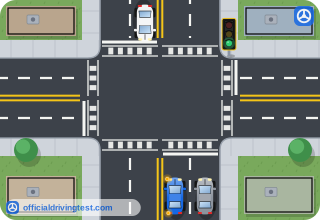
- It is an illegal maneuver that leads to crashes
- It is allowed when you signal first
- It is allowed when the road is empty of other traffic
- It is allowed on roads that have two lanes turning together
Show answer
Correct answer: It is an illegal maneuver that leads to crashes
Changing lanes during a turn is illegal and leads to crashes.
Source: Vermont Driver's Manual (2025 edition (VN-007 07/2024)), page 35 · Open this page in the manual (Manual page 35)
-
A driver in a lane marked with a straight arrow reaches the intersection. What does the manual say about turning right or left from that lane?
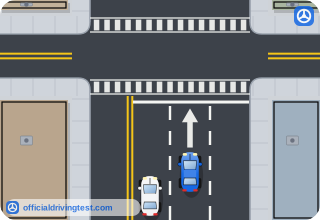
- It is allowed if no vehicles are nearby
- It is allowed if you signal early
- It is illegal and unsafe
- It is allowed only at a red light
Show answer
Correct answer: It is illegal and unsafe
Drivers must follow the direction shown for their lane, so turning from a straight-arrow lane is illegal and unsafe.
Source: Vermont Driver's Manual (2025 edition (VN-007 07/2024)), page 35 · Open this page in the manual (Manual page 35)
-
If you are in the wrong lane at an intersection, what does the manual say is safer than a sudden lane change?
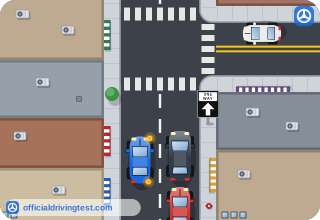
- Stopping in the lane until the traffic around you clears
- Driving around the block and finding an alternate route
- Backing up to the previous intersection and starting again
- Slowing down and cutting across the lanes to the turn
Show answer
Correct answer: Driving around the block and finding an alternate route
A sudden lane change raises the risk of a crash, so driving around the block is safer.
Source: Vermont Driver's Manual (2025 edition (VN-007 07/2024)), page 35 · Open this page in the manual (Manual page 35)