Vermont: Right-of-way, turning and passing — Part 1 Practice Test
Questions in this part include: “When making a left turn, how close to the centerline should you position your vehicle if it is safe to do so?” · “At the approach to a right turn, about how far from the right side of the road should the vehicle be?”
Independent educational site · not affiliated with any government agency or DMV
Ready? Test yourself
- Instant feedback with an explanation
- Every answer cites its source in the manual
- Your best score is saved on this device
- Keyboard: press 1 to 4 to answer and Enter for the next question
Questions are original and based on the official manual "Vermont Driver's Manual" (2025 edition (VN-007 07/2024)), Vermont Department of Motor Vehicles.
All 21 questions in this practice test
Take the test above first, then use this list to study. Tap “Show answer” to see the correct answer and explanation.
Show the questions and answersHide the questions
-
On a multilane road, where should you be well in advance of a left turn?
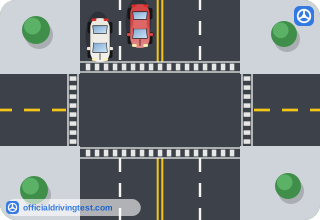
- In the right lane
- In the left lane
- In the lane with the most traffic
- In the center of the road
Show answer
Correct answer: In the left lane
On a multilane road you should be in the left lane well before a left turn and never move suddenly from the right lane to the left.
Source: Vermont Driver's Manual (2025 edition (VN-007 07/2024)), page 26 · Open this page in the manual (Manual page 26)
-
When making a left turn, how close to the centerline should you position your vehicle if it is safe to do so?
- Within two feet
- Within five feet
- Within ten feet
- Within one foot
Show answer
Correct answer: Within one foot
For a left turn the manual says to position the vehicle within one foot of the centerline when it is safe.
Source: Vermont Driver's Manual (2025 edition (VN-007 07/2024)), page 26 · Open this page in the manual (Manual page 26)
-
Why should you keep your wheels straight until you are ready to make a left turn?
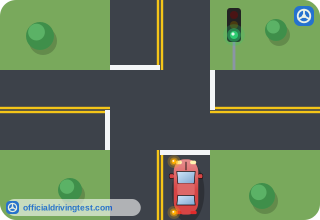
- So you are not pushed into oncoming traffic if hit from behind
- So the driver behind you can tell that you plan to turn
- So your turn signal does not switch off during the turn
- So you can turn more quickly once the road is clear
Show answer
Correct answer: So you are not pushed into oncoming traffic if hit from behind
Straight wheels keep your vehicle from being pushed into oncoming traffic if another vehicle hits you from behind.
Source: Vermont Driver's Manual (2025 edition (VN-007 07/2024)), page 26 · Open this page in the manual (Manual page 26)
-
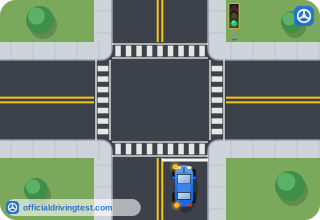
When the road is clear and you make a left turn, where should you keep your vehicle?
- Across the center line
- To the right of the center line
- On the center line
- Along the far right curb of the new street
Show answer
Correct answer: To the right of the center line
During a left turn you keep to the right of the center line.
Source: Vermont Driver's Manual (2025 edition (VN-007 07/2024)), page 26 · Open this page in the manual (Manual page 26)
-
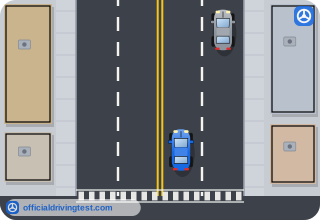
What should you do after completing a turn?
- Move to the edge of the lane and signal that the turn is complete
- Speed up at once to the posted limit without checking behind
- Check your blind spot for several seconds before moving on
- Check your rearview mirror and center your vehicle in the lane
Show answer
Correct answer: Check your rearview mirror and center your vehicle in the lane
After a turn you check the rearview mirror and center the vehicle in the lane.
Source: Vermont Driver's Manual (2025 edition (VN-007 07/2024)), page 27 · Open this page in the manual (Manual page 27)
-
Before starting a left turn, in which order does the manual say to search the intersection?
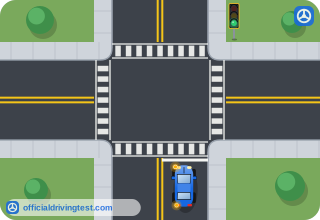
- Right, front, and left
- Left, front, and right
- Front, left, and right
- Left, right, and front
Show answer
Correct answer: Right, front, and left
For a left turn the search is right, front, and left before you begin the turn.
Source: Vermont Driver's Manual (2025 edition (VN-007 07/2024)), page 27 · Open this page in the manual (Manual page 27)
-
At the approach to a right turn, about how far from the right side of the road should the vehicle be?
- About one foot
- About six feet
- About three feet
- About ten feet
Show answer
Correct answer: About three feet
The manual says the vehicle should be about three feet from the right side of the road when approaching a right turn.
Source: Vermont Driver's Manual (2025 edition (VN-007 07/2024)), page 27 · Open this page in the manual (Manual page 27)
-
What should you not do before turning right?
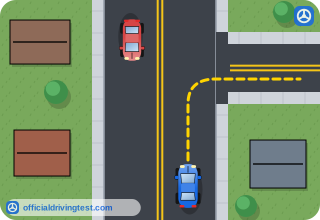
- Slow down gradually
- Swing your vehicle to the left
- Check the mirror for the vehicle behind you
- Search the intersection left, front, and right
Show answer
Correct answer: Swing your vehicle to the left
The manual says not to swing the vehicle to the left before turning right.
Source: Vermont Driver's Manual (2025 edition (VN-007 07/2024)), page 27 · Open this page in the manual (Manual page 27)
-
After searching the intersection left, front and right before a right turn, what does the manual's checklist add just before you start the turn?
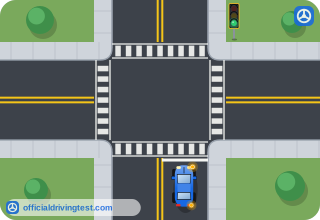
- Look right a second time
- Look over your shoulder to the rear
- Look at the sidewalk on the left
- Quickly look left again
Show answer
Correct answer: Quickly look left again
The right-turn checklist ends the search with a quick look to the left again just before you start the turn.
Source: Vermont Driver's Manual (2025 edition (VN-007 07/2024)), page 27 · Open this page in the manual (Manual page 27)
-
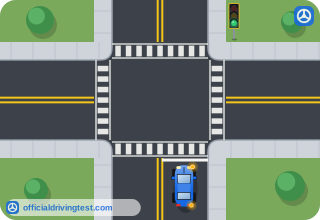
Where in your lane should you make a right turn?
- In the center of your lane
- Close to the left side of your lane
- Close to the right side of your lane
- Wherever there is the most room
Show answer
Correct answer: Close to the right side of your lane
A right turn is made close to the right side of the lane.
Source: Vermont Driver's Manual (2025 edition (VN-007 07/2024)), page 27 · Open this page in the manual (Manual page 27)
-
If you are turning into a street with more than one lane going in your direction, which lane should you turn into?
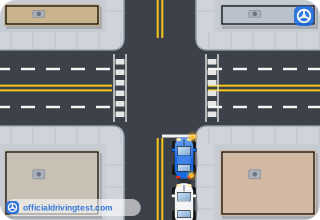
- The farthest lane
- The nearest lane
- The center lane
- Whichever lane has the least traffic
Show answer
Correct answer: The nearest lane
When turning into a multilane street, turn into the nearest lane.
Source: Vermont Driver's Manual (2025 edition (VN-007 07/2024)), page 27 · Open this page in the manual (Manual page 27)
-
What is the basic rule of driving on a multilane road?
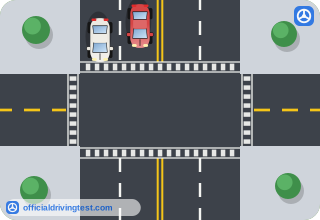
- Drive in the left lane unless you are exiting
- Drive in whichever lane is moving fastest
- Drive in the center lane unless you are passing
- Drive to the right unless you are passing or turning
Show answer
Correct answer: Drive to the right unless you are passing or turning
The basic multilane rule is to stay to the right except when passing or turning.
Source: Vermont Driver's Manual (2025 edition (VN-007 07/2024)), page 27 · Open this page in the manual (Manual page 27)
-
Who must a driver on any road yield the right-of-way to?
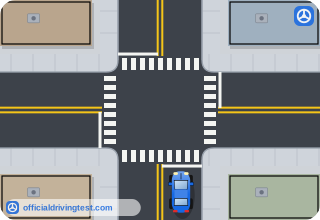
- Only vehicles that are coming from your right at the intersection
- Only vehicles that are larger than yours or traveling faster than you
- Pedestrians, bicyclists and other traffic already in the intersection
- Only vehicles in the lane directly to your left at that moment
Show answer
Correct answer: Pedestrians, bicyclists and other traffic already in the intersection
A driver must yield to pedestrians, bicyclists and other traffic already in the intersection.
Source: Vermont Driver's Manual (2025 edition (VN-007 07/2024)), page 28 · Open this page in the manual (Manual page 28)
-
When nearing an intersection marked with a "yield right-of-way" sign, what are you required to do?
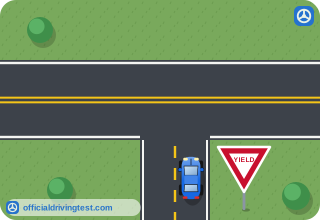
- Stop completely every time before you enter the intersection ahead
- Travel slowly enough to stop if necessary and enter only when the way is clear
- Keep your speed the same whenever no other vehicles are in sight ahead
- Enter right away if you reached the intersection before other vehicles
Show answer
Correct answer: Travel slowly enough to stop if necessary and enter only when the way is clear
At a yield sign you must be slow enough to stop if needed and enter only when the way is clear.
Source: Vermont Driver's Manual (2025 edition (VN-007 07/2024)), page 28 · Open this page in the manual (Manual page 28)
-
At a four-way stop, which vehicle should have the right-of-way?
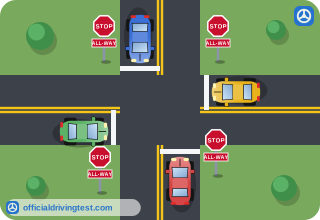
- The largest vehicle
- The vehicle going straight
- The vehicle in the left lane
- The first vehicle to arrive
Show answer
Correct answer: The first vehicle to arrive
At a four-way stop the first vehicle to arrive should have the right-of-way.
Source: Vermont Driver's Manual (2025 edition (VN-007 07/2024)), page 28 · Open this page in the manual (Manual page 28)
-
Two vehicles approach a four-way stop at about the same time from different directions. Which driver should yield?
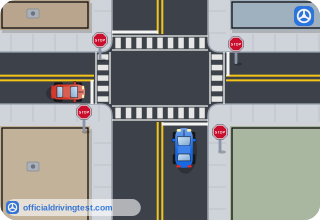
- The driver on the left yields to the driver on the right
- The driver on the right yields to the driver on the left
- The driver in the smaller vehicle yields
- The driver going straight yields to the one turning
Show answer
Correct answer: The driver on the left yields to the driver on the right
When two vehicles arrive together from different directions, the driver on the left yields to the driver on the right.
Source: Vermont Driver's Manual (2025 edition (VN-007 07/2024)), page 28 · Open this page in the manual (Manual page 28)
-
If you are turning left, what must you do about oncoming traffic?
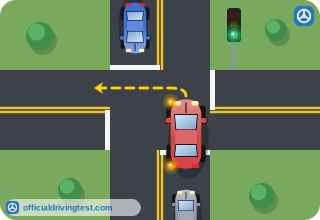
- Yield only to oncoming motor vehicles, not bicyclists
- Turn first if you have already signaled
- Yield to all oncoming traffic
- Turn first if you are in the left lane
Show answer
Correct answer: Yield to all oncoming traffic
A driver turning left must yield to every oncoming vehicle, whether a motor vehicle or a bicyclist.
Source: Vermont Driver's Manual (2025 edition (VN-007 07/2024)), page 28 · Open this page in the manual (Manual page 28)
-
A driver approaching the road from a driveway, alley or parking lot must yield the right-of-way to whom?
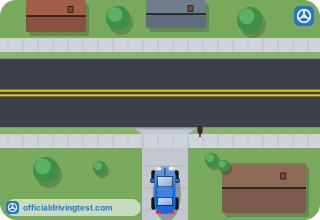
- Only traffic coming from the left
- All traffic on the road
- Only pedestrians
- Only vehicles that are moving faster
Show answer
Correct answer: All traffic on the road
A driver entering the road from a driveway, alley, parking lot or T-intersection must yield to all traffic on the road.
Source: Vermont Driver's Manual (2025 edition (VN-007 07/2024)), page 28 · Open this page in the manual (Manual page 28)
-
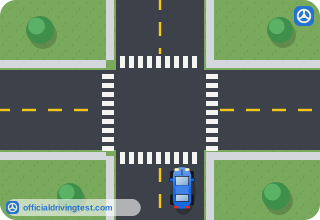
Before entering any intersection, what must you always do?
- Come to a complete stop and wait for other drivers to signal you on
- Sound your horn to warn other drivers that you are entering
- Look only in the direction of oncoming traffic before you enter
- Search in all directions and be sure you have a clear path
Show answer
Correct answer: Search in all directions and be sure you have a clear path
Before entering an intersection you must search in all directions and have a clear path.
Source: Vermont Driver's Manual (2025 edition (VN-007 07/2024)), page 28 · Open this page in the manual (Manual page 28)
-
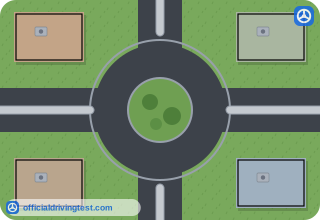
In which direction does traffic proceed in a roundabout?
- Clockwise
- Whichever way is shorter
- Counter clockwise
- Toward the side with the least traffic
Show answer
Correct answer: Counter clockwise
Traffic in a roundabout proceeds in a counter clockwise direction.
Source: Vermont Driver's Manual (2025 edition (VN-007 07/2024)), page 29 · Open this page in the manual (Manual page 29)
-
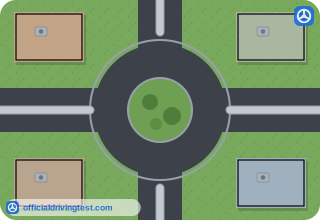
How does traffic enter and exit a roundabout?
- Only through left turns
- Only through right turns
- Through left or right turns
- Straight across the center
Show answer
Correct answer: Only through right turns
The manual says traffic enters and exits a roundabout only through right turns.
Source: Vermont Driver's Manual (2025 edition (VN-007 07/2024)), page 29 · Open this page in the manual (Manual page 29)