Utah: Right-of-way, turning and passing — Part 4 Practice Test
Questions in this part include: “When you reach a roundabout, whom does the handbook say you yield to?” · “What does the handbook say about thinking you have the right-of-way?”
Independent educational site · not affiliated with any government agency or DMV
Ready? Test yourself
- Instant feedback with an explanation
- Every answer cites its source in the manual
- Your best score is saved on this device
- Keyboard: press 1 to 4 to answer and Enter for the next question
Questions are original and based on the official manual "Utah Driver Handbook" (2026 edition (new 2026 laws effective May 6, 2026)), Utah Department of Public Safety, Driver License Division.
All 19 questions in this practice test
Take the test above first, then use this list to study. Tap “Show answer” to see the correct answer and explanation.
Show the questions and answersHide the questions
-
What is the first thing the handbook tells you to do as you approach a roundabout?
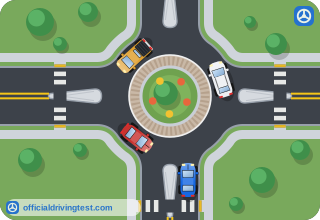
- Slow down
- Stop completely at the entrance
- Speed up to merge with traffic
- Switch to the left lane
Show answer
Correct answer: Slow down
The handbook starts its roundabout steps with slowing down as you approach.
Source: Utah Driver Handbook (2026 edition (new 2026 laws effective May 6, 2026)), page 45 · Open this page in the manual (Manual page 45)
-
When you reach a roundabout, whom does the handbook say you yield to?
- Only vehicles larger than yours
- No one, because vehicles entering have the right-of-way
- Oncoming traffic
- Only vehicles that are behind you
Show answer
Correct answer: Oncoming traffic
The second roundabout step is to yield to oncoming traffic and enter when it is clear.
Source: Utah Driver Handbook (2026 edition (new 2026 laws effective May 6, 2026)), page 45 · Open this page in the manual (Manual page 45)
-
After you have yielded and the way is clear, what is the last roundabout step the handbook gives?
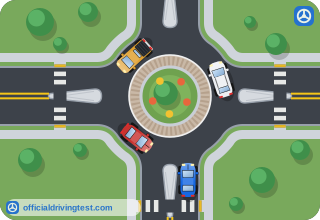
- Stop in the center island before leaving
- Go through the roundabout and exit at the street you want
- Leave at the first exit you reach
- Wait for a signal from a peace officer before exiting
Show answer
Correct answer: Go through the roundabout and exit at the street you want
The handbook ends the roundabout steps by proceeding through and exiting at the desired street.
Source: Utah Driver Handbook (2026 edition (new 2026 laws effective May 6, 2026)), page 45 · Open this page in the manual (Manual page 45)
-
What does the handbook say about thinking you have the right-of-way?
- Assume you have it whenever you arrive at the intersection first
- Assume you have it when you drive on a main road
- Assume you have it when your signal is on
- Never think you have it; look at the situation and think about safety
Show answer
Correct answer: Never think you have it; look at the situation and think about safety
The handbook says never to assume you have the right-of-way and to think about safety in each situation.
Source: Utah Driver Handbook (2026 edition (new 2026 laws effective May 6, 2026)), page 50 · Open this page in the manual (Manual page 50)
-
Who must you yield the right-of-way to at an intersection?
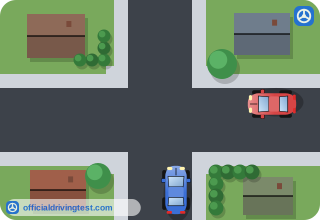
- A driver who is at the intersection before you
- A driver who is in a larger vehicle
- A driver who arrives after you but is going straight
- A driver who is traveling faster
Show answer
Correct answer: A driver who is at the intersection before you
The handbook lists a driver who is at the intersection before you as someone you yield to.
Source: Utah Driver Handbook (2026 edition (new 2026 laws effective May 6, 2026)), page 50 · Open this page in the manual (Manual page 50)
-
You are making a left turn. Who must you yield the right-of-way to?
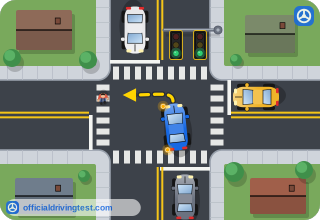
- Drivers behind you in your own lane
- Vehicles parked at the curb
- Drivers in the opposite lane
- No one, because a left turn has priority
Show answer
Correct answer: Drivers in the opposite lane
When you turn left you yield to drivers in the opposite lane.
Source: Utah Driver Handbook (2026 edition (new 2026 laws effective May 6, 2026)), page 50 · Open this page in the manual (Manual page 50)
-
You and another driver arrive at a four-way stop at the same time. Who has the right-of-way?
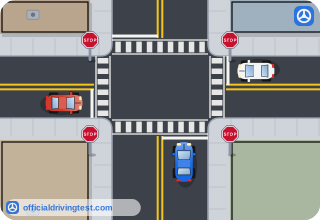
- The driver on your left
- The driver on your right
- The driver going straight
- The driver in the larger vehicle
Show answer
Correct answer: The driver on your right
At a four-way stop you yield to the driver on your right if you both arrive together.
Source: Utah Driver Handbook (2026 edition (new 2026 laws effective May 6, 2026)), page 50 · Open this page in the manual (Manual page 50)
-
You are coming from a driveway or a private road onto a public road. Whom must you yield to?
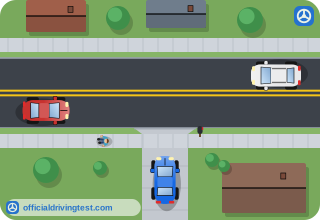
- Only drivers coming from the left
- No one, because you are already moving
- Only pedestrians
- Drivers on the public road
Show answer
Correct answer: Drivers on the public road
Drivers coming from a driveway or private road yield to drivers on the public road.
Source: Utah Driver Handbook (2026 edition (new 2026 laws effective May 6, 2026)), page 50 · Open this page in the manual (Manual page 50)
-
You are on an entrance ramp to an interstate highway. Whom must you yield to?
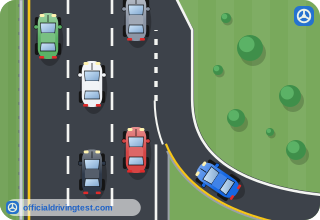
- Drivers already on the interstate
- No one, because merging traffic goes first
- Only trucks and buses
- Only drivers in the right lane of the ramp
Show answer
Correct answer: Drivers already on the interstate
Drivers on an entrance ramp yield to drivers already on the interstate.
Source: Utah Driver Handbook (2026 edition (new 2026 laws effective May 6, 2026)), page 50 · Open this page in the manual (Manual page 50)
-
Besides pedestrians and bicyclists, whom does the handbook say you yield to when they are still in the intersection?
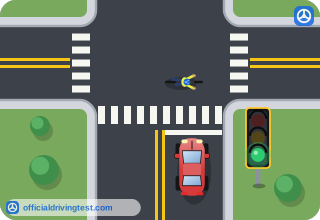
- Only emergency vehicles
- Only vehicles on your right
- Others still in the intersection
- Nobody else
Show answer
Correct answer: Others still in the intersection
You yield to pedestrians, bicyclists, and others that are still in the intersection.
Source: Utah Driver Handbook (2026 edition (new 2026 laws effective May 6, 2026)), page 50 · Open this page in the manual (Manual page 50)
-
On a narrow mountain road, who must yield when one vehicle is traveling uphill and the other downhill?
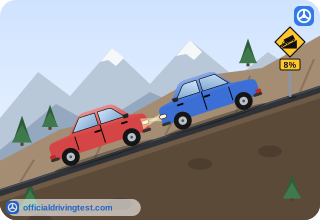
- The vehicle traveling uphill must yield to the one going downhill
- The smaller of the two vehicles must yield to the larger
- The vehicle traveling downhill must yield to the one going uphill
- The vehicle on the left side of the road must yield
Show answer
Correct answer: The vehicle traveling downhill must yield to the one going uphill
The handbook says you must yield to vehicles going uphill if you are traveling downhill on a narrow road.
Source: Utah Driver Handbook (2026 edition (new 2026 laws effective May 6, 2026)), page 60 · Open this page in the manual (Manual page 60)
-
Who has the right-of-way at a narrow or single-lane bridge?
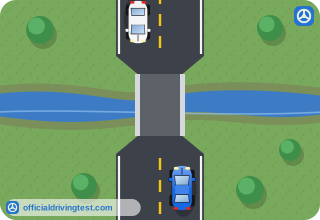
- The driver in the larger vehicle
- The driver traveling faster
- The driver coming downhill
- The first driver to reach the bridge
Show answer
Correct answer: The first driver to reach the bridge
At narrow and single-lane bridges, the first driver to the bridge has the right-of-way and drivers take turns crossing.
Source: Utah Driver Handbook (2026 edition (new 2026 laws effective May 6, 2026)), page 61 · Open this page in the manual (Manual page 61)
-
What should drivers do at a narrow or single-lane rural bridge?
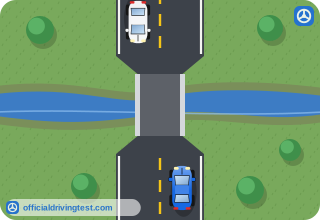
- Take turns crossing the bridge
- Cross together side by side
- Honk and cross without stopping
- Let the larger vehicle push through
Show answer
Correct answer: Take turns crossing the bridge
The handbook says drivers should take turns crossing a single-lane bridge.
Source: Utah Driver Handbook (2026 edition (new 2026 laws effective May 6, 2026)), page 61 · Open this page in the manual (Manual page 61)
-
How should a driver treat a bicyclist in an intersection?
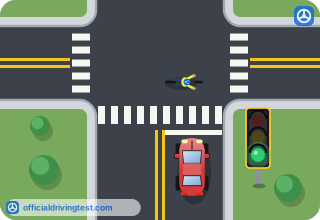
- Yield to the bicyclist as for pedestrians and other vehicles
- Go first, because a motor vehicle is larger than a bicycle
- Sound the horn so that the bicyclist stops moving
- Speed up to clear the intersection ahead of the bicyclist
Show answer
Correct answer: Yield to the bicyclist as for pedestrians and other vehicles
Drivers must yield to bicyclists in intersections just as they do to pedestrians and other vehicles.
Source: Utah Driver Handbook (2026 edition (new 2026 laws effective May 6, 2026)), page 74 · Open this page in the manual (Manual page 74)
-
What must a driver do when a bicycle path or bike lane intersects a road?
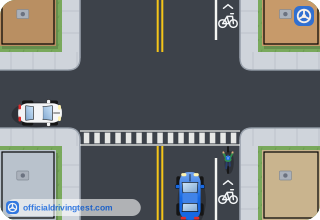
- Speed up to cross before any bicyclist arrives
- Stop, then go first because the road has priority
- Yield the right-of-way
- Drive in the bike lane until the crossing is clear
Show answer
Correct answer: Yield the right-of-way
Where a bicycle path or lane crosses a road, the driver must yield the right-of-way.
Source: Utah Driver Handbook (2026 edition (new 2026 laws effective May 6, 2026)), page 74 · Open this page in the manual (Manual page 74)
-
A bicyclist is approaching an intersection where you plan to turn. What should you do?
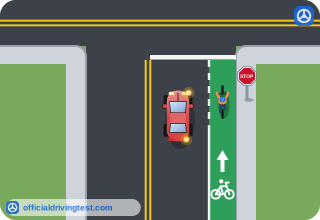
- Slow down and let the cyclist clear the intersection
- Turn quickly in front of the cyclist before the cyclist arrives
- Sound your horn and turn immediately without waiting
- Pass the cyclist and then make your turn
Show answer
Correct answer: Slow down and let the cyclist clear the intersection
A driver should slow down and wait until the cyclist has cleared the intersection before turning.
Source: Utah Driver Handbook (2026 edition (new 2026 laws effective May 6, 2026)), page 74 · Open this page in the manual (Manual page 74)
-
When turning left, how may a bicyclist use left-turn or two-way left-turn lanes?
- In the same manner required of motor vehicles
- Only when no motor vehicles are present
- Never; the bicyclist must dismount and walk
- Only with an adult rider
Show answer
Correct answer: In the same manner required of motor vehicles
A bicyclist turning left may use the left-turn or two-way left-turn lanes as a motor vehicle does.
Source: Utah Driver Handbook (2026 edition (new 2026 laws effective May 6, 2026)), page 75 · Open this page in the manual (Manual page 75)
-
When a large vehicle is turning ahead of you, when should you turn?
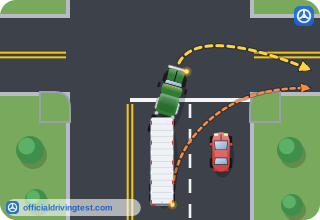
- Not until the vehicle has finished its turn
- While the large vehicle is still turning, behind it
- Before the large vehicle begins its turn
- As soon as the large vehicle signals
Show answer
Correct answer: Not until the vehicle has finished its turn
To avoid a crash, wait until a large vehicle has finished its turn before you turn.
Source: Utah Driver Handbook (2026 edition (new 2026 laws effective May 6, 2026)), page 79 · Open this page in the manual (Manual page 79)
-
Where should you always stop at an intersection stop line, given that stop lines are designed to give larger vehicles more turning space?
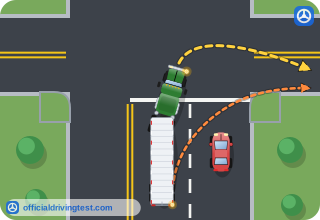
- On the stop line
- Behind the stop line
- With the front wheels over the stop line
- Just past the stop line to see better
Show answer
Correct answer: Behind the stop line
Stop lines give larger vehicles room to turn, so you should always stop behind them.
Source: Utah Driver Handbook (2026 edition (new 2026 laws effective May 6, 2026)), page 79 · Open this page in the manual (Manual page 79)