Utah: Right-of-way, turning and passing — Part 2 Practice Test
Questions in this part include: “In a reverse two-point turn, how far past the driveway or alley do you drive before backing in?” · “Where does the handbook say you must never make a U-turn?”
Independent educational site · not affiliated with any government agency or DMV
Ready? Test yourself
- Instant feedback with an explanation
- Every answer cites its source in the manual
- Your best score is saved on this device
- Keyboard: press 1 to 4 to answer and Enter for the next question
Questions are original and based on the official manual "Utah Driver Handbook" (2026 edition (new 2026 laws effective May 6, 2026)), Utah Department of Public Safety, Driver License Division.
All 19 questions in this practice test
Take the test above first, then use this list to study. Tap “Show answer” to see the correct answer and explanation.
Show the questions and answersHide the questions
-
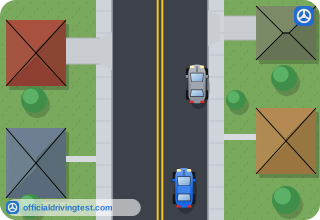
In a forward two-point turn, where do you position the car in the driveway or alley?
- Centered in the driveway
- As near as possible to the left side of the drive
- As near as possible to the right side of the drive
- Straddling both sides of the drive
Show answer
Correct answer: As near as possible to the right side of the drive
You turn as near as possible to the right side of the drive.
Source: Utah Driver Handbook (2026 edition (new 2026 laws effective May 6, 2026)), page 37 · Open this page in the manual (Manual page 37)
-
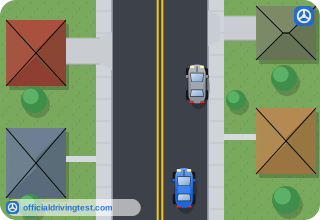
In a forward two-point turn, when do you stop after turning into the driveway?
- When the front bumper reaches the end of the driveway
- As the vehicle's rear clears the curb or edge of the driveway
- When the whole vehicle is inside the driveway
- When the front wheels touch the curb
Show answer
Correct answer: As the vehicle's rear clears the curb or edge of the driveway
You stop as the rear of the vehicle clears the curb or edge of the driveway, then shift to reverse.
Source: Utah Driver Handbook (2026 edition (new 2026 laws effective May 6, 2026)), page 37 · Open this page in the manual (Manual page 37)
-
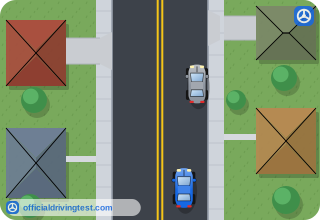
In a forward two-point turn, how do you turn the steering wheel when backing out of the driveway?
- Quickly to the left
- Gently to the right
- Gently to the left
- Quickly to the right
Show answer
Correct answer: Quickly to the right
When the path is clear you back up while turning the steering wheel quickly to the right.
Source: Utah Driver Handbook (2026 edition (new 2026 laws effective May 6, 2026)), page 37 · Open this page in the manual (Manual page 37)
-
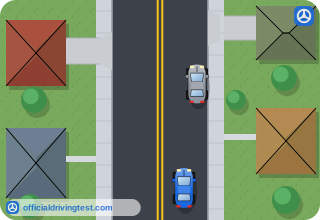
To begin a reverse two-point turn into a driveway or alley, which turn do you signal?
- A left turn
- A right turn
- Emergency flashers instead of a turn signal
- No signal; brake lights are enough
Show answer
Correct answer: A right turn
A reverse two-point turn starts by checking behind you and signaling a right turn.
Source: Utah Driver Handbook (2026 edition (new 2026 laws effective May 6, 2026)), page 37 · Open this page in the manual (Manual page 37)
-
In a reverse two-point turn, how far past the driveway or alley do you drive before backing in?
- One car length
- Two car lengths
- Half a car length
- Three car lengths
Show answer
Correct answer: One car length
You drive one car length past the driveway or alley before backing into it.
Source: Utah Driver Handbook (2026 edition (new 2026 laws effective May 6, 2026)), page 37 · Open this page in the manual (Manual page 37)
-
In a reverse two-point turn, what do you do before backing into the driveway?
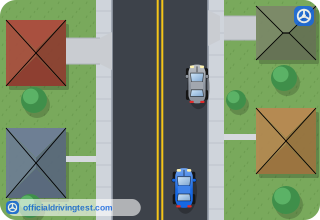
- Put your left arm on the door and look back over your left shoulder
- Keep both hands at the top of the wheel and watch only the mirrors
- Keep both hands on the wheel and use only the rearview mirror
- Put your right arm on the seat and look back over your right shoulder
Show answer
Correct answer: Put your right arm on the seat and look back over your right shoulder
Before backing into the driveway you put your right arm on the seat and look back over your right shoulder.
Source: Utah Driver Handbook (2026 edition (new 2026 laws effective May 6, 2026)), page 37 · Open this page in the manual (Manual page 37)
-
When should a three-point turn be used?
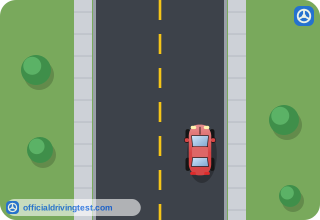
- Whenever a U-turn would save time
- Only on a freeway when you miss an exit
- Only if the road is too narrow for a U-turn
- Only on roads with four or more lanes
Show answer
Correct answer: Only if the road is too narrow for a U-turn
A three-point turn is only for when the road is too narrow for a U-turn.
Source: Utah Driver Handbook (2026 edition (new 2026 laws effective May 6, 2026)), page 38 · Open this page in the manual (Manual page 38)
-
On what kind of road should a three-point turn only be used?
- A two-lane road
- A divided highway
- A four-lane road
- A freeway ramp
Show answer
Correct answer: A two-lane road
The handbook says a three-point turn should only be used on a two-lane road.
Source: Utah Driver Handbook (2026 edition (new 2026 laws effective May 6, 2026)), page 38 · Open this page in the manual (Manual page 38)
-
In a three-point turn, where do you stop after signaling a right turn?
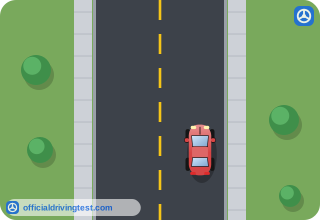
- In the center of the road
- On the left side of the road
- On the right side of the road
- Past the center line in the oncoming lane
Show answer
Correct answer: On the right side of the road
After checking and signaling a right turn, you stop on the right side of the road.
Source: Utah Driver Handbook (2026 edition (new 2026 laws effective May 6, 2026)), page 38 · Open this page in the manual (Manual page 38)
-
In a three-point turn, which head checks do you do after shifting to reverse?
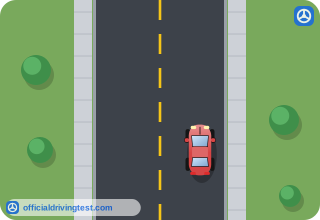
- Over your left shoulder only
- Over both shoulders
- Over your right shoulder only
- None; use your mirrors only
Show answer
Correct answer: Over both shoulders
After shifting to reverse you check traffic and head check over both shoulders.
Source: Utah Driver Handbook (2026 edition (new 2026 laws effective May 6, 2026)), page 38 · Open this page in the manual (Manual page 38)
-
In a three-point turn, which way do you steer when you back up?
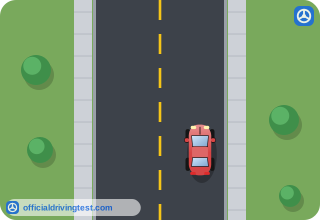
- Hard left
- Straight back
- Slightly left
- Hard right
Show answer
Correct answer: Hard right
To back up in a three-point turn you turn hard right once traffic is clear.
Source: Utah Driver Handbook (2026 edition (new 2026 laws effective May 6, 2026)), page 38 · Open this page in the manual (Manual page 38)
-
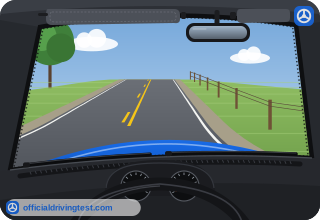
Never make a U-turn on a curve near the top of a hill where you cannot see or be seen from both directions for how far?
- 200 feet
- 500 feet
- 300 feet
- 1000 feet
Show answer
Correct answer: 500 feet
A U-turn is never allowed on a curve near a hilltop where you cannot see or be seen from both directions for 500 feet.
Source: Utah Driver Handbook (2026 edition (new 2026 laws effective May 6, 2026)), page 38 · Open this page in the manual (Manual page 38)
-
Where must you never make a U-turn?
- On a railroad grade crossing
- From the left-hand lane of a street that is wide enough
- Just right of the center line of a street that is wide enough
- From the center of a street that is wide enough
Show answer
Correct answer: On a railroad grade crossing
The handbook says never to make a U-turn on a railroad track or railroad grade crossing.
Source: Utah Driver Handbook (2026 edition (new 2026 laws effective May 6, 2026)), page 38 · Open this page in the manual (Manual page 38)
-
Where does the handbook say you must never make a U-turn?
- On a street wide enough, from the left-hand lane
- On a street wide enough, just right of the center line
- On a street wide enough, from the center of the street
- On a freeway
Show answer
Correct answer: On a freeway
A U-turn must never be made on a freeway.
Source: Utah Driver Handbook (2026 edition (new 2026 laws effective May 6, 2026)), page 38 · Open this page in the manual (Manual page 38)
-
What should you know about U-turn laws?
- Only the state law, since it applies everywhere
- The law of the city where your license was issued
- The specific law of the city in which you are driving
- That a police officer must approve each U-turn
Show answer
Correct answer: The specific law of the city in which you are driving
Each city has its own U-turn laws, so you must know the law of the city where you are driving.
Source: Utah Driver Handbook (2026 edition (new 2026 laws effective May 6, 2026)), page 38 · Open this page in the manual (Manual page 38)
-
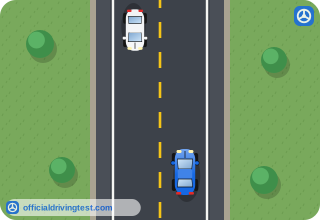
A U-turn should only be made on a street or highway wide enough to allow it from which position?
- From the left-hand lane
- From the right-hand lane
- From the shoulder
- From the far right curb
Show answer
Correct answer: From the left-hand lane
A U-turn should only be made where the street is wide enough to turn from the left-hand lane or just right of the center line or center of the street.
Source: Utah Driver Handbook (2026 edition (new 2026 laws effective May 6, 2026)), page 38 · Open this page in the manual (Manual page 38)
-
Before a U-turn, how do you do the head check?
- Over your right shoulder only, every time
- Over both shoulders before turning
- Over the shoulder in the turn's direction
- In the mirrors only, without turning
Show answer
Correct answer: Over the shoulder in the turn's direction
For a U-turn you signal in the direction of the turn and perform a head check over your shoulder in that direction.
Source: Utah Driver Handbook (2026 edition (new 2026 laws effective May 6, 2026)), page 38 · Open this page in the manual (Manual page 38)
-
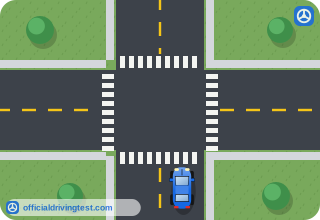
What should you do at all intersections?
- Speed up to clear the intersection before others arrive
- Keep to the left lane until you see cross traffic
- Rely on other drivers to obey signals and signs
- Slow down and search for controls, traffic, and hazards
Show answer
Correct answer: Slow down and search for controls, traffic, and hazards
You slow down and look for controls, traffic, pedestrians and bicyclists, road conditions and view blockers.
Source: Utah Driver Handbook (2026 edition (new 2026 laws effective May 6, 2026)), page 41 · Open this page in the manual (Manual page 41)
-
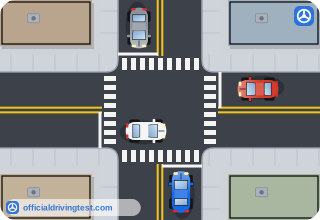
Why should you not rely on other drivers to obey traffic signals and signs?
- Signals often fail at intersections
- They may not yield the right-of-way
- Pedestrians always cross against signals
- Most signals are timed too short to see
Show answer
Correct answer: They may not yield the right-of-way
Other drivers may not yield, so be prepared to avoid a crash.
Source: Utah Driver Handbook (2026 edition (new 2026 laws effective May 6, 2026)), page 41 · Open this page in the manual (Manual page 41)