Utah: Right-of-way, turning and passing — Part 1 Practice Test
Questions in this part include: “When should you check traffic and mirrors?” · “After a turn and reaching the speed of traffic, which lane should you move into when it is safe?”
Independent educational site · not affiliated with any government agency or DMV
Ready? Test yourself
- Instant feedback with an explanation
- Every answer cites its source in the manual
- Your best score is saved on this device
- Keyboard: press 1 to 4 to answer and Enter for the next question
Questions are original and based on the official manual "Utah Driver Handbook" (2026 edition (new 2026 laws effective May 6, 2026)), Utah Department of Public Safety, Driver License Division.
All 19 questions in this practice test
Take the test above first, then use this list to study. Tap “Show answer” to see the correct answer and explanation.
Show the questions and answersHide the questions
-
In the handbook’s definitions, how does a roundabout flow?
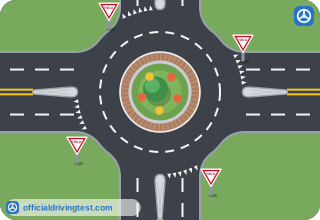
- Counterclockwise
- Clockwise
- Left to right
- Back and forth
Show answer
Correct answer: Counterclockwise
A traffic roundabout is a circular intersection that flows counterclockwise.
Source: Utah Driver Handbook (2026 edition (new 2026 laws effective May 6, 2026)), page 3 · Open this page in the manual (Manual page 3)
-
When turning onto a road with multiple lanes, in which lane must you finish your turn?
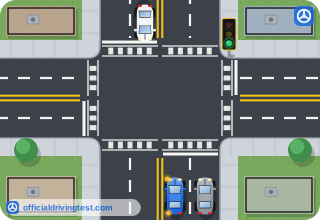
- Any lane, as long as you signal first
- Whichever lane on the new road has the least traffic
- The lane that corresponds to the one you started from
- The far-right lane, whichever lane you started from
Show answer
Correct answer: The lane that corresponds to the one you started from
You must finish the turn in the lane that corresponds to the lane you started from.
Source: Utah Driver Handbook (2026 edition (new 2026 laws effective May 6, 2026)), page 31 · Open this page in the manual (Manual page 31)
-
On multi-lane roads, which lane should you always move to or stay in unless you are passing another vehicle or the lane is blocked?
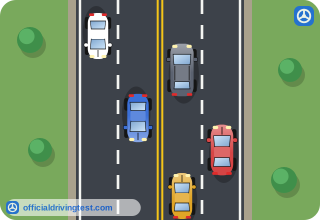
- The far-left lane
- The far-right lane
- The center lane
- The lane with the fastest traffic
Show answer
Correct answer: The far-right lane
On multi-lane roads you should always move to or remain in the far-right lane unless passing or the lane is blocked.
Source: Utah Driver Handbook (2026 edition (new 2026 laws effective May 6, 2026)), page 31 · Open this page in the manual (Manual page 31)
-
When should you change lanes if you are driving through an intersection?
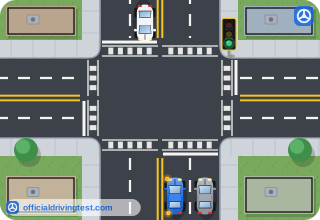
- Only if the lane ahead of you is blocked by another vehicle
- Only when the traffic signal has turned green for your lane
- Only after you slow to under 15 mph inside the intersection
- Never in the intersection; wait until you have completely cleared it
Show answer
Correct answer: Never in the intersection; wait until you have completely cleared it
Never attempt a lane change in an intersection; wait until you have completely cleared it.
Source: Utah Driver Handbook (2026 edition (new 2026 laws effective May 6, 2026)), page 31 · Open this page in the manual (Manual page 31)
-
When you merge into a lane of traffic, whom must you yield the right-of-way to?
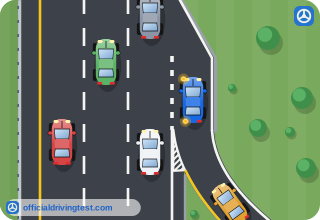
- All vehicles in the continuing lane that are close enough to be an immediate threat
- Only vehicles that are larger than yours and traveling in the continuing lane
- Only vehicles in the continuing traffic lane that are traveling faster than you
- Vehicles in the continuing lane only if they signal that they will change lanes
Show answer
Correct answer: All vehicles in the continuing lane that are close enough to be an immediate threat
You must yield to all vehicles in the continuing lane that are close enough to be an immediate threat.
Source: Utah Driver Handbook (2026 edition (new 2026 laws effective May 6, 2026)), page 31 · Open this page in the manual (Manual page 31)
-
When should you check traffic and mirrors?
- Only before you start a turn or enter an intersection
- Only when you are changing lanes or merging onto a road
- Before, during, and after an intersection, turn, or lane change
- Only after you have finished a turn or a lane change
Show answer
Correct answer: Before, during, and after an intersection, turn, or lane change
Check traffic and mirrors regularly: before, during, and after an intersection, turn, or lane change.
Source: Utah Driver Handbook (2026 edition (new 2026 laws effective May 6, 2026)), page 31 · Open this page in the manual (Manual page 31)
-
If you must stop before turning because of traffic, a signal, or signs, where do you stop?
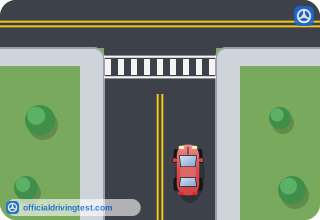
- Just past the stop line, so you can see cross traffic
- Inside the crosswalk, as close to the intersection as possible
- Behind the stop sign, even when a stop line comes before it
- Behind the stop line, crosswalk, or stop sign, whichever comes first
Show answer
Correct answer: Behind the stop line, crosswalk, or stop sign, whichever comes first
You stop smoothly behind the stop line, crosswalk, or stop sign, whichever comes first.
Source: Utah Driver Handbook (2026 edition (new 2026 laws effective May 6, 2026)), page 36 · Open this page in the manual (Manual page 36)
-
While stopped before a turn, what should you do with your front wheels?
- Keep them aimed straight ahead
- Turn them in the direction of your turn
- Turn them slightly toward the curb
- Turn them slightly to the left
Show answer
Correct answer: Keep them aimed straight ahead
When stopped before turning, you keep the front wheels aimed straight ahead.
Source: Utah Driver Handbook (2026 edition (new 2026 laws effective May 6, 2026)), page 36 · Open this page in the manual (Manual page 36)
-
After you complete a turn, what should be true of your turn signal?
- It stays on until you reach the next intersection
- It is switched to the opposite direction
- It stays on until you reach the speed of traffic
- It has been canceled
Show answer
Correct answer: It has been canceled
After turning you make sure you finished in the correct lane and your turn signal has been canceled.
Source: Utah Driver Handbook (2026 edition (new 2026 laws effective May 6, 2026)), page 36 · Open this page in the manual (Manual page 36)
-
After a turn and reaching the speed of traffic, which lane should you move into when it is safe?
- The left-most lane that is open
- The center lane of the road ahead
- The right-most lane, if not already in it
- The lane with the fewest vehicles ahead
Show answer
Correct answer: The right-most lane, if not already in it
After turning you move into the right-most lane when it is safe, if you are not already there.
Source: Utah Driver Handbook (2026 edition (new 2026 laws effective May 6, 2026)), page 36 · Open this page in the manual (Manual page 36)
-
Before a right turn, over which shoulder do you perform a head check?
- Your right shoulder
- Your left shoulder
- Both shoulders
- Neither; use your mirrors only
Show answer
Correct answer: Your right shoulder
For a right turn you signal and perform a head check over your right shoulder.
Source: Utah Driver Handbook (2026 edition (new 2026 laws effective May 6, 2026)), page 37 · Open this page in the manual (Manual page 37)
-
Before a left turn, over which shoulder do you perform a head check?
- Your right shoulder
- Both shoulders
- Your left shoulder
- Neither; use your mirrors only
Show answer
Correct answer: Your left shoulder
For a left turn you signal and perform a head check over your left shoulder.
Source: Utah Driver Handbook (2026 edition (new 2026 laws effective May 6, 2026)), page 37 · Open this page in the manual (Manual page 37)
-
What should you not do when making a turn?
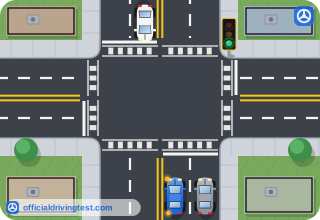
- Maintain a safe speed
- Cut the corner or make a wide turn
- Look for pedestrians and other objects
- Signal for two seconds before turning
Show answer
Correct answer: Cut the corner or make a wide turn
The turn steps say not to cut the corner or make a wide turn.
Source: Utah Driver Handbook (2026 edition (new 2026 laws effective May 6, 2026)), page 37 · Open this page in the manual (Manual page 37)
-
While turning, what should you look for in your traffic check?
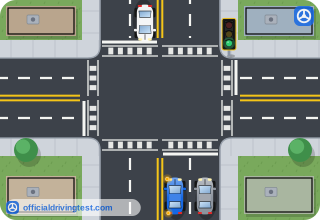
- Only vehicles behind you
- Only oncoming vehicles
- Only traffic signals and signs
- Pedestrians and other objects
Show answer
Correct answer: Pedestrians and other objects
During a turn you do a traffic check looking for pedestrians and other objects.
Source: Utah Driver Handbook (2026 edition (new 2026 laws effective May 6, 2026)), page 37 · Open this page in the manual (Manual page 37)
-
As you complete a right turn, what should you do with your speed?
- Brake firmly until traffic clears
- Accelerate smoothly up to the posted speed
- Hold the turning speed for a full block
- Accelerate quickly to pass slower traffic
Show answer
Correct answer: Accelerate smoothly up to the posted speed
As you complete the turn, you accelerate smoothly up to the posted speed.
Source: Utah Driver Handbook (2026 edition (new 2026 laws effective May 6, 2026)), page 37 · Open this page in the manual (Manual page 37)
-
When turning from a road with multiple lanes, how long must you stay in the lane you chose for the turn?
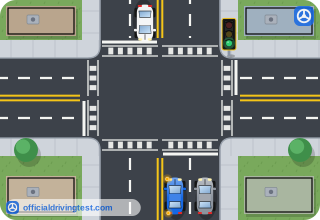
- Until the turn is completed
- Until you reach the middle of the intersection
- Until you see oncoming traffic is clear
- Until you pass the crosswalk
Show answer
Correct answer: Until the turn is completed
You identify and enter the lane from which you will turn and stay in it until the turn is completed.
Source: Utah Driver Handbook (2026 edition (new 2026 laws effective May 6, 2026)), page 37 · Open this page in the manual (Manual page 37)
-
What does the handbook say about driving on an island?
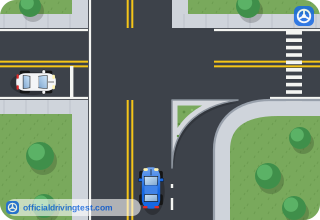
- Driving across it is allowed to avoid a stopped vehicle
- Driving within it is allowed if no pedestrians are present
- Driving over it is allowed only at low speed
- A vehicle may not be operated over, across, or within any part of it
Show answer
Correct answer: A vehicle may not be operated over, across, or within any part of it
A person may not operate a vehicle over, across, or within any part of an island.
Source: Utah Driver Handbook (2026 edition (new 2026 laws effective May 6, 2026)), page 37 · Open this page in the manual (Manual page 37)
-
When can a street alley or driveway be used to turn around?
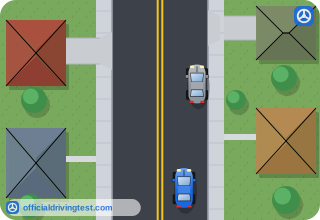
- Whenever you miss a turn on any road
- Only on a one-way street
- When you cannot drive around the block
- Only when a police officer allows it
Show answer
Correct answer: When you cannot drive around the block
A street alley or driveway can be used for a two-point turn when you cannot drive around the block.
Source: Utah Driver Handbook (2026 edition (new 2026 laws effective May 6, 2026)), page 37 · Open this page in the manual (Manual page 37)
-
To begin a forward two-point turn into a driveway or alley, which turn do you signal?
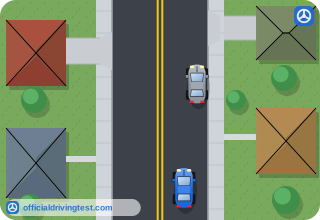
- A left turn
- A right turn
- Emergency flashers instead of a turn signal
- No signal; brake lights are enough
Show answer
Correct answer: A left turn
A forward two-point turn starts by checking for oncoming traffic and signaling a left turn.
Source: Utah Driver Handbook (2026 edition (new 2026 laws effective May 6, 2026)), page 37 · Open this page in the manual (Manual page 37)