Utah: Railroad and light rail crossings — Part 1 Practice Test
Questions in this part include: “At a railroad crossing that has a gate, what must you do?” · “Which statement about crossing gates and barriers at a railroad crossing is correct?”
Independent educational site · not affiliated with any government agency or DMV
Ready? Test yourself
- Instant feedback with an explanation
- Every answer cites its source in the manual
- Your best score is saved on this device
- Keyboard: press 1 to 4 to answer and Enter for the next question
Questions are original and based on the official manual "Utah Driver Handbook" (2026 edition (new 2026 laws effective May 6, 2026)), Utah Department of Public Safety, Driver License Division.
All 23 questions in this practice test
Take the test above first, then use this list to study. Tap “Show answer” to see the correct answer and explanation.
Show the questions and answersHide the questions
-
At a railroad crossing controlled by flashing signals, gates, a watchman, or stop signs, how far from the nearest rail must you stop?
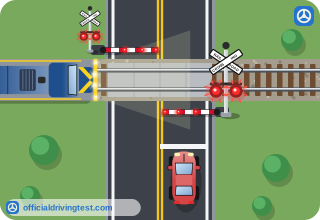
- Between 5 and 10 feet
- More than 50 feet but not more than 100 feet
- More than 15 feet but not more than 50 feet
- Less than 15 feet
Show answer
Correct answer: More than 15 feet but not more than 50 feet
You stop more than 15 feet but not more than 50 feet from the nearest rail until it is safe to continue.
Source: Utah Driver Handbook (2026 edition (new 2026 laws effective May 6, 2026)), page 35 · Open this page in the manual (Manual page 35)
-
At a railroad crossing that has a gate, what must you do?
- Wait for the gate to be raised
- Drive around the gate when no train is visible
- Cross as soon as the train has passed, even if the gate is down
- Cross once the lights stop flashing, whatever the gate position
Show answer
Correct answer: Wait for the gate to be raised
If there is a gate at the crossing, you wait for it to be raised.
Source: Utah Driver Handbook (2026 edition (new 2026 laws effective May 6, 2026)), page 35 · Open this page in the manual (Manual page 35)
-
What does a round yellow warning sign with an "X" and black "RR" caution you to do?
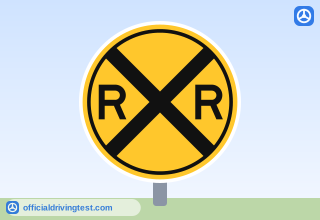
- Slow down, look and listen for a train, and be prepared to stop
- Stop only if you can see a train coming down the tracks
- Speed up to cross before a train arrives
- Yield only to vehicles on the tracks
Show answer
Correct answer: Slow down, look and listen for a train, and be prepared to stop
The round yellow railroad warning sign tells you to slow down, look, and listen for a train or railroad vehicle, ready to stop.
Source: Utah Driver Handbook (2026 edition (new 2026 laws effective May 6, 2026)), page 47 · Open this page in the manual (Manual page 47)
-
When crossing railroad tracks, what does the handbook tell you to do?
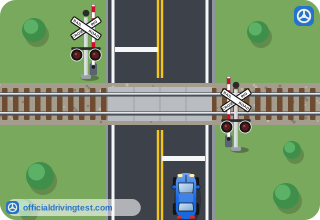
- Shift gears while on the tracks
- Look both ways and cross the tracks quickly
- Stop on the tracks to check for trains
- Pass a slower vehicle as you cross
Show answer
Correct answer: Look both ways and cross the tracks quickly
You should look both ways and cross quickly, and never stop on the tracks.
Source: Utah Driver Handbook (2026 edition (new 2026 laws effective May 6, 2026)), page 47 · Open this page in the manual (Manual page 47)
-
If you must stop for traffic or a signal near a railroad crossing, where do you wait?
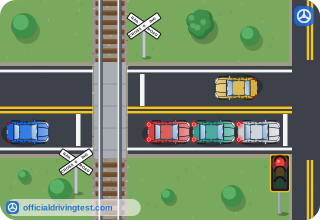
- On the tracks, if there is room
- Just past the tracks
- Beside the tracks, in the next lane
- At the stop line before the tracks
Show answer
Correct answer: At the stop line before the tracks
The handbook says to wait at the stop line before the tracks and never stop on them.
Source: Utah Driver Handbook (2026 edition (new 2026 laws effective May 6, 2026)), page 47 · Open this page in the manual (Manual page 47)
-
If a train is crossing, when may you drive ahead?
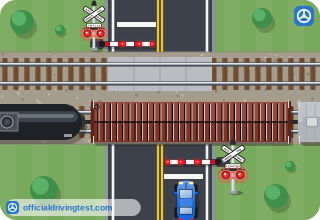
- When the train is well down the track
- As soon as the last car passes you
- As soon as the front of the train has passed
- When the train is slowing down
Show answer
Correct answer: When the train is well down the track
You should wait until the train is well down the track before you drive ahead.
Source: Utah Driver Handbook (2026 edition (new 2026 laws effective May 6, 2026)), page 47 · Open this page in the manual (Manual page 47)
-
At a crossing with lights and gates, when may you proceed after a train has passed?
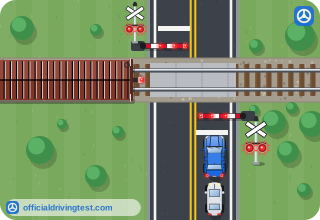
- As soon as the gate arms begin to rise
- Once the lights stop flashing, even if the arms are down
- After the arms have raised, the lights are off, and it is safe
- When no other vehicle is stopped ahead of you
Show answer
Correct answer: After the arms have raised, the lights are off, and it is safe
You must wait until the arms are up and the lights are off, and it is safe to go.
Source: Utah Driver Handbook (2026 edition (new 2026 laws effective May 6, 2026)), page 47 · Open this page in the manual (Manual page 47)
-
When you stop at a railroad crossing, how far from the nearest rail must you be?
- Between 5 and 10 feet
- Between 50 and 100 feet
- Between 100 and 200 feet
- Between 15 and 50 feet
Show answer
Correct answer: Between 15 and 50 feet
Your stopping position must be at least 15 feet but not more than 50 feet from the nearest rail.
Source: Utah Driver Handbook (2026 edition (new 2026 laws effective May 6, 2026)), page 86 · Open this page in the manual (Manual page 86)
-
Which action does the handbook say you should never do at a railroad crossing?
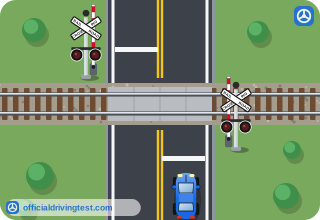
- Slow down on the approach to the tracks
- Turn down the car radio as you approach
- Look before crossing the tracks
- Pass a car that is going your direction
Show answer
Correct answer: Pass a car that is going your direction
Passing another vehicle that is traveling your way at a crossing is something you should never do.
Source: Utah Driver Handbook (2026 edition (new 2026 laws effective May 6, 2026)), page 86 · Open this page in the manual (Manual page 86)
-
Why is turning down the car radio a good safety measure when approaching a railroad crossing?
- Radio signals can interfere with crossing signals
- Trains sound their horns as they approach a crossing
- Crossing gates only lower when the radio is off
- Trains give no warning except flashing lights
Show answer
Correct answer: Trains sound their horns as they approach a crossing
Trains blow their horns on approach, so a quieter car lets you hear them.
Source: Utah Driver Handbook (2026 edition (new 2026 laws effective May 6, 2026)), page 86 · Open this page in the manual (Manual page 86)
-
At night you do not see any train lights near a railroad crossing. What should you assume?
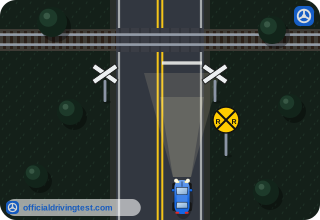
- No train is coming
- Only passenger trains run at night
- A train may still be coming
- The crossing is out of service
Show answer
Correct answer: A train may still be coming
Not seeing lights does not mean the crossing is clear; a train could still be approaching.
Source: Utah Driver Handbook (2026 edition (new 2026 laws effective May 6, 2026)), page 86 · Open this page in the manual (Manual page 86)
-
What must you do if the lights at a railroad crossing are flashing?
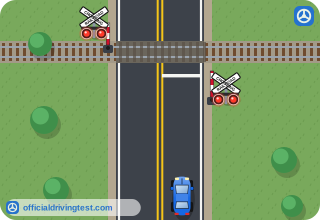
- Stop completely and not proceed while they flash
- Slow down and proceed if no train is visible
- Stop only if you can see a train approaching
- Slow to 15 miles per hour and cross carefully
Show answer
Correct answer: Stop completely and not proceed while they flash
Flashing lights require a complete stop, and you may not go while they are still flashing.
Source: Utah Driver Handbook (2026 edition (new 2026 laws effective May 6, 2026)), page 86 · Open this page in the manual (Manual page 86)
-
After a complete stop, you suspect flashing crossing lights are not working properly. How far down the tracks in both directions must you have a clear line of sight before you may drive through (along with no evidence of an approaching train and being able to cross safely)?
- At least one mile
- At least 500 feet
- At least 1,000 feet
- At least a quarter mile
Show answer
Correct answer: At least one mile
Only after stopping, and only with a clear view of at least one mile both ways, may you drive through lights you suspect are faulty.
Source: Utah Driver Handbook (2026 edition (new 2026 laws effective May 6, 2026)), page 86 · Open this page in the manual (Manual page 86)
-
Which statement about crossing gates and barriers at a railroad crossing is correct?
- You may drive around a lowered gate when no train is in sight
- You may drive around a gate that is in the process of being raised
- You may not go through, around, or under it while it is down or moving
- You may go under a lowered gate if you are walking a bicycle
Show answer
Correct answer: You may not go through, around, or under it while it is down or moving
Driving through, around, or under a gate or barrier is not allowed while it is down or moving.
Source: Utah Driver Handbook (2026 edition (new 2026 laws effective May 6, 2026)), page 86 · Open this page in the manual (Manual page 86)
-
What do advance warning signs tell you when you are approaching a railroad crossing?
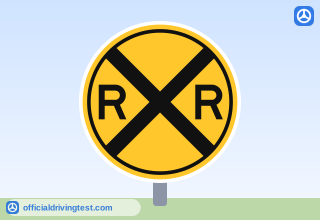
- To stop at the sign and wait for the train to pass completely
- To slow down, look, listen, and be ready to stop at the crossing
- To speed up and cross before a train has time to arrive
- To move into the left lane well before the crossing ahead
Show answer
Correct answer: To slow down, look, listen, and be ready to stop at the crossing
Advance warning signs are placed before the crossing to tell you to slow down, look, listen, and be ready to stop.
Source: Utah Driver Handbook (2026 edition (new 2026 laws effective May 6, 2026)), page 87 · Open this page in the manual (Manual page 87)
-
What do the stop line, X, and RR markings painted in front of a railroad crossing warn you to do?
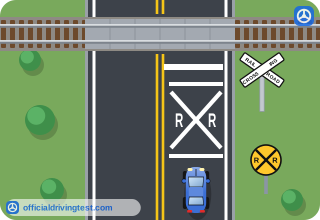
- Yield to all vehicles coming from your right side
- Change lanes before reaching the tracks
- Drive faster to clear the tracks
- Be aware of the crossing and watch for a possible train
Show answer
Correct answer: Be aware of the crossing and watch for a possible train
The markings warn you that a crossing is ahead so you pay close attention to a train that might approach.
Source: Utah Driver Handbook (2026 edition (new 2026 laws effective May 6, 2026)), page 87 · Open this page in the manual (Manual page 87)
-
Where are crossbuck signs found?
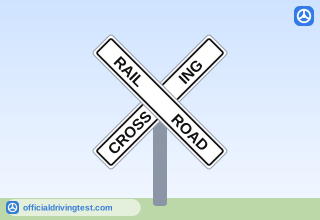
- Only at crossings with gates
- At all public crossings
- Only at crossings with more than one track
- Only on rural roads
Show answer
Correct answer: At all public crossings
Every public railroad crossing has a crossbuck sign.
Source: Utah Driver Handbook (2026 edition (new 2026 laws effective May 6, 2026)), page 87 · Open this page in the manual (Manual page 87)
-
At a crossing with more than one track, what does a sign posted below the crossbuck show?
- The speed of the next train
- The distance to the next crossing
- The number of tracks
- The name of the railroad company
Show answer
Correct answer: The number of tracks
The sign under the crossbuck tells you how many tracks there are.
Source: Utah Driver Handbook (2026 edition (new 2026 laws effective May 6, 2026)), page 87 · Open this page in the manual (Manual page 87)
-
What does it mean when crossing lights begin to flash or bells begin to ring?
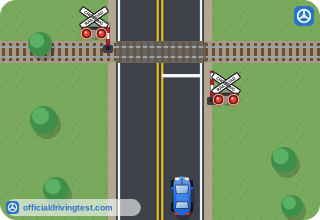
- A train is coming, so you must stop
- A train has just passed and you may go
- The crossing is closed to heavy vehicles only
- You may cross if you can do it before the gates lower
Show answer
Correct answer: A train is coming, so you must stop
Flashing lights or ringing bells mean a train is coming, and you must stop.
Source: Utah Driver Handbook (2026 edition (new 2026 laws effective May 6, 2026)), page 87 · Open this page in the manual (Manual page 87)
-
At a crossing with more than one set of tracks and flashing lights, what must you ensure before crossing?
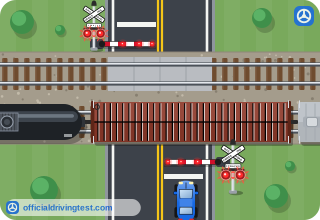
- That only the nearest track is clear
- That only the track with the flashing lights is clear
- That all tracks are clear
- That the farthest track is clear
Show answer
Correct answer: That all tracks are clear
With several sets of tracks, every one must be clear before you cross.
Source: Utah Driver Handbook (2026 edition (new 2026 laws effective May 6, 2026)), page 87 · Open this page in the manual (Manual page 87)
-
At a railroad crossing with gates, when must you stop?
- Only after the gates are fully down across the road
- When lights flash, before the gates lower across your lane
- Only when you can actually see the train approaching
- Only after the bells have started ringing continuously
Show answer
Correct answer: When lights flash, before the gates lower across your lane
You stop as soon as the lights flash, before the gates come down across your lane.
Source: Utah Driver Handbook (2026 edition (new 2026 laws effective May 6, 2026)), page 87 · Open this page in the manual (Manual page 87)
-
At a railroad crossing with gates, how long must you remain stopped?
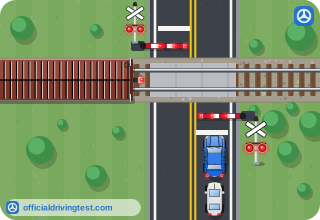
- Until the gates begin to rise above the road
- Until the train has moved completely out of sight
- Until the lights have flashed at least three times
- Until the gates are raised and the lights stop flashing
Show answer
Correct answer: Until the gates are raised and the lights stop flashing
You wait until the gates are up and the lights have stopped flashing, never driving around the gates.
Source: Utah Driver Handbook (2026 edition (new 2026 laws effective May 6, 2026)), page 87 · Open this page in the manual (Manual page 87)
-
What must a school bus driver never do while on a railroad crossing?
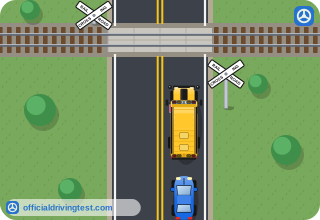
- Check both directions
- Shift gears
- Listen for approaching trains
- Stop before the crossing
Show answer
Correct answer: Shift gears
School bus drivers stop, check both ways, and proceed only when safe, and they never shift gears on the crossing.
Source: Utah Driver Handbook (2026 edition (new 2026 laws effective May 6, 2026)), page 87 · Open this page in the manual (Manual page 87)