Utah: Right-of-way, turning and passing — Part 3 Practice Test
Questions in this part include: “When a light turns green, what should you make sure of before you go?” · “In a four-legged continuous flow intersection, how many legs operate with displaced left turns?”
Independent educational site · not affiliated with any government agency or DMV
Ready? Test yourself
- Instant feedback with an explanation
- Every answer cites its source in the manual
- Your best score is saved on this device
- Keyboard: press 1 to 4 to answer and Enter for the next question
Questions are original and based on the official manual "Utah Driver Handbook" (2026 edition (new 2026 laws effective May 6, 2026)), Utah Department of Public Safety, Driver License Division.
All 19 questions in this practice test
Take the test above first, then use this list to study. Tap “Show answer” to see the correct answer and explanation.
Show the questions and answersHide the questions
-
Before moving after a stop at an intersection, in what order should you look?
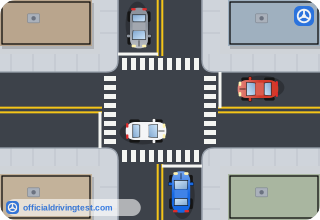
- Left, right, and then left again
- Right, left, and then right again
- Right, then straight ahead, then left
- Straight ahead, then left
Show answer
Correct answer: Left, right, and then left again
You look left, right and then left again before entering the intersection.
Source: Utah Driver Handbook (2026 edition (new 2026 laws effective May 6, 2026)), page 41 · Open this page in the manual (Manual page 41)
-
When a light turns green, what should you make sure of before you go?
- The vehicle behind you has started to move
- Other drivers have seen your turn signal
- Your path is clear and there is no cross traffic
- The driver behind you has seen your signal
Show answer
Correct answer: Your path is clear and there is no cross traffic
You make sure your path of travel is clear and there is no cross traffic.
Source: Utah Driver Handbook (2026 edition (new 2026 laws effective May 6, 2026)), page 41 · Open this page in the manual (Manual page 41)
-
Why should you not turn into a lane just because an oncoming vehicle has its turn signal on?
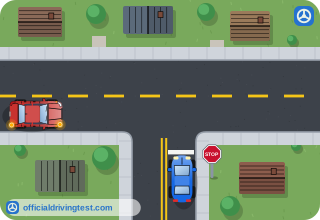
- Oncoming drivers always turn left right away
- The driver may have forgotten to turn the signal off
- The signal means the driver is slowing for pedestrians
- Turn signals only work after dark in Utah
Show answer
Correct answer: The driver may have forgotten to turn the signal off
The driver may plan to turn after passing you, or may have forgotten to turn the signal off.
Source: Utah Driver Handbook (2026 edition (new 2026 laws effective May 6, 2026)), page 42 · Open this page in the manual (Manual page 42)
-
When you stop behind another vehicle at an intersection, what should you be able to see?
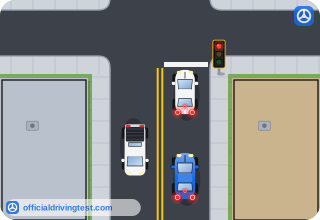
- The license plate of the vehicle ahead
- The traffic signal over that vehicle
- The rear tires of the vehicle ahead
- The crosswalk in front of that vehicle
Show answer
Correct answer: The rear tires of the vehicle ahead
Seeing the rear tires of the vehicle ahead means you have kept a safe gap.
Source: Utah Driver Handbook (2026 edition (new 2026 laws effective May 6, 2026)), page 42 · Open this page in the manual (Manual page 42)
-
When stopping at an intersection, where should you come to a complete stop?
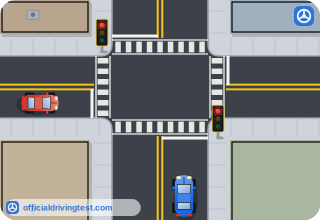
- Behind any stop signs, signals, sidewalks, or stop lines
- Past the stop line, so you can see cross traffic
- In the middle of the crosswalk
- Beside the first car in the cross street
Show answer
Correct answer: Behind any stop signs, signals, sidewalks, or stop lines
You stop completely behind the stop sign, signal, sidewalk or stop line.
Source: Utah Driver Handbook (2026 edition (new 2026 laws effective May 6, 2026)), page 42 · Open this page in the manual (Manual page 42)
-
While driving through an intersection, what should you NOT do?
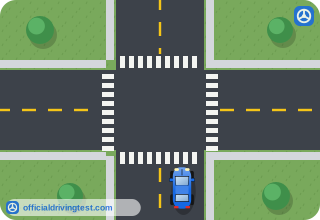
- Slow down
- Keep both hands on the wheel
- Yield to pedestrians in the intersection
- Change lanes
Show answer
Correct answer: Change lanes
The handbook says not to change lanes while proceeding through the intersection.
Source: Utah Driver Handbook (2026 edition (new 2026 laws effective May 6, 2026)), page 42 · Open this page in the manual (Manual page 42)
-
Once through an intersection with multiple lanes, where should you move when it is safe, if you are not already there?
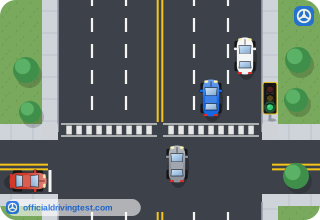
- Into the left-most lane
- Into the right-most lane
- Into the center lane
- Into the lane with the fastest traffic
Show answer
Correct answer: Into the right-most lane
The handbook says to move into the right-most lane when it is safe to do so.
Source: Utah Driver Handbook (2026 edition (new 2026 laws effective May 6, 2026)), page 42 · Open this page in the manual (Manual page 42)
-
Once through an intersection with multiple lanes, to what speed should you accelerate?
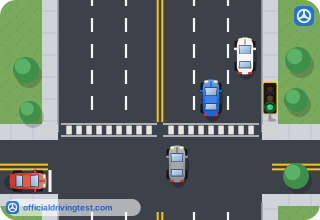
- The speed of traffic
- The posted limit, whatever traffic does
- Five miles per hour over traffic
- Slower than traffic until the next block
Show answer
Correct answer: The speed of traffic
You accelerate smoothly to the speed of traffic.
Source: Utah Driver Handbook (2026 edition (new 2026 laws effective May 6, 2026)), page 42 · Open this page in the manual (Manual page 42)
-
What is looking over your shoulder to check your blind spot called?
- A mirror sweep
- A blind scan
- A head check
- A shoulder signal
Show answer
Correct answer: A head check
The handbook calls looking over your shoulder to check blind spots a head check.
Source: Utah Driver Handbook (2026 edition (new 2026 laws effective May 6, 2026)), page 42 · Open this page in the manual (Manual page 42)
-
At a continuous flow intersection left turn, where is the second signal located?
- Just past the intersection on the right
- On the far left of the intersection
- On the far right of the intersection
- In the center of the intersection
Show answer
Correct answer: On the far left of the intersection
After the first signal you watch the second signal on the far left of the intersection.
Source: Utah Driver Handbook (2026 edition (new 2026 laws effective May 6, 2026)), page 42 · Open this page in the manual (Manual page 42)
-
At a continuous flow intersection left turn, what do you do when the first signal is green?
- Turn left directly into the cross street
- Merge right and wait for traffic
- Stop in the middle of the intersection
- Cross the oncoming lanes of traffic
Show answer
Correct answer: Cross the oncoming lanes of traffic
On the first green you cross the oncoming lanes of traffic, then follow the second signal.
Source: Utah Driver Handbook (2026 edition (new 2026 laws effective May 6, 2026)), page 42 · Open this page in the manual (Manual page 42)
-
In a continuous flow intersection, what is true of right turns on red?
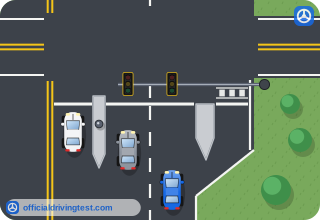
- They are restricted; follow the signs
- They are always allowed after stopping
- They are always prohibited
- They are allowed only at night
Show answer
Correct answer: They are restricted; follow the signs
Free-right turns on red and a traditional right-on-red are restricted there; watch signs to know when right turns are permitted.
Source: Utah Driver Handbook (2026 edition (new 2026 laws effective May 6, 2026)), page 42 · Open this page in the manual (Manual page 42)
-
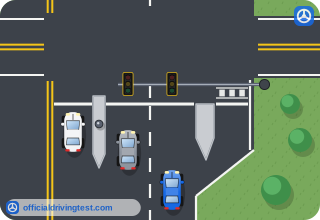
When turning right at a continuous flow intersection, whom should you yield to?
- Only pedestrians in the crosswalk
- Only oncoming traffic and pedestrians
- Only bicyclists and pedestrians
- Traffic, bicyclists, and pedestrians
Show answer
Correct answer: Traffic, bicyclists, and pedestrians
You yield to traffic, bicyclists and pedestrians, then make the turn and merge.
Source: Utah Driver Handbook (2026 edition (new 2026 laws effective May 6, 2026)), page 42 · Open this page in the manual (Manual page 42)
-
In a four-legged continuous flow intersection, how many legs operate with displaced left turns?
- Two
- All four
- One
- Three
Show answer
Correct answer: All four
A four-legged design has displaced left turns on every leg instead of only two.
Source: Utah Driver Handbook (2026 edition (new 2026 laws effective May 6, 2026)), page 42 · Open this page in the manual (Manual page 42)
-
What does a diverging diamond intersection require of traffic on the freeway overpass or underpass?
- To briefly drive on the opposite side of the road
- To merge into a single lane over the bridge
- To stop before the bridge every time
- To make all turns from the right lane only
Show answer
Correct answer: To briefly drive on the opposite side of the road
Traffic briefly drives on the opposite side of the road from what drivers are used to.
Source: Utah Driver Handbook (2026 edition (new 2026 laws effective May 6, 2026)), page 43 · Open this page in the manual (Manual page 43)
-
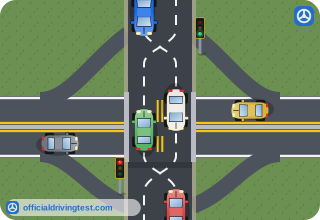
A diverging diamond intersection eliminates many of which conflicts?
- Right-turn conflicts at the ramps
- Merging conflicts on the freeway
- Left-turn conflicts at the ramps
- Pedestrian conflicts at the ramps
Show answer
Correct answer: Left-turn conflicts at the ramps
It eliminates many left-turn conflicts at the ramps and improves efficiency.
Source: Utah Driver Handbook (2026 edition (new 2026 laws effective May 6, 2026)), page 43 · Open this page in the manual (Manual page 43)
-
How do drivers reach a left turn at a Thru-Turn intersection?
- Turn left from a shared lane after a flashing signal
- Go through, make a signalized U-turn, and return to turn right
- Turn right, make a U-turn, and go straight through
- Wait in a center lane until all traffic stops
Show answer
Correct answer: Go through, make a signalized U-turn, and return to turn right
Left turns are eliminated at the intersection: drivers go through, make a signalized U-turn removed from the intersection, and come back to turn right.
Source: Utah Driver Handbook (2026 edition (new 2026 laws effective May 6, 2026)), page 43 · Open this page in the manual (Manual page 43)
-
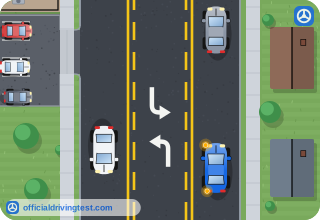
When using a shared center left turn lane, what should you check just before steering into it?
- Your right blind spot
- The traffic signal color
- Your left blind spot
- Your fuel gauge
Show answer
Correct answer: Your left blind spot
You check mirrors and signal left, then check your left blind spot before steering smoothly into the lane.
Source: Utah Driver Handbook (2026 edition (new 2026 laws effective May 6, 2026)), page 44 · Open this page in the manual (Manual page 44)
-
Generally, how far before your turn may you enter a shared left turn lane?
- No more than 500 feet
- No more than 100 feet
- No more than 300 feet
- No more than 1,000 feet
Show answer
Correct answer: No more than 500 feet
You may not enter the lane more than 500 feet before the turn unless the last car is more than 500 feet from the intersection.
Source: Utah Driver Handbook (2026 edition (new 2026 laws effective May 6, 2026)), page 44 · Open this page in the manual (Manual page 44)