Utah: Right-of-way, turning and passing
Who yields at intersections and roundabouts, turns and U-turns, continuous flow and diverging diamond intersections, and passing. Split into 4 shorter tests so you're not stuck in one long quiz.
Independent educational site · not affiliated with any government agency or DMV
Choose a part
Right-of-way, turning and passing — Part 1
Questions in this part include: “When should you check traffic and mirrors?”
StartRight-of-way, turning and passing — Part 2
Questions in this part include: “In a reverse two-point turn, how far past the driveway or alley do you drive before backing in?”
StartRight-of-way, turning and passing — Part 3
Questions in this part include: “When a light turns green, what should you make sure of before you go?”
StartRight-of-way, turning and passing — Part 4
Questions in this part include: “When you reach a roundabout, whom does the handbook say you yield to?”
StartAll 76 Right-of-way, turning and passing questions with answers
Choose a part above to take a practice test, or study every question and answer here.
Show the questions and answersHide the questions
-
In the handbook’s definitions, how does a roundabout flow?
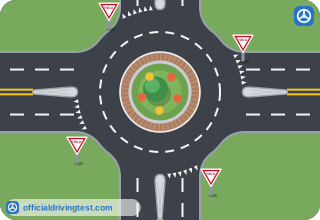
- Counterclockwise
- Clockwise
- Left to right
- Back and forth
Show answer
Correct answer: Counterclockwise
A traffic roundabout is a circular intersection that flows counterclockwise.
Source: Utah Driver Handbook (2026 edition (new 2026 laws effective May 6, 2026)), page 3 · Open this page in the manual (Manual page 3)
-
When turning onto a road with multiple lanes, in which lane must you finish your turn?
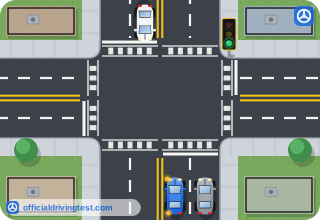
- Any lane, as long as you signal first
- Whichever lane on the new road has the least traffic
- The lane that corresponds to the one you started from
- The far-right lane, whichever lane you started from
Show answer
Correct answer: The lane that corresponds to the one you started from
You must finish the turn in the lane that corresponds to the lane you started from.
Source: Utah Driver Handbook (2026 edition (new 2026 laws effective May 6, 2026)), page 31 · Open this page in the manual (Manual page 31)
-
On multi-lane roads, which lane should you always move to or stay in unless you are passing another vehicle or the lane is blocked?
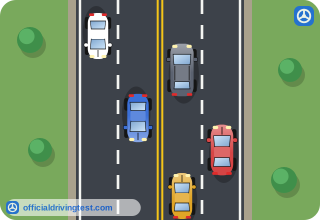
- The far-left lane
- The far-right lane
- The center lane
- The lane with the fastest traffic
Show answer
Correct answer: The far-right lane
On multi-lane roads you should always move to or remain in the far-right lane unless passing or the lane is blocked.
Source: Utah Driver Handbook (2026 edition (new 2026 laws effective May 6, 2026)), page 31 · Open this page in the manual (Manual page 31)
-
When should you change lanes if you are driving through an intersection?
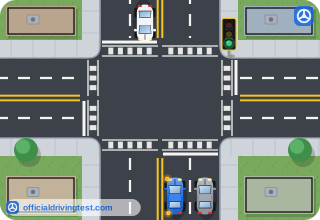
- Only if the lane ahead of you is blocked by another vehicle
- Only when the traffic signal has turned green for your lane
- Only after you slow to under 15 mph inside the intersection
- Never in the intersection; wait until you have completely cleared it
Show answer
Correct answer: Never in the intersection; wait until you have completely cleared it
Never attempt a lane change in an intersection; wait until you have completely cleared it.
Source: Utah Driver Handbook (2026 edition (new 2026 laws effective May 6, 2026)), page 31 · Open this page in the manual (Manual page 31)
-
When you merge into a lane of traffic, whom must you yield the right-of-way to?
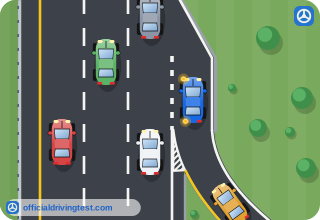
- All vehicles in the continuing lane that are close enough to be an immediate threat
- Only vehicles that are larger than yours and traveling in the continuing lane
- Only vehicles in the continuing traffic lane that are traveling faster than you
- Vehicles in the continuing lane only if they signal that they will change lanes
Show answer
Correct answer: All vehicles in the continuing lane that are close enough to be an immediate threat
You must yield to all vehicles in the continuing lane that are close enough to be an immediate threat.
Source: Utah Driver Handbook (2026 edition (new 2026 laws effective May 6, 2026)), page 31 · Open this page in the manual (Manual page 31)
-
When should you check traffic and mirrors?
- Only before you start a turn or enter an intersection
- Only when you are changing lanes or merging onto a road
- Before, during, and after an intersection, turn, or lane change
- Only after you have finished a turn or a lane change
Show answer
Correct answer: Before, during, and after an intersection, turn, or lane change
Check traffic and mirrors regularly: before, during, and after an intersection, turn, or lane change.
Source: Utah Driver Handbook (2026 edition (new 2026 laws effective May 6, 2026)), page 31 · Open this page in the manual (Manual page 31)
-
If you must stop before turning because of traffic, a signal, or signs, where do you stop?
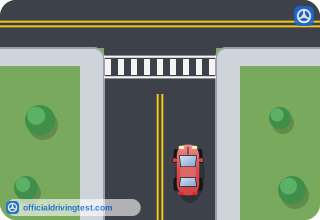
- Just past the stop line, so you can see cross traffic
- Inside the crosswalk, as close to the intersection as possible
- Behind the stop sign, even when a stop line comes before it
- Behind the stop line, crosswalk, or stop sign, whichever comes first
Show answer
Correct answer: Behind the stop line, crosswalk, or stop sign, whichever comes first
You stop smoothly behind the stop line, crosswalk, or stop sign, whichever comes first.
Source: Utah Driver Handbook (2026 edition (new 2026 laws effective May 6, 2026)), page 36 · Open this page in the manual (Manual page 36)
-
While stopped before a turn, what should you do with your front wheels?
- Keep them aimed straight ahead
- Turn them in the direction of your turn
- Turn them slightly toward the curb
- Turn them slightly to the left
Show answer
Correct answer: Keep them aimed straight ahead
When stopped before turning, you keep the front wheels aimed straight ahead.
Source: Utah Driver Handbook (2026 edition (new 2026 laws effective May 6, 2026)), page 36 · Open this page in the manual (Manual page 36)
-
After you complete a turn, what should be true of your turn signal?
- It stays on until you reach the next intersection
- It is switched to the opposite direction
- It stays on until you reach the speed of traffic
- It has been canceled
Show answer
Correct answer: It has been canceled
After turning you make sure you finished in the correct lane and your turn signal has been canceled.
Source: Utah Driver Handbook (2026 edition (new 2026 laws effective May 6, 2026)), page 36 · Open this page in the manual (Manual page 36)
-
After a turn and reaching the speed of traffic, which lane should you move into when it is safe?
- The left-most lane that is open
- The center lane of the road ahead
- The right-most lane, if not already in it
- The lane with the fewest vehicles ahead
Show answer
Correct answer: The right-most lane, if not already in it
After turning you move into the right-most lane when it is safe, if you are not already there.
Source: Utah Driver Handbook (2026 edition (new 2026 laws effective May 6, 2026)), page 36 · Open this page in the manual (Manual page 36)
-
Before a right turn, over which shoulder do you perform a head check?
- Your right shoulder
- Your left shoulder
- Both shoulders
- Neither; use your mirrors only
Show answer
Correct answer: Your right shoulder
For a right turn you signal and perform a head check over your right shoulder.
Source: Utah Driver Handbook (2026 edition (new 2026 laws effective May 6, 2026)), page 37 · Open this page in the manual (Manual page 37)
-
Before a left turn, over which shoulder do you perform a head check?
- Your right shoulder
- Both shoulders
- Your left shoulder
- Neither; use your mirrors only
Show answer
Correct answer: Your left shoulder
For a left turn you signal and perform a head check over your left shoulder.
Source: Utah Driver Handbook (2026 edition (new 2026 laws effective May 6, 2026)), page 37 · Open this page in the manual (Manual page 37)
-
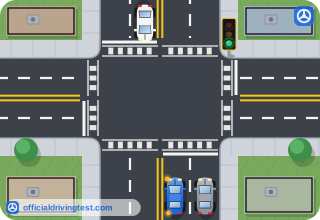
What should you not do when making a turn?
- Maintain a safe speed
- Cut the corner or make a wide turn
- Look for pedestrians and other objects
- Signal for two seconds before turning
Show answer
Correct answer: Cut the corner or make a wide turn
The turn steps say not to cut the corner or make a wide turn.
Source: Utah Driver Handbook (2026 edition (new 2026 laws effective May 6, 2026)), page 37 · Open this page in the manual (Manual page 37)
-
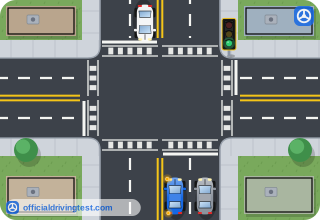
While turning, what should you look for in your traffic check?
- Only vehicles behind you
- Only oncoming vehicles
- Only traffic signals and signs
- Pedestrians and other objects
Show answer
Correct answer: Pedestrians and other objects
During a turn you do a traffic check looking for pedestrians and other objects.
Source: Utah Driver Handbook (2026 edition (new 2026 laws effective May 6, 2026)), page 37 · Open this page in the manual (Manual page 37)
-
As you complete a right turn, what should you do with your speed?
- Brake firmly until traffic clears
- Accelerate smoothly up to the posted speed
- Hold the turning speed for a full block
- Accelerate quickly to pass slower traffic
Show answer
Correct answer: Accelerate smoothly up to the posted speed
As you complete the turn, you accelerate smoothly up to the posted speed.
Source: Utah Driver Handbook (2026 edition (new 2026 laws effective May 6, 2026)), page 37 · Open this page in the manual (Manual page 37)
-
When turning from a road with multiple lanes, how long must you stay in the lane you chose for the turn?
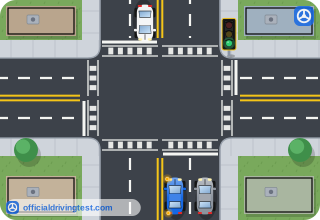
- Until the turn is completed
- Until you reach the middle of the intersection
- Until you see oncoming traffic is clear
- Until you pass the crosswalk
Show answer
Correct answer: Until the turn is completed
You identify and enter the lane from which you will turn and stay in it until the turn is completed.
Source: Utah Driver Handbook (2026 edition (new 2026 laws effective May 6, 2026)), page 37 · Open this page in the manual (Manual page 37)
-
What does the handbook say about driving on an island?
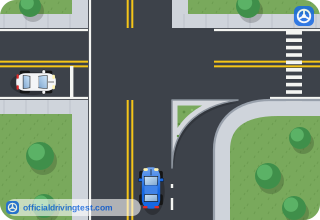
- Driving across it is allowed to avoid a stopped vehicle
- Driving within it is allowed if no pedestrians are present
- Driving over it is allowed only at low speed
- A vehicle may not be operated over, across, or within any part of it
Show answer
Correct answer: A vehicle may not be operated over, across, or within any part of it
A person may not operate a vehicle over, across, or within any part of an island.
Source: Utah Driver Handbook (2026 edition (new 2026 laws effective May 6, 2026)), page 37 · Open this page in the manual (Manual page 37)
-
When can a street alley or driveway be used to turn around?
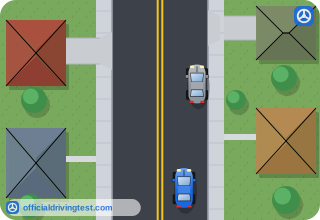
- Whenever you miss a turn on any road
- Only on a one-way street
- When you cannot drive around the block
- Only when a police officer allows it
Show answer
Correct answer: When you cannot drive around the block
A street alley or driveway can be used for a two-point turn when you cannot drive around the block.
Source: Utah Driver Handbook (2026 edition (new 2026 laws effective May 6, 2026)), page 37 · Open this page in the manual (Manual page 37)
-
To begin a forward two-point turn into a driveway or alley, which turn do you signal?
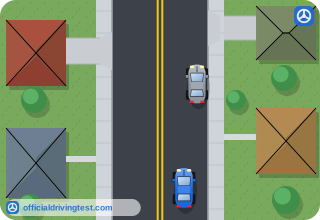
- A left turn
- A right turn
- Emergency flashers instead of a turn signal
- No signal; brake lights are enough
Show answer
Correct answer: A left turn
A forward two-point turn starts by checking for oncoming traffic and signaling a left turn.
Source: Utah Driver Handbook (2026 edition (new 2026 laws effective May 6, 2026)), page 37 · Open this page in the manual (Manual page 37)
-
In a forward two-point turn, where do you position the car in the driveway or alley?
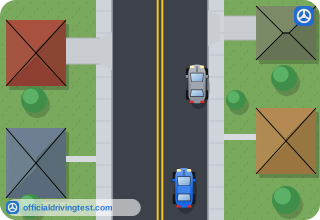
- Centered in the driveway
- As near as possible to the left side of the drive
- As near as possible to the right side of the drive
- Straddling both sides of the drive
Show answer
Correct answer: As near as possible to the right side of the drive
You turn as near as possible to the right side of the drive.
Source: Utah Driver Handbook (2026 edition (new 2026 laws effective May 6, 2026)), page 37 · Open this page in the manual (Manual page 37)
-
In a forward two-point turn, when do you stop after turning into the driveway?
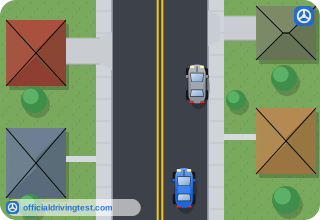
- When the front bumper reaches the end of the driveway
- As the vehicle's rear clears the curb or edge of the driveway
- When the whole vehicle is inside the driveway
- When the front wheels touch the curb
Show answer
Correct answer: As the vehicle's rear clears the curb or edge of the driveway
You stop as the rear of the vehicle clears the curb or edge of the driveway, then shift to reverse.
Source: Utah Driver Handbook (2026 edition (new 2026 laws effective May 6, 2026)), page 37 · Open this page in the manual (Manual page 37)
-
In a forward two-point turn, how do you turn the steering wheel when backing out of the driveway?
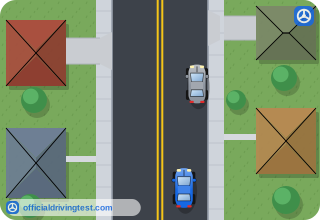
- Quickly to the left
- Gently to the right
- Gently to the left
- Quickly to the right
Show answer
Correct answer: Quickly to the right
When the path is clear you back up while turning the steering wheel quickly to the right.
Source: Utah Driver Handbook (2026 edition (new 2026 laws effective May 6, 2026)), page 37 · Open this page in the manual (Manual page 37)
-
To begin a reverse two-point turn into a driveway or alley, which turn do you signal?
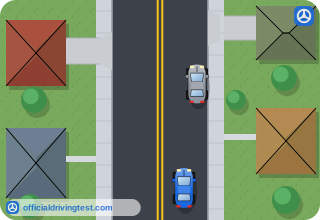
- A left turn
- A right turn
- Emergency flashers instead of a turn signal
- No signal; brake lights are enough
Show answer
Correct answer: A right turn
A reverse two-point turn starts by checking behind you and signaling a right turn.
Source: Utah Driver Handbook (2026 edition (new 2026 laws effective May 6, 2026)), page 37 · Open this page in the manual (Manual page 37)
-
In a reverse two-point turn, how far past the driveway or alley do you drive before backing in?
- One car length
- Two car lengths
- Half a car length
- Three car lengths
Show answer
Correct answer: One car length
You drive one car length past the driveway or alley before backing into it.
Source: Utah Driver Handbook (2026 edition (new 2026 laws effective May 6, 2026)), page 37 · Open this page in the manual (Manual page 37)
-
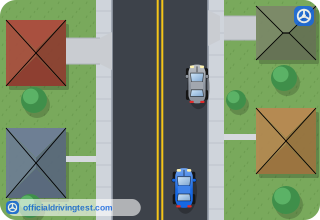
In a reverse two-point turn, what do you do before backing into the driveway?
- Put your left arm on the door and look back over your left shoulder
- Keep both hands at the top of the wheel and watch only the mirrors
- Keep both hands on the wheel and use only the rearview mirror
- Put your right arm on the seat and look back over your right shoulder
Show answer
Correct answer: Put your right arm on the seat and look back over your right shoulder
Before backing into the driveway you put your right arm on the seat and look back over your right shoulder.
Source: Utah Driver Handbook (2026 edition (new 2026 laws effective May 6, 2026)), page 37 · Open this page in the manual (Manual page 37)
-
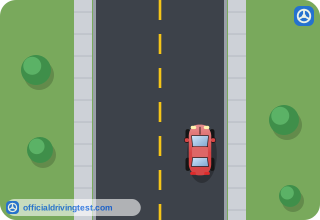
When should a three-point turn be used?
- Whenever a U-turn would save time
- Only on a freeway when you miss an exit
- Only if the road is too narrow for a U-turn
- Only on roads with four or more lanes
Show answer
Correct answer: Only if the road is too narrow for a U-turn
A three-point turn is only for when the road is too narrow for a U-turn.
Source: Utah Driver Handbook (2026 edition (new 2026 laws effective May 6, 2026)), page 38 · Open this page in the manual (Manual page 38)
-
On what kind of road should a three-point turn only be used?
- A two-lane road
- A divided highway
- A four-lane road
- A freeway ramp
Show answer
Correct answer: A two-lane road
The handbook says a three-point turn should only be used on a two-lane road.
Source: Utah Driver Handbook (2026 edition (new 2026 laws effective May 6, 2026)), page 38 · Open this page in the manual (Manual page 38)
-
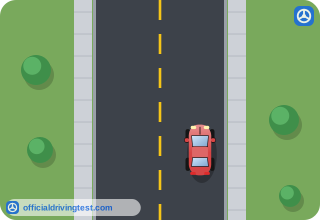
In a three-point turn, where do you stop after signaling a right turn?
- In the center of the road
- On the left side of the road
- On the right side of the road
- Past the center line in the oncoming lane
Show answer
Correct answer: On the right side of the road
After checking and signaling a right turn, you stop on the right side of the road.
Source: Utah Driver Handbook (2026 edition (new 2026 laws effective May 6, 2026)), page 38 · Open this page in the manual (Manual page 38)
-
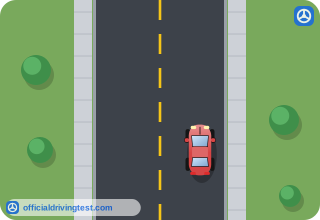
In a three-point turn, which head checks do you do after shifting to reverse?
- Over your left shoulder only
- Over both shoulders
- Over your right shoulder only
- None; use your mirrors only
Show answer
Correct answer: Over both shoulders
After shifting to reverse you check traffic and head check over both shoulders.
Source: Utah Driver Handbook (2026 edition (new 2026 laws effective May 6, 2026)), page 38 · Open this page in the manual (Manual page 38)
-
In a three-point turn, which way do you steer when you back up?
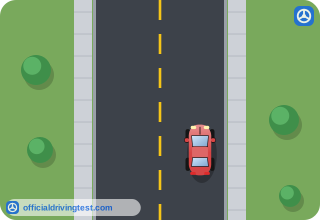
- Hard left
- Straight back
- Slightly left
- Hard right
Show answer
Correct answer: Hard right
To back up in a three-point turn you turn hard right once traffic is clear.
Source: Utah Driver Handbook (2026 edition (new 2026 laws effective May 6, 2026)), page 38 · Open this page in the manual (Manual page 38)
-
Never make a U-turn on a curve near the top of a hill where you cannot see or be seen from both directions for how far?
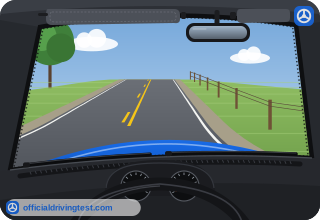
- 200 feet
- 500 feet
- 300 feet
- 1000 feet
Show answer
Correct answer: 500 feet
A U-turn is never allowed on a curve near a hilltop where you cannot see or be seen from both directions for 500 feet.
Source: Utah Driver Handbook (2026 edition (new 2026 laws effective May 6, 2026)), page 38 · Open this page in the manual (Manual page 38)
-
Where must you never make a U-turn?
- On a railroad grade crossing
- From the left-hand lane of a street that is wide enough
- Just right of the center line of a street that is wide enough
- From the center of a street that is wide enough
Show answer
Correct answer: On a railroad grade crossing
The handbook says never to make a U-turn on a railroad track or railroad grade crossing.
Source: Utah Driver Handbook (2026 edition (new 2026 laws effective May 6, 2026)), page 38 · Open this page in the manual (Manual page 38)
-
Where does the handbook say you must never make a U-turn?
- On a street wide enough, from the left-hand lane
- On a street wide enough, just right of the center line
- On a street wide enough, from the center of the street
- On a freeway
Show answer
Correct answer: On a freeway
A U-turn must never be made on a freeway.
Source: Utah Driver Handbook (2026 edition (new 2026 laws effective May 6, 2026)), page 38 · Open this page in the manual (Manual page 38)
-
What should you know about U-turn laws?
- Only the state law, since it applies everywhere
- The law of the city where your license was issued
- The specific law of the city in which you are driving
- That a police officer must approve each U-turn
Show answer
Correct answer: The specific law of the city in which you are driving
Each city has its own U-turn laws, so you must know the law of the city where you are driving.
Source: Utah Driver Handbook (2026 edition (new 2026 laws effective May 6, 2026)), page 38 · Open this page in the manual (Manual page 38)
-
A U-turn should only be made on a street or highway wide enough to allow it from which position?
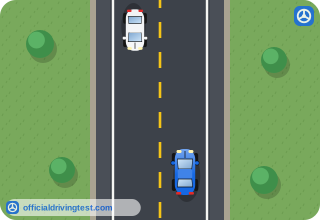
- From the left-hand lane
- From the right-hand lane
- From the shoulder
- From the far right curb
Show answer
Correct answer: From the left-hand lane
A U-turn should only be made where the street is wide enough to turn from the left-hand lane or just right of the center line or center of the street.
Source: Utah Driver Handbook (2026 edition (new 2026 laws effective May 6, 2026)), page 38 · Open this page in the manual (Manual page 38)
-
Before a U-turn, how do you do the head check?
- Over your right shoulder only, every time
- Over both shoulders before turning
- Over the shoulder in the turn's direction
- In the mirrors only, without turning
Show answer
Correct answer: Over the shoulder in the turn's direction
For a U-turn you signal in the direction of the turn and perform a head check over your shoulder in that direction.
Source: Utah Driver Handbook (2026 edition (new 2026 laws effective May 6, 2026)), page 38 · Open this page in the manual (Manual page 38)
-
What should you do at all intersections?
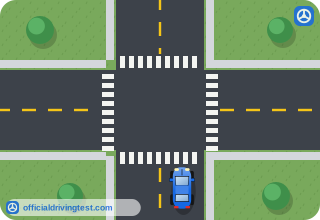
- Speed up to clear the intersection before others arrive
- Keep to the left lane until you see cross traffic
- Rely on other drivers to obey signals and signs
- Slow down and search for controls, traffic, and hazards
Show answer
Correct answer: Slow down and search for controls, traffic, and hazards
You slow down and look for controls, traffic, pedestrians and bicyclists, road conditions and view blockers.
Source: Utah Driver Handbook (2026 edition (new 2026 laws effective May 6, 2026)), page 41 · Open this page in the manual (Manual page 41)
-
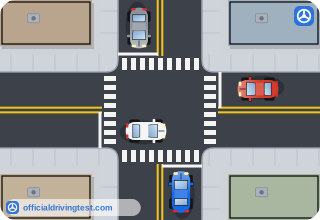
Why should you not rely on other drivers to obey traffic signals and signs?
- Signals often fail at intersections
- They may not yield the right-of-way
- Pedestrians always cross against signals
- Most signals are timed too short to see
Show answer
Correct answer: They may not yield the right-of-way
Other drivers may not yield, so be prepared to avoid a crash.
Source: Utah Driver Handbook (2026 edition (new 2026 laws effective May 6, 2026)), page 41 · Open this page in the manual (Manual page 41)
-
Before moving after a stop at an intersection, in what order should you look?
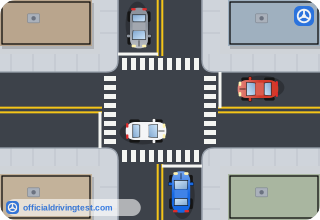
- Left, right, and then left again
- Right, left, and then right again
- Right, then straight ahead, then left
- Straight ahead, then left
Show answer
Correct answer: Left, right, and then left again
You look left, right and then left again before entering the intersection.
Source: Utah Driver Handbook (2026 edition (new 2026 laws effective May 6, 2026)), page 41 · Open this page in the manual (Manual page 41)
-
When a light turns green, what should you make sure of before you go?
- The vehicle behind you has started to move
- Other drivers have seen your turn signal
- Your path is clear and there is no cross traffic
- The driver behind you has seen your signal
Show answer
Correct answer: Your path is clear and there is no cross traffic
You make sure your path of travel is clear and there is no cross traffic.
Source: Utah Driver Handbook (2026 edition (new 2026 laws effective May 6, 2026)), page 41 · Open this page in the manual (Manual page 41)
-
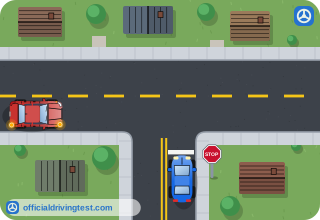
Why should you not turn into a lane just because an oncoming vehicle has its turn signal on?
- Oncoming drivers always turn left right away
- The driver may have forgotten to turn the signal off
- The signal means the driver is slowing for pedestrians
- Turn signals only work after dark in Utah
Show answer
Correct answer: The driver may have forgotten to turn the signal off
The driver may plan to turn after passing you, or may have forgotten to turn the signal off.
Source: Utah Driver Handbook (2026 edition (new 2026 laws effective May 6, 2026)), page 42 · Open this page in the manual (Manual page 42)
-
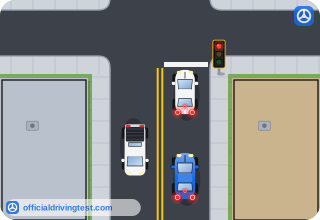
When you stop behind another vehicle at an intersection, what should you be able to see?
- The license plate of the vehicle ahead
- The traffic signal over that vehicle
- The rear tires of the vehicle ahead
- The crosswalk in front of that vehicle
Show answer
Correct answer: The rear tires of the vehicle ahead
Seeing the rear tires of the vehicle ahead means you have kept a safe gap.
Source: Utah Driver Handbook (2026 edition (new 2026 laws effective May 6, 2026)), page 42 · Open this page in the manual (Manual page 42)
-
When stopping at an intersection, where should you come to a complete stop?
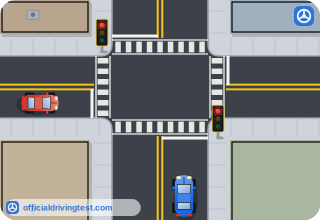
- Behind any stop signs, signals, sidewalks, or stop lines
- Past the stop line, so you can see cross traffic
- In the middle of the crosswalk
- Beside the first car in the cross street
Show answer
Correct answer: Behind any stop signs, signals, sidewalks, or stop lines
You stop completely behind the stop sign, signal, sidewalk or stop line.
Source: Utah Driver Handbook (2026 edition (new 2026 laws effective May 6, 2026)), page 42 · Open this page in the manual (Manual page 42)
-
While driving through an intersection, what should you NOT do?
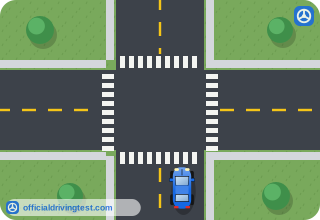
- Slow down
- Keep both hands on the wheel
- Yield to pedestrians in the intersection
- Change lanes
Show answer
Correct answer: Change lanes
The handbook says not to change lanes while proceeding through the intersection.
Source: Utah Driver Handbook (2026 edition (new 2026 laws effective May 6, 2026)), page 42 · Open this page in the manual (Manual page 42)
-
Once through an intersection with multiple lanes, where should you move when it is safe, if you are not already there?
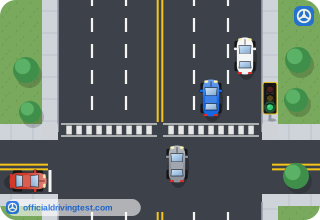
- Into the left-most lane
- Into the right-most lane
- Into the center lane
- Into the lane with the fastest traffic
Show answer
Correct answer: Into the right-most lane
The handbook says to move into the right-most lane when it is safe to do so.
Source: Utah Driver Handbook (2026 edition (new 2026 laws effective May 6, 2026)), page 42 · Open this page in the manual (Manual page 42)
-
Once through an intersection with multiple lanes, to what speed should you accelerate?
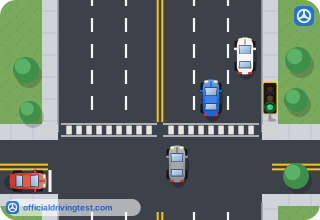
- The speed of traffic
- The posted limit, whatever traffic does
- Five miles per hour over traffic
- Slower than traffic until the next block
Show answer
Correct answer: The speed of traffic
You accelerate smoothly to the speed of traffic.
Source: Utah Driver Handbook (2026 edition (new 2026 laws effective May 6, 2026)), page 42 · Open this page in the manual (Manual page 42)
-
What is looking over your shoulder to check your blind spot called?
- A mirror sweep
- A blind scan
- A head check
- A shoulder signal
Show answer
Correct answer: A head check
The handbook calls looking over your shoulder to check blind spots a head check.
Source: Utah Driver Handbook (2026 edition (new 2026 laws effective May 6, 2026)), page 42 · Open this page in the manual (Manual page 42)
-
At a continuous flow intersection left turn, where is the second signal located?
- Just past the intersection on the right
- On the far left of the intersection
- On the far right of the intersection
- In the center of the intersection
Show answer
Correct answer: On the far left of the intersection
After the first signal you watch the second signal on the far left of the intersection.
Source: Utah Driver Handbook (2026 edition (new 2026 laws effective May 6, 2026)), page 42 · Open this page in the manual (Manual page 42)
-
At a continuous flow intersection left turn, what do you do when the first signal is green?
- Turn left directly into the cross street
- Merge right and wait for traffic
- Stop in the middle of the intersection
- Cross the oncoming lanes of traffic
Show answer
Correct answer: Cross the oncoming lanes of traffic
On the first green you cross the oncoming lanes of traffic, then follow the second signal.
Source: Utah Driver Handbook (2026 edition (new 2026 laws effective May 6, 2026)), page 42 · Open this page in the manual (Manual page 42)
-
In a continuous flow intersection, what is true of right turns on red?
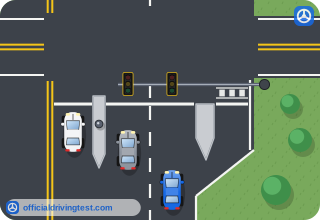
- They are restricted; follow the signs
- They are always allowed after stopping
- They are always prohibited
- They are allowed only at night
Show answer
Correct answer: They are restricted; follow the signs
Free-right turns on red and a traditional right-on-red are restricted there; watch signs to know when right turns are permitted.
Source: Utah Driver Handbook (2026 edition (new 2026 laws effective May 6, 2026)), page 42 · Open this page in the manual (Manual page 42)
-
When turning right at a continuous flow intersection, whom should you yield to?
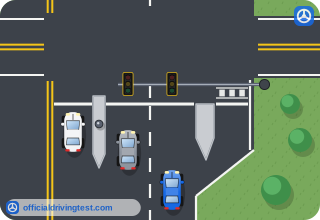
- Only pedestrians in the crosswalk
- Only oncoming traffic and pedestrians
- Only bicyclists and pedestrians
- Traffic, bicyclists, and pedestrians
Show answer
Correct answer: Traffic, bicyclists, and pedestrians
You yield to traffic, bicyclists and pedestrians, then make the turn and merge.
Source: Utah Driver Handbook (2026 edition (new 2026 laws effective May 6, 2026)), page 42 · Open this page in the manual (Manual page 42)
-
In a four-legged continuous flow intersection, how many legs operate with displaced left turns?
- Two
- All four
- One
- Three
Show answer
Correct answer: All four
A four-legged design has displaced left turns on every leg instead of only two.
Source: Utah Driver Handbook (2026 edition (new 2026 laws effective May 6, 2026)), page 42 · Open this page in the manual (Manual page 42)
-
What does a diverging diamond intersection require of traffic on the freeway overpass or underpass?
- To briefly drive on the opposite side of the road
- To merge into a single lane over the bridge
- To stop before the bridge every time
- To make all turns from the right lane only
Show answer
Correct answer: To briefly drive on the opposite side of the road
Traffic briefly drives on the opposite side of the road from what drivers are used to.
Source: Utah Driver Handbook (2026 edition (new 2026 laws effective May 6, 2026)), page 43 · Open this page in the manual (Manual page 43)
-
A diverging diamond intersection eliminates many of which conflicts?
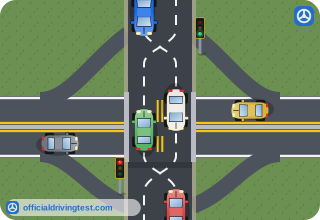
- Right-turn conflicts at the ramps
- Merging conflicts on the freeway
- Left-turn conflicts at the ramps
- Pedestrian conflicts at the ramps
Show answer
Correct answer: Left-turn conflicts at the ramps
It eliminates many left-turn conflicts at the ramps and improves efficiency.
Source: Utah Driver Handbook (2026 edition (new 2026 laws effective May 6, 2026)), page 43 · Open this page in the manual (Manual page 43)
-
How do drivers reach a left turn at a Thru-Turn intersection?
- Turn left from a shared lane after a flashing signal
- Go through, make a signalized U-turn, and return to turn right
- Turn right, make a U-turn, and go straight through
- Wait in a center lane until all traffic stops
Show answer
Correct answer: Go through, make a signalized U-turn, and return to turn right
Left turns are eliminated at the intersection: drivers go through, make a signalized U-turn removed from the intersection, and come back to turn right.
Source: Utah Driver Handbook (2026 edition (new 2026 laws effective May 6, 2026)), page 43 · Open this page in the manual (Manual page 43)
-
When using a shared center left turn lane, what should you check just before steering into it?
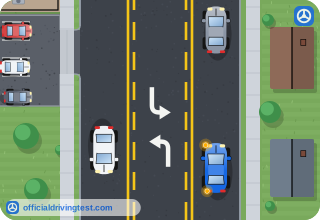
- Your right blind spot
- The traffic signal color
- Your left blind spot
- Your fuel gauge
Show answer
Correct answer: Your left blind spot
You check mirrors and signal left, then check your left blind spot before steering smoothly into the lane.
Source: Utah Driver Handbook (2026 edition (new 2026 laws effective May 6, 2026)), page 44 · Open this page in the manual (Manual page 44)
-
Generally, how far before your turn may you enter a shared left turn lane?
- No more than 500 feet
- No more than 100 feet
- No more than 300 feet
- No more than 1,000 feet
Show answer
Correct answer: No more than 500 feet
You may not enter the lane more than 500 feet before the turn unless the last car is more than 500 feet from the intersection.
Source: Utah Driver Handbook (2026 edition (new 2026 laws effective May 6, 2026)), page 44 · Open this page in the manual (Manual page 44)
-
What is the first thing the handbook tells you to do as you approach a roundabout?
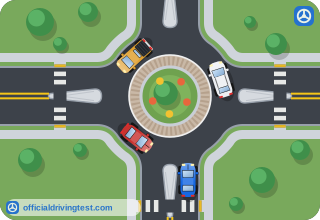
- Slow down
- Stop completely at the entrance
- Speed up to merge with traffic
- Switch to the left lane
Show answer
Correct answer: Slow down
The handbook starts its roundabout steps with slowing down as you approach.
Source: Utah Driver Handbook (2026 edition (new 2026 laws effective May 6, 2026)), page 45 · Open this page in the manual (Manual page 45)
-
When you reach a roundabout, whom does the handbook say you yield to?
- Only vehicles larger than yours
- No one, because vehicles entering have the right-of-way
- Oncoming traffic
- Only vehicles that are behind you
Show answer
Correct answer: Oncoming traffic
The second roundabout step is to yield to oncoming traffic and enter when it is clear.
Source: Utah Driver Handbook (2026 edition (new 2026 laws effective May 6, 2026)), page 45 · Open this page in the manual (Manual page 45)
-
After you have yielded and the way is clear, what is the last roundabout step the handbook gives?
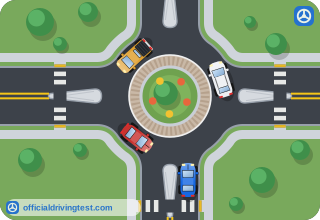
- Stop in the center island before leaving
- Go through the roundabout and exit at the street you want
- Leave at the first exit you reach
- Wait for a signal from a peace officer before exiting
Show answer
Correct answer: Go through the roundabout and exit at the street you want
The handbook ends the roundabout steps by proceeding through and exiting at the desired street.
Source: Utah Driver Handbook (2026 edition (new 2026 laws effective May 6, 2026)), page 45 · Open this page in the manual (Manual page 45)
-
What does the handbook say about thinking you have the right-of-way?
- Assume you have it whenever you arrive at the intersection first
- Assume you have it when you drive on a main road
- Assume you have it when your signal is on
- Never think you have it; look at the situation and think about safety
Show answer
Correct answer: Never think you have it; look at the situation and think about safety
The handbook says never to assume you have the right-of-way and to think about safety in each situation.
Source: Utah Driver Handbook (2026 edition (new 2026 laws effective May 6, 2026)), page 50 · Open this page in the manual (Manual page 50)
-
Who must you yield the right-of-way to at an intersection?
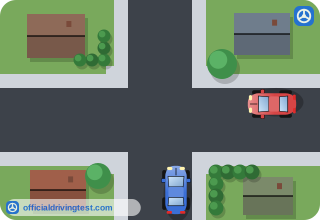
- A driver who is at the intersection before you
- A driver who is in a larger vehicle
- A driver who arrives after you but is going straight
- A driver who is traveling faster
Show answer
Correct answer: A driver who is at the intersection before you
The handbook lists a driver who is at the intersection before you as someone you yield to.
Source: Utah Driver Handbook (2026 edition (new 2026 laws effective May 6, 2026)), page 50 · Open this page in the manual (Manual page 50)
-
You are making a left turn. Who must you yield the right-of-way to?
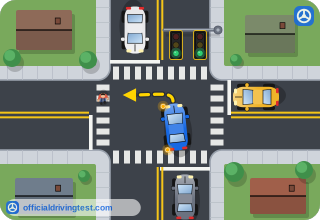
- Drivers behind you in your own lane
- Vehicles parked at the curb
- Drivers in the opposite lane
- No one, because a left turn has priority
Show answer
Correct answer: Drivers in the opposite lane
When you turn left you yield to drivers in the opposite lane.
Source: Utah Driver Handbook (2026 edition (new 2026 laws effective May 6, 2026)), page 50 · Open this page in the manual (Manual page 50)
-
You and another driver arrive at a four-way stop at the same time. Who has the right-of-way?
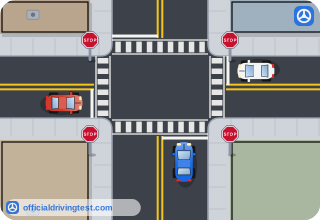
- The driver on your left
- The driver on your right
- The driver going straight
- The driver in the larger vehicle
Show answer
Correct answer: The driver on your right
At a four-way stop you yield to the driver on your right if you both arrive together.
Source: Utah Driver Handbook (2026 edition (new 2026 laws effective May 6, 2026)), page 50 · Open this page in the manual (Manual page 50)
-
You are coming from a driveway or a private road onto a public road. Whom must you yield to?
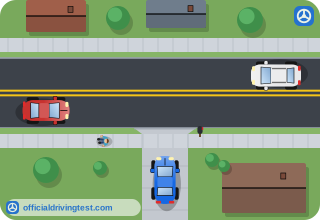
- Only drivers coming from the left
- No one, because you are already moving
- Only pedestrians
- Drivers on the public road
Show answer
Correct answer: Drivers on the public road
Drivers coming from a driveway or private road yield to drivers on the public road.
Source: Utah Driver Handbook (2026 edition (new 2026 laws effective May 6, 2026)), page 50 · Open this page in the manual (Manual page 50)
-
You are on an entrance ramp to an interstate highway. Whom must you yield to?
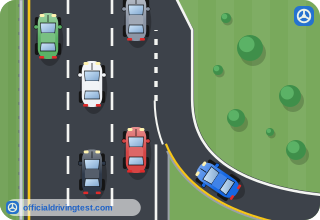
- Drivers already on the interstate
- No one, because merging traffic goes first
- Only trucks and buses
- Only drivers in the right lane of the ramp
Show answer
Correct answer: Drivers already on the interstate
Drivers on an entrance ramp yield to drivers already on the interstate.
Source: Utah Driver Handbook (2026 edition (new 2026 laws effective May 6, 2026)), page 50 · Open this page in the manual (Manual page 50)
-
Besides pedestrians and bicyclists, whom does the handbook say you yield to when they are still in the intersection?
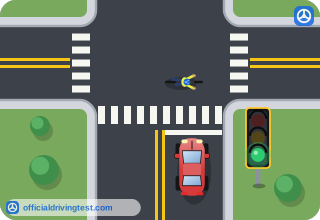
- Only emergency vehicles
- Only vehicles on your right
- Others still in the intersection
- Nobody else
Show answer
Correct answer: Others still in the intersection
You yield to pedestrians, bicyclists, and others that are still in the intersection.
Source: Utah Driver Handbook (2026 edition (new 2026 laws effective May 6, 2026)), page 50 · Open this page in the manual (Manual page 50)
-
On a narrow mountain road, who must yield when one vehicle is traveling uphill and the other downhill?
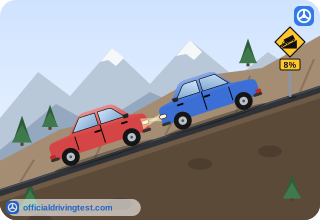
- The vehicle traveling uphill must yield to the one going downhill
- The smaller of the two vehicles must yield to the larger
- The vehicle traveling downhill must yield to the one going uphill
- The vehicle on the left side of the road must yield
Show answer
Correct answer: The vehicle traveling downhill must yield to the one going uphill
The handbook says you must yield to vehicles going uphill if you are traveling downhill on a narrow road.
Source: Utah Driver Handbook (2026 edition (new 2026 laws effective May 6, 2026)), page 60 · Open this page in the manual (Manual page 60)
-
Who has the right-of-way at a narrow or single-lane bridge?
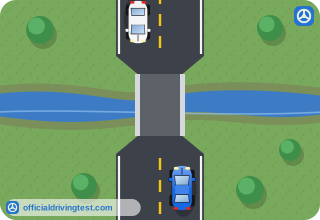
- The driver in the larger vehicle
- The driver traveling faster
- The driver coming downhill
- The first driver to reach the bridge
Show answer
Correct answer: The first driver to reach the bridge
At narrow and single-lane bridges, the first driver to the bridge has the right-of-way and drivers take turns crossing.
Source: Utah Driver Handbook (2026 edition (new 2026 laws effective May 6, 2026)), page 61 · Open this page in the manual (Manual page 61)
-
What should drivers do at a narrow or single-lane rural bridge?
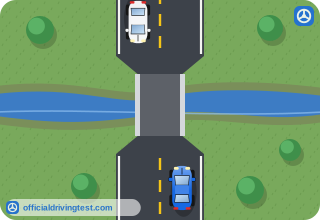
- Take turns crossing the bridge
- Cross together side by side
- Honk and cross without stopping
- Let the larger vehicle push through
Show answer
Correct answer: Take turns crossing the bridge
The handbook says drivers should take turns crossing a single-lane bridge.
Source: Utah Driver Handbook (2026 edition (new 2026 laws effective May 6, 2026)), page 61 · Open this page in the manual (Manual page 61)
-
How should a driver treat a bicyclist in an intersection?
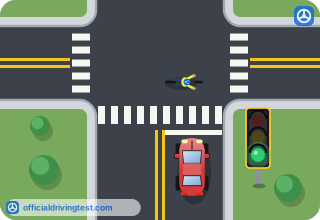
- Yield to the bicyclist as for pedestrians and other vehicles
- Go first, because a motor vehicle is larger than a bicycle
- Sound the horn so that the bicyclist stops moving
- Speed up to clear the intersection ahead of the bicyclist
Show answer
Correct answer: Yield to the bicyclist as for pedestrians and other vehicles
Drivers must yield to bicyclists in intersections just as they do to pedestrians and other vehicles.
Source: Utah Driver Handbook (2026 edition (new 2026 laws effective May 6, 2026)), page 74 · Open this page in the manual (Manual page 74)
-
What must a driver do when a bicycle path or bike lane intersects a road?
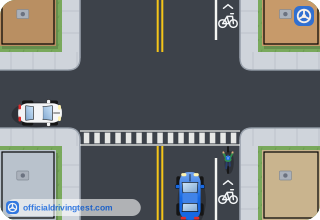
- Speed up to cross before any bicyclist arrives
- Stop, then go first because the road has priority
- Yield the right-of-way
- Drive in the bike lane until the crossing is clear
Show answer
Correct answer: Yield the right-of-way
Where a bicycle path or lane crosses a road, the driver must yield the right-of-way.
Source: Utah Driver Handbook (2026 edition (new 2026 laws effective May 6, 2026)), page 74 · Open this page in the manual (Manual page 74)
-
A bicyclist is approaching an intersection where you plan to turn. What should you do?
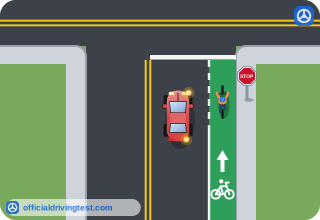
- Slow down and let the cyclist clear the intersection
- Turn quickly in front of the cyclist before the cyclist arrives
- Sound your horn and turn immediately without waiting
- Pass the cyclist and then make your turn
Show answer
Correct answer: Slow down and let the cyclist clear the intersection
A driver should slow down and wait until the cyclist has cleared the intersection before turning.
Source: Utah Driver Handbook (2026 edition (new 2026 laws effective May 6, 2026)), page 74 · Open this page in the manual (Manual page 74)
-
When turning left, how may a bicyclist use left-turn or two-way left-turn lanes?
- In the same manner required of motor vehicles
- Only when no motor vehicles are present
- Never; the bicyclist must dismount and walk
- Only with an adult rider
Show answer
Correct answer: In the same manner required of motor vehicles
A bicyclist turning left may use the left-turn or two-way left-turn lanes as a motor vehicle does.
Source: Utah Driver Handbook (2026 edition (new 2026 laws effective May 6, 2026)), page 75 · Open this page in the manual (Manual page 75)
-
When a large vehicle is turning ahead of you, when should you turn?
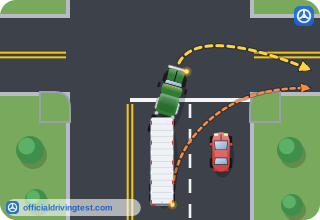
- Not until the vehicle has finished its turn
- While the large vehicle is still turning, behind it
- Before the large vehicle begins its turn
- As soon as the large vehicle signals
Show answer
Correct answer: Not until the vehicle has finished its turn
To avoid a crash, wait until a large vehicle has finished its turn before you turn.
Source: Utah Driver Handbook (2026 edition (new 2026 laws effective May 6, 2026)), page 79 · Open this page in the manual (Manual page 79)
-
Where should you always stop at an intersection stop line, given that stop lines are designed to give larger vehicles more turning space?
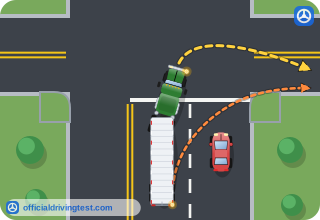
- On the stop line
- Behind the stop line
- With the front wheels over the stop line
- Just past the stop line to see better
Show answer
Correct answer: Behind the stop line
Stop lines give larger vehicles room to turn, so you should always stop behind them.
Source: Utah Driver Handbook (2026 edition (new 2026 laws effective May 6, 2026)), page 79 · Open this page in the manual (Manual page 79)