Texas: Sharing the road — Part 3 Practice Test
Questions in this part include: “On which of the following may an EPAMD be operated?” · “About how far can an average passenger car traveling 55 mph take to stop completely?”
Independent educational site · not affiliated with any government agency or DMV
Ready? Test yourself
Answer to start, or tap Start below:
An Electronic Personal Assistive Mobility Device (EPAMD), such as a Segway, is defined as having an average power of:
- Instant feedback with an explanation
- Every answer cites its source in the manual
- Your best score is saved on this device
- Keyboard: press 1 to 4 to answer and Enter for the next question
Questions are original and based on the official manual "Texas Driver Handbook" (Revised January 2026), Texas Department of Public Safety (DPS).
All 18 questions in this practice test
Take the test above first, then use this list to study. Tap “Show answer” to see the correct answer and explanation.
Show the questions and answersHide the questions
-
An Electronic Personal Assistive Mobility Device (EPAMD), such as a Segway, is defined as having an average power of:
- 10 horsepower
- 5,000 watts
- 100 watts
- 750 watts
Show answer
Correct answer: 750 watts
An EPAMD is a two, non-tandem wheeled, self-balancing device propelled by an electric propulsion system with an average power of 750 watts or one horsepower.
Source: Texas Driver Handbook (Revised January 2026), page 67
-
On which of the following may an EPAMD be operated?
- Any interstate highway regardless of speed limit
- Only inside private parking garages
- Only on a golf course
- A sidewalk or a path set aside for bicycles only
Show answer
Correct answer: A sidewalk or a path set aside for bicycles only
An EPAMD may be operated on a sidewalk, a path set aside for exclusive bicycle use, or on a residential street with a maximum speed limit of 30 mph under certain conditions.
Source: Texas Driver Handbook (Revised January 2026), page 67
-
When an EPAMD is operated on a public roadway, how should it be ridden?
- In the center of the travel lane
- On the left shoulder only
- In the passing lane
- As far right as practicable
Show answer
Correct answer: As far right as practicable
When operated on a public roadway, an EPAMD shall be ridden as close as practicable to the right-hand edge.
Source: Texas Driver Handbook (Revised January 2026), page 67
-
The slow-moving vehicle (SMV) emblem is required on vehicles that:
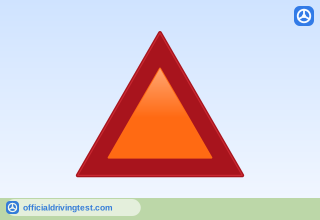
- Are driven only on streets within city limits
- Carry hazardous materials on public roads
- Are designed for a maximum speed of 25 mph or less
- Can travel faster than 55 mph on highways
Show answer
Correct answer: Are designed for a maximum speed of 25 mph or less
The slow-moving vehicle emblem is required for all slow-moving vehicles, defined as those designed to operate at a maximum speed of 25 mph or less, including farm and other machinery and machinery drawn by animals or slow-moving motor vehicles.
Source: Texas Driver Handbook (Revised January 2026), page 37
-
Where is it prohibited to display a slow-moving vehicle (SMV) emblem in Texas?
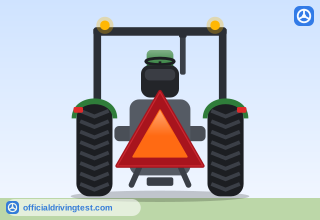
- On any vehicle or stationary object that is not actually a slow-moving vehicle
- On farm tractors and other slow farm equipment on public roads
- On animal-drawn buggies
- On road maintenance machinery that travels on public roads below 25 mph
Show answer
Correct answer: On any vehicle or stationary object that is not actually a slow-moving vehicle
The use of the slow-moving vehicle emblem is prohibited on anything other than a slow-moving vehicle. It must not be used on other vehicles or on stationary objects.
Source: Texas Driver Handbook (Revised January 2026), page 37
-
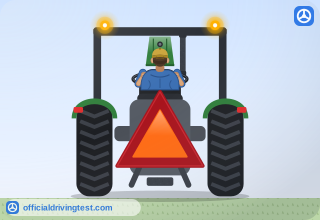
Which of the following is an exception to the slow-moving vehicle emblem requirement?
- Any vehicle traveling under 40 mph
- Any vehicle owned by a farmer, regardless of its speed
- Vehicles that operate only in daylight, between 6 a.m. and 6 p.m.
- Machinery towed by a slow-moving vehicle whose emblem remains visible
Show answer
Correct answer: Machinery towed by a slow-moving vehicle whose emblem remains visible
An implement or machinery being towed by a slow-moving vehicle bearing an emblem does not need its own emblem, as long as the towing vehicle's emblem remains visible. A vehicle used in actual construction work within a marked construction zone is also exempt.
Source: Texas Driver Handbook (Revised January 2026), page 37
-
Before moving into the passing lane to pass a truck, what should you do first?
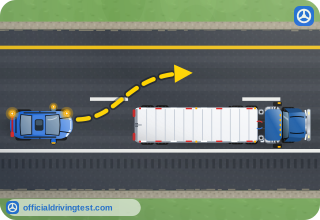
- Check to your front and rear, and check your mirrors and blind spots
- Flash your headlights and pull out immediately without checking your mirrors
- Wait for the truck driver to wave you into the lane
- Accelerate quickly so you spend less time in the passing lane
Show answer
Correct answer: Check to your front and rear, and check your mirrors and blind spots
Before passing a truck, check to your front and rear, check your mirrors and blind spots, then move into the passing lane only if it is clear and you are in a legal passing zone.
Source: Texas Driver Handbook (Revised January 2026), page 51
-
How should you let a truck driver know you are passing, especially at night?
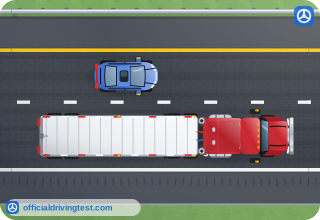
- By honking your horn repeatedly
- By flashing your headlights
- By turning on your hazard lights
- By tailgating closely until the driver notices
Show answer
Correct answer: By flashing your headlights
Let the truck driver know you are passing by flashing your headlights, especially at night.
Source: Texas Driver Handbook (Revised January 2026), page 51
-
On a level highway, about how much longer does it take to pass a truck compared to passing a car?
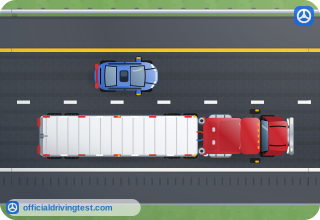
- One to two seconds longer
- Three to five seconds longer
- Ten to fifteen seconds longer
- It takes the same amount of time
Show answer
Correct answer: Three to five seconds longer
On a level highway, it takes three to five seconds longer to pass a truck than a car.
Source: Texas Driver Handbook (Revised January 2026), page 51
-
Why is it often easier to pass a truck when driving on an upgrade (uphill)?
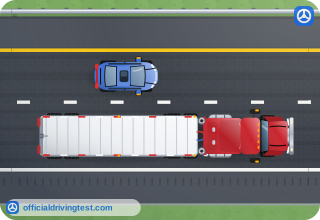
- The truck often loses speed going uphill
- Trucks are required by law to pull over on hills
- There is always an extra passing lane on hills
- Trucks are not allowed to use the left lane uphill
Show answer
Correct answer: The truck often loses speed going uphill
On an upgrade, a truck often loses speed, so it's easier to pass than a car.
Source: Texas Driver Handbook (Revised January 2026), page 51
-
Why might you need to increase your speed when passing a truck on a downgrade (downhill)?
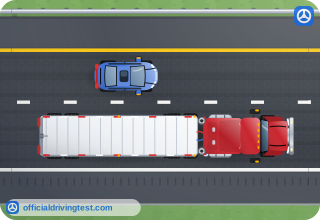
- The truck's momentum causes it to go faster going downhill
- Trucks are required to speed up on downgrades
- Downgrades always have lower speed limits for cars
- The truck driver will slow down to let you pass
Show answer
Correct answer: The truck's momentum causes it to go faster going downhill
On a downgrade, the truck's momentum causes it to go faster, so you may need to increase your speed to complete the pass.
Source: Texas Driver Handbook (Revised January 2026), page 51
-
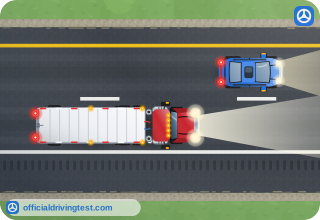
If a truck driver flashes the truck's lights after you have passed, what does that signal mean?
- That you should slow down and let the truck pass you back
- That there is a hazard ahead you should avoid
- That the truck driver wants you to stop
- That it is clear for you to pull back in front of the truck
Show answer
Correct answer: That it is clear for you to pull back in front of the truck
If the driver flashes the truck's lights after you pass, it's a signal that it is clear for you to pull back in front of the truck.
Source: Texas Driver Handbook (Revised January 2026), page 51
-
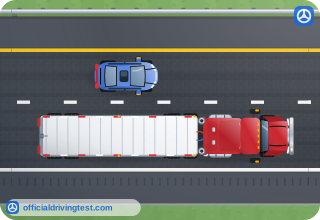
After passing a truck, when should you move back into the lane in front of it?
- Immediately after your rear bumper clears the truck's front bumper
- Whenever the truck driver honks the horn
- Only when you can see the entire front of the truck in your rearview mirror
- As soon as your vehicle is slightly ahead of the truck's front bumper
Show answer
Correct answer: Only when you can see the entire front of the truck in your rearview mirror
Be sure to move back only when you can see the entire front of the truck in your rearview mirror.
Source: Texas Driver Handbook (Revised January 2026), page 51
-
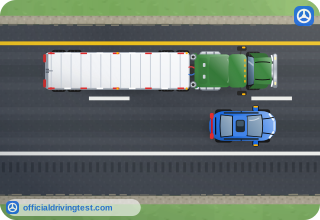
When a truck is passing you, what should you do to help the truck driver?
- Speed up to help the truck finish passing faster
- Move closer to the center line
- Flash your high beams at the truck driver
- Keep to the far side of your lane and slow down slightly
Show answer
Correct answer: Keep to the far side of your lane and slow down slightly
When a truck passes you, help the truck driver by keeping to the far side of your lane. You'll make it easier if you slightly reduce your speed and don't speed up.
Source: Texas Driver Handbook (Revised January 2026), page 51
-
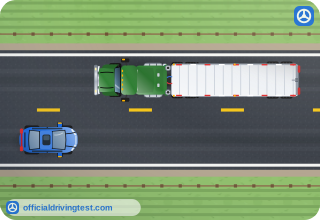
When meeting a truck coming from the opposite direction, why should you keep as far to the side as possible?
- Because the truck's headlights could blind you
- Because oncoming trucks always have the right-of-way
- So the truck driver can pass you more easily
- To avoid a sideswipe crash and reduce wind turbulence
Show answer
Correct answer: To avoid a sideswipe crash and reduce wind turbulence
When you meet a truck coming from the opposite direction, keep as far to the side as possible to avoid a sideswipe crash and to reduce the wind turbulence between the two vehicles. Turbulence pushes vehicles apart; it does not pull them together.
Source: Texas Driver Handbook (Revised January 2026), page 51
-
About how far can an average passenger car traveling 55 mph take to stop completely?
- About 100 feet
- About 240 feet, three-fourths of a football field
- About 400 feet, longer than a football field
- About 50 feet
Show answer
Correct answer: About 240 feet, three-fourths of a football field
The average passenger car traveling at 55 mph can stop in approximately 240 feet, which is about three-fourths the length of a football field.
Source: Texas Driver Handbook (Revised January 2026), page 51
-
About how far may a fully loaded tractor-trailer need to completely stop, traveling at the same speed as a car?
- About 150 feet, less than a car
- About 50 feet
- More than 400 feet, well over a football field
- About the same distance as a car, 240 feet
Show answer
Correct answer: More than 400 feet, well over a football field
A fully loaded tractor-trailer may take more than 400 feet to completely stop, well over the length of a football field, and much farther than a passenger car.
Source: Texas Driver Handbook (Revised January 2026), page 51
-
What is a good rule of thumb for avoiding a truck's blind spot when following it?
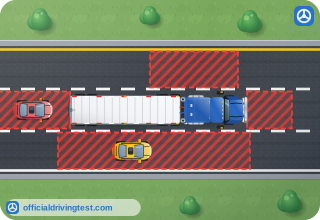
- Trucks have no blind spots at the rear
- Staying directly behind the trailer's center is always the safest spot
- If you can't see the truck driver in his side mirror, he can't see you
- As long as your headlights are on, the driver can always see you
Show answer
Correct answer: If you can't see the truck driver in his side mirror, he can't see you
An excellent rule of thumb for motorists sharing the road with a tractor-trailer is: if you can't see the truck driver in his side mirror, he can't see you. Avoid following too closely in the truck's rear blind spot.
Source: Texas Driver Handbook (Revised January 2026), page 51