Texas: 30 Hardest Driving Test Questions
Questions that need a second thought, picked for close numbers, exceptions and easy-to-confuse rules. Take your time.
Independent educational site · not affiliated with any government agency or DMV
Ready? Test yourself
Answer to start, or tap Start below:
If there is no sidewalk, on which side of the road should a pedestrian walk, according to the Texas Driver Handbook?
- Instant feedback with an explanation
- Every answer cites its source in the manual
- Your best score is saved on this device
- Keyboard: press 1 to 4 to answer and Enter for the next question
Questions are original and based on the official manual "Texas Driver Handbook" (Revised January 2026), Texas Department of Public Safety (DPS).
All 30 questions in this practice test
Take the test above first, then use this list to study. Tap “Show answer” to see the correct answer and explanation.
Show the questions and answersHide the questions
-
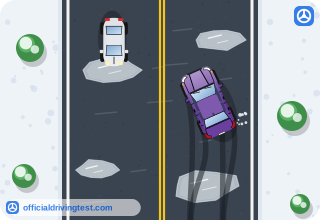
To steer out of a skid, you should turn the steering wheel:
- All the way to one side and hold it there
- Not at all; keep it perfectly straight
- In the direction of the skid, then gently straighten the wheels
- Sharply away from the skid, then quickly straighten the wheels
Show answer
Correct answer: In the direction of the skid, then gently straighten the wheels
Turn your steering wheel in the direction of the skid, and as you recover control, gently straighten the wheels.
Source: Texas Driver Handbook (Revised January 2026), page 48
-
If there is no sidewalk, on which side of the road should a pedestrian walk, according to the Texas Driver Handbook?
- The right side, with traffic
- The left side of the road
- Either side, it does not matter
- In the center of the road
Show answer
Correct answer: The left side of the road
Without a sidewalk, pedestrians should walk on the left side of the road and step off the pavement when a car approaches.
Source: Texas Driver Handbook (Revised January 2026), page 61
-
What is the minimum amount of liability insurance required in Texas against the injury or death of one person?
- $25,000
- $30,000
- $60,000
- $55,000
Show answer
Correct answer: $30,000
As of January 1, 2011, the minimum liability insurance in Texas is $30,000 against injury or death of one person.
Source: Texas Driver Handbook (Revised January 2026), page 18
-
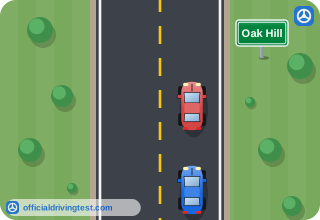
For speeds above 30 mph, what following time gap should you maintain behind the vehicle ahead during good road conditions?
- 2-second gap
- 3-second gap
- 4-second gap
- 6-second gap
Show answer
Correct answer: 4-second gap
For speeds above 30 mph, the handbook instructs drivers to maintain a 4-second gap during good road conditions.
Source: Texas Driver Handbook (Revised January 2026), page 45
-
How close to a fire hydrant may you legally park a vehicle?
- You may not park within 10 feet of a fire hydrant
- You may not park within 25 feet of a fire hydrant
- You may not park within 5 feet of a fire hydrant
- You may not park within 15 feet of a fire hydrant
Show answer
Correct answer: You may not park within 15 feet of a fire hydrant
You may not park or stand a vehicle within 15 feet of a fire hydrant.
Source: Texas Driver Handbook (Revised January 2026), page 42
-
What blood alcohol concentration (BAC) does Texas law allow for minors while driving?
- 0.08 or less
- 0.02 or less
- None at all
- 0.05 or less
Show answer
Correct answer: None at all
Texas law does not allow any amount of blood alcohol concentration (BAC) for minors — this is the basis of the state's zero tolerance policy.
Source: Texas Driver Handbook (Revised January 2026), page 55
-
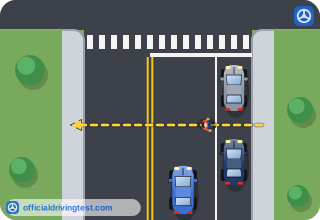
If a pedestrian crosses a street at a point other than within a crosswalk at an intersection, what must the pedestrian do?
- Signal to drivers with a hand wave and proceed
- Yield the right-of-way to all vehicles
- Cross only during daylight hours
- Wait for a police officer to stop traffic
Show answer
Correct answer: Yield the right-of-way to all vehicles
A pedestrian who crosses outside a crosswalk at an intersection must yield the right-of-way to all vehicles.
Source: Texas Driver Handbook (Revised January 2026), page 61
-
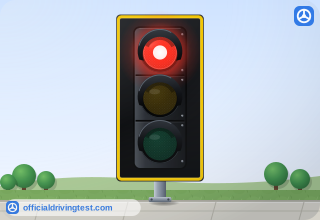
At a steady red light, when is a left turn allowed?
- A left turn on red is never allowed in Texas
- Anytime there is no oncoming traffic in sight
- Only for buses and emergency vehicles
- If both streets are one-way, unless prohibited by law
Show answer
Correct answer: If both streets are one-way, unless prohibited by law
You may also turn left on a steady red light if both streets are one-way, unless prohibited by law.
Source: Texas Driver Handbook (Revised January 2026), page 25
-
Apart from any time people or vehicles cannot be seen clearly for at least 1,000 feet, when must you use your headlights in Texas?
- From one hour after sunset to one hour before sunrise
- Only on highways, never on city streets
- From 30 minutes after sunset to 30 minutes before sunrise
- Only after complete darkness
Show answer
Correct answer: From 30 minutes after sunset to 30 minutes before sunrise
Texas law requires headlights beginning 30 minutes after sunset until 30 minutes before sunrise, and anytime people or vehicles cannot be seen clearly for at least 1,000 feet.
Source: Texas Driver Handbook (Revised January 2026), page 47
-
What does a pennant-shaped sign indicate?
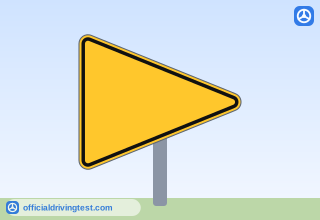
- An upcoming school zone
- Advance warning of a no-passing zone
- Advance warning of a railroad crossing
- A stop sign ahead
Show answer
Correct answer: Advance warning of a no-passing zone
The pennant shape gives advance warning of a no-passing zone.
Source: Texas Driver Handbook (Revised January 2026), page 26
-
Under GDL Phase Two, during what hours are covered drivers generally prohibited from driving unless it is necessary for work, a school-related activity, or a medical emergency?
- 10 p.m. to 5 a.m.
- Midnight to 5 a.m.
- 11 p.m. to 6 a.m.
- Midnight to 6 a.m.
Show answer
Correct answer: Midnight to 5 a.m.
During Phase Two, drivers may not drive between midnight and 5:00 a.m. unless necessary for work, a school-related activity, or a medical emergency.
Source: Texas Driver Handbook (Revised January 2026), page 3
-
A child under 8 years old must be secured in a federally approved child car seat unless the child is:
- More than 4 feet 9 inches tall
- Older than 5 years
- Riding in the back seat
- Already wearing a seat belt
Show answer
Correct answer: More than 4 feet 9 inches tall
Any child under 8 years old must be secured in a federally approved child car seat unless the child is more than 4'9" tall.
Source: Texas Driver Handbook (Revised January 2026), page 64
-
Your car stalls on the tracks and a train is approaching. What should you do?
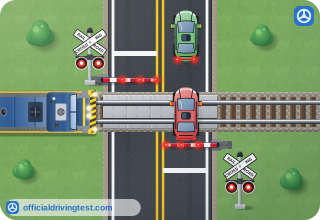
- Get out and run toward the train, to the side of the tracks
- Stay in the car with your seatbelt on
- Try repeatedly to restart the engine until the train arrives
- Run in the same direction the train is traveling
Show answer
Correct answer: Get out and run toward the train, to the side of the tracks
If your car stalls on the tracks and a train is approaching, get out quickly and move away from the tracks. Run toward the approaching train to the side of the tracks and avoid flying debris.
Source: Texas Driver Handbook (Revised January 2026), page 22
-
At an intersection where you face a flashing red light, why should you still watch carefully before proceeding?
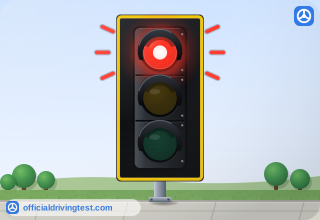
- Vehicles on the intersecting road may not have to stop
- All directions always face a flashing red light at the same time
- Cross traffic must always yield to you
- A flashing red light means the signal is broken and can be ignored
Show answer
Correct answer: Vehicles on the intersecting road may not have to stop
Vehicles on the intersecting road may not have to stop, so you must proceed carefully even after stopping.
Source: Texas Driver Handbook (Revised January 2026), page 25
-
You should use low beam headlights when following another vehicle within:
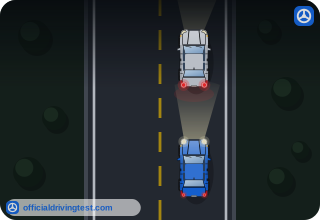
- 50 feet
- 1,000 feet
- 150 feet
- 300 feet
Show answer
Correct answer: 300 feet
Use low beam headlights when following closely, within 300 feet, behind another vehicle.
Source: Texas Driver Handbook (Revised January 2026), page 47
-
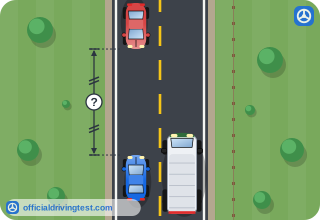
When passing on a two-lane road, you should have enough time and space to return to the right lane before an approaching car comes within how many feet of you?
- 500 feet
- 50 feet
- 200 feet
- 20 feet
Show answer
Correct answer: 200 feet
Be sure you have enough time and space to overtake the car ahead and return to the right lane before an approaching car comes within 200 feet of you.
Source: Texas Driver Handbook (Revised January 2026), page 39
-
What does a sign indicating two lanes for turning left mean?
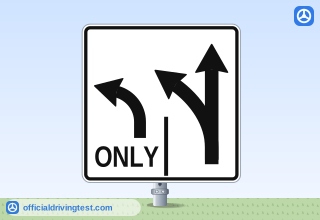
- Both lanes must turn left; neither lane has a choice
- Only the right lane may turn left
- Left turns are prohibited from both lanes
- The left lane must turn left; the other lane has a choice
Show answer
Correct answer: The left lane must turn left; the other lane has a choice
This sign indicates two lanes of traffic are permitted to turn left. Traffic in the left lane must turn left, while traffic in the other lane has a choice.
Source: Texas Driver Handbook (Revised January 2026), page 30
-
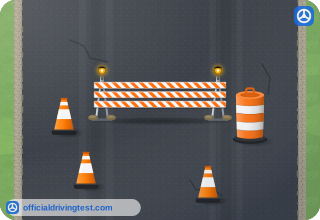
On a work zone barricade or vertical panel, diagonal stripes sloping downward to the right mean the driver should:
- Bear to the right
- Bear to the left
- Stop immediately
- Reverse direction
Show answer
Correct answer: Bear to the right
The diagonal stripes on a barricade or vertical panel guide drivers toward the direction traffic should pass. Stripes sloping downward to the right mean the driver should bear to the right.
Source: Texas Driver Handbook (Revised January 2026), page 36
-
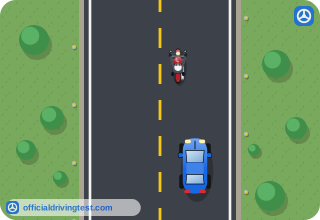
In dry conditions, how do motorcycles generally compare to cars when stopping?
- Motorcycles can stop more quickly than a car
- Motorcycles always take much longer to stop than a car
- Motorcycles and cars stop at exactly the same rate in all conditions
- Motorcycles cannot stop quickly under any circumstances
Show answer
Correct answer: Motorcycles can stop more quickly than a car
In dry conditions, motorcycles can stop more quickly than a car, so being aware and alert at all times can help prevent a collision.
Source: Texas Driver Handbook (Revised January 2026), page 53
-
If an adult submits to a blood or breath specimen and the results show a BAC of 0.08 or greater, how long can the license be suspended for a 1st offense?
- 30 days
- 90 days
- 180 days
- 365 days
Show answer
Correct answer: 90 days
If a person submits to a specimen and the results show a BAC of 0.08 or greater, their driver license may be suspended for 90 days for a 1st offense (up to 365 days for subsequent offenses).
Source: Texas Driver Handbook (Revised January 2026), page 58
-
The requirement to remove the key from the ignition before leaving a vehicle unattended does NOT apply when:
- The driver will return within five minutes
- The engine was started using a remote starter
- The vehicle is parked on private property
- The vehicle has an alarm system installed
Show answer
Correct answer: The engine was started using a remote starter
The requirements about turning off the engine, locking the ignition, and removing the key do not apply to a driver who starts the engine using a remote starter that remotely starts the engine without the key in the ignition.
Source: Texas Driver Handbook (Revised January 2026), page 43
-
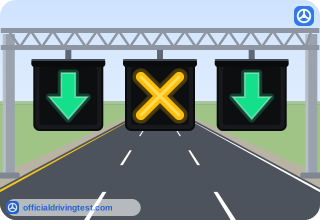
On an overhead lane-use control signal, what does a steady yellow X mean?
- A driver may enter the lane immediately
- The lane is permanently closed
- A driver must reverse direction
- A driver should prepare to vacate the lane
Show answer
Correct answer: A driver should prepare to vacate the lane
A steady yellow X means a driver should prepare to safely vacate the lane over which the signal is located because a lane control change is being made.
Source: Texas Driver Handbook (Revised January 2026), page 32
-
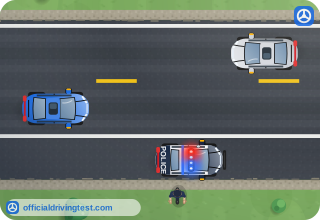
The posted speed limit is 20 mph on a one-lane road and you pass a stopped emergency vehicle with lights activated. How slow must you go?
- No more than 20 mph less than the limit
- Exactly 15 mph
- You do not need to slow down at all
- Less than 5 mph
Show answer
Correct answer: Less than 5 mph
When the posted speed limit is less than 25 mph, you must slow to a speed less than 5 mph when passing a stopped emergency vehicle with its lights activated.
Source: Texas Driver Handbook (Revised January 2026), page 23
-
If a minor's breath or blood specimen confirms a detectable amount of alcohol below the 0.08 BAC legal limit, what is the license suspension for a 1st offense?
- 30 days
- 60 days
- 120 days
- 180 days
Show answer
Correct answer: 60 days
A minor whose specimen confirms a detectable amount of alcohol below 0.08 will have their license suspended for 60 days on the 1st offense.
Source: Texas Driver Handbook (Revised January 2026), page 57
-
On multi-lane highways, which lane do tractor-trailers typically stay in?
- The center lane, to help traffic flow
- The far-left lane at all times
- The far-right lane at all times
- Whichever lane has the least traffic
Show answer
Correct answer: The center lane, to help traffic flow
On multi-lane highways, tractor-trailers stay in the center lane to help the flow of local traffic on and off the highway and to increase the truck driver's options if he/she has to switch lanes to avoid a crash.
Source: Texas Driver Handbook (Revised January 2026), page 51
-
On the side of a street directly opposite a fire station entrance, you may not park within how many feet of the entrance?
- 20 feet
- 50 feet
- 100 feet
- 75 feet
Show answer
Correct answer: 75 feet
You may not park on the side of a street opposite the entrance to any fire station within 75 feet of the entrance.
Source: Texas Driver Handbook (Revised January 2026), page 42
-
You are driving on a frontage road of a controlled-access highway. Who must you yield to?
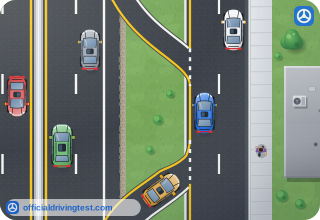
- Vehicles entering or leaving the frontage road to or from the highway
- Only vehicles already on the frontage road ahead of you
- No one, since frontage road drivers always have the right-of-way
- Only pedestrians crossing the frontage road
Show answer
Correct answer: Vehicles entering or leaving the frontage road to or from the highway
A driver on a frontage road of a controlled-access highway must yield to a vehicle entering or about to enter the frontage road from the highway, and to one leaving or about to leave the frontage road to enter the highway.
Source: Texas Driver Handbook (Revised January 2026), page 21
-
When riding a bicycle on a one-way road with two or more marked traffic lanes, where should the bicyclist ride?
- In the center of the rightmost lane
- On the painted line between two marked traffic lanes
- In the middle lane only
- As near as possible to the left curb or edge of the road
Show answer
Correct answer: As near as possible to the left curb or edge of the road
On a one-way road with two or more marked traffic lanes, a bicyclist should ride as near as possible to the left curb or edge of the road.
Source: Texas Driver Handbook (Revised January 2026), page 62
-
At 40 mph, to about what fraction is a driver's field of vision reduced, according to the handbook?
- About 2/3
- About 2/5
- About 1/5
- About 1/2
Show answer
Correct answer: About 2/5
At 40 mph, the handbook shows field of vision is reduced to about 2/5 of the stationary field of vision.
Source: Texas Driver Handbook (Revised January 2026), page 45
-
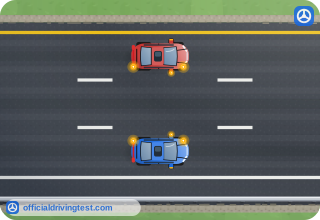
On a road divided into three or more lanes moving the same direction, a vehicle entering a lane from the right must yield to:
- Only vehicles with their turn signal off
- A vehicle entering the same lane of traffic from the left
- A vehicle already two lanes away
- No one, since the right lane always has priority
Show answer
Correct answer: A vehicle entering the same lane of traffic from the left
On a road with three or more lanes moving the same direction, a vehicle entering a lane from the right must yield to a vehicle entering that same lane from the left.
Source: Texas Driver Handbook (Revised January 2026), page 21