Texas: Sharing the road
Safely sharing the road with motorcycles, bicycles, trucks, and buses. Split into 5 shorter tests so you're not stuck in one long quiz.
Independent educational site · not affiliated with any government agency or DMV
Choose a part
Sharing the road — Part 1
Questions in this part include: “Under Texas law, how is a bicycle classified for traffic purposes?”
Sharing the road — Part 2
Questions in this part include: “What braking equipment must every bicycle have in Texas?”
Sharing the road — Part 3
Questions in this part include: “On which of the following may an EPAMD be operated?”
Sharing the road — Part 4
Questions in this part include: “On multi-lane highways, which lane do tractor-trailers typically stay in?”
Sharing the road — Part 5
Questions in this part include: “What is the aim of the Texas Motorcycle Operator Training and Safety program?”
Questions are original and based on the official manual "Texas Driver Handbook" (Revised January 2026), Texas Department of Public Safety (DPS).
All 90 Sharing the road questions with answers
Choose a part above to take a practice test, or study every question and answer here.
Show the questions and answersHide the questions
1Part 118 questions
-
Under Texas law, how is a bicycle classified for traffic purposes?
- As a vehicle, with the same rights and responsibilities as a driver
- As a pedestrian device with no traffic law obligations
- As a toy not subject to any traffic regulation
- As a motor vehicle requiring registration and license plates
Show answer
Correct answer: As a vehicle, with the same rights and responsibilities as a driver
A bicycle is a vehicle, and a person riding one has the same rights and responsibilities as a driver operating a motor vehicle, unless a rule cannot by its nature apply to a bicyclist.
Source: Texas Driver Handbook (Revised January 2026), page 62
-
What happens if a bicyclist violates a traffic law in Texas?
- Nothing, since bicycles are not motor vehicles
- They face a driver's penalties, and a conviction goes on their driver record
- Only a verbal warning can be issued
- The violation is recorded but can never affect a driver's record
Show answer
Correct answer: They face a driver's penalties, and a conviction goes on their driver record
A person operating a bicycle is subject to the same penalties as a motor vehicle operator for violating traffic law, and all traffic convictions, whether on a bicycle or in a motor vehicle, go on the individual's driver record.
Source: Texas Driver Handbook (Revised January 2026), page 62
-
Which of the following is a rule bicyclists must follow according to the Texas Driver Handbook?
- Bicyclists may roll through stop signs if no traffic is present
- Bicyclists must obey all traffic laws, signs, and signals
- Bicyclists only need to obey signs, not signals
- Traffic laws apply to bicyclists only during daytime
Show answer
Correct answer: Bicyclists must obey all traffic laws, signs, and signals
Bicyclists must always obey all traffic laws, signs, and signals, and must stop at all stop signs and red lights, just like motor vehicle drivers.
Source: Texas Driver Handbook (Revised January 2026), page 62
-
In which direction must a bicyclist ride relative to traffic?
- Against the flow of traffic so they can see approaching vehicles
- In whichever direction is most convenient at the time
- Always with the flow of traffic, never opposite it
- On the left side of the road only, regardless of traffic flow
Show answer
Correct answer: Always with the flow of traffic, never opposite it
A bicyclist must always ride with the flow of traffic and should never ride opposite the flow of traffic.
Source: Texas Driver Handbook (Revised January 2026), page 62
-
According to the Texas Driver Handbook, where may a person ride on a bicycle?
- Anywhere on the frame as long as they can reach the pedals
- Only on or astride a permanent and regular seat
- On the handlebars, if wearing a helmet
- Standing on the pedals at all times
Show answer
Correct answer: Only on or astride a permanent and regular seat
A bicyclist may only ride on or astride a permanent and regular seat.
Source: Texas Driver Handbook (Revised January 2026), page 62
-
When riding a bicycle on a one-way road with two or more marked traffic lanes, where should the bicyclist ride?
- In the center of the rightmost lane
- On the painted line between two marked traffic lanes
- In the middle lane only
- As near as possible to the left curb or edge of the road
Show answer
Correct answer: As near as possible to the left curb or edge of the road
On a one-way road with two or more marked traffic lanes, a bicyclist should ride as near as possible to the left curb or edge of the road.
Source: Texas Driver Handbook (Revised January 2026), page 62
-
What must bicyclists riding two abreast do on a road with marked lanes?
- Ride in a single lane and not impede traffic
- Occupy two full lanes to increase visibility
- Ride only on sidewalks
- Alternate which rider is in front every mile
Show answer
Correct answer: Ride in a single lane and not impede traffic
Individuals riding two abreast on a laned road must ride in a single lane and not impede the flow of traffic.
Source: Texas Driver Handbook (Revised January 2026), page 62
-
According to the handbook, where else may bicyclists legally ride besides the travel lane?
- On the shoulder of the road
- On any sidewalk, regardless of local rules
- In the emergency lane of a freeway only
- Bicyclists may not ride anywhere except a marked bicycle lane
Show answer
Correct answer: On the shoulder of the road
Bicyclists may ride on the shoulder of the road.
Source: Texas Driver Handbook (Revised January 2026), page 62
-
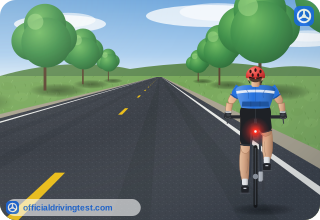
How may a bicyclist signal a right turn in Texas?
- Left arm pointed downward, or right arm pointing up
- Right arm pointed downward
- Left arm pointing up, or right arm pointed horizontally
- Left arm pointed horizontally only
Show answer
Correct answer: Left arm pointing up, or right arm pointed horizontally
A right turn is signaled using either the left arm pointing up or the right arm pointed horizontally.
Source: Texas Driver Handbook (Revised January 2026), page 62
-
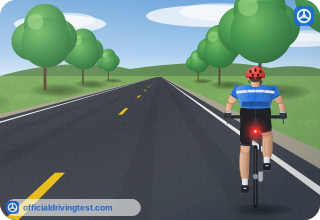
How does a bicyclist signal a left turn?
- Right arm pointed horizontally
- Left arm pointed horizontally
- Left arm pointing up
- Right arm pointing up
Show answer
Correct answer: Left arm pointed horizontally
A left turn is signaled by pointing the left arm horizontally.
Source: Texas Driver Handbook (Revised January 2026), page 62
-
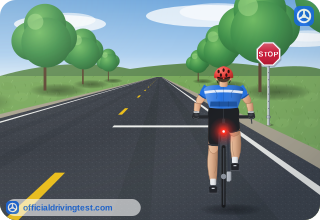
How does a bicyclist signal that they are about to stop?
- Both arms raised overhead
- Left arm pointed horizontally
- Left arm pointed downward
- Right arm pointed downward
Show answer
Correct answer: Left arm pointed downward
A stop is signaled using the left arm pointed downward.
Source: Texas Driver Handbook (Revised January 2026), page 62
-
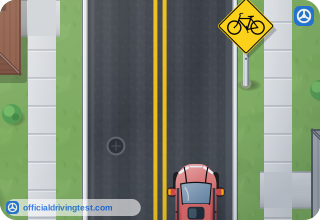
A bicyclist moving slower than other traffic must generally ride:
- In the center of the travel lane
- As near as possible to the right curb or edge of the road
- On the left side of the road, against the flow of traffic
- Only in a designated bicycle lane, never near the curb
Show answer
Correct answer: As near as possible to the right curb or edge of the road
A person operating a bicycle who is moving slower than other traffic shall ride as near as possible to the right curb or edge of the road, unless an exception applies.
Source: Texas Driver Handbook (Revised January 2026), page 62
-
Which of these is NOT listed as an exception allowing a slower bicyclist to move away from the right curb or edge of the road?
- Preparing for a left turn at an intersection
- Overtaking and passing another vehicle going the same direction
- Riding at night to be more visible
- Avoiding unsafe conditions such as potholes or debris
Show answer
Correct answer: Riding at night to be more visible
The exceptions listed are overtaking another vehicle, preparing for a left turn, unsafe road conditions, and certain narrow outside lanes. Riding at night is not one of the listed exceptions.
Source: Texas Driver Handbook (Revised January 2026), page 62
-
A bicyclist may also ride away from the right edge of the road when the outside lane is:
- Wider than 14 feet and has a designated bicycle lane
- Less than 14 feet wide and has no adjacent bicycle lane
- Freshly paved and free of potholes or debris
- Marked exclusively for buses
Show answer
Correct answer: Less than 14 feet wide and has no adjacent bicycle lane
A bicyclist may move away from the right edge when the outside lane is less than 14 feet wide and lacks an adjacent designated bicycle lane, or when the lane is too narrow for a bicycle and motor vehicle to safely travel side by side.
Source: Texas Driver Handbook (Revised January 2026), page 62
-
According to the handbook's 'Don'ts,' a bicyclist should never:
- Use hand signals to indicate turns
- Ride on the shoulder of the road when traffic is heavy
- Carry more people than the bicycle is designed or equipped for
- Ride during daylight hours
Show answer
Correct answer: Carry more people than the bicycle is designed or equipped for
A bicyclist should never carry more individuals than the bicycle is designed or equipped for.
Source: Texas Driver Handbook (Revised January 2026), page 62
-
What is prohibited regarding attaching a bicycle to another vehicle?
- Bicyclists may attach themselves to a moving streetcar or vehicle if wearing a helmet
- A bicyclist must never attach the bicycle or themselves to a moving streetcar or vehicle upon a road
- Only attaching to buses is prohibited
- Attaching is allowed at speeds under 10 mph
Show answer
Correct answer: A bicyclist must never attach the bicycle or themselves to a moving streetcar or vehicle upon a road
A bicyclist must never attach the bicycle or person to a moving streetcar or vehicle upon a road.
Source: Texas Driver Handbook (Revised January 2026), page 62
-
A bicyclist should never carry a package, bundle, or article that:
- Is carried in a basket mounted on the front of the bicycle
- Prevents the rider from keeping at least one hand on the handlebars
- Weighs less than 10 pounds
- Is visible to other traffic
Show answer
Correct answer: Prevents the rider from keeping at least one hand on the handlebars
A bicyclist should never carry any package, bundle, or article which prevents the rider from keeping at least one hand on the handlebars.
Source: Texas Driver Handbook (Revised January 2026), page 62
-
What is one purpose of the shared lane marking (sharrow) on Texas roads?
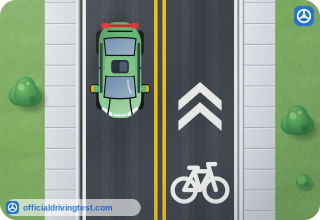
- To mark a lane exclusively for bicycles that motor vehicles may never enter
- To alert road users to where bicyclists are likely to ride in the road
- To indicate a designated bicycle parking area
- To replace the need for bicyclists to obey traffic signals
Show answer
Correct answer: To alert road users to where bicyclists are likely to ride in the road
The shared lane marking helps bicyclists position themselves to reduce the chance of hitting an opening car door, helps with positioning in narrow lanes, alerts road users to bicyclists' likely location, encourages safe passing, and reduces wrong-way bicycling.
Source: Texas Driver Handbook (Revised January 2026), page 62
2Part 218 questions
-
What braking equipment must every bicycle have in Texas?
- No brake is legally required
- A brake that only works at speeds under 5 mph
- A brake that enables the wheels to skid on dry, level, clean pavement
- Hydraulic disc brakes on both the front and the rear wheels
Show answer
Correct answer: A brake that enables the wheels to skid on dry, level, clean pavement
Every bicycle must be equipped with a brake that enables the operator to make the wheels skid on dry, level, clean pavement when applied.
Source: Texas Driver Handbook (Revised January 2026), page 63
-
What may hearing-impaired bicycle riders display for safety?
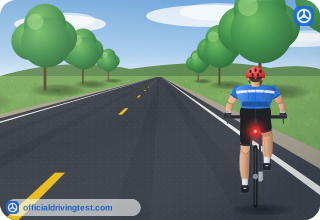
- A flashing blue light
- A safety flag
- An orange traffic cone
- A loud bell only
Show answer
Correct answer: A safety flag
Hearing-impaired bicycle riders may display a safety flag.
Source: Texas Driver Handbook (Revised January 2026), page 63
-
What lighting and reflector equipment must a bicycle used at night have in Texas?
- A front red light and a rear white reflector
- Flashing lights on both wheels
- A white front light and a red, DPS-approved rear reflector
- Only a rear red reflector; no front light is required
Show answer
Correct answer: A white front light and a red, DPS-approved rear reflector
A bicycle used at nighttime must have a front lamp emitting a white light visible from at least 500 feet, and a red, DPS-approved rear reflector visible from 50 to 300 feet (a red rear light visible from 500 feet may be used in addition).
Source: Texas Driver Handbook (Revised January 2026), page 63
-
Regarding bicycle helmets, the Texas Driver Handbook states:
- Helmets are mandatory statewide for all riders
- Helmets may be required, depending on your local laws
- Helmets are never required anywhere in Texas
- Only riders under age 21 must wear helmets statewide
Show answer
Correct answer: Helmets may be required, depending on your local laws
Bicyclists may be required by law to wear a helmet depending on local laws.
Source: Texas Driver Handbook (Revised January 2026), page 63
-
When riding on pedestrian facilities such as sidewalks or paths, a bicyclist should:
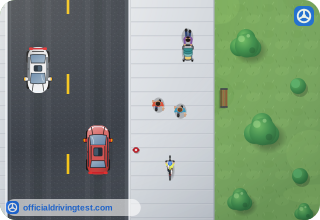
- Maintain maximum speed to clear the area quickly
- Reduce speed and exercise caution
- Ring a bell continuously instead of slowing down
- Ride only at night
Show answer
Correct answer: Reduce speed and exercise caution
When riding on pedestrian facilities, bicyclists should reduce speed and exercise caution.
Source: Texas Driver Handbook (Revised January 2026), page 63
-
Bicycle safety guidelines advise riders to avoid weaving in and out of parked cars, and to do what when stopping, parking, or making repairs?
- Move off the street
- Stay in the travel lane and signal
- Weave through traffic to find a spot
- Wait for a police escort
Show answer
Correct answer: Move off the street
Bicyclists should not weave in and out of parked cars, and should move off the street to stop, park, or make repairs to their bicycle.
Source: Texas Driver Handbook (Revised January 2026), page 63
-
According to the handbook, a bicyclist should select a route based on:
- The shortest possible distance only
- The rider's bicycling skill and experience
- The number of traffic lights along the way
- Whichever road has the highest speed limit
Show answer
Correct answer: The rider's bicycling skill and experience
A bicyclist should select a route according to the rider's bicycling skill and experience.
Source: Texas Driver Handbook (Revised January 2026), page 63
-
What optional equipment may a bicycle be equipped with, according to the handbook?
- A license plate
- A car horn
- Tinted windows
- A mirror
Show answer
Correct answer: A mirror
Bicycles may be equipped with a mirror.
Source: Texas Driver Handbook (Revised January 2026), page 63
-
What clothing does the handbook recommend for bicyclists to increase their visibility to drivers?
- Dark colored clothing to blend with the road
- Light colored or reflective clothing
- All-black clothing at night
- Camouflage patterns
Show answer
Correct answer: Light colored or reflective clothing
Bicyclists should wear light colored or reflective clothing to make it easier for drivers to see them.
Source: Texas Driver Handbook (Revised January 2026), page 63
-
What should bicyclists be aware of when riding in wet weather?
- Wet weather has no effect on road surfaces
- Motorists can see bicyclists better in wet weather
- Only unpaved roads become hazardous when wet
- Manhole covers and painted stripes become slick
Show answer
Correct answer: Manhole covers and painted stripes become slick
In wet weather, manhole covers and painted stripes become slick, water can obscure hazards like potholes, and motorist visibility is greatly decreased.
Source: Texas Driver Handbook (Revised January 2026), page 63
-
It is an offense to drive an open bed truck, open flatbed truck, or draw an open flatbed trailer if who is occupying the bed?
- A pet without a leash
- Cargo that is not properly secured
- A child younger than 18 years of age
- An adult passenger wearing a seat belt
Show answer
Correct answer: A child younger than 18 years of age
It is an offense to drive an open bed truck, open flatbed truck, or draw an open flatbed trailer when a child younger than 18 is occupying the bed.
Source: Texas Driver Handbook (Revised January 2026), page 64
-
Which of the following is listed as a defense to prosecution for having a child in an open truck bed?
- The trip being shorter than 10 minutes at low speed
- Moving farm workers between fields on a farm-to-market road
- Driving during rush hour
- Having the child wear a helmet
Show answer
Correct answer: Moving farm workers between fields on a farm-to-market road
A listed defense is transporting farm workers from one field to another on a farm-to-market road, ranch-to-market road, or county road outside a municipality.
Source: Texas Driver Handbook (Revised January 2026), page 64
-
Which situation is also listed as a defense to prosecution for having a child ride in an open vehicle bed?
- The vehicle is in a parade or responding to an emergency
- The child is asleep
- The trip is under one mile
- The child is seated and holding on to the side rails of the bed
Show answer
Correct answer: The vehicle is in a parade or responding to an emergency
Defenses to prosecution also include operating or towing the vehicle in a parade or in an emergency, on a beach, or in a permitted hayride, or if it is the only vehicle owned by the household.
Source: Texas Driver Handbook (Revised January 2026), page 64
-
It is an offense to operate a motor vehicle towing a boat or personal watercraft if who is riding in or on it?
- A person under 18 years of age
- A person without a life jacket
- A person over 65 years of age
- Two or more passengers
Show answer
Correct answer: A person under 18 years of age
It is an offense to operate a motor vehicle towing a boat or personal watercraft in or on which a person younger than 18 is riding, with defenses for parades, emergencies, or being on a beach.
Source: Texas Driver Handbook (Revised January 2026), page 65
-
What class of offense is it to operate a truck, road tractor, or truck tractor when another person occupies a trailer or semi-trailer being drawn?
- A Class A misdemeanor
- A Class C misdemeanor
- A state jail felony
- A Class B misdemeanor
Show answer
Correct answer: A Class B misdemeanor
It is a Class B misdemeanor to operate a truck, road tractor, or truck tractor when another person occupies a trailer or semi-trailer being drawn.
Source: Texas Driver Handbook (Revised January 2026), page 65
-
A neighborhood electronic vehicle may only be operated on a street or highway when the posted speed limit is:
- 45 mph or less
- 25 mph or less
- 55 mph or less
- There is no speed limit restriction
Show answer
Correct answer: 45 mph or less
A neighborhood electronic vehicle may only be operated on a street or highway when the posted speed limit is 45 mph or less.
Source: Texas Driver Handbook (Revised January 2026), page 67
-
A motor assisted scooter may only be operated on a street or highway when the posted speed limit is:
- 15 mph or less
- 55 mph or less
- 35 mph or less
- 45 mph or less
Show answer
Correct answer: 35 mph or less
A motor assisted scooter may only be operated on a street or highway when the posted speed limit is 35 mph or less.
Source: Texas Driver Handbook (Revised January 2026), page 67
-
According to the handbook, a motor assisted scooter's gas or electric motor must not exceed what size?
- 100 cc
- 250 cc
- 10 cc
- 40 cc
Show answer
Correct answer: 40 cc
A motor assisted scooter is defined as having a gas or electric motor not exceeding 40 cc.
Source: Texas Driver Handbook (Revised January 2026), page 67
3Part 318 questions
-
An Electronic Personal Assistive Mobility Device (EPAMD), such as a Segway, is defined as having an average power of:
- 10 horsepower
- 5,000 watts
- 100 watts
- 750 watts
Show answer
Correct answer: 750 watts
An EPAMD is a two, non-tandem wheeled, self-balancing device propelled by an electric propulsion system with an average power of 750 watts or one horsepower.
Source: Texas Driver Handbook (Revised January 2026), page 67
-
On which of the following may an EPAMD be operated?
- Any interstate highway regardless of speed limit
- Only inside private parking garages
- Only on a golf course
- A sidewalk or a path set aside for bicycles only
Show answer
Correct answer: A sidewalk or a path set aside for bicycles only
An EPAMD may be operated on a sidewalk, a path set aside for exclusive bicycle use, or on a residential street with a maximum speed limit of 30 mph under certain conditions.
Source: Texas Driver Handbook (Revised January 2026), page 67
-
When an EPAMD is operated on a public roadway, how should it be ridden?
- In the center of the travel lane
- On the left shoulder only
- In the passing lane
- As far right as practicable
Show answer
Correct answer: As far right as practicable
When operated on a public roadway, an EPAMD shall be ridden as close as practicable to the right-hand edge.
Source: Texas Driver Handbook (Revised January 2026), page 67
-
The slow-moving vehicle (SMV) emblem is required on vehicles that:
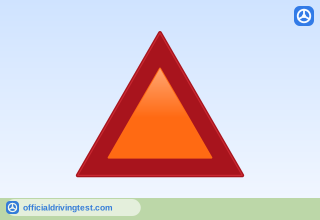
- Are driven only on streets within city limits
- Carry hazardous materials on public roads
- Are designed for a maximum speed of 25 mph or less
- Can travel faster than 55 mph on highways
Show answer
Correct answer: Are designed for a maximum speed of 25 mph or less
The slow-moving vehicle emblem is required for all slow-moving vehicles, defined as those designed to operate at a maximum speed of 25 mph or less, including farm and other machinery and machinery drawn by animals or slow-moving motor vehicles.
Source: Texas Driver Handbook (Revised January 2026), page 37
-
Where is it prohibited to display a slow-moving vehicle (SMV) emblem in Texas?
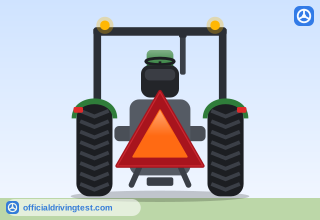
- On any vehicle or stationary object that is not actually a slow-moving vehicle
- On farm tractors and other slow farm equipment on public roads
- On animal-drawn buggies
- On road maintenance machinery that travels on public roads below 25 mph
Show answer
Correct answer: On any vehicle or stationary object that is not actually a slow-moving vehicle
The use of the slow-moving vehicle emblem is prohibited on anything other than a slow-moving vehicle. It must not be used on other vehicles or on stationary objects.
Source: Texas Driver Handbook (Revised January 2026), page 37
-
Which of the following is an exception to the slow-moving vehicle emblem requirement?
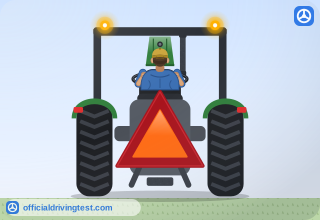
- Any vehicle traveling under 40 mph
- Any vehicle owned by a farmer, regardless of its speed
- Vehicles that operate only in daylight, between 6 a.m. and 6 p.m.
- Machinery towed by a slow-moving vehicle whose emblem remains visible
Show answer
Correct answer: Machinery towed by a slow-moving vehicle whose emblem remains visible
An implement or machinery being towed by a slow-moving vehicle bearing an emblem does not need its own emblem, as long as the towing vehicle's emblem remains visible. A vehicle used in actual construction work within a marked construction zone is also exempt.
Source: Texas Driver Handbook (Revised January 2026), page 37
-
Before moving into the passing lane to pass a truck, what should you do first?
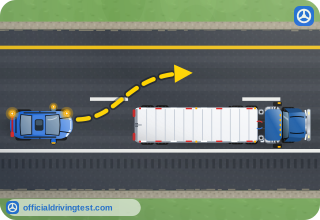
- Check to your front and rear, and check your mirrors and blind spots
- Flash your headlights and pull out immediately without checking your mirrors
- Wait for the truck driver to wave you into the lane
- Accelerate quickly so you spend less time in the passing lane
Show answer
Correct answer: Check to your front and rear, and check your mirrors and blind spots
Before passing a truck, check to your front and rear, check your mirrors and blind spots, then move into the passing lane only if it is clear and you are in a legal passing zone.
Source: Texas Driver Handbook (Revised January 2026), page 51
-
How should you let a truck driver know you are passing, especially at night?
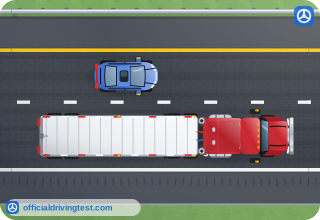
- By honking your horn repeatedly
- By flashing your headlights
- By turning on your hazard lights
- By tailgating closely until the driver notices
Show answer
Correct answer: By flashing your headlights
Let the truck driver know you are passing by flashing your headlights, especially at night.
Source: Texas Driver Handbook (Revised January 2026), page 51
-
On a level highway, about how much longer does it take to pass a truck compared to passing a car?
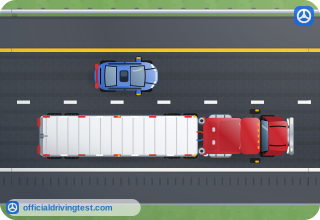
- One to two seconds longer
- Three to five seconds longer
- Ten to fifteen seconds longer
- It takes the same amount of time
Show answer
Correct answer: Three to five seconds longer
On a level highway, it takes three to five seconds longer to pass a truck than a car.
Source: Texas Driver Handbook (Revised January 2026), page 51
-
Why is it often easier to pass a truck when driving on an upgrade (uphill)?
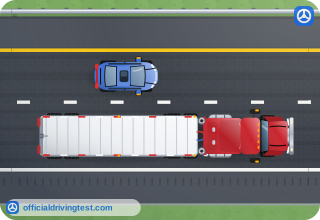
- The truck often loses speed going uphill
- Trucks are required by law to pull over on hills
- There is always an extra passing lane on hills
- Trucks are not allowed to use the left lane uphill
Show answer
Correct answer: The truck often loses speed going uphill
On an upgrade, a truck often loses speed, so it's easier to pass than a car.
Source: Texas Driver Handbook (Revised January 2026), page 51
-
Why might you need to increase your speed when passing a truck on a downgrade (downhill)?
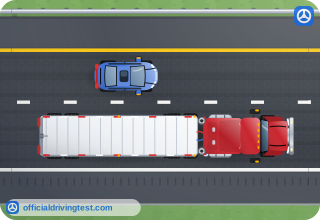
- The truck's momentum causes it to go faster going downhill
- Trucks are required to speed up on downgrades
- Downgrades always have lower speed limits for cars
- The truck driver will slow down to let you pass
Show answer
Correct answer: The truck's momentum causes it to go faster going downhill
On a downgrade, the truck's momentum causes it to go faster, so you may need to increase your speed to complete the pass.
Source: Texas Driver Handbook (Revised January 2026), page 51
-
If a truck driver flashes the truck's lights after you have passed, what does that signal mean?
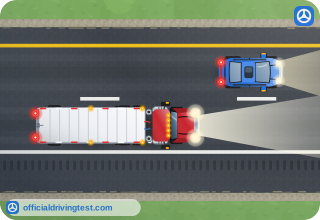
- That you should slow down and let the truck pass you back
- That there is a hazard ahead you should avoid
- That the truck driver wants you to stop
- That it is clear for you to pull back in front of the truck
Show answer
Correct answer: That it is clear for you to pull back in front of the truck
If the driver flashes the truck's lights after you pass, it's a signal that it is clear for you to pull back in front of the truck.
Source: Texas Driver Handbook (Revised January 2026), page 51
-
After passing a truck, when should you move back into the lane in front of it?
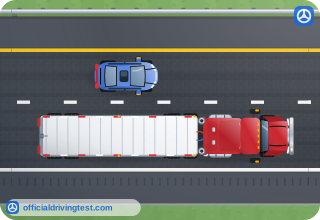
- Immediately after your rear bumper clears the truck's front bumper
- Whenever the truck driver honks the horn
- Only when you can see the entire front of the truck in your rearview mirror
- As soon as your vehicle is slightly ahead of the truck's front bumper
Show answer
Correct answer: Only when you can see the entire front of the truck in your rearview mirror
Be sure to move back only when you can see the entire front of the truck in your rearview mirror.
Source: Texas Driver Handbook (Revised January 2026), page 51
-
When a truck is passing you, what should you do to help the truck driver?
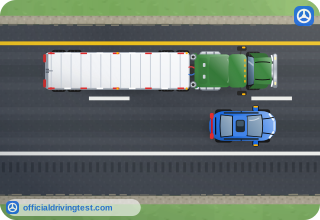
- Speed up to help the truck finish passing faster
- Move closer to the center line
- Flash your high beams at the truck driver
- Keep to the far side of your lane and slow down slightly
Show answer
Correct answer: Keep to the far side of your lane and slow down slightly
When a truck passes you, help the truck driver by keeping to the far side of your lane. You'll make it easier if you slightly reduce your speed and don't speed up.
Source: Texas Driver Handbook (Revised January 2026), page 51
-
When meeting a truck coming from the opposite direction, why should you keep as far to the side as possible?
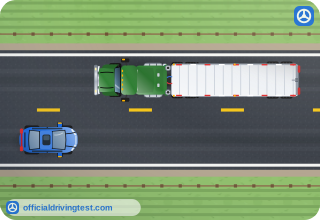
- Because the truck's headlights could blind you
- Because oncoming trucks always have the right-of-way
- So the truck driver can pass you more easily
- To avoid a sideswipe crash and reduce wind turbulence
Show answer
Correct answer: To avoid a sideswipe crash and reduce wind turbulence
When you meet a truck coming from the opposite direction, keep as far to the side as possible to avoid a sideswipe crash and to reduce the wind turbulence between the two vehicles. Turbulence pushes vehicles apart; it does not pull them together.
Source: Texas Driver Handbook (Revised January 2026), page 51
-
About how far can an average passenger car traveling 55 mph take to stop completely?
- About 100 feet
- About 240 feet, three-fourths of a football field
- About 400 feet, longer than a football field
- About 50 feet
Show answer
Correct answer: About 240 feet, three-fourths of a football field
The average passenger car traveling at 55 mph can stop in approximately 240 feet, which is about three-fourths the length of a football field.
Source: Texas Driver Handbook (Revised January 2026), page 51
-
About how far may a fully loaded tractor-trailer need to completely stop, traveling at the same speed as a car?
- About 150 feet, less than a car
- About 50 feet
- More than 400 feet, well over a football field
- About the same distance as a car, 240 feet
Show answer
Correct answer: More than 400 feet, well over a football field
A fully loaded tractor-trailer may take more than 400 feet to completely stop, well over the length of a football field, and much farther than a passenger car.
Source: Texas Driver Handbook (Revised January 2026), page 51
-
What is a good rule of thumb for avoiding a truck's blind spot when following it?
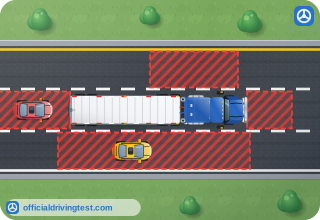
- Trucks have no blind spots at the rear
- Staying directly behind the trailer's center is always the safest spot
- If you can't see the truck driver in his side mirror, he can't see you
- As long as your headlights are on, the driver can always see you
Show answer
Correct answer: If you can't see the truck driver in his side mirror, he can't see you
An excellent rule of thumb for motorists sharing the road with a tractor-trailer is: if you can't see the truck driver in his side mirror, he can't see you. Avoid following too closely in the truck's rear blind spot.
Source: Texas Driver Handbook (Revised January 2026), page 51
4Part 418 questions
-
What should you do with your headlights when following a truck at night?
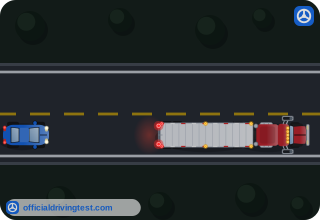
- Always use your high beams so the truck driver can see you better
- Turn your headlights off completely
- Flash your high beams continuously
- Always dim them, so they don't reflect off its mirrors and blind the driver
Show answer
Correct answer: Always dim them, so they don't reflect off its mirrors and blind the driver
When you follow a truck at night, always dim your headlights. Bright lights from a vehicle behind will blind the truck driver when the lights reflect off the truck's large side mirrors.
Source: Texas Driver Handbook (Revised January 2026), page 51
-
If you are stopped behind a truck on an upgrade (hill), what should you do?
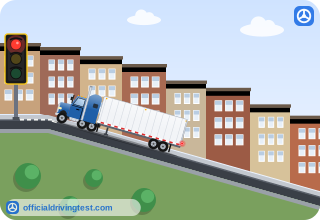
- Leave space in case it drifts back, and keep left in your lane
- Pull up as close as possible to save space on the hill
- Honk your horn continuously until the truck moves
- Move directly behind the center of the trailer
Show answer
Correct answer: Leave space in case it drifts back, and keep left in your lane
If you are stopped behind a truck on an upgrade, leave space in case the truck drifts back when it starts to move. Also, keep to the left in your lane so the driver can see you're stopped behind the truck.
Source: Texas Driver Handbook (Revised January 2026), page 51
-
Why should you avoid passing a truck on the right if it might be about to turn right?
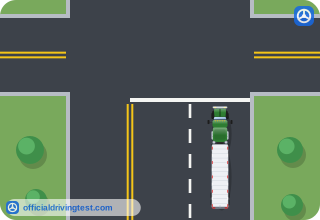
- The truck's exhaust makes visibility poor on the right side
- Trucks make wide right turns and may leave an open space on the right
- It is illegal to drive on the right side of any truck
- Trucks always signal a left turn even when turning right
Show answer
Correct answer: Trucks make wide right turns and may leave an open space on the right
Trucks make wide, right turns and sometimes leave an open space to the right just before the turn. To avoid a crash, don't pass a truck on the right if there is a possibility the truck might make a right turn.
Source: Texas Driver Handbook (Revised January 2026), page 51
-
What should you do if a truck is preparing to back up from a road into a loading area?
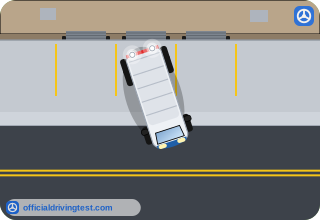
- Quickly drive behind the truck before it finishes backing up
- Honk and drive around it on the shoulder
- Flash your lights and proceed as normal
- Never cross behind it; wait for it to finish before trying to pass
Show answer
Correct answer: Never cross behind it; wait for it to finish before trying to pass
Never cross behind a truck preparing to back up. The road is temporarily blocked, and if you pass too closely behind the truck, a crash may occur because you are in the truck's blind spot.
Source: Texas Driver Handbook (Revised January 2026), page 51
-
On multi-lane highways, which lane do tractor-trailers typically stay in?
- The center lane, to help traffic flow
- The far-left lane at all times
- The far-right lane at all times
- Whichever lane has the least traffic
Show answer
Correct answer: The center lane, to help traffic flow
On multi-lane highways, tractor-trailers stay in the center lane to help the flow of local traffic on and off the highway and to increase the truck driver's options if he/she has to switch lanes to avoid a crash.
Source: Texas Driver Handbook (Revised January 2026), page 51
-
Why should you never cut in front of a truck to reach your exit or turn?
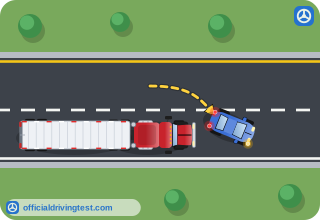
- It removes the truck driver's cushion of safety
- It is only dangerous at night
- The truck driver will simply speed up to avoid you
- It is fine as long as you use your turn signal
Show answer
Correct answer: It removes the truck driver's cushion of safety
Never cut in front of a truck. Cutting into the open space in front of a truck removes the driver's cushion of safety. Trying to beat a truck to a single-lane construction zone is particularly dangerous.
Source: Texas Driver Handbook (Revised January 2026), page 51
-
Why do many car-truck collisions at intersections happen?
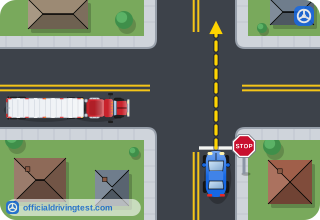
- Truck drivers are not required to obey traffic signals
- The car driver does not realize how close the truck is
- Trucks are not required to have working headlights
- Trucks are not visible from the front
Show answer
Correct answer: The car driver does not realize how close the truck is
Because of its large size, a tractor-trailer often appears to be traveling at a slower speed than it is. A substantial number of car and truck collisions take place at intersections because the driver of the car does not realize how close the truck is or how quickly it is approaching.
Source: Texas Driver Handbook (Revised January 2026), page 52
-
About what proportion of motorcycle crashes involve another vehicle?
- About one-tenth
- About one-half
- Almost all of them
- About one-fourth
Show answer
Correct answer: About one-half
Approximately one-half of all motorcycle crashes involve another vehicle.
Source: Texas Driver Handbook (Revised January 2026), page 52
-
According to the National Highway Traffic Safety Administration, how do a motorcyclist's odds of dying in a traffic crash compare to a passenger car occupant's?
- About the same
- About two times more likely
- About 35 times more likely
- Slightly less likely
Show answer
Correct answer: About 35 times more likely
According to the National Highway Traffic Safety Administration, motorcyclists are about 35 times more likely to die in a traffic crash than passenger car occupants.
Source: Texas Driver Handbook (Revised January 2026), page 52
-
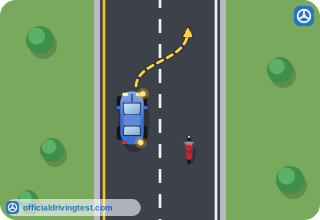
Which is a common reason drivers fail to see an approaching motorcyclist?
- Motorcyclists are not allowed to use turn signals
- Motorcycles travel only on designated motorcycle-only roads
- Many drivers tend to look for other cars, not for motorcyclists
- Motorcycles are required to have tinted headlights
Show answer
Correct answer: Many drivers tend to look for other cars, not for motorcyclists
Many drivers tend to look for other cars, not for motorcyclists. Other reasons include the motorcycle's smaller profile, difficulty judging its speed and distance, frequent lane movements, and distracted driving.
Source: Texas Driver Handbook (Revised January 2026), page 52
-
What is the most common type of crash between cars and motorcycles at an intersection?
- A car turning left in front of a motorcycle
- A motorcyclist rear-ending a stopped car
- Two motorcycles colliding head-on
- A car being sideswiped while parked
Show answer
Correct answer: A car turning left in front of a motorcycle
The most common crash between cars and motorcycles is at an intersection when the driver of a car is making a left turn in front of a motorcycle.
Source: Texas Driver Handbook (Revised January 2026), page 52
-
Why should you always check your mirrors and blind spots before entering or leaving a lane of traffic?
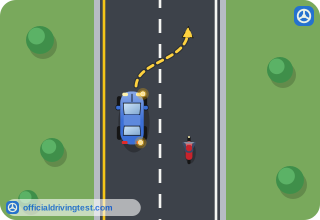
- Motorcyclists are often hidden in blind spots or missed because of their small size
- Checking them is only necessary on highways, not when driving on city streets
- It is only required at night
- Blind spots do not affect how well other drivers can see a motorcycle
Show answer
Correct answer: Motorcyclists are often hidden in blind spots or missed because of their small size
Motorcyclists are often hidden in a vehicle's blind spot or missed in a quick look due to their smaller size. Always make a visual check for motorcycles by checking mirrors and blind spots before entering or leaving a lane of traffic and at intersections.
Source: Texas Driver Handbook (Revised January 2026), page 52
-
Why can road hazards like potholes, gravel, railroad crossings, and wet surfaces be more dangerous for motorcyclists than for car drivers?
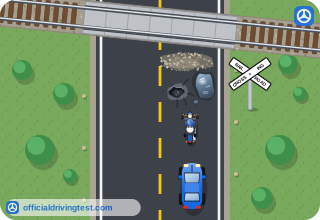
- They impair a motorcyclist's braking and handling
- Motorcycles are not equipped with brakes
- They only affect motorcycles at night
- Motorcyclists are required to stop completely at every pothole
Show answer
Correct answer: They impair a motorcyclist's braking and handling
Road conditions that are a minor annoyance to a car driver may pose a major hazard to motorcyclists. Potholes, gravel, railroad crossings, and wet or slippery surfaces impair the motorcyclists' braking and handling abilities, so they may suddenly change speed or position. Expect and allow room for such actions.
Source: Texas Driver Handbook (Revised January 2026), page 52
-
What can a strong gust of wind do to a motorcycle if the rider isn't prepared for it?
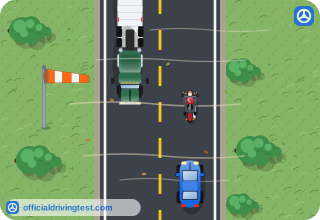
- Move it across an entire lane
- Cause its engine to stall completely
- Have no effect on a motorcycle at all
- Only affect it if it is parked
Show answer
Correct answer: Move it across an entire lane
A strong gust of wind can move a motorcycle across an entire lane if the rider isn't prepared for it. Wind gusts from large trucks in the other lane can also be a hazard.
Source: Texas Driver Handbook (Revised January 2026), page 52
-
How can a large vehicle such as a van, bus, or truck create a hazard for motorcyclists?
- It can block a motorcycle from a driver's view
- It has no effect on visibility for other drivers
- It always signals when a motorcycle is nearby
- It is required to keep an extra lane clear for motorcycles
Show answer
Correct answer: It can block a motorcycle from a driver's view
A large vehicle such as a van, bus, or truck can block a motorcycle from a driver's view, and the motorcyclist may seem to suddenly appear from nowhere.
Source: Texas Driver Handbook (Revised January 2026), page 52
-
When should you take a second look for motorcyclists, particularly?
- Only when driving on the highway
- Only during rainy weather
- Only when you already see a motorcycle nearby
- Before making a left turn at an intersection
Show answer
Correct answer: Before making a left turn at an intersection
Although you may not see any cars, be aware there may be a motorcycle. Be careful at intersections, and always take a second look for a motorcycle before turning at an intersection, particularly when making left turns.
Source: Texas Driver Handbook (Revised January 2026), page 52
-
Why shouldn't you assume a motorcycle's flashing turn signal means the rider is about to turn?
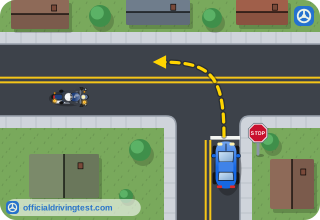
- The signals usually aren't self-canceling, and riders may leave them on
- Motorcycle turn signals are purely decorative and mean nothing
- Motorcycles are not legally required to use turn signals
- Motorcycle signals only work when the engine is off
Show answer
Correct answer: The signals usually aren't self-canceling, and riders may leave them on
Don't be fooled by a flashing turn signal. Motorcycle signals usually are not self-canceling and riders sometimes forget to turn them off. Wait to be sure the motorcycle is going to turn before you proceed.
Source: Texas Driver Handbook (Revised January 2026), page 52
-
How much of the traffic lane is a motorcyclist entitled to?
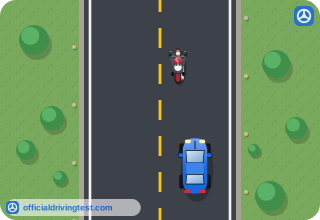
- Only half a lane, since a car can share the rest
- Only the shoulder of the road
- Whatever space is left over after cars have passed
- A full lane width; do not try to share the lane
Show answer
Correct answer: A full lane width; do not try to share the lane
Allow the motorcyclist a full lane width. Although it may seem as though there is enough room in the traffic lane for an automobile and a motorcycle, the motorcycle is entitled to a full lane and may need the room to maneuver safely. Do not attempt to share the lane with a motorcycle.
Source: Texas Driver Handbook (Revised January 2026), page 52
5Part 518 questions
-
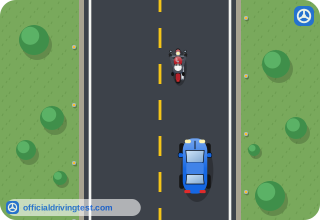
How much following distance should you allow when following a motorcycle?
- At least four to six seconds
- One second is enough
- There is no recommended following distance for motorcycles
- Exactly the same as one car length
Show answer
Correct answer: At least four to six seconds
Allow more following distance, at least four to six seconds, when following a motorcycle so the motorcyclist has enough time to maneuver or stop in an emergency.
Source: Texas Driver Handbook (Revised January 2026), page 53
-
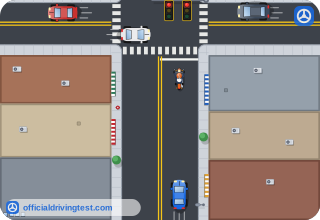
How far back is it recommended you stop when behind a motorcycle at an intersection, signal, or crossing?
- As close as possible, to save space at the intersection
- There is no need to leave any extra space
- Half a vehicle length
- A full vehicle length, in case your car is rear-ended
Show answer
Correct answer: A full vehicle length, in case your car is rear-ended
Stop a safe distance behind the motorcyclist at intersections, signals, or crossings. A full vehicle length is recommended to help prevent impact with the motorcycle should your vehicle suffer a rear-end collision.
Source: Texas Driver Handbook (Revised January 2026), page 53
-
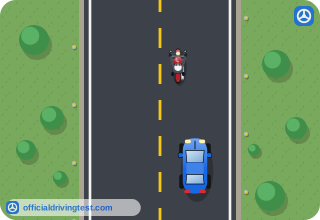
In dry conditions, how do motorcycles generally compare to cars when stopping?
- Motorcycles can stop more quickly than a car
- Motorcycles always take much longer to stop than a car
- Motorcycles and cars stop at exactly the same rate in all conditions
- Motorcycles cannot stop quickly under any circumstances
Show answer
Correct answer: Motorcycles can stop more quickly than a car
In dry conditions, motorcycles can stop more quickly than a car, so being aware and alert at all times can help prevent a collision.
Source: Texas Driver Handbook (Revised January 2026), page 53
-
What is the aim of the Texas Motorcycle Operator Training and Safety program?
- To manufacture motorcycle safety equipment
- To improve rider skills and reduce motorcycle crashes
- To issue motorcycle license plates
- To set statewide speed limits for motorcycles
Show answer
Correct answer: To improve rider skills and reduce motorcycle crashes
The Program's aim is to improve rider skills and reduce the number and severity of motorcycle crashes in Texas. It develops curriculum, monitors motorcycle training classes, and promotes motorcycle safety and awareness.
Source: Texas Driver Handbook (Revised January 2026), page 53
-
Which state agency administers the Motorcycle Operator Training and Safety program, after it moved from DPS in 2020?
- TxDOT (Texas Department of Transportation)
- The Texas Education Agency
- The Texas DMV
- TDLR (Texas Department of Licensing & Regulation)
Show answer
Correct answer: TDLR (Texas Department of Licensing & Regulation)
The Texas Legislature created the Motorcycle Operator Training and Safety program in 1983 and moved its administration from DPS to TDLR in 2020. A portion of each motorcycle license fee is used to support this program.
Source: Texas Driver Handbook (Revised January 2026), page 53
-
What rights and responsibilities does a person riding a bicycle have on the road?
- All of the rights and responsibilities of a driver of a vehicle
- None; bicycles are not considered vehicles
- Only the right to ride on sidewalks
- Only the responsibility to yield to all vehicles at all times
Show answer
Correct answer: All of the rights and responsibilities of a driver of a vehicle
A bicycle is a vehicle. Any person riding a bicycle has all of the rights and responsibilities as a driver of a vehicle.
Source: Texas Driver Handbook (Revised January 2026), page 53
-
Are bicyclists always restricted to the right lane of traffic?
- No, for example on one-way multi-lane streets or before a left turn
- Yes, bicyclists must always stay in the rightmost lane no matter what
- Yes, unless a police officer gives special permission
- Yes, bicyclists may never use any other lane
Show answer
Correct answer: No, for example on one-way multi-lane streets or before a left turn
Bicyclists are not restricted to the right lane of traffic. One-way, multi-lane streets are one example, as is when a bicyclist is changing lanes to make a left turn. Bicyclists should follow the same path any other vehicle would take traveling in the same direction.
Source: Texas Driver Handbook (Revised January 2026), page 53
-
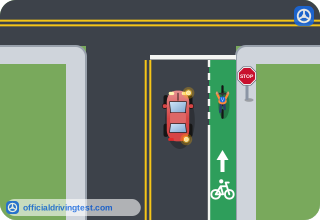
What should a motorist do when preparing for a right turn near bicycle traffic?
- Merge with the bicycle traffic and avoid turning directly across its path
- Turn quickly in front of any bicyclist to complete the turn faster
- Stay in the leftmost lane regardless of bicycle traffic
- Sound the horn until the bicyclist stops
Show answer
Correct answer: Merge with the bicycle traffic and avoid turning directly across its path
A motorist should merge with bicycle traffic when preparing for a right turn. Avoid turning directly across the path of bicycle traffic.
Source: Texas Driver Handbook (Revised January 2026), page 53
-
When are bicyclists required to ride as far to the right in the lane as possible?
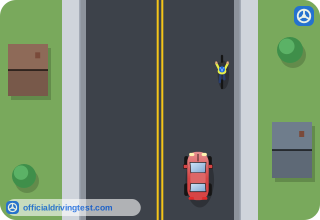
- Only when the lane can be shared safely side-by-side
- At all times, with no exceptions whatsoever
- Only on highways with a speed limit above 55 mph
- Only when a police officer is present
Show answer
Correct answer: Only when the lane can be shared safely side-by-side
Bicyclists are required to ride as far to the right in the lane as possible only when the lane can be shared safely by a car and a bicycle, side-by-side. There are certain conditions that still allow a bicyclist to take the full lane.
Source: Texas Driver Handbook (Revised January 2026), page 53
-
Under which condition may a bicyclist leave the right side of the lane and take the full lane?
- When preparing for a left turn at an intersection or onto a private road or driveway
- Whenever the bicyclist simply prefers to have more space or wants to ride a little faster
- Only between the hours of 9 a.m. and 5 p.m.
- Only if the bicyclist is wearing a helmet
Show answer
Correct answer: When preparing for a left turn at an intersection or onto a private road or driveway
A bicyclist may take the full lane when preparing for a left turn at an intersection or onto a private road or driveway.
Source: Texas Driver Handbook (Revised January 2026), page 53
-
Which unsafe road condition allows a bicyclist to move away from the right side of the lane?
- Parked vehicles, animals, potholes, or debris
- Bright sunshine
- Light traffic with no other vehicles nearby
- A posted speed limit sign
Show answer
Correct answer: Parked vehicles, animals, potholes, or debris
A bicyclist may take the full lane when there are unsafe conditions in the road, such as fixed or moving objects, parked or moving vehicles, pedestrians, animals, potholes, or debris.
Source: Texas Driver Handbook (Revised January 2026), page 53
-
When a lane is of substandard width, making it unsafe for a car and bicycle to share it side-by-side, what is best for the cyclist to do?
- Ride on the sidewalk at all times instead
- Stop and wait for the lane to widen
- Ride only as far left as possible, in the oncoming lane
- Take the full lane, whether riding single file or two abreast
Show answer
Correct answer: Take the full lane, whether riding single file or two abreast
The lane may be of substandard width, making it unsafe for a car and a bicycle to safely share the lane side-by-side. When this is the case, it is best for the cyclist to take the full lane, whether riding single file or two abreast.
Source: Texas Driver Handbook (Revised January 2026), page 53
-
What is the most common car-bicycle crash caused by a motorist at an intersection?
- A car turns left in front of an oncoming bicycle
- A bicyclist rear-ends a stopped car
- Two bicyclists collide with each other
- A parked car is sideswiped by a bicyclist
Show answer
Correct answer: A car turns left in front of an oncoming bicycle
The most common car-bicycle crashes caused by a motorist include a motorist turning left in front of oncoming bicycle traffic; oncoming bicycle traffic is often overlooked or its speed misjudged.
Source: Texas Driver Handbook (Revised January 2026), page 53
-
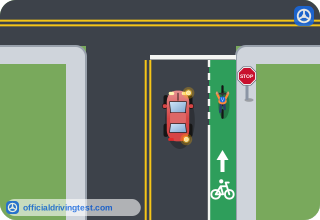
What should a motorist do to safely turn right across the path of a bicyclist?
- Speed up to clear the bicyclist's path before turning
- Sound the horn and turn immediately
- Stop in the bicyclist's lane and wait for a signal from the bicyclist
- Slow down and merge with the bicycle traffic for a safe right turn
Show answer
Correct answer: Slow down and merge with the bicycle traffic for a safe right turn
A motorist turns right across the path of the bicycle. The motorist should slow down and merge with the bicycle traffic for a safe right turn.
Source: Texas Driver Handbook (Revised January 2026), page 53
-
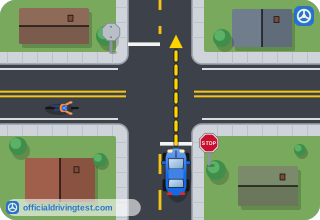
A motorist pulls away from a stop sign and fails to yield the right-of-way to bicycle cross traffic. What rule applies here?
- Bicycles must always yield to motor vehicles at stop signs, regardless of who arrived first
- Right-of-way at a stop sign is determined by vehicle size
- At intersections, right-of-way rules apply equally to motor vehicles and bicycles
- Right-of-way rules only apply to motor vehicles, not bicycles
Show answer
Correct answer: At intersections, right-of-way rules apply equally to motor vehicles and bicycles
A common car-bicycle crash occurs when a motorist pulls away from a stop sign and fails to yield the right-of-way to bicycle cross traffic. At intersections, the right-of-way rules apply equally to motor vehicles and bicycles.
Source: Texas Driver Handbook (Revised January 2026), page 54
-
Which regulations should a bicycle rider observe on the road?
- Bicyclists never need to signal turns
- Bicyclists must obey all traffic laws and signal turns
- Bicycles are exempt from all traffic laws
- Bicyclists may ride against traffic at any time
Show answer
Correct answer: Bicyclists must obey all traffic laws and signal turns
Bicyclists must obey the same traffic laws, signs, and signals as motor vehicle drivers and use proper hand signals when turning or stopping.
Source: Texas Driver Handbook (Revised January 2026), page 62
-
When is a bicyclist not required to ride at the right side of the roadway?
- Only when riding with a group of ten or more
- When passing, preparing to turn left, or avoiding hazards
- Never; bicyclists must always ride at the far right
- Only on weekends
Show answer
Correct answer: When passing, preparing to turn left, or avoiding hazards
A bicyclist may move away from the right side of the road when passing, preparing for a left turn, avoiding hazards, or when the lane is too narrow to share safely.
Source: Texas Driver Handbook (Revised January 2026), page 62
-
When are bicyclists allowed to ride two abreast in a traffic lane?
- When they do not impede traffic flow
- At all times, regardless of traffic
- Only on interstate highways
- Never; it is always illegal
Show answer
Correct answer: When they do not impede traffic flow
Bicyclists may ride two abreast within a single lane as long as doing so does not impede the normal flow of traffic.
Source: Texas Driver Handbook (Revised January 2026), page 62