Texas: Sharing the road — Part 4 Practice Test
Questions in this part include: “On multi-lane highways, which lane do tractor-trailers typically stay in?” · “What is the most common type of crash between cars and motorcycles at an intersection?”
Independent educational site · not affiliated with any government agency or DMV
Ready? Test yourself
- Instant feedback with an explanation
- Every answer cites its source in the manual
- Your best score is saved on this device
Questions are original and based on the official manual "Texas Driver Handbook" (Revised January 2026), Texas Department of Public Safety (DPS).
All 18 questions in this practice test
Take the test above first, then use this list to study. Tap “Show answer” to see the correct answer and explanation.
Show the questions and answersHide the questions
-
What should you do with your headlights when following a truck at night?
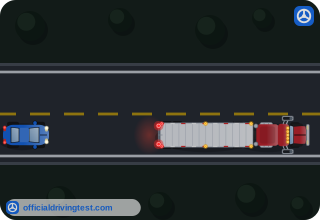
- Always use your high beams so the truck driver can see you better
- Turn your headlights off completely
- Flash your high beams continuously
- Always dim them, so they don't reflect off its mirrors and blind the driver
Show answer
Correct answer: Always dim them, so they don't reflect off its mirrors and blind the driver
When you follow a truck at night, always dim your headlights. Bright lights from a vehicle behind will blind the truck driver when the lights reflect off the truck's large side mirrors.
Source: Texas Driver Handbook (Revised January 2026), page 51
-
If you are stopped behind a truck on an upgrade (hill), what should you do?
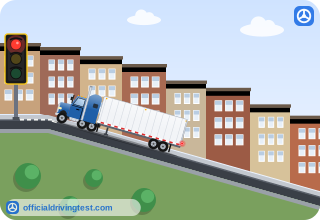
- Leave space in case it drifts back, and keep left in your lane
- Pull up as close as possible to save space on the hill
- Honk your horn continuously until the truck moves
- Move directly behind the center of the trailer
Show answer
Correct answer: Leave space in case it drifts back, and keep left in your lane
If you are stopped behind a truck on an upgrade, leave space in case the truck drifts back when it starts to move. Also, keep to the left in your lane so the driver can see you're stopped behind the truck.
Source: Texas Driver Handbook (Revised January 2026), page 51
-
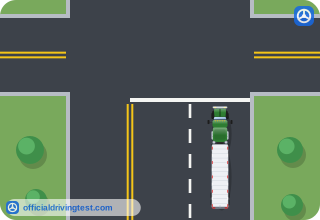
Why should you avoid passing a truck on the right if it might be about to turn right?
- The truck's exhaust makes visibility poor on the right side
- Trucks make wide right turns and may leave an open space on the right
- It is illegal to drive on the right side of any truck
- Trucks always signal a left turn even when turning right
Show answer
Correct answer: Trucks make wide right turns and may leave an open space on the right
Trucks make wide, right turns and sometimes leave an open space to the right just before the turn. To avoid a crash, don't pass a truck on the right if there is a possibility the truck might make a right turn.
Source: Texas Driver Handbook (Revised January 2026), page 51
-
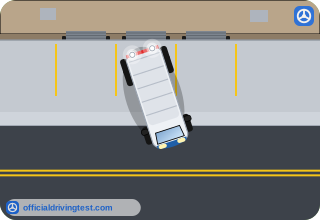
What should you do if a truck is preparing to back up from a road into a loading area?
- Quickly drive behind the truck before it finishes backing up
- Honk and drive around it on the shoulder
- Flash your lights and proceed as normal
- Never cross behind it; wait for it to finish before trying to pass
Show answer
Correct answer: Never cross behind it; wait for it to finish before trying to pass
Never cross behind a truck preparing to back up. The road is temporarily blocked, and if you pass too closely behind the truck, a crash may occur because you are in the truck's blind spot.
Source: Texas Driver Handbook (Revised January 2026), page 51
-
On multi-lane highways, which lane do tractor-trailers typically stay in?
- The center lane, to help traffic flow
- The far-left lane at all times
- The far-right lane at all times
- Whichever lane has the least traffic
Show answer
Correct answer: The center lane, to help traffic flow
On multi-lane highways, tractor-trailers stay in the center lane to help the flow of local traffic on and off the highway and to increase the truck driver's options if he/she has to switch lanes to avoid a crash.
Source: Texas Driver Handbook (Revised January 2026), page 51
-
Why should you never cut in front of a truck to reach your exit or turn?
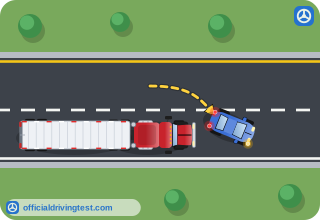
- It removes the truck driver's cushion of safety
- It is only dangerous at night
- The truck driver will simply speed up to avoid you
- It is fine as long as you use your turn signal
Show answer
Correct answer: It removes the truck driver's cushion of safety
Never cut in front of a truck. Cutting into the open space in front of a truck removes the driver's cushion of safety. Trying to beat a truck to a single-lane construction zone is particularly dangerous.
Source: Texas Driver Handbook (Revised January 2026), page 51
-
Why do many car-truck collisions at intersections happen?
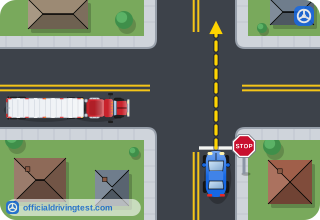
- Truck drivers are not required to obey traffic signals
- The car driver does not realize how close the truck is
- Trucks are not required to have working headlights
- Trucks are not visible from the front
Show answer
Correct answer: The car driver does not realize how close the truck is
Because of its large size, a tractor-trailer often appears to be traveling at a slower speed than it is. A substantial number of car and truck collisions take place at intersections because the driver of the car does not realize how close the truck is or how quickly it is approaching.
Source: Texas Driver Handbook (Revised January 2026), page 52
-
About what proportion of motorcycle crashes involve another vehicle?
- About one-tenth
- About one-half
- Almost all of them
- About one-fourth
Show answer
Correct answer: About one-half
Approximately one-half of all motorcycle crashes involve another vehicle.
Source: Texas Driver Handbook (Revised January 2026), page 52
-
According to the National Highway Traffic Safety Administration, how do a motorcyclist's odds of dying in a traffic crash compare to a passenger car occupant's?
- About the same
- About two times more likely
- About 35 times more likely
- Slightly less likely
Show answer
Correct answer: About 35 times more likely
According to the National Highway Traffic Safety Administration, motorcyclists are about 35 times more likely to die in a traffic crash than passenger car occupants.
Source: Texas Driver Handbook (Revised January 2026), page 52
-
Which is a common reason drivers fail to see an approaching motorcyclist?
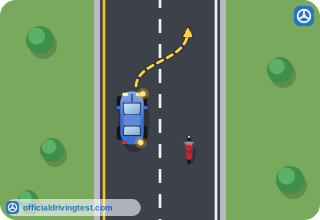
- Motorcyclists are not allowed to use turn signals
- Motorcycles travel only on designated motorcycle-only roads
- Many drivers tend to look for other cars, not for motorcyclists
- Motorcycles are required to have tinted headlights
Show answer
Correct answer: Many drivers tend to look for other cars, not for motorcyclists
Many drivers tend to look for other cars, not for motorcyclists. Other reasons include the motorcycle's smaller profile, difficulty judging its speed and distance, frequent lane movements, and distracted driving.
Source: Texas Driver Handbook (Revised January 2026), page 52
-
What is the most common type of crash between cars and motorcycles at an intersection?
- A car turning left in front of a motorcycle
- A motorcyclist rear-ending a stopped car
- Two motorcycles colliding head-on
- A car being sideswiped while parked
Show answer
Correct answer: A car turning left in front of a motorcycle
The most common crash between cars and motorcycles is at an intersection when the driver of a car is making a left turn in front of a motorcycle.
Source: Texas Driver Handbook (Revised January 2026), page 52
-
Why should you always check your mirrors and blind spots before entering or leaving a lane of traffic?
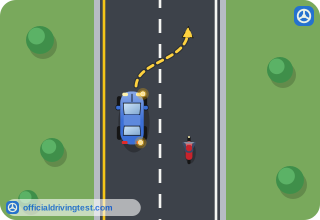
- Motorcyclists are often hidden in blind spots or missed because of their small size
- Checking them is only necessary on highways, not when driving on city streets
- It is only required at night
- Blind spots do not affect how well other drivers can see a motorcycle
Show answer
Correct answer: Motorcyclists are often hidden in blind spots or missed because of their small size
Motorcyclists are often hidden in a vehicle's blind spot or missed in a quick look due to their smaller size. Always make a visual check for motorcycles by checking mirrors and blind spots before entering or leaving a lane of traffic and at intersections.
Source: Texas Driver Handbook (Revised January 2026), page 52
-
Why can road hazards like potholes, gravel, railroad crossings, and wet surfaces be more dangerous for motorcyclists than for car drivers?
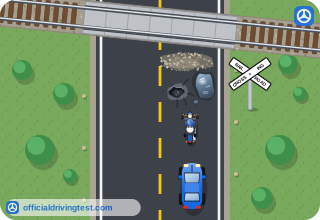
- They impair a motorcyclist's braking and handling
- Motorcycles are not equipped with brakes
- They only affect motorcycles at night
- Motorcyclists are required to stop completely at every pothole
Show answer
Correct answer: They impair a motorcyclist's braking and handling
Road conditions that are a minor annoyance to a car driver may pose a major hazard to motorcyclists. Potholes, gravel, railroad crossings, and wet or slippery surfaces impair the motorcyclists' braking and handling abilities, so they may suddenly change speed or position. Expect and allow room for such actions.
Source: Texas Driver Handbook (Revised January 2026), page 52
-
What can a strong gust of wind do to a motorcycle if the rider isn't prepared for it?
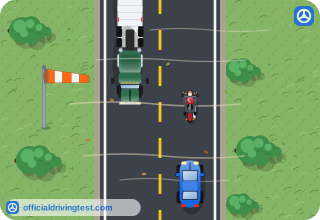
- Move it across an entire lane
- Cause its engine to stall completely
- Have no effect on a motorcycle at all
- Only affect it if it is parked
Show answer
Correct answer: Move it across an entire lane
A strong gust of wind can move a motorcycle across an entire lane if the rider isn't prepared for it. Wind gusts from large trucks in the other lane can also be a hazard.
Source: Texas Driver Handbook (Revised January 2026), page 52
-
How can a large vehicle such as a van, bus, or truck create a hazard for motorcyclists?
- It can block a motorcycle from a driver's view
- It has no effect on visibility for other drivers
- It always signals when a motorcycle is nearby
- It is required to keep an extra lane clear for motorcycles
Show answer
Correct answer: It can block a motorcycle from a driver's view
A large vehicle such as a van, bus, or truck can block a motorcycle from a driver's view, and the motorcyclist may seem to suddenly appear from nowhere.
Source: Texas Driver Handbook (Revised January 2026), page 52
-
When should you take a second look for motorcyclists, particularly?
- Only when driving on the highway
- Only during rainy weather
- Only when you already see a motorcycle nearby
- Before making a left turn at an intersection
Show answer
Correct answer: Before making a left turn at an intersection
Although you may not see any cars, be aware there may be a motorcycle. Be careful at intersections, and always take a second look for a motorcycle before turning at an intersection, particularly when making left turns.
Source: Texas Driver Handbook (Revised January 2026), page 52
-
Why shouldn't you assume a motorcycle's flashing turn signal means the rider is about to turn?
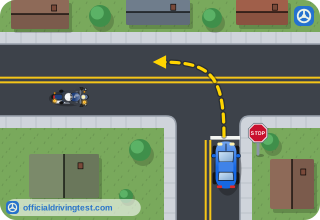
- The signals usually aren't self-canceling, and riders may leave them on
- Motorcycle turn signals are purely decorative and mean nothing
- Motorcycles are not legally required to use turn signals
- Motorcycle signals only work when the engine is off
Show answer
Correct answer: The signals usually aren't self-canceling, and riders may leave them on
Don't be fooled by a flashing turn signal. Motorcycle signals usually are not self-canceling and riders sometimes forget to turn them off. Wait to be sure the motorcycle is going to turn before you proceed.
Source: Texas Driver Handbook (Revised January 2026), page 52
-
How much of the traffic lane is a motorcyclist entitled to?
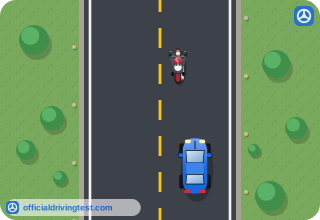
- Only half a lane, since a car can share the rest
- Only the shoulder of the road
- Whatever space is left over after cars have passed
- A full lane width; do not try to share the lane
Show answer
Correct answer: A full lane width; do not try to share the lane
Allow the motorcyclist a full lane width. Although it may seem as though there is enough room in the traffic lane for an automobile and a motorcycle, the motorcycle is entitled to a full lane and may need the room to maneuver safely. Do not attempt to share the lane with a motorcycle.
Source: Texas Driver Handbook (Revised January 2026), page 52