Texas: Sharing the road — Part 1 Practice Test
Questions in this part include: “Under Texas law, how is a bicycle classified for traffic purposes?” · “According to the Texas Driver Handbook, where may a person ride on a bicycle?”
Independent educational site · not affiliated with any government agency or DMV
Ready? Test yourself
Answer to start, or tap Start below:
Under Texas law, how is a bicycle classified for traffic purposes?
- Instant feedback with an explanation
- Every answer cites its source in the manual
- Your best score is saved on this device
- Keyboard: press 1 to 4 to answer and Enter for the next question
Questions are original and based on the official manual "Texas Driver Handbook" (Revised January 2026), Texas Department of Public Safety (DPS).
All 18 questions in this practice test
Take the test above first, then use this list to study. Tap “Show answer” to see the correct answer and explanation.
Show the questions and answersHide the questions
-
Under Texas law, how is a bicycle classified for traffic purposes?
- As a vehicle, with the same rights and responsibilities as a driver
- As a pedestrian device with no traffic law obligations
- As a toy not subject to any traffic regulation
- As a motor vehicle requiring registration and license plates
Show answer
Correct answer: As a vehicle, with the same rights and responsibilities as a driver
A bicycle is a vehicle, and a person riding one has the same rights and responsibilities as a driver operating a motor vehicle, unless a rule cannot by its nature apply to a bicyclist.
Source: Texas Driver Handbook (Revised January 2026), page 62
-
What happens if a bicyclist violates a traffic law in Texas?
- Nothing, since bicycles are not motor vehicles
- They face a driver's penalties, and a conviction goes on their driver record
- Only a verbal warning can be issued
- The violation is recorded but can never affect a driver's record
Show answer
Correct answer: They face a driver's penalties, and a conviction goes on their driver record
A person operating a bicycle is subject to the same penalties as a motor vehicle operator for violating traffic law, and all traffic convictions, whether on a bicycle or in a motor vehicle, go on the individual's driver record.
Source: Texas Driver Handbook (Revised January 2026), page 62
-
Which of the following is a rule bicyclists must follow according to the Texas Driver Handbook?
- Bicyclists may roll through stop signs if no traffic is present
- Bicyclists must obey all traffic laws, signs, and signals
- Bicyclists only need to obey signs, not signals
- Traffic laws apply to bicyclists only during daytime
Show answer
Correct answer: Bicyclists must obey all traffic laws, signs, and signals
Bicyclists must always obey all traffic laws, signs, and signals, and must stop at all stop signs and red lights, just like motor vehicle drivers.
Source: Texas Driver Handbook (Revised January 2026), page 62
-
In which direction must a bicyclist ride relative to traffic?
- Against the flow of traffic so they can see approaching vehicles
- In whichever direction is most convenient at the time
- Always with the flow of traffic, never opposite it
- On the left side of the road only, regardless of traffic flow
Show answer
Correct answer: Always with the flow of traffic, never opposite it
A bicyclist must always ride with the flow of traffic and should never ride opposite the flow of traffic.
Source: Texas Driver Handbook (Revised January 2026), page 62
-
According to the Texas Driver Handbook, where may a person ride on a bicycle?
- Anywhere on the frame as long as they can reach the pedals
- Only on or astride a permanent and regular seat
- On the handlebars, if wearing a helmet
- Standing on the pedals at all times
Show answer
Correct answer: Only on or astride a permanent and regular seat
A bicyclist may only ride on or astride a permanent and regular seat.
Source: Texas Driver Handbook (Revised January 2026), page 62
-
When riding a bicycle on a one-way road with two or more marked traffic lanes, where should the bicyclist ride?
- In the center of the rightmost lane
- On the painted line between two marked traffic lanes
- In the middle lane only
- As near as possible to the left curb or edge of the road
Show answer
Correct answer: As near as possible to the left curb or edge of the road
On a one-way road with two or more marked traffic lanes, a bicyclist should ride as near as possible to the left curb or edge of the road.
Source: Texas Driver Handbook (Revised January 2026), page 62
-
What must bicyclists riding two abreast do on a road with marked lanes?
- Ride in a single lane and not impede traffic
- Occupy two full lanes to increase visibility
- Ride only on sidewalks
- Alternate which rider is in front every mile
Show answer
Correct answer: Ride in a single lane and not impede traffic
Individuals riding two abreast on a laned road must ride in a single lane and not impede the flow of traffic.
Source: Texas Driver Handbook (Revised January 2026), page 62
-
According to the handbook, where else may bicyclists legally ride besides the travel lane?
- On the shoulder of the road
- On any sidewalk, regardless of local rules
- In the emergency lane of a freeway only
- Bicyclists may not ride anywhere except a marked bicycle lane
Show answer
Correct answer: On the shoulder of the road
Bicyclists may ride on the shoulder of the road.
Source: Texas Driver Handbook (Revised January 2026), page 62
-
How may a bicyclist signal a right turn in Texas?

- Left arm pointed downward, or right arm pointing up
- Right arm pointed downward
- Left arm pointing up, or right arm pointed horizontally
- Left arm pointed horizontally only
Show answer
Correct answer: Left arm pointing up, or right arm pointed horizontally
A right turn is signaled using either the left arm pointing up or the right arm pointed horizontally.
Source: Texas Driver Handbook (Revised January 2026), page 62
-
How does a bicyclist signal a left turn?

- Right arm pointed horizontally
- Left arm pointed horizontally
- Left arm pointing up
- Right arm pointing up
Show answer
Correct answer: Left arm pointed horizontally
A left turn is signaled by pointing the left arm horizontally.
Source: Texas Driver Handbook (Revised January 2026), page 62
-
How does a bicyclist signal that they are about to stop?
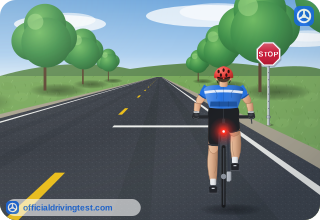
- Both arms raised overhead
- Left arm pointed horizontally
- Left arm pointed downward
- Right arm pointed downward
Show answer
Correct answer: Left arm pointed downward
A stop is signaled using the left arm pointed downward.
Source: Texas Driver Handbook (Revised January 2026), page 62
-
A bicyclist moving slower than other traffic must generally ride:
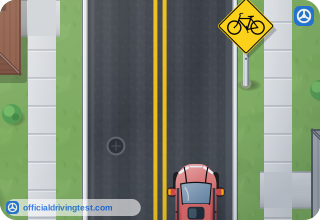
- In the center of the travel lane
- As near as possible to the right curb or edge of the road
- On the left side of the road, against the flow of traffic
- Only in a designated bicycle lane, never near the curb
Show answer
Correct answer: As near as possible to the right curb or edge of the road
A person operating a bicycle who is moving slower than other traffic shall ride as near as possible to the right curb or edge of the road, unless an exception applies.
Source: Texas Driver Handbook (Revised January 2026), page 62
-
Which of these is NOT listed as an exception allowing a slower bicyclist to move away from the right curb or edge of the road?
- Preparing for a left turn at an intersection
- Overtaking and passing another vehicle going the same direction
- Riding at night to be more visible
- Avoiding unsafe conditions such as potholes or debris
Show answer
Correct answer: Riding at night to be more visible
The exceptions listed are overtaking another vehicle, preparing for a left turn, unsafe road conditions, and certain narrow outside lanes. Riding at night is not one of the listed exceptions.
Source: Texas Driver Handbook (Revised January 2026), page 62
-
A bicyclist may also ride away from the right edge of the road when the outside lane is:
- Wider than 14 feet and has a designated bicycle lane
- Less than 14 feet wide and has no adjacent bicycle lane
- Freshly paved and free of potholes or debris
- Marked exclusively for buses
Show answer
Correct answer: Less than 14 feet wide and has no adjacent bicycle lane
A bicyclist may move away from the right edge when the outside lane is less than 14 feet wide and lacks an adjacent designated bicycle lane, or when the lane is too narrow for a bicycle and motor vehicle to safely travel side by side.
Source: Texas Driver Handbook (Revised January 2026), page 62
-
According to the handbook's 'Don'ts,' a bicyclist should never:
- Use hand signals to indicate turns
- Ride on the shoulder of the road when traffic is heavy
- Carry more people than the bicycle is designed or equipped for
- Ride during daylight hours
Show answer
Correct answer: Carry more people than the bicycle is designed or equipped for
A bicyclist should never carry more individuals than the bicycle is designed or equipped for.
Source: Texas Driver Handbook (Revised January 2026), page 62
-
What is prohibited regarding attaching a bicycle to another vehicle?
- Bicyclists may attach themselves to a moving streetcar or vehicle if wearing a helmet
- A bicyclist must never attach the bicycle or themselves to a moving streetcar or vehicle upon a road
- Only attaching to buses is prohibited
- Attaching is allowed at speeds under 10 mph
Show answer
Correct answer: A bicyclist must never attach the bicycle or themselves to a moving streetcar or vehicle upon a road
A bicyclist must never attach the bicycle or person to a moving streetcar or vehicle upon a road.
Source: Texas Driver Handbook (Revised January 2026), page 62
-
A bicyclist should never carry a package, bundle, or article that:
- Is carried in a basket mounted on the front of the bicycle
- Prevents the rider from keeping at least one hand on the handlebars
- Weighs less than 10 pounds
- Is visible to other traffic
Show answer
Correct answer: Prevents the rider from keeping at least one hand on the handlebars
A bicyclist should never carry any package, bundle, or article which prevents the rider from keeping at least one hand on the handlebars.
Source: Texas Driver Handbook (Revised January 2026), page 62
-
What is one purpose of the shared lane marking (sharrow) on Texas roads?
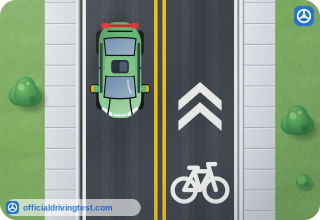
- To mark a lane exclusively for bicycles that motor vehicles may never enter
- To alert road users to where bicyclists are likely to ride in the road
- To indicate a designated bicycle parking area
- To replace the need for bicyclists to obey traffic signals
Show answer
Correct answer: To alert road users to where bicyclists are likely to ride in the road
The shared lane marking helps bicyclists position themselves to reduce the chance of hitting an opening car door, helps with positioning in narrow lanes, alerts road users to bicyclists' likely location, encourages safe passing, and reduces wrong-way bicycling.
Source: Texas Driver Handbook (Revised January 2026), page 62