Texas: Sharing the road — Part 5 Practice Test
Questions in this part include: “What is the aim of the Texas Motorcycle Operator Training and Safety program?” · “Which unsafe road condition allows a bicyclist to move away from the right side of the lane?”
Independent educational site · not affiliated with any government agency or DMV
Ready? Test yourself
- Instant feedback with an explanation
- Every answer cites its source in the manual
- Your best score is saved on this device
Questions are original and based on the official manual "Texas Driver Handbook" (Revised January 2026), Texas Department of Public Safety (DPS).
All 18 questions in this practice test
Take the test above first, then use this list to study. Tap “Show answer” to see the correct answer and explanation.
Show the questions and answersHide the questions
-
How much following distance should you allow when following a motorcycle?
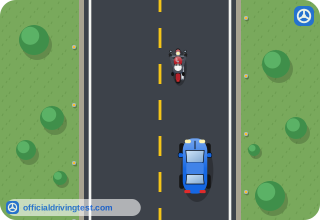
- At least four to six seconds
- One second is enough
- There is no recommended following distance for motorcycles
- Exactly the same as one car length
Show answer
Correct answer: At least four to six seconds
Allow more following distance, at least four to six seconds, when following a motorcycle so the motorcyclist has enough time to maneuver or stop in an emergency.
Source: Texas Driver Handbook (Revised January 2026), page 53
-
How far back is it recommended you stop when behind a motorcycle at an intersection, signal, or crossing?
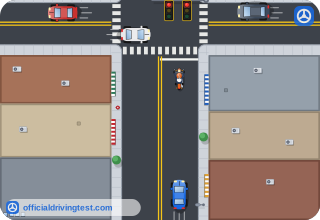
- As close as possible, to save space at the intersection
- There is no need to leave any extra space
- Half a vehicle length
- A full vehicle length, in case your car is rear-ended
Show answer
Correct answer: A full vehicle length, in case your car is rear-ended
Stop a safe distance behind the motorcyclist at intersections, signals, or crossings. A full vehicle length is recommended to help prevent impact with the motorcycle should your vehicle suffer a rear-end collision.
Source: Texas Driver Handbook (Revised January 2026), page 53
-
In dry conditions, how do motorcycles generally compare to cars when stopping?
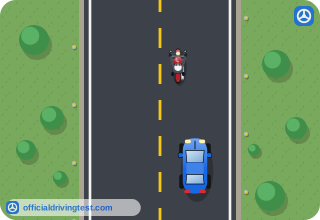
- Motorcycles can stop more quickly than a car
- Motorcycles always take much longer to stop than a car
- Motorcycles and cars stop at exactly the same rate in all conditions
- Motorcycles cannot stop quickly under any circumstances
Show answer
Correct answer: Motorcycles can stop more quickly than a car
In dry conditions, motorcycles can stop more quickly than a car, so being aware and alert at all times can help prevent a collision.
Source: Texas Driver Handbook (Revised January 2026), page 53
-
What is the aim of the Texas Motorcycle Operator Training and Safety program?
- To manufacture motorcycle safety equipment
- To improve rider skills and reduce motorcycle crashes
- To issue motorcycle license plates
- To set statewide speed limits for motorcycles
Show answer
Correct answer: To improve rider skills and reduce motorcycle crashes
The Program's aim is to improve rider skills and reduce the number and severity of motorcycle crashes in Texas. It develops curriculum, monitors motorcycle training classes, and promotes motorcycle safety and awareness.
Source: Texas Driver Handbook (Revised January 2026), page 53
-
Which state agency administers the Motorcycle Operator Training and Safety program, after it moved from DPS in 2020?
- TxDOT (Texas Department of Transportation)
- The Texas Education Agency
- The Texas DMV
- TDLR (Texas Department of Licensing & Regulation)
Show answer
Correct answer: TDLR (Texas Department of Licensing & Regulation)
The Texas Legislature created the Motorcycle Operator Training and Safety program in 1983 and moved its administration from DPS to TDLR in 2020. A portion of each motorcycle license fee is used to support this program.
Source: Texas Driver Handbook (Revised January 2026), page 53
-
What rights and responsibilities does a person riding a bicycle have on the road?
- All of the rights and responsibilities of a driver of a vehicle
- None; bicycles are not considered vehicles
- Only the right to ride on sidewalks
- Only the responsibility to yield to all vehicles at all times
Show answer
Correct answer: All of the rights and responsibilities of a driver of a vehicle
A bicycle is a vehicle. Any person riding a bicycle has all of the rights and responsibilities as a driver of a vehicle.
Source: Texas Driver Handbook (Revised January 2026), page 53
-
Are bicyclists always restricted to the right lane of traffic?
- No, for example on one-way multi-lane streets or before a left turn
- Yes, bicyclists must always stay in the rightmost lane no matter what
- Yes, unless a police officer gives special permission
- Yes, bicyclists may never use any other lane
Show answer
Correct answer: No, for example on one-way multi-lane streets or before a left turn
Bicyclists are not restricted to the right lane of traffic. One-way, multi-lane streets are one example, as is when a bicyclist is changing lanes to make a left turn. Bicyclists should follow the same path any other vehicle would take traveling in the same direction.
Source: Texas Driver Handbook (Revised January 2026), page 53
-
What should a motorist do when preparing for a right turn near bicycle traffic?
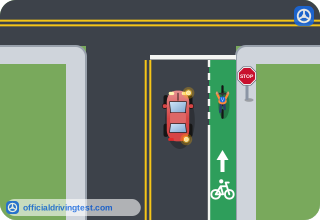
- Merge with the bicycle traffic and avoid turning directly across its path
- Turn quickly in front of any bicyclist to complete the turn faster
- Stay in the leftmost lane regardless of bicycle traffic
- Sound the horn until the bicyclist stops
Show answer
Correct answer: Merge with the bicycle traffic and avoid turning directly across its path
A motorist should merge with bicycle traffic when preparing for a right turn. Avoid turning directly across the path of bicycle traffic.
Source: Texas Driver Handbook (Revised January 2026), page 53
-
When are bicyclists required to ride as far to the right in the lane as possible?

- Only when the lane can be shared safely side-by-side
- At all times, with no exceptions whatsoever
- Only on highways with a speed limit above 55 mph
- Only when a police officer is present
Show answer
Correct answer: Only when the lane can be shared safely side-by-side
Bicyclists are required to ride as far to the right in the lane as possible only when the lane can be shared safely by a car and a bicycle, side-by-side. There are certain conditions that still allow a bicyclist to take the full lane.
Source: Texas Driver Handbook (Revised January 2026), page 53
-
Under which condition may a bicyclist leave the right side of the lane and take the full lane?
- When preparing for a left turn at an intersection or onto a private road or driveway
- Whenever the bicyclist simply prefers to have more space or wants to ride a little faster
- Only between the hours of 9 a.m. and 5 p.m.
- Only if the bicyclist is wearing a helmet
Show answer
Correct answer: When preparing for a left turn at an intersection or onto a private road or driveway
A bicyclist may take the full lane when preparing for a left turn at an intersection or onto a private road or driveway.
Source: Texas Driver Handbook (Revised January 2026), page 53
-
Which unsafe road condition allows a bicyclist to move away from the right side of the lane?
- Parked vehicles, animals, potholes, or debris
- Bright sunshine
- Light traffic with no other vehicles nearby
- A posted speed limit sign
Show answer
Correct answer: Parked vehicles, animals, potholes, or debris
A bicyclist may take the full lane when there are unsafe conditions in the road, such as fixed or moving objects, parked or moving vehicles, pedestrians, animals, potholes, or debris.
Source: Texas Driver Handbook (Revised January 2026), page 53
-
When a lane is of substandard width, making it unsafe for a car and bicycle to share it side-by-side, what is best for the cyclist to do?
- Ride on the sidewalk at all times instead
- Stop and wait for the lane to widen
- Ride only as far left as possible, in the oncoming lane
- Take the full lane, whether riding single file or two abreast
Show answer
Correct answer: Take the full lane, whether riding single file or two abreast
The lane may be of substandard width, making it unsafe for a car and a bicycle to safely share the lane side-by-side. When this is the case, it is best for the cyclist to take the full lane, whether riding single file or two abreast.
Source: Texas Driver Handbook (Revised January 2026), page 53
-
What is the most common car-bicycle crash caused by a motorist at an intersection?
- A car turns left in front of an oncoming bicycle
- A bicyclist rear-ends a stopped car
- Two bicyclists collide with each other
- A parked car is sideswiped by a bicyclist
Show answer
Correct answer: A car turns left in front of an oncoming bicycle
The most common car-bicycle crashes caused by a motorist include a motorist turning left in front of oncoming bicycle traffic; oncoming bicycle traffic is often overlooked or its speed misjudged.
Source: Texas Driver Handbook (Revised January 2026), page 53
-
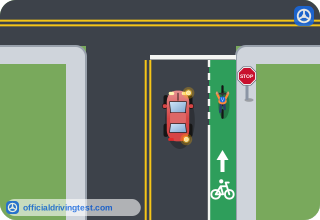
What should a motorist do to safely turn right across the path of a bicyclist?
- Speed up to clear the bicyclist's path before turning
- Sound the horn and turn immediately
- Stop in the bicyclist's lane and wait for a signal from the bicyclist
- Slow down and merge with the bicycle traffic for a safe right turn
Show answer
Correct answer: Slow down and merge with the bicycle traffic for a safe right turn
A motorist turns right across the path of the bicycle. The motorist should slow down and merge with the bicycle traffic for a safe right turn.
Source: Texas Driver Handbook (Revised January 2026), page 53
-
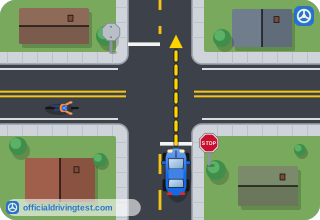
A motorist pulls away from a stop sign and fails to yield the right-of-way to bicycle cross traffic. What rule applies here?
- Bicycles must always yield to motor vehicles at stop signs, regardless of who arrived first
- Right-of-way at a stop sign is determined by vehicle size
- At intersections, right-of-way rules apply equally to motor vehicles and bicycles
- Right-of-way rules only apply to motor vehicles, not bicycles
Show answer
Correct answer: At intersections, right-of-way rules apply equally to motor vehicles and bicycles
A common car-bicycle crash occurs when a motorist pulls away from a stop sign and fails to yield the right-of-way to bicycle cross traffic. At intersections, the right-of-way rules apply equally to motor vehicles and bicycles.
Source: Texas Driver Handbook (Revised January 2026), page 54
-
Which regulations should a bicycle rider observe on the road?
- Bicyclists never need to signal turns
- Bicyclists must obey all traffic laws and signal turns
- Bicycles are exempt from all traffic laws
- Bicyclists may ride against traffic at any time
Show answer
Correct answer: Bicyclists must obey all traffic laws and signal turns
Bicyclists must obey the same traffic laws, signs, and signals as motor vehicle drivers and use proper hand signals when turning or stopping.
Source: Texas Driver Handbook (Revised January 2026), page 62
-
When is a bicyclist not required to ride at the right side of the roadway?
- Only when riding with a group of ten or more
- When passing, preparing to turn left, or avoiding hazards
- Never; bicyclists must always ride at the far right
- Only on weekends
Show answer
Correct answer: When passing, preparing to turn left, or avoiding hazards
A bicyclist may move away from the right side of the road when passing, preparing for a left turn, avoiding hazards, or when the lane is too narrow to share safely.
Source: Texas Driver Handbook (Revised January 2026), page 62
-
When are bicyclists allowed to ride two abreast in a traffic lane?
- When they do not impede traffic flow
- At all times, regardless of traffic
- Only on interstate highways
- Never; it is always illegal
Show answer
Correct answer: When they do not impede traffic flow
Bicyclists may ride two abreast within a single lane as long as doing so does not impede the normal flow of traffic.
Source: Texas Driver Handbook (Revised January 2026), page 62