Texas: Emergencies and special situations
Skids, blowouts, brake failure, winter weather, floods, and other special situations. Split into 3 shorter tests so you're not stuck in one long quiz.
Independent educational site · not affiliated with any government agency or DMV
Choose a part
Emergencies and special situations — Part 1
Questions in this part include: “According to the Texas Driver Handbook, what is one habit of a defensive driver?”
Emergencies and special situations — Part 2
Questions in this part include: “Is signing a traffic citation an admission of guilt?”
Emergencies and special situations — Part 3
Questions in this part include: “What is meant by "defensive driving"?”
Questions are original and based on the official manual "Texas Driver Handbook" (Revised January 2026), Texas Department of Public Safety (DPS).
All 53 Emergencies and special situations questions with answers
Choose a part above to take a practice test, or study every question and answer here.
Show the questions and answersHide the questions
1Part 118 questions
-
When calling a doctor or ambulance after a crash, what should you make sure to do?
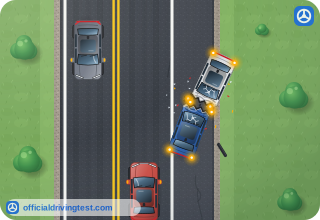
- Wait until you arrive at a hospital to make the call
- Give only your own name and phone number, not the crash location
- Note your surroundings and state the crash location clearly and correctly
- Hang up quickly so you don't tie up the phone line
Show answer
Correct answer: Note your surroundings and state the crash location clearly and correctly
When calling a doctor or ambulance, you should take notice of your surroundings and state the location of the crash clearly and correctly.
Source: Texas Driver Handbook (Revised January 2026), page 60
-
A crash victim says they are not hurt. What does the Texas Driver Handbook advise?
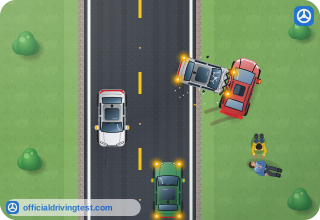
- Accept their word and leave the scene once you exchange your information
- Take them to a hospital in your own car right away, whatever they say
- Ask them to sign a statement that they were not hurt in the crash
- Do not assume they are uninjured; send for skilled help as quickly as possible
Show answer
Correct answer: Do not assume they are uninjured; send for skilled help as quickly as possible
The handbook says not to assume people are not injured simply because they say they are not, and to send for skilled help as quickly as possible. Unskilled handling can do more harm than good.
Source: Texas Driver Handbook (Revised January 2026), page 60
-
According to the Texas Driver Handbook, when should you move or lift a crash victim?
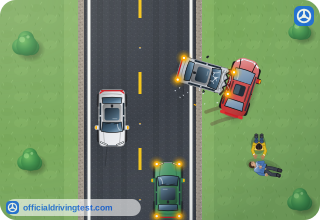
- Always move them off to the side of the road right away so traffic can pass
- Only if the victim specifically asks to be moved
- Move them into your own vehicle to drive them to the hospital yourself
- Only if absolutely necessary; then get help and try not to change their position
Show answer
Correct answer: Only if absolutely necessary; then get help and try not to change their position
You should not move or lift the victim unless it is absolutely necessary. If a victim must be moved, get help and try not to change the position in which the victim was found.
Source: Texas Driver Handbook (Revised January 2026), page 60
-
How should you stop serious bleeding on a crash victim, according to the handbook?
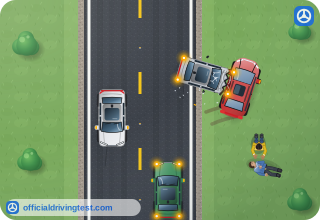
- Use thick cloth pads, as clean as possible, pressed by hand or by bandaging
- Apply ice directly onto the open wound until the bleeding stops
- Apply a tourniquet to every wound, no matter how small
- Simply wait for paramedics without touching the wound
Show answer
Correct answer: Use thick cloth pads, as clean as possible, pressed by hand or by bandaging
Stop serious bleeding with thick cloth pads, as clean as possible, applied with pressure by hand or by bandaging.
Source: Texas Driver Handbook (Revised January 2026), page 60
-
How should you help keep a crash victim comfortable while waiting for skilled help to arrive?
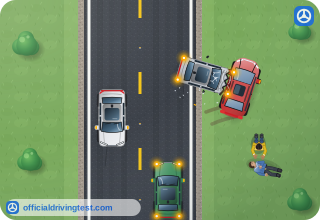
- Shade and cool them when hot; cover them with blankets or coats when cool
- Give them food and water right away
- Keep them talking and encourage them to move around
- Remove all of their clothing and keep them in the sun, whatever the weather
Show answer
Correct answer: Shade and cool them when hot; cover them with blankets or coats when cool
Keep the victim comfortable: if it is hot, cool the victim and provide shade as much as possible; if it is cool, cover the victim with blankets or coats if necessary and available.
Source: Texas Driver Handbook (Revised January 2026), page 60
-
According to the Texas Driver Handbook, what is one habit of a defensive driver?
- Focus only on the vehicle directly ahead
- Check a phone periodically while driving
- Assume other drivers will always signal correctly
- Stay alert and keep your eyes moving at all times
Show answer
Correct answer: Stay alert and keep your eyes moving at all times
The handbook lists staying alert and keeping your eyes moving to track what is happening at all times as a key defensive driving practice.
Source: Texas Driver Handbook (Revised January 2026), page 64
-
Besides staying alert, what else should a defensive driver do according to the handbook?
- Look for trouble spots developing all around and have a plan of action
- Wait until a hazard is directly in front of you before reacting
- Rely entirely on other drivers to avoid mistakes
- Drive faster to clear congested areas quickly
Show answer
Correct answer: Look for trouble spots developing all around and have a plan of action
Defensive drivers should look for developing trouble spots all around and always have a plan of action.
Source: Texas Driver Handbook (Revised January 2026), page 64
-
The handbook states that the law requires drivers to do what?
- Protect each other from their own mistakes
- Report every minor traffic violation they witness
- Always yield the right-of-way to aggressive drivers
- Drive at the minimum posted speed at all times
Show answer
Correct answer: Protect each other from their own mistakes
The handbook states that the law requires drivers to protect each other from their own mistakes.
Source: Texas Driver Handbook (Revised January 2026), page 64
-
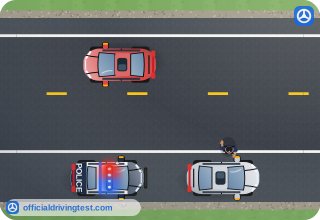
When you are stopped by law enforcement, what should you do first?
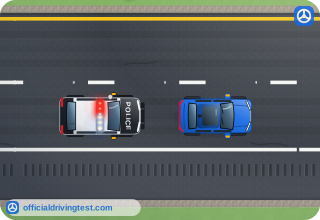
- Speed up to find a safer place farther ahead
- Turn around and drive the opposite direction
- Slow down and move safely to the right of the road
- Immediately stop in your current lane
Show answer
Correct answer: Slow down and move safely to the right of the road
The first suggested step is to slow down and move the vehicle safely to the right of the road.
Source: Texas Driver Handbook (Revised January 2026), page 65
-
Once parked after being stopped by law enforcement, what should you do to the vehicle before the officer approaches?
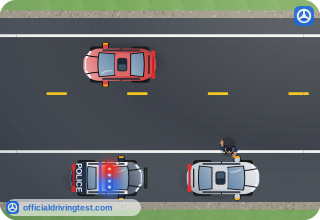
- Open all the doors of the vehicle
- Put it in park, set the emergency brake, turn off the engine, use hazard lights
- Leave the engine running and keep the vehicle in drive with your foot on the brake
- Turn off the hazard lights so the officer is not distracted
Show answer
Correct answer: Put it in park, set the emergency brake, turn off the engine, use hazard lights
You should place the vehicle in a parking position, set the emergency brake, turn the engine off, and activate the hazard warning lights.
Source: Texas Driver Handbook (Revised January 2026), page 65
-
If you are stopped by law enforcement at night, what should you do?
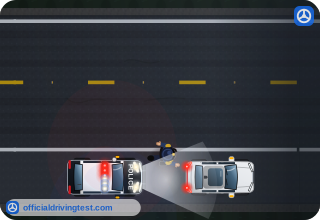
- Turn off all vehicle lights
- Flash your high beams repeatedly at the officer
- Turn on the radio loudly
- Turn on the interior dome light
Show answer
Correct answer: Turn on the interior dome light
If stopped at night, you should turn on the interior dome light.
Source: Texas Driver Handbook (Revised January 2026), page 65
-
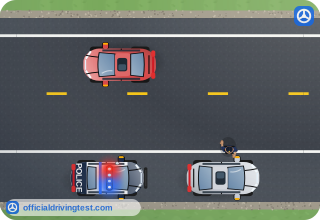
While waiting for the officer's instructions during a traffic stop, where should you keep your hands?
- In your pockets
- Reaching for your wallet immediately
- Out the window waving
- In sight on top of the steering wheel
Show answer
Correct answer: In sight on top of the steering wheel
You should remain in the car and keep both hands clearly in sight on top of the steering wheel while waiting for instructions.
Source: Texas Driver Handbook (Revised January 2026), page 65
-
Before reaching into your glove box or under the seat for your license or proof of insurance, what should you do?
- Ask a passenger to hide them
- Exit the vehicle first
- Tell the officer where they are and follow the officer's directions
- Retrieve them quickly before the officer arrives at your window
Show answer
Correct answer: Tell the officer where they are and follow the officer's directions
Before reaching into the glove box or under the seat, inform the officer of where the items are located and follow the officer's directions.
Source: Texas Driver Handbook (Revised January 2026), page 65
-
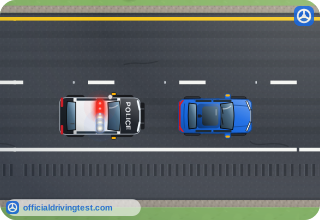
If you feel an area is unsafe to stop immediately for an emergency vehicle, what does the handbook say you can do?
- Ignore the emergency vehicle entirely
- Stop in the left lane of the highway and get out to meet the officer
- Turn on your hazard lights and drive slowly below the posted speed limit
- Speed away and stop several miles later
Show answer
Correct answer: Turn on your hazard lights and drive slowly below the posted speed limit
You can turn on your hazard lights and drive slowly below the posted speed limit, and you may call 9-1-1 and remain on the phone while you stop and verify the officer's identity, or drive to a nearby well-lighted, populated place.
Source: Texas Driver Handbook (Revised January 2026), page 65
-
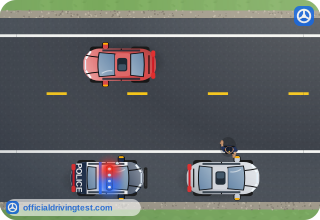
Why should drivers and passengers generally not exit the vehicle during a traffic stop unless asked to do so?
- It automatically voids the driver's insurance policy
- It is not addressed in the handbook
- It may be perceived as aggressive and a threat to the officer
- It is against the law to exit any vehicle at any time
Show answer
Correct answer: It may be perceived as aggressive and a threat to the officer
Drivers and passengers should not exit the vehicle unless asked to do so, since exiting may be perceived as aggressive behavior and a threat to the officer's safety.
Source: Texas Driver Handbook (Revised January 2026), page 65
-
During a traffic stop, are you required to answer an officer's questions?
- You cannot be punished for refusing, but must show your license
- You must answer every question or you will be arrested
- Only passengers are required to answer questions
- You must answer questions only if you are a minor
Show answer
Correct answer: You cannot be punished for refusing, but must show your license
You cannot be punished for refusing to answer questions; however, drivers are required by law to display a driver license when requested by an officer.
Source: Texas Driver Handbook (Revised January 2026), page 66
-
If you are lawfully arrested during a traffic stop, what must you provide to the officer?
- Your name, residence address, and date of birth
- Only your name
- Your Social Security number and place of employment
- Your employer's name, address, and phone number
Show answer
Correct answer: Your name, residence address, and date of birth
If you are lawfully arrested, you are also required to give your name, residence address, and date of birth.
Source: Texas Driver Handbook (Revised January 2026), page 66
-
Can law enforcement search your vehicle without your consent?
- No, never without your consent under any circumstance
- Only with a search warrant physically present at the scene
- Only after you have been formally charged in court
- Yes, if there is probable cause it contains evidence of a crime
Show answer
Correct answer: Yes, if there is probable cause it contains evidence of a crime
You may grant or deny consent to search, but if an officer has probable cause to believe your vehicle contains evidence of a crime, it can be searched without your consent.
Source: Texas Driver Handbook (Revised January 2026), page 66
2Part 218 questions
-
Is signing a traffic citation an admission of guilt?
- Yes, it is a full admission of guilt to the charges
- Yes, but only for moving violations
- No, but it forfeits your right to a trial
- No, it confirms your promise to pay or contact the court
Show answer
Correct answer: No, it confirms your promise to pay or contact the court
Signing a citation is not admitting guilt; it simply confirms your promise to pay the fine or contact the court.
Source: Texas Driver Handbook (Revised January 2026), page 66
-
What is the offense called when a person gives a false or fictitious name to a law enforcement officer who has lawfully arrested or detained them?
- Contempt of court
- False identification
- Perjury
- Obstruction of justice
Show answer
Correct answer: False identification
A person commits a False Identification Offense if he/she gives a false or fictitious name to a law enforcement officer who has lawfully arrested or detained the person.
Source: Texas Driver Handbook (Revised January 2026), page 66
-
What happens if a person intentionally flees from someone they know is a peace officer attempting a lawful arrest, using a vehicle to do so?
- It is not an offense as long as no one is injured
- It only becomes an offense if the person is caught within one mile
- It is treated the same as a parking violation
- It is evading arrest or detention, with higher penalties for using a vehicle
Show answer
Correct answer: It is evading arrest or detention, with higher penalties for using a vehicle
A person commits an offense of evading arrest or detention if they intentionally flee from a known peace officer attempting a lawful arrest or detention, and penalties are higher if a vehicle or watercraft is used or injury is caused.
Source: Texas Driver Handbook (Revised January 2026), page 66
-
If you believe an officer acted inappropriately during a traffic stop, what does the handbook recommend?
- Post the officer's information publicly online immediately
- Refuse to sign any citation until the complaint is resolved
- Report it to the officer's superiors and follow agency guidelines
- Argue with the officer at the scene until they apologize
Show answer
Correct answer: Report it to the officer's superiors and follow agency guidelines
If you believe an officer acted inappropriately, you should report that conduct to the officer's superiors and follow agency guidelines for submitting complaints as soon as possible.
Source: Texas Driver Handbook (Revised January 2026), page 66
-
What is aggressive driving also referred to as in the Texas Driver Handbook?
- Defensive driving
- Distracted driving
- Reckless parking
- Road rage
Show answer
Correct answer: Road rage
Road rage, also referred to as aggressive driving, causes hundreds of injuries and deaths each year.
Source: Texas Driver Handbook (Revised January 2026), page 66
-
To avoid road rage, what does the handbook suggest doing regarding your trip?
- Avoid checking traffic conditions before leaving
- Skip planning altogether and leave whenever you want
- Plan ahead and allow extra time for traffic or breakdowns
- Always drive as fast as possible to save time
Show answer
Correct answer: Plan ahead and allow extra time for traffic or breakdowns
The handbook suggests planning your trip or schedule in advance and allowing extra time in case of a breakdown or traffic congestion.
Source: Texas Driver Handbook (Revised January 2026), page 66
-
If you need to use your horn to alert another driver, what does the handbook say you should do?
- Tap the horn; do not hold it down
- Hold the horn down until the other driver responds
- Avoid using the horn under any circumstances
- Flash your headlights instead and never use the horn
Show answer
Correct answer: Tap the horn; do not hold it down
Should you need to use the horn, tap the horn; do not hold down the horn, and do not confront other drivers or make obscene gestures.
Source: Texas Driver Handbook (Revised January 2026), page 66
-
What does the handbook advise against doing to keep someone from passing or entering your lane of travel?
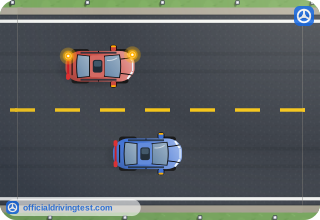
- Maintaining a steady, consistent speed
- Checking your mirrors frequently
- Slowing down, braking hard, or speeding up
- Signaling your lane change in advance
Show answer
Correct answer: Slowing down, braking hard, or speeding up
The handbook advises not to intentionally slow down, slam on your brakes, or speed up to keep someone from passing or entering your lane of travel.
Source: Texas Driver Handbook (Revised January 2026), page 66
-
What does the handbook say about tailgating as a way to avoid road rage?
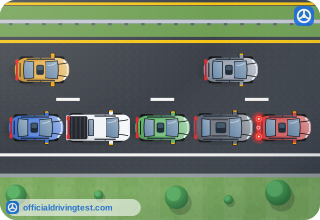
- Tailgating is acceptable if you are in a hurry
- Tailgating helps other drivers move faster
- It is not addressed in the handbook
- Do not tailgate; follow at a safe distance
Show answer
Correct answer: Do not tailgate; follow at a safe distance
The handbook advises drivers to not tailgate and instead follow at a safe distance to help avoid road rage.
Source: Texas Driver Handbook (Revised January 2026), page 66
-
What does "Your Keys to Safe Driving" say about courtesy?
- The fastest driver always has the right-of-way
- Right-of-way should always be taken immediately when available
- Courtesy is optional if you are in a hurry
- Safety comes before the right-of-way
Show answer
Correct answer: Safety comes before the right-of-way
Under "Courtesy," the handbook states that safety comes before the right-of-way.
Source: Texas Driver Handbook (Revised January 2026), page 67
-
What does the handbook say about failing to signal?
- It is dangerous and inconsiderate
- It is only a minor inconvenience with no real risk
- It is required only in heavy traffic
- It has no effect on the safety of others
Show answer
Correct answer: It is dangerous and inconsiderate
Under "Proper Signaling," the handbook states that failure to signal is dangerous and inconsiderate.
Source: Texas Driver Handbook (Revised January 2026), page 67
-
Regarding fitness to drive, what does "Your Keys to Safe Driving" recommend?
- Drive more slowly if you feel tired but keep going
- Take a short break at highway speed
- Let someone else drive if you are not physically or mentally alert
- Drink coffee and continue driving regardless of how you feel
Show answer
Correct answer: Let someone else drive if you are not physically or mentally alert
Under "Fitness to drive," the handbook recommends letting someone else drive if you are not physically or mentally alert.
Source: Texas Driver Handbook (Revised January 2026), page 67
-
Which of the following should you avoid to help prevent carbon monoxide poisoning?
- Driving with the windows down
- Using cruise control on the highway
- Checking your mirrors frequently
- Leaving the motor running in a garage
Show answer
Correct answer: Leaving the motor running in a garage
To avoid carbon monoxide poisoning, the handbook warns against leaving the motor running in a garage.
Source: Texas Driver Handbook (Revised January 2026), page 68
-
The handbook warns against leaving vents open in which situation, to avoid carbon monoxide exposure?
- When driving through a tunnel briefly
- When driving at highway speed
- When following closely behind another car
- When parked in direct sunlight
Show answer
Correct answer: When following closely behind another car
The handbook warns against leaving vents open when following closely behind another car, which can draw in exhaust fumes.
Source: Texas Driver Handbook (Revised January 2026), page 68
-
If you encounter a carbon monoxide poisoning victim, what should you do?
- Leave the windows closed and wait for help
- Move them to fresh air and call 911
- Give them water and wait for them to recover on their own
- Drive them to the nearest gas station
Show answer
Correct answer: Move them to fresh air and call 911
If you encounter a carbon monoxide poisoning victim, move them to fresh air and call 911.
Source: Texas Driver Handbook (Revised January 2026), page 68
-
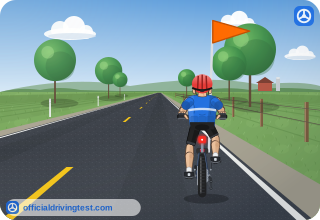
You see this flag on the back of a bicycle. What should you do?
- Sound your horn continuously to get their attention
- Flash your headlights repeatedly and pass immediately
- Ignore the flag since it has no legal meaning
- Slow down, as the operator may be hearing impaired
Show answer
Correct answer: Slow down, as the operator may be hearing impaired
If you see this flag on the back of a bicycle, slow down, as the operator may be hearing impaired. The flag may also be displayed on vehicles to alert others that the driver may be hearing impaired.
Source: Texas Driver Handbook (Revised January 2026), page 35
-
The basic rule that applies in all difficult driving situations is:
- Always accelerate out of danger
- Turn off the engine immediately
- Think before you act
- Always brake as hard as possible
Show answer
Correct answer: Think before you act
There is one basic rule that applies in all driving situations: think before you act.
Source: Texas Driver Handbook (Revised January 2026), page 48
-
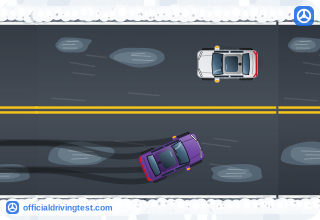
If your car starts to skid, you should first:
- Hit the brakes as hard as possible immediately
- Accelerate firmly to help the tires regain traction
- Shift into reverse
- Take your foot off the gas and do not brake suddenly and hard
Show answer
Correct answer: Take your foot off the gas and do not brake suddenly and hard
If the car starts to skid, do not hit the brakes suddenly and hard; take your foot off the gas pedal.
Source: Texas Driver Handbook (Revised January 2026), page 48
3Part 317 questions
-
To steer out of a skid, you should turn the steering wheel:
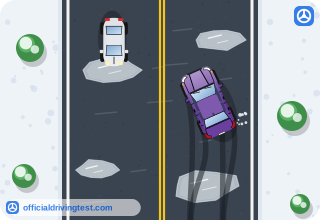
- All the way to one side and hold it there
- Not at all; keep it perfectly straight
- In the direction of the skid, then gently straighten the wheels
- Sharply away from the skid, then quickly straighten the wheels
Show answer
Correct answer: In the direction of the skid, then gently straighten the wheels
Turn your steering wheel in the direction of the skid, and as you recover control, gently straighten the wheels.
Source: Texas Driver Handbook (Revised January 2026), page 48
-
To help avoid a skid, you should:
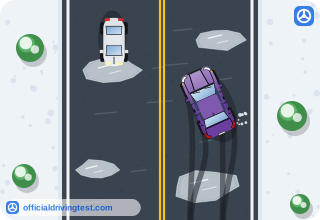
- Slow down when road and weather conditions are poor, and check your tires for age and wear
- Drive at normal highway speed regardless of the road and weather conditions
- Only worry about tire tread in the summer
- Keep your tires slightly underinflated so they grip the road better on wet or icy pavement
Show answer
Correct answer: Slow down when road and weather conditions are poor, and check your tires for age and wear
Avoid a situation that could cause a skid by slowing down when the road and weather conditions are poor, and check your car's tires, since old or worn tires with minimal or damaged tread are dangerous.
Source: Texas Driver Handbook (Revised January 2026), page 49
-
If your brakes fail, you should:
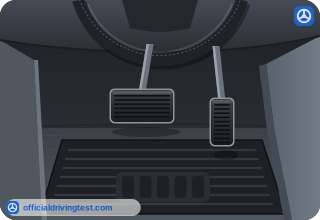
- Shift to a lower gear and apply the parking brake cautiously
- Turn off the engine immediately while moving
- Slam the parking brake on as hard and fast as possible
- Shift into the highest gear available
Show answer
Correct answer: Shift to a lower gear and apply the parking brake cautiously
If your brakes fail, do not panic. Shift to a lower gear and apply your parking brake cautiously to avoid locking the brakes and throwing your car into a skid.
Source: Texas Driver Handbook (Revised January 2026), page 49
-
If you swerve and run off the pavement, you should:
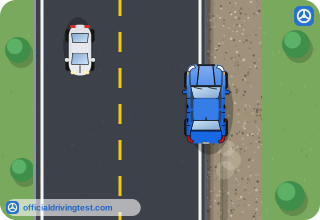
- Turn the wheel sharply back toward the road right away
- Grip the wheel tightly, take your foot off the gas, and avoid hard braking
- Hit the brakes hard and swing back onto the pavement immediately
- Accelerate to jump back onto the road
Show answer
Correct answer: Grip the wheel tightly, take your foot off the gas, and avoid hard braking
If something causes you to run off the pavement, do not hit the brakes suddenly and hard; grip the steering wheel tightly and take your foot off the gas pedal.
Source: Texas Driver Handbook (Revised January 2026), page 49
-
After running off the pavement and slowing down, before returning to the road you should:
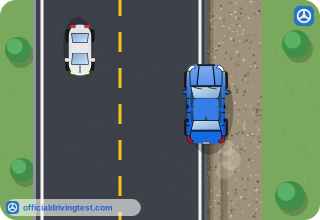
- Check traffic behind you, then carefully return to the road
- Swing back onto the pavement as quickly as possible
- Come to a complete stop in the travel lane
- Reverse back onto the highway
Show answer
Correct answer: Check traffic behind you, then carefully return to the road
Use your brakes carefully and do not swing back onto the pavement; wait until your speed is reduced, check the traffic behind you, and then carefully drive back onto the pavement.
Source: Texas Driver Handbook (Revised January 2026), page 49
-
If you have a flat tire or blowout, you should:
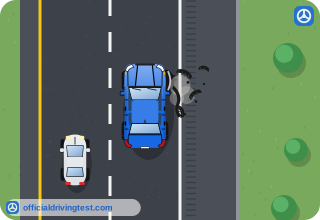
- Turn the steering wheel sharply to correct for the pull of the tire
- Accelerate until you find a safe place to stop
- Take your foot off the gas, brake gently, and steer straight to a stop
- Hit the brakes suddenly and hard
Show answer
Correct answer: Take your foot off the gas, brake gently, and steer straight to a stop
If you have a flat tire or blowout, do not hit the brakes suddenly and hard; take your foot off the gas pedal, gently apply the brakes, and steer straight ahead to a stop.
Source: Texas Driver Handbook (Revised January 2026), page 49
-
When driving down a steep hill, you can help slow your vehicle by:
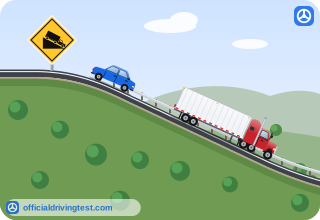
- Shifting into the highest gear
- Turning off the engine
- Shifting into a low gear
- Coasting in neutral
Show answer
Correct answer: Shifting into a low gear
When driving down a steep hill, you can shift your car into a low gear to help slow your vehicle; never coast in neutral or, with a standard transmission, with your foot on the clutch.
Source: Texas Driver Handbook (Revised January 2026), page 49
-
During winter driving, why should you increase your following distance?
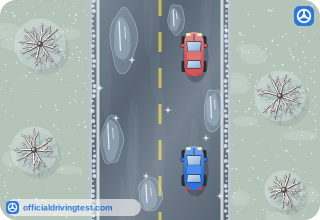
- Because many rear-end collisions on ice happen without space to stop
- Because it is required only on toll roads
- Because snow tires never lose traction on ice or packed snow
- Because a longer gap improves fuel economy in cold weather
Show answer
Correct answer: Because many rear-end collisions on ice happen without space to stop
Increase the distance from the vehicle ahead of you according to pavement conditions; many rear-end collisions occur on icy streets because drivers don't leave space to stop, and snow tires will still slide on ice or packed snow.
Source: Texas Driver Handbook (Revised January 2026), page 49
-
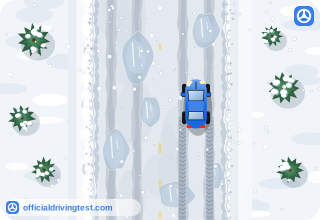
According to the handbook, when driving on snow or ice:
- You can safely drive at the normal posted speed limit
- Locking your brakes improves steering control
- Traction is the same on every road regardless of sun or shade
- There is no "safe" speed range, and you should avoid locking your brakes
Show answer
Correct answer: There is no "safe" speed range, and you should avoid locking your brakes
There is no such thing as a safe speed range on snow or ice. You must be extremely cautious and avoid locking your brakes, which causes a loss of steering and control.
Source: Texas Driver Handbook (Revised January 2026), page 49
-
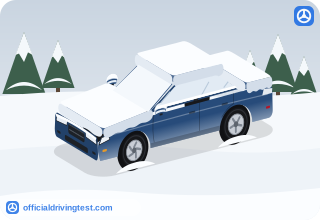
Before driving in winter weather, you should make sure to:
- Only clear the windshield, ignoring the other windows
- Avoid using the defroster to save fuel
- Remove snow and ice and make sure the wipers and defroster work properly
- Leave the windows partially covered with frost for visibility
Show answer
Correct answer: Remove snow and ice and make sure the wipers and defroster work properly
Keep windows clear: remove snow and ice before you drive, even for a short trip, and make certain the windshield wipers and defroster are working properly.
Source: Texas Driver Handbook (Revised January 2026), page 49
-
When starting to drive on a snowy or icy road, you should:

- Start out very slowly and test your brakes gently once moving
- Spin the wheels rapidly to warm up the tires and melt the ice
- Accelerate hard immediately to build momentum
- Slam the brakes to test how slick the road is
Show answer
Correct answer: Start out very slowly and test your brakes gently once moving
Get a feel for the road: start out very slowly, since spinning the wheels is useless, and test your brakes gently after the car is in motion to determine how much traction you have.
Source: Texas Driver Handbook (Revised January 2026), page 49
-
Regarding tire chains and snow tires in winter, the handbook cautions that:
- Neither one lets you drive on slick pavement at normal speeds
- Chains make it completely safe to drive at any speed on ice
- Snow tires should never be used on Texas roads
- Chains are less effective than snow tires in all conditions
Show answer
Correct answer: Neither one lets you drive on slick pavement at normal speeds
Chains are the most effective option where ice and snow remain on the road, but neither chains nor snow tires will permit you to drive on slick pavement at normal speeds, so don't get a false feeling of security.
Source: Texas Driver Handbook (Revised January 2026), page 49
-
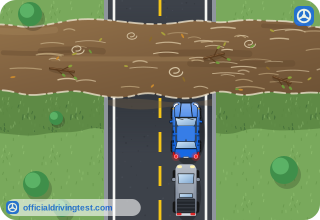
According to the handbook, about how much water will reach the bottom of most passenger cars, causing loss of control and possible stalling?
- One inch
- Three feet
- Five feet
- Six inches
Show answer
Correct answer: Six inches
Six inches of water will reach the bottom of most passenger cars, causing loss of control and possible stalling.
Source: Texas Driver Handbook (Revised January 2026), page 50
-
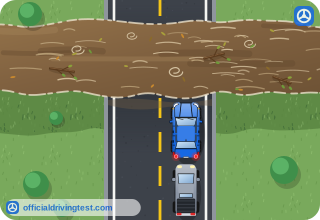
According to the handbook, how much rushing water can carry away pick-up trucks, SUVs, and most other vehicles?
- Two feet
- Two inches
- Ten feet
- Six inches
Show answer
Correct answer: Two feet
Two feet of rushing water will carry away pick-up trucks, SUVs, and most other vehicles. Twelve inches of water will float many cars.
Source: Texas Driver Handbook (Revised January 2026), page 50
-
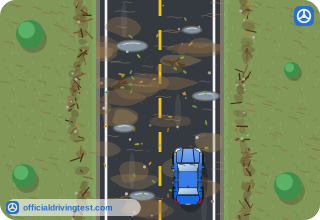
After floodwaters have receded from a road, drivers should proceed cautiously because:
- The weakened road may collapse under the vehicle's weight
- The road will always be perfectly safe once the water is gone
- Speed limits automatically double after a flood
- Traffic signals stop working permanently after floods
Show answer
Correct answer: The weakened road may collapse under the vehicle's weight
Water across a road may hide a missing segment of roadbed or a missing bridge. Roads weaken under floodwater, and drivers should proceed cautiously after waters have receded since the road may collapse under the vehicle's weight.
Source: Texas Driver Handbook (Revised January 2026), page 50
-
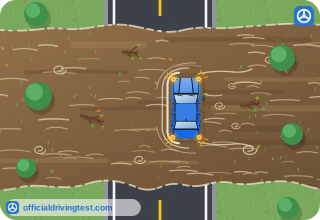
If your vehicle stalls in floodwater, officials advise that you should:
- Get out quickly and move to higher ground
- Stay inside the vehicle and wait for the water to recede
- Try repeatedly to restart the engine while water rises
- Open the trunk and check for damage before exiting
Show answer
Correct answer: Get out quickly and move to higher ground
If your vehicle stalls in floodwater, get out quickly and move to higher ground. When there's water on the road, remember: Turn Around Don't Drown.
Source: Texas Driver Handbook (Revised January 2026), page 50
-
What is meant by "defensive driving"?
- Driving as fast as traffic allows
- Only driving when accompanied by another person
- Driving without insurance
- Driving to avoid crashes, even when others make mistakes
Show answer
Correct answer: Driving to avoid crashes, even when others make mistakes
Defensive driving means anticipating hazardous situations and other drivers' possible mistakes, and adjusting your driving to avoid a crash despite them.
Source: Texas Driver Handbook (Revised January 2026), page 64