Texas: Emergencies and special situations — Part 3 Practice Test
Questions in this part include: “What is meant by "defensive driving"?”
Independent educational site · not affiliated with any government agency or DMV
Ready? Test yourself
- Instant feedback with an explanation
- Every answer cites its source in the manual
- Your best score is saved on this device
Questions are original and based on the official manual "Texas Driver Handbook" (Revised January 2026), Texas Department of Public Safety (DPS).
All 17 questions in this practice test
Take the test above first, then use this list to study. Tap “Show answer” to see the correct answer and explanation.
Show the questions and answersHide the questions
-
To steer out of a skid, you should turn the steering wheel:
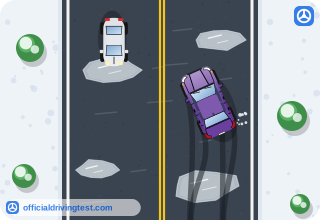
- All the way to one side and hold it there
- Not at all; keep it perfectly straight
- In the direction of the skid, then gently straighten the wheels
- Sharply away from the skid, then quickly straighten the wheels
Show answer
Correct answer: In the direction of the skid, then gently straighten the wheels
Turn your steering wheel in the direction of the skid, and as you recover control, gently straighten the wheels.
Source: Texas Driver Handbook (Revised January 2026), page 48
-
To help avoid a skid, you should:
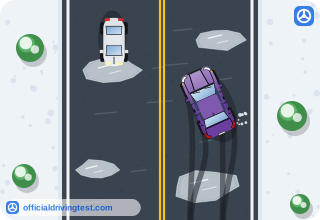
- Slow down when road and weather conditions are poor, and check your tires for age and wear
- Drive at normal highway speed regardless of the road and weather conditions
- Only worry about tire tread in the summer
- Keep your tires slightly underinflated so they grip the road better on wet or icy pavement
Show answer
Correct answer: Slow down when road and weather conditions are poor, and check your tires for age and wear
Avoid a situation that could cause a skid by slowing down when the road and weather conditions are poor, and check your car's tires, since old or worn tires with minimal or damaged tread are dangerous.
Source: Texas Driver Handbook (Revised January 2026), page 49
-
If your brakes fail, you should:
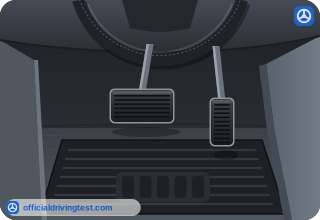
- Shift to a lower gear and apply the parking brake cautiously
- Turn off the engine immediately while moving
- Slam the parking brake on as hard and fast as possible
- Shift into the highest gear available
Show answer
Correct answer: Shift to a lower gear and apply the parking brake cautiously
If your brakes fail, do not panic. Shift to a lower gear and apply your parking brake cautiously to avoid locking the brakes and throwing your car into a skid.
Source: Texas Driver Handbook (Revised January 2026), page 49
-
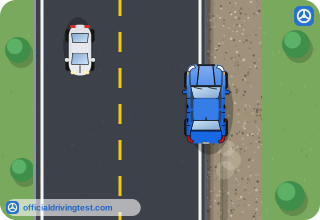
If you swerve and run off the pavement, you should:
- Turn the wheel sharply back toward the road right away
- Grip the wheel tightly, take your foot off the gas, and avoid hard braking
- Hit the brakes hard and swing back onto the pavement immediately
- Accelerate to jump back onto the road
Show answer
Correct answer: Grip the wheel tightly, take your foot off the gas, and avoid hard braking
If something causes you to run off the pavement, do not hit the brakes suddenly and hard; grip the steering wheel tightly and take your foot off the gas pedal.
Source: Texas Driver Handbook (Revised January 2026), page 49
-
After running off the pavement and slowing down, before returning to the road you should:
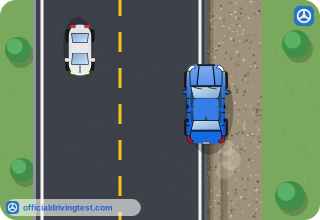
- Check traffic behind you, then carefully return to the road
- Swing back onto the pavement as quickly as possible
- Come to a complete stop in the travel lane
- Reverse back onto the highway
Show answer
Correct answer: Check traffic behind you, then carefully return to the road
Use your brakes carefully and do not swing back onto the pavement; wait until your speed is reduced, check the traffic behind you, and then carefully drive back onto the pavement.
Source: Texas Driver Handbook (Revised January 2026), page 49
-
If you have a flat tire or blowout, you should:
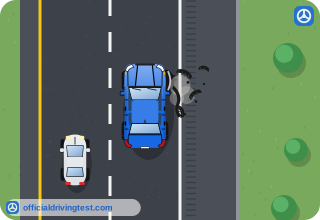
- Turn the steering wheel sharply to correct for the pull of the tire
- Accelerate until you find a safe place to stop
- Take your foot off the gas, brake gently, and steer straight to a stop
- Hit the brakes suddenly and hard
Show answer
Correct answer: Take your foot off the gas, brake gently, and steer straight to a stop
If you have a flat tire or blowout, do not hit the brakes suddenly and hard; take your foot off the gas pedal, gently apply the brakes, and steer straight ahead to a stop.
Source: Texas Driver Handbook (Revised January 2026), page 49
-
When driving down a steep hill, you can help slow your vehicle by:
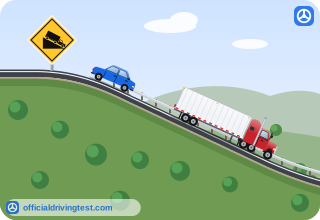
- Shifting into the highest gear
- Turning off the engine
- Shifting into a low gear
- Coasting in neutral
Show answer
Correct answer: Shifting into a low gear
When driving down a steep hill, you can shift your car into a low gear to help slow your vehicle; never coast in neutral or, with a standard transmission, with your foot on the clutch.
Source: Texas Driver Handbook (Revised January 2026), page 49
-
During winter driving, why should you increase your following distance?
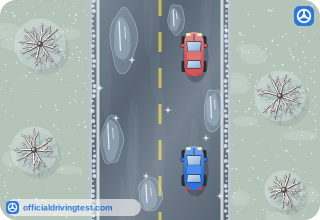
- Because many rear-end collisions on ice happen without space to stop
- Because it is required only on toll roads
- Because snow tires never lose traction on ice or packed snow
- Because a longer gap improves fuel economy in cold weather
Show answer
Correct answer: Because many rear-end collisions on ice happen without space to stop
Increase the distance from the vehicle ahead of you according to pavement conditions; many rear-end collisions occur on icy streets because drivers don't leave space to stop, and snow tires will still slide on ice or packed snow.
Source: Texas Driver Handbook (Revised January 2026), page 49
-
According to the handbook, when driving on snow or ice:
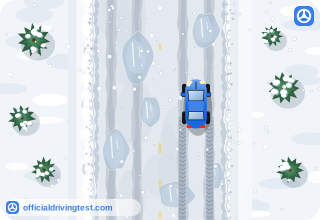
- You can safely drive at the normal posted speed limit
- Locking your brakes improves steering control
- Traction is the same on every road regardless of sun or shade
- There is no "safe" speed range, and you should avoid locking your brakes
Show answer
Correct answer: There is no "safe" speed range, and you should avoid locking your brakes
There is no such thing as a safe speed range on snow or ice. You must be extremely cautious and avoid locking your brakes, which causes a loss of steering and control.
Source: Texas Driver Handbook (Revised January 2026), page 49
-
Before driving in winter weather, you should make sure to:
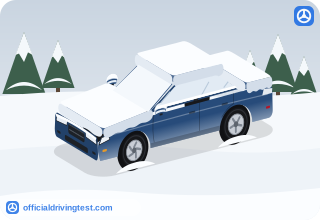
- Only clear the windshield, ignoring the other windows
- Avoid using the defroster to save fuel
- Remove snow and ice and make sure the wipers and defroster work properly
- Leave the windows partially covered with frost for visibility
Show answer
Correct answer: Remove snow and ice and make sure the wipers and defroster work properly
Keep windows clear: remove snow and ice before you drive, even for a short trip, and make certain the windshield wipers and defroster are working properly.
Source: Texas Driver Handbook (Revised January 2026), page 49
-
When starting to drive on a snowy or icy road, you should:
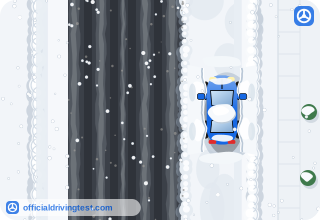
- Start out very slowly and test your brakes gently once moving
- Spin the wheels rapidly to warm up the tires and melt the ice
- Accelerate hard immediately to build momentum
- Slam the brakes to test how slick the road is
Show answer
Correct answer: Start out very slowly and test your brakes gently once moving
Get a feel for the road: start out very slowly, since spinning the wheels is useless, and test your brakes gently after the car is in motion to determine how much traction you have.
Source: Texas Driver Handbook (Revised January 2026), page 49
-
Regarding tire chains and snow tires in winter, the handbook cautions that:
- Neither one lets you drive on slick pavement at normal speeds
- Chains make it completely safe to drive at any speed on ice
- Snow tires should never be used on Texas roads
- Chains are less effective than snow tires in all conditions
Show answer
Correct answer: Neither one lets you drive on slick pavement at normal speeds
Chains are the most effective option where ice and snow remain on the road, but neither chains nor snow tires will permit you to drive on slick pavement at normal speeds, so don't get a false feeling of security.
Source: Texas Driver Handbook (Revised January 2026), page 49
-
According to the handbook, about how much water will reach the bottom of most passenger cars, causing loss of control and possible stalling?
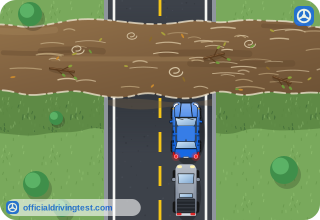
- One inch
- Three feet
- Five feet
- Six inches
Show answer
Correct answer: Six inches
Six inches of water will reach the bottom of most passenger cars, causing loss of control and possible stalling.
Source: Texas Driver Handbook (Revised January 2026), page 50
-
According to the handbook, how much rushing water can carry away pick-up trucks, SUVs, and most other vehicles?
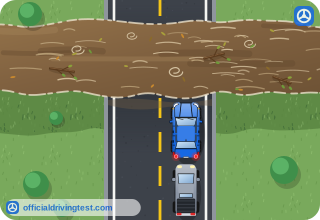
- Two feet
- Two inches
- Ten feet
- Six inches
Show answer
Correct answer: Two feet
Two feet of rushing water will carry away pick-up trucks, SUVs, and most other vehicles. Twelve inches of water will float many cars.
Source: Texas Driver Handbook (Revised January 2026), page 50
-
After floodwaters have receded from a road, drivers should proceed cautiously because:
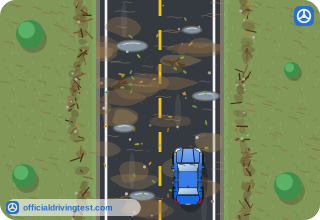
- The weakened road may collapse under the vehicle's weight
- The road will always be perfectly safe once the water is gone
- Speed limits automatically double after a flood
- Traffic signals stop working permanently after floods
Show answer
Correct answer: The weakened road may collapse under the vehicle's weight
Water across a road may hide a missing segment of roadbed or a missing bridge. Roads weaken under floodwater, and drivers should proceed cautiously after waters have receded since the road may collapse under the vehicle's weight.
Source: Texas Driver Handbook (Revised January 2026), page 50
-
If your vehicle stalls in floodwater, officials advise that you should:
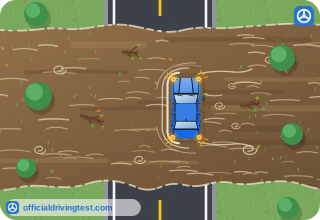
- Get out quickly and move to higher ground
- Stay inside the vehicle and wait for the water to recede
- Try repeatedly to restart the engine while water rises
- Open the trunk and check for damage before exiting
Show answer
Correct answer: Get out quickly and move to higher ground
If your vehicle stalls in floodwater, get out quickly and move to higher ground. When there's water on the road, remember: Turn Around Don't Drown.
Source: Texas Driver Handbook (Revised January 2026), page 50
-
What is meant by "defensive driving"?
- Driving as fast as traffic allows
- Only driving when accompanied by another person
- Driving without insurance
- Driving to avoid crashes, even when others make mistakes
Show answer
Correct answer: Driving to avoid crashes, even when others make mistakes
Defensive driving means anticipating hazardous situations and other drivers' possible mistakes, and adjusting your driving to avoid a crash despite them.
Source: Texas Driver Handbook (Revised January 2026), page 64