Texas: Emergency vehicles & work zones Practice Test
Yielding to emergency vehicles and driving safely through work zones.
Independent educational site · not affiliated with any government agency or DMV
Ready? Test yourself
Answer to start, or tap Start below:
What is the basic color used for construction and maintenance work zone devices such as barricades, drums, cones, and vertical panels?
- Instant feedback with an explanation
- Every answer cites its source in the manual
- Your best score is saved on this device
- Keyboard: press 1 to 4 to answer and Enter for the next question
Questions are original and based on the official manual "Texas Driver Handbook" (Revised January 2026), Texas Department of Public Safety (DPS).
All 30 questions in this practice test
Take the test above first, then use this list to study. Tap “Show answer” to see the correct answer and explanation.
Show the questions and answersHide the questions
-
A police car sounding its siren is approaching from behind. What should you do?
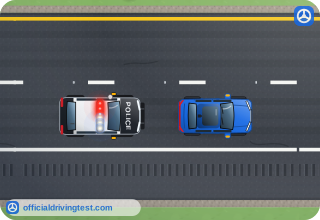
- If traffic allows, pull to the right edge of the road and stop
- Speed up to clear the intersection ahead
- Stop immediately wherever you are, even in an intersection
- Continue driving at the same speed and let the vehicle pass on the left
Show answer
Correct answer: If traffic allows, pull to the right edge of the road and stop
You must yield to emergency vehicles sounding a siren, bell, or flashing red light. If traffic allows, pull to the right edge of the road and stop; if you cannot pull over, slow down and leave a clear path for the emergency vehicle.
Source: Texas Driver Handbook (Revised January 2026), page 22
-
How close are you allowed to follow a fire truck answering an alarm or an ambulance with its flashing red lights on?
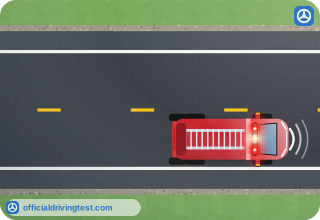
- You must stay within 50 feet to keep it in sight
- The rule only applies at night
- You are not allowed to follow within 500 feet
- You may follow as closely as you like
Show answer
Correct answer: You are not allowed to follow within 500 feet
You are not allowed to follow within 500 feet of a fire truck answering an alarm or an ambulance when the flashing red lights are on.
Source: Texas Driver Handbook (Revised January 2026), page 22
-
A fire truck has answered an alarm on a particular street. What should you do?
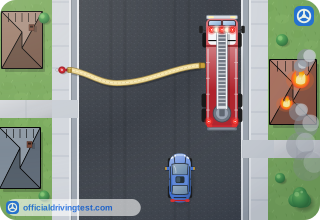
- Do not drive or park on that street
- Park there to watch, since it is public property
- Drive through as normal since fire trucks are already stopped
- Follow closely behind other cars leaving the area
Show answer
Correct answer: Do not drive or park on that street
Do not drive or park on the street where a fire truck has answered an alarm.
Source: Texas Driver Handbook (Revised January 2026), page 22
-
Regarding parking near an emergency scene, you must not:
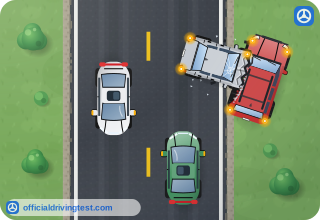
- Park where it interferes with an ambulance arriving or leaving
- Park more than one block away from the emergency scene
- Turn off your headlights while parked near the scene
- Park facing the opposite direction of traffic
Show answer
Correct answer: Park where it interferes with an ambulance arriving or leaving
Do not park in a location that interferes with the arrival or departure of an ambulance to or from the scene of an emergency.
Source: Texas Driver Handbook (Revised January 2026), page 22
-
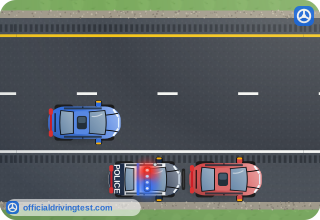
You approach a stopped emergency vehicle with its lights activated on a highway with two or more lanes traveling your direction. Which of these is one way to obey the law?
- Speed up to pass the emergency vehicle quickly
- Move closer to get a better look
- Keep your speed and stay in the lane closest to it
- Vacate the lane closest to the emergency vehicle
Show answer
Correct answer: Vacate the lane closest to the emergency vehicle
Unless an officer directs otherwise, you must either vacate the lane closest to the stopped emergency vehicle (on a highway with two or more lanes in your direction) or slow to not more than 20 mph below the posted limit (less than 5 mph when the limit is under 25 mph).
Source: Texas Driver Handbook (Revised January 2026), page 23
-
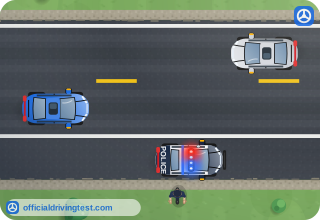
The posted speed limit is 60 mph and you pass a stopped emergency vehicle with lights activated on a road with only one lane in your direction. How slow must you go?
- You may not slow down at all
- Less than 5 mph, regardless of the posted limit
- Not more than 20 mph less than the posted speed limit
- Exactly the posted speed limit
Show answer
Correct answer: Not more than 20 mph less than the posted speed limit
When the posted speed limit is 25 mph or more, you must slow to a speed not more than 20 mph less than the posted speed limit when passing a stopped emergency vehicle with its lights activated.
Source: Texas Driver Handbook (Revised January 2026), page 23
-
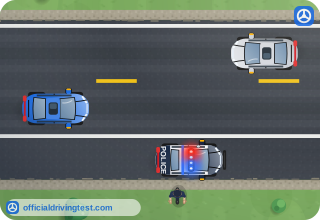
The posted speed limit is 20 mph on a one-lane road and you pass a stopped emergency vehicle with lights activated. How slow must you go?
- No more than 20 mph less than the limit
- Exactly 15 mph
- You do not need to slow down at all
- Less than 5 mph
Show answer
Correct answer: Less than 5 mph
When the posted speed limit is less than 25 mph, you must slow to a speed less than 5 mph when passing a stopped emergency vehicle with its lights activated.
Source: Texas Driver Handbook (Revised January 2026), page 23
-
What is the purpose of the impact-absorbing barrels sometimes placed in front of solid obstacles on Texas roads?
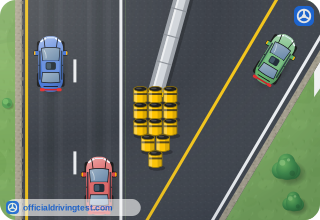
- To cushion impacts and make crashes less serious
- To mark the center line of the roadway
- To indicate the beginning of a school zone
- To provide extra lighting for night driving
Show answer
Correct answer: To cushion impacts and make crashes less serious
Barrels engineered to act as an impact cushion reduce the seriousness of crashes. They are usually installed in front of a solid obstacle and in areas of high crash frequency.
Source: Texas Driver Handbook (Revised January 2026), page 35
-
What is the basic color used for construction and maintenance work zone devices such as barricades, drums, cones, and vertical panels?
- Orange
- Yellow
- Red
- Green
Show answer
Correct answer: Orange
Orange is the basic color used for construction and maintenance work zone devices, including signs, barricades, vertical panels, drums, cones, tubes, and flashing arrow panels.
Source: Texas Driver Handbook (Revised January 2026), page 35
-
What is the main purpose of traffic control devices used in construction and maintenance work zones?
- To collect tolls from passing vehicles
- To designate a carpool lane
- To direct road users safely through and protect workers
- To enforce a lower speed limit only for trucks
Show answer
Correct answer: To direct road users safely through and protect workers
Traffic control devices in work zones are used to direct drivers, bicyclists, and pedestrians safely through the zone and to provide for the safety of the workers.
Source: Texas Driver Handbook (Revised January 2026), page 35
-
When approaching a construction or maintenance work zone, a driver should be prepared to do all of the following EXCEPT:
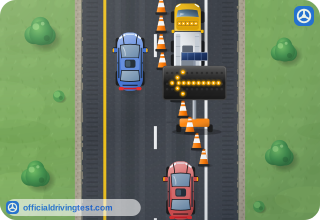
- Slow down or stop as you approach workers and equipment
- Change lanes if needed
- Expect unexpected movements of workers and equipment
- Speed up to clear the work zone as quickly as possible
Show answer
Correct answer: Speed up to clear the work zone as quickly as possible
In a work zone, drivers should be prepared to slow down or stop, change lanes, and expect unexpected movements of workers and equipment — not speed up.
Source: Texas Driver Handbook (Revised January 2026), page 35
-
What shape are most construction and maintenance signs in Texas work zones?
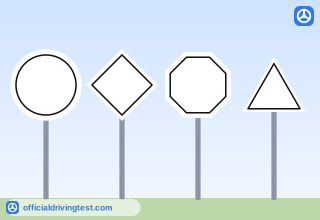
- Octagon
- Triangle
- Circle
- Diamond
Show answer
Correct answer: Diamond
Construction and maintenance signs alert drivers of unusual or potentially dangerous conditions near work zones. Most of these signs are diamond shaped, though a few are rectangular.
Source: Texas Driver Handbook (Revised January 2026), page 35
-
Which of the following are examples of channelizing devices used to guide drivers through highway and street work zones?
- Traffic lights and stop signs only
- Speed bumps and rumble strips
- Guardrails and permanent concrete barriers only
- Barricades, vertical panels, drums, cones, and tubes
Show answer
Correct answer: Barricades, vertical panels, drums, cones, and tubes
Barricades, vertical panels, drums, cones, and tubes are the most commonly used channelizing devices to alert drivers of dangerous conditions and guide them safely through work zones.
Source: Texas Driver Handbook (Revised January 2026), page 36
-
At night, channelizing devices in a work zone are often equipped with what?
- Nothing extra; they rely only on daylight visibility
- Flashing or steady-burn lights
- Loudspeakers announcing detours
- Motion-activated sirens
Show answer
Correct answer: Flashing or steady-burn lights
At night, channelizing devices such as barricades, drums, and cones are often equipped with flashing or steady-burn lights so drivers can see them more easily.
Source: Texas Driver Handbook (Revised January 2026), page 36
-
When you encounter a channelizing device in a work zone, you should:
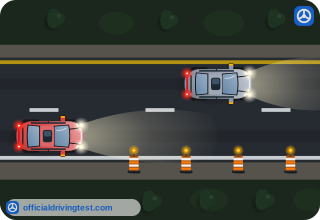
- Stop completely until a police officer waves you through
- Drive on the shoulder to bypass the device
- Slow down and prepare to change lanes when it is safe to do so
- Speed up to merge ahead of other traffic
Show answer
Correct answer: Slow down and prepare to change lanes when it is safe to do so
When you encounter a channelizing device, slow down and prepare to change lanes when it is safe, and be prepared for drivers who wait until the last second to move into the open lane.
Source: Texas Driver Handbook (Revised January 2026), page 36
-
After changing lanes to get around a work zone, when should you return to your normal driving lane?
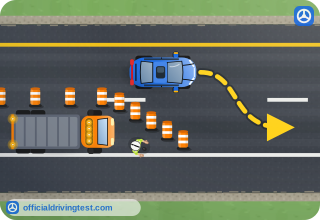
- Immediately once you see the first worker
- As soon as the cones end, without checking mirrors
- Before reaching the sign indicating you are leaving the construction zone
- Only after checking traffic behind you
Show answer
Correct answer: Only after checking traffic behind you
Maintain reduced speed until you clear the construction zone (there should be a sign indicating you are leaving it), and return to the normal driving lane only after checking traffic behind you.
Source: Texas Driver Handbook (Revised January 2026), page 36
-
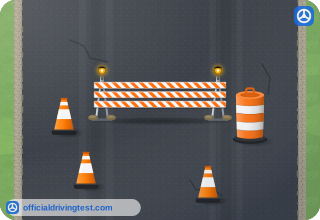
On a work zone barricade or vertical panel, diagonal stripes sloping downward to the right mean the driver should:
- Bear to the right
- Bear to the left
- Stop immediately
- Reverse direction
Show answer
Correct answer: Bear to the right
The diagonal stripes on a barricade or vertical panel guide drivers toward the direction traffic should pass. Stripes sloping downward to the right mean the driver should bear to the right.
Source: Texas Driver Handbook (Revised January 2026), page 36
-
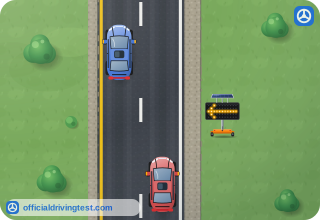
What is the purpose of a flashing or sequencing arrow panel in a work zone?
- To display the current speed limit that applies in the work zone
- To warn of an upcoming railroad crossing just past the work zone
- To guide drivers into certain lanes and show part of the road is closed
- To indicate a school crossing where children may be in the road
Show answer
Correct answer: To guide drivers into certain lanes and show part of the road is closed
Large flashing or sequencing arrow panels may be used in work zones day and night to guide drivers into certain traffic lanes and to inform them part of the road ahead is closed.
Source: Texas Driver Handbook (Revised January 2026), page 36
-
How is a flag person in a Texas work zone typically identified?
- By a hard hat and plain work clothes with no markings
- By a police badge and a car with a siren and flashing lights
- By an orange vest, shirt, or jacket and stop/slow paddles or red flags
- By a blue uniform, a whistle, and a lighted green traffic wand
Show answer
Correct answer: By an orange vest, shirt, or jacket and stop/slow paddles or red flags
A flag person wears an orange vest, shirt, or jacket and uses stop/slow paddles or red flags to direct traffic through work zones.
Source: Texas Driver Handbook (Revised January 2026), page 36
-
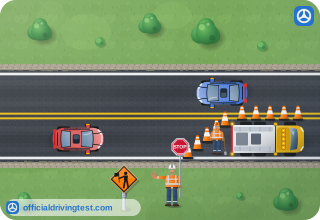
In a Texas work zone, a flag person's instructions:
- Are only suggestions drivers may ignore
- Only apply to commercial trucks
- May be disregarded if no other vehicles are present
- Must be obeyed
Show answer
Correct answer: Must be obeyed
A flag person is used in cases of extreme hazard, and their instructions must be obeyed by all drivers.
Source: Texas Driver Handbook (Revised January 2026), page 36
-
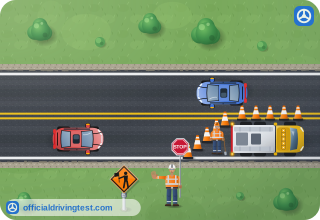
When a flag person signals you to stop in a work zone, you should:
- Pull onto the shoulder and carefully pass around the flag person
- Turn around immediately and find another route around the work zone
- Proceed slowly through the work zone if no workers are visible nearby
- Stop in your lane without veering, and wait until told to proceed
Show answer
Correct answer: Stop in your lane without veering, and wait until told to proceed
When instructed to stop, do so in your lane and do not veer right or left. Do not attempt to go forward until the flag person instructs you to do so.
Source: Texas Driver Handbook (Revised January 2026), page 36
-
What is an Automated Flagger Assistance Device (AFAD)?
- A remotely operated device that controls traffic, letting the flag person stay out of the lane
- A radar unit that automatically mails tickets to drivers speeding through work zones
- A GPS tracking system installed in construction vehicles to monitor their location
- A type of traffic light used only after dark
Show answer
Correct answer: A remotely operated device that controls traffic, letting the flag person stay out of the lane
An AFAD is used to control road users through temporary traffic zones. It is designed to be remotely operated, allowing a flag person to be positioned out of the lane of traffic.
Source: Texas Driver Handbook (Revised January 2026), page 36
-
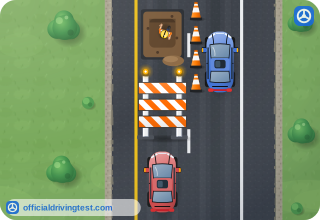
In Texas, is it a violation to drive around a barricade placed on a roadway?
- No, as long as no workers are present
- No, it is only prohibited between 8 a.m. and 5 p.m.
- Only if a police officer is present at the time
- Yes, driving around a barricade is a misdemeanor offense
Show answer
Correct answer: Yes, driving around a barricade is a misdemeanor offense
It is a violation to disobey the instructions, signals, warnings, or markings of a warning sign, or to drive around a barricade. This offense is a misdemeanor.
Source: Texas Driver Handbook (Revised January 2026), page 37
-
What is the standard fine for disobeying a warning sign or barricade in Texas, and when does it double?
- A flat fine of $1,000 with no possibility of doubling
- A fine of $1 to $200, doubled in a work zone when workers are present
- A flat fine of $500, which doubles if it happens at night
- A fine of $50 to $100, which doubles when the offense is on a weekend
Show answer
Correct answer: A fine of $1 to $200, doubled in a work zone when workers are present
Disobeying a warning sign or barricade is a misdemeanor punishable by a fine of $1 to $200. Fines double in a construction or maintenance work zone when workers are present anywhere in the zone.
Source: Texas Driver Handbook (Revised January 2026), page 37
-
Driving around a warning sign or barricade placed where water is covering part of a road, street, or highway is punishable in Texas by:
- A Class B misdemeanor, with a fine of up to $2,000 and/or up to 180 days in jail
- A simple verbal warning with no fine
- A $10 parking ticket
- Automatic suspension of the driver's license only, with no fine or jail time
Show answer
Correct answer: A Class B misdemeanor, with a fine of up to $2,000 and/or up to 180 days in jail
The offense is a Class B misdemeanor punishable by a fine of up to $2,000 and/or up to 180 days in jail when a warning sign or barricade has been placed where water is over any portion of a road, street, or highway.
Source: Texas Driver Handbook (Revised January 2026), page 37
-
The 'Slow Down or Move Over' law applies when which of these is stopped on the road with its lights activated?
- Only a law enforcement vehicle that also has its siren sounding
- An emergency medical, police, fire, tow, utility, or TxDOT vehicle
- Only a tow truck that is hooking up a disabled vehicle
- Only vehicles displaying a red flag
Show answer
Correct answer: An emergency medical, police, fire, tow, utility, or TxDOT vehicle
The Slow Down or Move Over law applies to emergency medical vehicles, law enforcement vehicles, fire trucks, tow trucks, utility service vehicles, and TxDOT or other highway construction/maintenance vehicles stopped with lights activated.
Source: Texas Driver Handbook (Revised January 2026), page 46
-
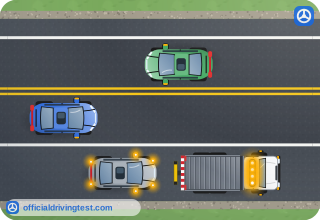
Under the Slow Down or Move Over law, if you do not move to another lane, by how much must you reduce your speed below the posted speed limit?
- 10 mph
- 15 mph
- 20 mph
- 25 mph
Show answer
Correct answer: 20 mph
The law requires drivers to reduce their speed to 20 mph below the speed limit if they do not move out of the lane closest to the stopped vehicle.
Source: Texas Driver Handbook (Revised January 2026), page 46
-
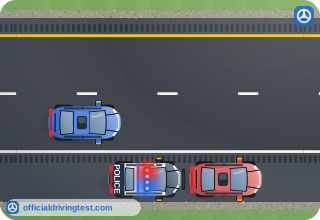
Besides reducing speed, what is the other option under the Slow Down or Move Over law when the road has multiple lanes traveling in the same direction?
- Turn on your hazard lights and stop
- Move out of the lane closest to the stopped vehicle
- Honk your horn to alert the workers
- Pass the stopped vehicle as quickly as possible
Show answer
Correct answer: Move out of the lane closest to the stopped vehicle
The law allows drivers to move out of the lane closest to the stopped emergency medical vehicle, law enforcement vehicle, fire truck, tow truck, or TxDOT vehicle, if the road has multiple lanes traveling in the same direction.
Source: Texas Driver Handbook (Revised January 2026), page 46
-
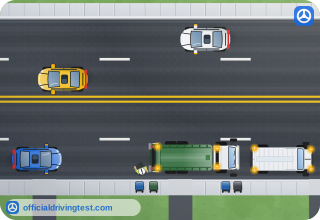
What does the handbook advise about mail, delivery, and trash-collection vehicles that make frequent stops in the roadway?
- Ignore them, since the Move Over law does not apply to them
- Proceed with caution and, if possible, change lanes before passing
- Always come to a complete stop behind them until they move
- Only pass them by driving on the shoulder
Show answer
Correct answer: Proceed with caution and, if possible, change lanes before passing
The handbook notes that mail, delivery, and trash-collection vehicles often stop frequently in the roadway, so drivers must proceed with caution and change lanes before safely passing, if possible.
Source: Texas Driver Handbook (Revised January 2026), page 46
-
If you are driving and hear a siren approaching, what should you do?
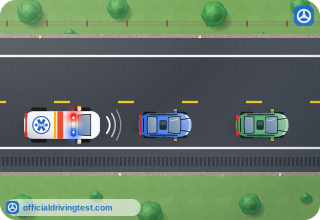
- Pull to the right edge of the road and stop, if traffic allows
- Speed up to get out of the way
- Stop immediately wherever you are, even in an intersection
- Continue at the same speed and let the emergency vehicle go around you
Show answer
Correct answer: Pull to the right edge of the road and stop, if traffic allows
Yield to emergency vehicles sounding a siren, bell, or flashing red light: if traffic allows, pull to the right edge of the road and stop; if you cannot pull over, slow down and leave a clear path.
Source: Texas Driver Handbook (Revised January 2026), page 22