Texas: Emergencies and special situations — Part 1 Practice Test
Questions in this part include: “According to the Texas Driver Handbook, what is one habit of a defensive driver?” · “During a traffic stop, are you required to answer an officer's questions?”
Independent educational site · not affiliated with any government agency or DMV
Ready? Test yourself
Answer to start, or tap Start below:
According to the Texas Driver Handbook, what is one habit of a defensive driver?
- Instant feedback with an explanation
- Every answer cites its source in the manual
- Your best score is saved on this device
- Keyboard: press 1 to 4 to answer and Enter for the next question
Questions are original and based on the official manual "Texas Driver Handbook" (Revised January 2026), Texas Department of Public Safety (DPS).
All 18 questions in this practice test
Take the test above first, then use this list to study. Tap “Show answer” to see the correct answer and explanation.
Show the questions and answersHide the questions
-
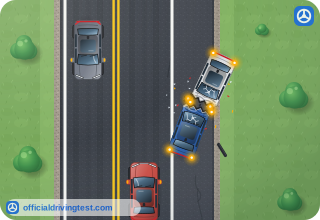
When calling a doctor or ambulance after a crash, what should you make sure to do?
- Wait until you arrive at a hospital to make the call
- Give only your own name and phone number, not the crash location
- Note your surroundings and state the crash location clearly and correctly
- Hang up quickly so you don't tie up the phone line
Show answer
Correct answer: Note your surroundings and state the crash location clearly and correctly
When calling a doctor or ambulance, you should take notice of your surroundings and state the location of the crash clearly and correctly.
Source: Texas Driver Handbook (Revised January 2026), page 60
-
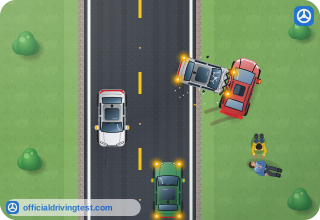
A crash victim says they are not hurt. What does the Texas Driver Handbook advise?
- Accept their word and leave the scene once you exchange your information
- Take them to a hospital in your own car right away, whatever they say
- Ask them to sign a statement that they were not hurt in the crash
- Do not assume they are uninjured; send for skilled help as quickly as possible
Show answer
Correct answer: Do not assume they are uninjured; send for skilled help as quickly as possible
The handbook says not to assume people are not injured simply because they say they are not, and to send for skilled help as quickly as possible. Unskilled handling can do more harm than good.
Source: Texas Driver Handbook (Revised January 2026), page 60
-
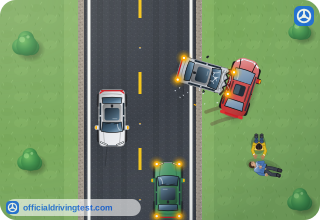
According to the Texas Driver Handbook, when should you move or lift a crash victim?
- Always move them off to the side of the road right away so traffic can pass
- Only if the victim specifically asks to be moved
- Move them into your own vehicle to drive them to the hospital yourself
- Only if absolutely necessary; then get help and try not to change their position
Show answer
Correct answer: Only if absolutely necessary; then get help and try not to change their position
You should not move or lift the victim unless it is absolutely necessary. If a victim must be moved, get help and try not to change the position in which the victim was found.
Source: Texas Driver Handbook (Revised January 2026), page 60
-
How should you stop serious bleeding on a crash victim, according to the handbook?
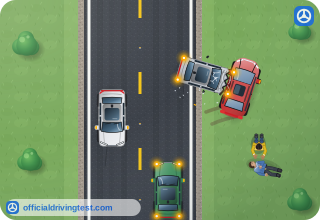
- Use thick cloth pads, as clean as possible, pressed by hand or by bandaging
- Apply ice directly onto the open wound until the bleeding stops
- Apply a tourniquet to every wound, no matter how small
- Simply wait for paramedics without touching the wound
Show answer
Correct answer: Use thick cloth pads, as clean as possible, pressed by hand or by bandaging
Stop serious bleeding with thick cloth pads, as clean as possible, applied with pressure by hand or by bandaging.
Source: Texas Driver Handbook (Revised January 2026), page 60
-
How should you help keep a crash victim comfortable while waiting for skilled help to arrive?
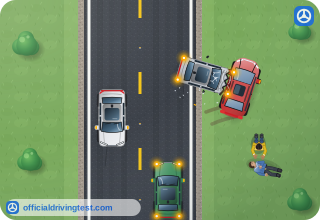
- Shade and cool them when hot; cover them with blankets or coats when cool
- Give them food and water right away
- Keep them talking and encourage them to move around
- Remove all of their clothing and keep them in the sun, whatever the weather
Show answer
Correct answer: Shade and cool them when hot; cover them with blankets or coats when cool
Keep the victim comfortable: if it is hot, cool the victim and provide shade as much as possible; if it is cool, cover the victim with blankets or coats if necessary and available.
Source: Texas Driver Handbook (Revised January 2026), page 60
-
According to the Texas Driver Handbook, what is one habit of a defensive driver?
- Focus only on the vehicle directly ahead
- Check a phone periodically while driving
- Assume other drivers will always signal correctly
- Stay alert and keep your eyes moving at all times
Show answer
Correct answer: Stay alert and keep your eyes moving at all times
The handbook lists staying alert and keeping your eyes moving to track what is happening at all times as a key defensive driving practice.
Source: Texas Driver Handbook (Revised January 2026), page 64
-
Besides staying alert, what else should a defensive driver do according to the handbook?
- Look for trouble spots developing all around and have a plan of action
- Wait until a hazard is directly in front of you before reacting
- Rely entirely on other drivers to avoid mistakes
- Drive faster to clear congested areas quickly
Show answer
Correct answer: Look for trouble spots developing all around and have a plan of action
Defensive drivers should look for developing trouble spots all around and always have a plan of action.
Source: Texas Driver Handbook (Revised January 2026), page 64
-
The handbook states that the law requires drivers to do what?
- Protect each other from their own mistakes
- Report every minor traffic violation they witness
- Always yield the right-of-way to aggressive drivers
- Drive at the minimum posted speed at all times
Show answer
Correct answer: Protect each other from their own mistakes
The handbook states that the law requires drivers to protect each other from their own mistakes.
Source: Texas Driver Handbook (Revised January 2026), page 64
-
When you are stopped by law enforcement, what should you do first?
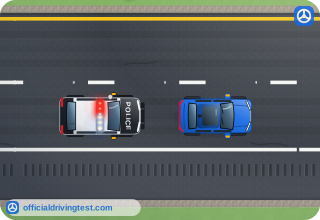
- Speed up to find a safer place farther ahead
- Turn around and drive the opposite direction
- Slow down and move safely to the right of the road
- Immediately stop in your current lane
Show answer
Correct answer: Slow down and move safely to the right of the road
The first suggested step is to slow down and move the vehicle safely to the right of the road.
Source: Texas Driver Handbook (Revised January 2026), page 65
-
Once parked after being stopped by law enforcement, what should you do to the vehicle before the officer approaches?
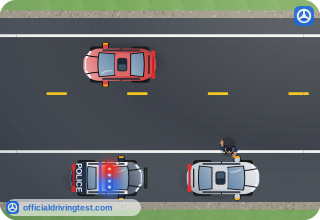
- Open all the doors of the vehicle
- Put it in park, set the emergency brake, turn off the engine, use hazard lights
- Leave the engine running and keep the vehicle in drive with your foot on the brake
- Turn off the hazard lights so the officer is not distracted
Show answer
Correct answer: Put it in park, set the emergency brake, turn off the engine, use hazard lights
You should place the vehicle in a parking position, set the emergency brake, turn the engine off, and activate the hazard warning lights.
Source: Texas Driver Handbook (Revised January 2026), page 65
-
If you are stopped by law enforcement at night, what should you do?
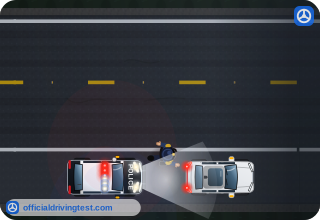
- Turn off all vehicle lights
- Flash your high beams repeatedly at the officer
- Turn on the radio loudly
- Turn on the interior dome light
Show answer
Correct answer: Turn on the interior dome light
If stopped at night, you should turn on the interior dome light.
Source: Texas Driver Handbook (Revised January 2026), page 65
-
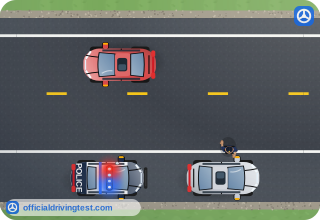
While waiting for the officer's instructions during a traffic stop, where should you keep your hands?
- In your pockets
- Reaching for your wallet immediately
- Out the window waving
- In sight on top of the steering wheel
Show answer
Correct answer: In sight on top of the steering wheel
You should remain in the car and keep both hands clearly in sight on top of the steering wheel while waiting for instructions.
Source: Texas Driver Handbook (Revised January 2026), page 65
-
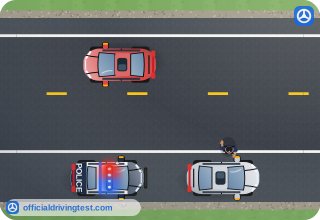
Before reaching into your glove box or under the seat for your license or proof of insurance, what should you do?
- Ask a passenger to hide them
- Exit the vehicle first
- Tell the officer where they are and follow the officer's directions
- Retrieve them quickly before the officer arrives at your window
Show answer
Correct answer: Tell the officer where they are and follow the officer's directions
Before reaching into the glove box or under the seat, inform the officer of where the items are located and follow the officer's directions.
Source: Texas Driver Handbook (Revised January 2026), page 65
-
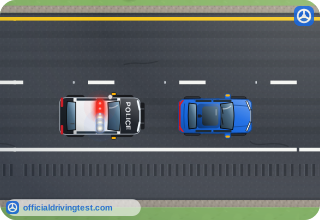
If you feel an area is unsafe to stop immediately for an emergency vehicle, what does the handbook say you can do?
- Ignore the emergency vehicle entirely
- Stop in the left lane of the highway and get out to meet the officer
- Turn on your hazard lights and drive slowly below the posted speed limit
- Speed away and stop several miles later
Show answer
Correct answer: Turn on your hazard lights and drive slowly below the posted speed limit
You can turn on your hazard lights and drive slowly below the posted speed limit, and you may call 9-1-1 and remain on the phone while you stop and verify the officer's identity, or drive to a nearby well-lighted, populated place.
Source: Texas Driver Handbook (Revised January 2026), page 65
-
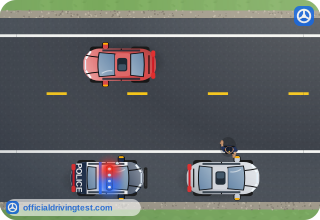
Why should drivers and passengers generally not exit the vehicle during a traffic stop unless asked to do so?
- It automatically voids the driver's insurance policy
- It is not addressed in the handbook
- It may be perceived as aggressive and a threat to the officer
- It is against the law to exit any vehicle at any time
Show answer
Correct answer: It may be perceived as aggressive and a threat to the officer
Drivers and passengers should not exit the vehicle unless asked to do so, since exiting may be perceived as aggressive behavior and a threat to the officer's safety.
Source: Texas Driver Handbook (Revised January 2026), page 65
-
During a traffic stop, are you required to answer an officer's questions?
- You cannot be punished for refusing, but must show your license
- You must answer every question or you will be arrested
- Only passengers are required to answer questions
- You must answer questions only if you are a minor
Show answer
Correct answer: You cannot be punished for refusing, but must show your license
You cannot be punished for refusing to answer questions; however, drivers are required by law to display a driver license when requested by an officer.
Source: Texas Driver Handbook (Revised January 2026), page 66
-
If you are lawfully arrested during a traffic stop, what must you provide to the officer?
- Your name, residence address, and date of birth
- Only your name
- Your Social Security number and place of employment
- Your employer's name, address, and phone number
Show answer
Correct answer: Your name, residence address, and date of birth
If you are lawfully arrested, you are also required to give your name, residence address, and date of birth.
Source: Texas Driver Handbook (Revised January 2026), page 66
-
Can law enforcement search your vehicle without your consent?
- No, never without your consent under any circumstance
- Only with a search warrant physically present at the scene
- Only after you have been formally charged in court
- Yes, if there is probable cause it contains evidence of a crime
Show answer
Correct answer: Yes, if there is probable cause it contains evidence of a crime
You may grant or deny consent to search, but if an officer has probable cause to believe your vehicle contains evidence of a crime, it can be searched without your consent.
Source: Texas Driver Handbook (Revised January 2026), page 66