Tennessee: Interstate driving — Part 5 Practice Test
Questions in this part include: “Where may you drive onto the interstate?” · “What does the manual tell you to do when you become drowsy while driving?”
Independent educational site · not affiliated with any government agency or DMV
Ready? Test yourself
- Instant feedback with an explanation
- Every answer cites its source in the manual
- Your best score is saved on this device
- Keyboard: press 1 to 4 to answer and Enter for the next question
Questions are original and based on the official manual "Tennessee Comprehensive Driver License Manual" (March 2025 printing), Tennessee Department of Safety and Homeland Security.
All 16 questions in this practice test
Take the test above first, then use this list to study. Tap “Show answer” to see the correct answer and explanation.
Show the questions and answersHide the questions
-
Where may you drive onto the interstate?
- At any point where the shoulder is paved
- Only through an opening provided for that entrance
- Across the median where no traffic is near
- At any crossroad, after a full stop
Show answer
Correct answer: Only through an opening provided for that entrance
You may not drive onto the interstate except through an opening provided for that purpose.
Source: Tennessee Comprehensive Driver License Manual (March 2025 printing), page 71 · Open this page in the manual (Manual page 71)
-
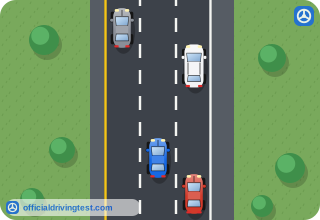
How does the manual tell you to make traffic checks on the interstate?
- Watch only the vehicle directly ahead of you
- Check behind you only before you exit
- Look in your rear view and side mirrors often
- Rely on other drivers to warn you
Show answer
Correct answer: Look in your rear view and side mirrors often
Make frequent traffic checks by looking often in your rear view and side-view mirrors.
Source: Tennessee Comprehensive Driver License Manual (March 2025 printing), page 71 · Open this page in the manual (Manual page 71)
-
On the interstate, what should you check your instruments for often?
- Oil level and tire tread
- Speed and fuel supply
- Radio and climate settings
- Mileage and trip time
Show answer
Correct answer: Speed and fuel supply
Check your instruments often for your speed and your fuel supply.
Source: Tennessee Comprehensive Driver License Manual (March 2025 printing), page 71 · Open this page in the manual (Manual page 71)
-
Besides other vehicles, what does the manual tell you to look out for on an interstate highway?
- Pedestrians from a vehicle breakdown, and animals
- Bicyclists riding along the left lane line
- Railroad crossings just beyond the exits
- Crossing guards at the interstate ramps
Show answer
Correct answer: Pedestrians from a vehicle breakdown, and animals
Be prepared for the unexpected: people may be on foot after a breakdown, and animals may be on the roadway.
Source: Tennessee Comprehensive Driver License Manual (March 2025 printing), page 71 · Open this page in the manual (Manual page 71)
-
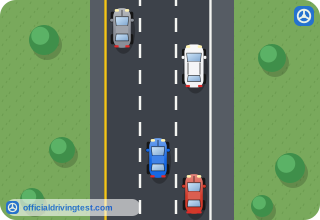
To avoid lane wandering on the interstate, what does the manual tell you to do?
- Keep to the left unless you plan to exit
- Use the center lane for most of your trip
- Change lanes often to stay alert
- Keep to the right unless overtaking or passing
Show answer
Correct answer: Keep to the right unless overtaking or passing
Weaving and wandering are dangerous; keep to the right unless you are overtaking or passing another vehicle.
Source: Tennessee Comprehensive Driver License Manual (March 2025 printing), page 71 · Open this page in the manual (Manual page 71)
-
According to the manual, what is mainly responsible for the greater danger of night driving?
- Fatigue and sharply reduced vision
- Higher speed limits after dark
- Heavier truck traffic
- Fewer lanes open at night
Show answer
Correct answer: Fatigue and sharply reduced vision
Mile for mile, night driving is far more dangerous than day driving, mainly because of fatigue and sharply reduced vision.
Source: Tennessee Comprehensive Driver License Manual (March 2025 printing), page 71 · Open this page in the manual (Manual page 71)
-
What is "interstate hypnosis"?
- Blurred vision caused by the glare of oncoming headlights
- Anger that builds up when other drivers cut you off
- Dizziness caused by watching the passing lane lines
- Drowsiness or unawareness from reduced activity and steady sounds
Show answer
Correct answer: Drowsiness or unawareness from reduced activity and steady sounds
Interstate hypnosis is drowsiness or unawareness brought on by reduced activity and the steady sounds of wind, engine and tire hum.
Source: Tennessee Comprehensive Driver License Manual (March 2025 printing), page 71 · Open this page in the manual (Manual page 71)
-
To fight interstate hypnosis, what should you do with your eyes?
- Stare straight ahead at the center of your lane
- Keep shifting them left and right and check the mirror
- Keep them on the car directly ahead of you
- Look only at the road just past your hood
Show answer
Correct answer: Keep shifting them left and right and check the mirror
Look well ahead but avoid staring: keep shifting your eyes left and right and check your rear view mirror, since staring straight ahead can almost put you to sleep.
Source: Tennessee Comprehensive Driver License Manual (March 2025 printing), page 71 · Open this page in the manual (Manual page 71)
-
What does the manual tell you to do when you become drowsy while driving?
- Turn up the radio
- Chew gum and keep going
- Quit driving
- Speed up to arrive sooner
Show answer
Correct answer: Quit driving
Quit driving when you are drowsy, because drowsiness is the first step in falling asleep.
Source: Tennessee Comprehensive Driver License Manual (March 2025 printing), page 71 · Open this page in the manual (Manual page 71)
-
To help fight interstate hypnosis, how should you keep your car's interior?
- As cool as possible
- As warm as possible
- As dark as possible
- As quiet as possible
Show answer
Correct answer: As cool as possible
One of the manual's tips against interstate hypnosis is to keep the inside of the car as cool as possible.
Source: Tennessee Comprehensive Driver License Manual (March 2025 printing), page 71 · Open this page in the manual (Manual page 71)
-
According to the manual, it is safest for you and others if you drive no more than how many hours per day?
- Six hours
- Ten hours
- Twelve hours
- Eight hours
Show answer
Correct answer: Eight hours
The manual says it is safest not to drive more than eight hours per day.
Source: Tennessee Comprehensive Driver License Manual (March 2025 printing), page 71 · Open this page in the manual (Manual page 71)
-
What is "rubbernecking"?
- Following another vehicle too closely on the interstate
- Weaving in and out of lanes to get ahead of traffic
- Turning your head to check your blind spot
- Slowing down to look at crashes or other unusual sights
Show answer
Correct answer: Slowing down to look at crashes or other unusual sights
Rubbernecking means slowing down to look at crashes or almost anything else out of the ordinary, and it is one of the worst causes of congestion.
Source: Tennessee Comprehensive Driver License Manual (March 2025 printing), page 72 · Open this page in the manual (Manual page 72)
-
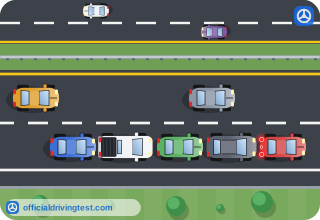
According to the manual, how does tailgating add to traffic congestion?
- It forces entering drivers to stop on the ramp
- It keeps other drivers out of the HOV lane
- It causes crashes that can clog major routes for hours
- It makes slower drivers leave the right lane
Show answer
Correct answer: It causes crashes that can clog major routes for hours
Following too closely accounts for many crashes, and those crashes clog major routes, often for hours.
Source: Tennessee Comprehensive Driver License Manual (March 2025 printing), page 72 · Open this page in the manual (Manual page 72)
-
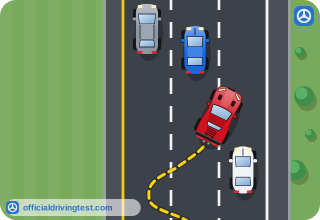
How much does weaving in and out of interstate lanes improve arrival or travel times?
- About 10 percent
- Virtually none
- Several minutes per trip
- Up to half an hour
Show answer
Correct answer: Virtually none
Unnecessary lane changes produce virtually no improvement in travel time; at best they slow all traffic and at worst cause crashes.
Source: Tennessee Comprehensive Driver License Manual (March 2025 printing), page 72 · Open this page in the manual (Manual page 72)
-
How can drivers who do not watch the fuel gauge or maintain their vehicles cause traffic congestion?
- Their vehicles must use the HOV lane in rush hour
- Their vehicles are barred from interstates at rush hour
- Their vehicles must leave at the next exit ramp
- Their vehicles can run out of gas or stall, causing bottlenecks
Show answer
Correct answer: Their vehicles can run out of gas or stall, causing bottlenecks
Such vehicles can run out of gas, malfunction or stall on the road, causing bottlenecks and major slowdowns.
Source: Tennessee Comprehensive Driver License Manual (March 2025 printing), page 72 · Open this page in the manual (Manual page 72)
-
Which of these are given as examples of new road features drivers need to become familiar with?
- Stop signs and yield signs
- HOV lanes and rumble strips
- Crosswalks and curbs
- Solid yellow center lines
Show answer
Correct answer: HOV lanes and rumble strips
As road designs change, drivers must learn new conditions such as HOV lanes and rumble strips.
Source: Tennessee Comprehensive Driver License Manual (March 2025 printing), page 101 · Open this page in the manual (Manual page 101)