Tennessee: Interstate driving
Entering and leaving the interstate, lane use, speed and space on the interstate, and what to do after missing an exit. Split into 5 shorter tests so you're not stuck in one long quiz.
Independent educational site · not affiliated with any government agency or DMV
Choose a part
Interstate driving — Part 1
Questions in this part include: “What is the minimum speed limit in the right lane(s) of the interstates?”
StartInterstate driving — Part 2
Questions in this part include: “According to the manual, what is the benefit of driving at an even speed on the interstate?”
StartInterstate driving — Part 3
Questions in this part include: “How does the manual describe High Occupancy Vehicle (HOV) lanes?”
StartInterstate driving — Part 4
Questions in this part include: “When approaching any type of interchange, what should you follow?”
StartInterstate driving — Part 5
Questions in this part include: “Where may you drive onto the interstate?”
StartAll 82 Interstate driving questions with answers
Choose a part above to take a practice test, or study every question and answer here.
Show the questions and answersHide the questions
-
What is the minimum speed in the left most lane of an interstate highway, unless traffic congestion and flow prevent safe driving at such speed?
- 55 m.p.h.
- 45 m.p.h.
- 35 m.p.h.
- 65 m.p.h.
Show answer
Correct answer: 55 m.p.h.
It is unlawful to drive less than 55 m.p.h. in the left most lane of any interstate, unless congestion and flow prevent safe driving at that speed.
Source: Tennessee Comprehensive Driver License Manual (March 2025 printing), page 47 · Open this page in the manual (Manual page 47)
-
What is the minimum speed limit in the right lane(s) of the interstates?
- 35 m.p.h.
- 55 m.p.h.
- 45 m.p.h.
- 25 m.p.h.
Show answer
Correct answer: 45 m.p.h.
Under normal driving conditions, all vehicles must travel at least 45 m.p.h. in the right lane(s) so they are not a hazard to other drivers.
Source: Tennessee Comprehensive Driver License Manual (March 2025 printing), page 47 · Open this page in the manual (Manual page 47)
-
Who may use emergency crossovers on an interstate?
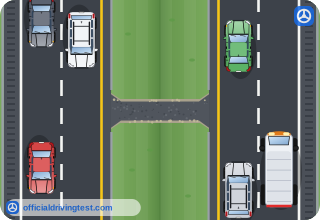
- Any driver stuck in a traffic jam on the road
- Drivers who have just missed an interstate exit
- Any driver when no other traffic is around
- Emergency vehicles and highway maintenance crews only
Show answer
Correct answer: Emergency vehicles and highway maintenance crews only
Emergency crossovers are for emergency vehicles and highway maintenance crews only.
Source: Tennessee Comprehensive Driver License Manual (March 2025 printing), page 59 · Open this page in the manual (Manual page 59)
-
You missed your exit on an interstate. What should you do?
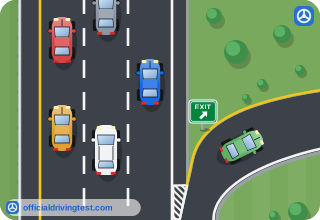
- Drive on to the next exit ramp
- Back up along the shoulder to the exit
- Use an emergency crossover to turn around
- Cross the median strip where it is flat
Show answer
Correct answer: Drive on to the next exit ramp
If you miss an exit, you drive on to the next exit ramp rather than turn around or cut across the median.
Source: Tennessee Comprehensive Driver License Manual (March 2025 printing), page 59 · Open this page in the manual (Manual page 59)
-
Where is a crossover on a four-lane highway permitted?
- At any gap in a median on an interstate road
- At any place the median looks passable to drivers
- Only at paved openings provided on four-lane highways
- Wherever two lanes meet at a ramp junction
Show answer
Correct answer: Only at paved openings provided on four-lane highways
A crossover is permitted only at paved openings provided on four-lane highways, and none are provided for interstate traffic.
Source: Tennessee Comprehensive Driver License Manual (March 2025 printing), page 60 · Open this page in the manual (Manual page 60)
-
What does the manual say about backing up on the interstate?
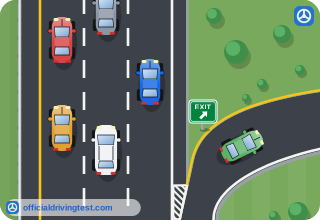
- It is allowed on the shoulder with flashers on
- It is allowed if you missed your exit and no one is behind you
- It is allowed for no more than 100 feet
- It is illegal
Show answer
Correct answer: It is illegal
Backing up on the interstate is illegal, even if you missed your exit.
Source: Tennessee Comprehensive Driver License Manual (March 2025 printing), page 64 · Open this page in the manual (Manual page 64)
-
When may you stop on an interstate highway?
- To check your directions or map
- To let a passenger out
- Only for an emergency
- To rest briefly on the shoulder
Show answer
Correct answer: Only for an emergency
A stopped car on the interstate, even on the shoulder, is extremely dangerous, so stop only for an emergency.
Source: Tennessee Comprehensive Driver License Manual (March 2025 printing), page 66 · Open this page in the manual (Manual page 66)
-
What does the manual say about walking on the interstate?
- It is legal on the shoulder in daylight
- It is legal when your vehicle is disabled
- It is both illegal and dangerous
- It is legal if you wear bright clothing
Show answer
Correct answer: It is both illegal and dangerous
Walking on the interstate is both illegal and dangerous.
Source: Tennessee Comprehensive Driver License Manual (March 2025 printing), page 66 · Open this page in the manual (Manual page 66)
-
According to the manual, why does traffic on interstates usually move more safely and efficiently?
- Because access to the roadway is controlled
- Because the speed limit is the same on every section
- Because large trucks may not use them during rush hour
- Because police patrol every mile of the interstate
Show answer
Correct answer: Because access to the roadway is controlled
Interstates are controlled-access roads, and the manual gives that as the reason their traffic usually moves more safely and efficiently.
Source: Tennessee Comprehensive Driver License Manual (March 2025 printing), page 68 · Open this page in the manual (Manual page 68)
-
According to the manual, which of these will you NOT find on an interstate?
- Entrance ramps
- Interchanges
- Railroad crossings
- Deceleration lanes
Show answer
Correct answer: Railroad crossings
Interstates have no stop signs, no traffic lights and no railroad crossings; drivers enter and leave at interchanges using ramps.
Source: Tennessee Comprehensive Driver License Manual (March 2025 printing), page 68 · Open this page in the manual (Manual page 68)
-
What does "limited access" or "controlled access" mean on an interstate?
- Only cars and light trucks may use the road at any time
- Drivers enter or leave only at interchanges, without crossing traffic
- Drivers may enter at any crossroad if they first come to a stop
- Only drivers who live along the route may use its entrances
Show answer
Correct answer: Drivers enter or leave only at interchanges, without crossing traffic
On a limited-access road, drivers get on and off only at entrances and exits called interchanges, and never cross the path of other traffic.
Source: Tennessee Comprehensive Driver License Manual (March 2025 printing), page 68 · Open this page in the manual (Manual page 68)
-
Interstates and divided highways have largely removed the chance of which kind of collision?
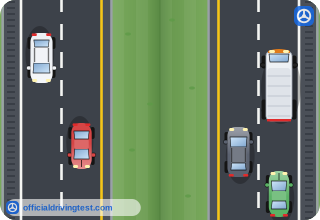
- Rear-end collisions
- Multiple-car collisions
- Sideswipe collisions
- Head-on collisions
Show answer
Correct answer: Head-on collisions
Because traffic going the other way is kept separate, interstates and divided highways have largely removed the chance of head-on collisions.
Source: Tennessee Comprehensive Driver License Manual (March 2025 printing), page 68 · Open this page in the manual (Manual page 68)
-
According to the manual, what does safe use of the interstates demand of the driver?
- Driving in the left lane except when you plan to exit
- A speed of at least 70 mph on every section of road
- Full awareness of higher-speed driving and constant alertness
- Changing lanes often to keep up with the fastest traffic
Show answer
Correct answer: Full awareness of higher-speed driving and constant alertness
Interstate driving is a higher-speed type of driving, so it calls for complete awareness of that and constant alertness.
Source: Tennessee Comprehensive Driver License Manual (March 2025 printing), page 68 · Open this page in the manual (Manual page 68)
-
Before driving on the interstate, what should you plan in advance?
- Your entrance, direction and exit
- Which single lane you will use all the way
- The rest areas where you will sleep
- The speed you will drive on each part
Show answer
Correct answer: Your entrance, direction and exit
The manual says to plan the trip ahead so you know where you will get on, which direction you will go and where you will get off.
Source: Tennessee Comprehensive Driver License Manual (March 2025 printing), page 68 · Open this page in the manual (Manual page 68)
-
Why does the manual say to check the gas gauge before getting on the interstate?
- Gas stations are not allowed near interstate exits
- Your fuel use doubles at interstate speeds
- Running low on fuel is a moving violation
- In rural areas it may be many miles between exits
Show answer
Correct answer: In rural areas it may be many miles between exits
Exits can be far apart in rural areas, so you could run out of gas before reaching another gas station.
Source: Tennessee Comprehensive Driver License Manual (March 2025 printing), page 68 · Open this page in the manual (Manual page 68)
-
How is entering an interstate different from entering most other busy roads?
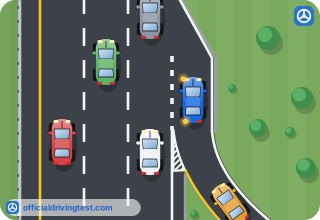
- You must stop at the end of the ramp before you enter
- You must wait for a driver on the interstate to wave you in
- You speed up to merge instead of slowing down or stopping
- You must enter at the speed of the road you just left
Show answer
Correct answer: You speed up to merge instead of slowing down or stopping
Before most busy roads you slow down or stop, but on an interstate you do the opposite and use the acceleration lane to speed up and merge.
Source: Tennessee Comprehensive Driver License Manual (March 2025 printing), page 68 · Open this page in the manual (Manual page 68)
-
What is the acceleration lane (entrance ramp) used for when you enter an interstate?
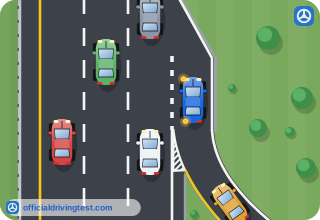
- To reach interstate speed so you can merge smoothly
- To stop and wait until the travel lane is empty
- To pass slower vehicles already on the interstate
- To slow down before you join the traffic lane
Show answer
Correct answer: To reach interstate speed so you can merge smoothly
You stay to the right and build up speed on the ramp so you can merge smoothly into the travel lane when the way is clear.
Source: Tennessee Comprehensive Driver License Manual (March 2025 printing), page 68 · Open this page in the manual (Manual page 68)
-
Which signal should you give on the entrance ramp to show that you need to enter the traffic lane?
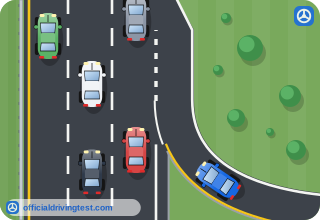
- A right turn signal
- Your emergency flashers
- A tap on the horn
- A left turn signal
Show answer
Correct answer: A left turn signal
The manual says to give the proper left turn signal on the ramp to show you need to enter the traffic lane.
Source: Tennessee Comprehensive Driver License Manual (March 2025 printing), page 68 · Open this page in the manual (Manual page 68)
-
According to the manual, what does unnecessary stopping on interstate on-ramps cause?
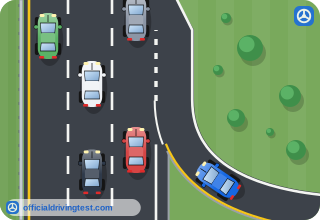
- Many head-on collisions
- Many rollover crashes
- Many rear-end collisions
- Many crashes in the HOV lane
Show answer
Correct answer: Many rear-end collisions
Drivers behind you on the ramp do not expect you to stop, so needless stops on on-ramps cause many rear-end collisions and block the even flow of traffic.
Source: Tennessee Comprehensive Driver License Manual (March 2025 printing), page 68 · Open this page in the manual (Manual page 68)
-
Why should you not drive to the end of the entrance ramp and stop?
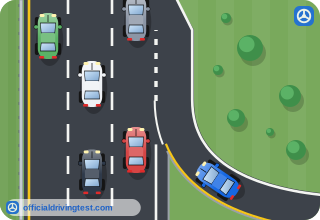
- You will not have enough room to get up to interstate speed
- Stopping there is allowed only for buses and trucks
- The end of the ramp is reserved for exiting traffic
- You would block the view of drivers on the interstate
Show answer
Correct answer: You will not have enough room to get up to interstate speed
From a stop at the end of the ramp there is not enough room left to reach the speed of interstate traffic, and drivers behind you will not expect the stop.
Source: Tennessee Comprehensive Driver License Manual (March 2025 printing), page 68 · Open this page in the manual (Manual page 68)
-
If you have to wait for space to enter an interstate, what should you do?
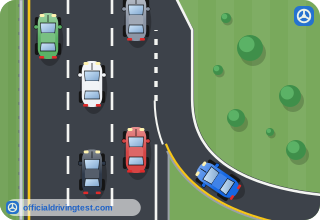
- Stop at the end of the ramp until the lane is clear
- Drive onto the paved shoulder and wait for a gap
- Keep your speed and force your way into the lane
- Slow down on the ramp so you still have room to speed up
Show answer
Correct answer: Slow down on the ramp so you still have room to speed up
Slowing down while still on the ramp leaves you some room to speed up again before you have to merge.
Source: Tennessee Comprehensive Driver License Manual (March 2025 printing), page 68 · Open this page in the manual (Manual page 68)
-
Heavy traffic has caused a slowdown at an entrance ramp. Unless it is absolutely unavoidable, what is best?
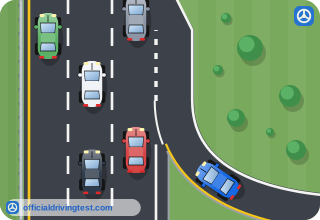
- Stop and wait until the ramp is completely clear
- Keep your vehicle moving, at least at a slow pace
- Back up and use a different entrance ramp
- Drive around the slowdown on the paved shoulder
Show answer
Correct answer: Keep your vehicle moving, at least at a slow pace
Even in a slowdown at an entrance ramp, the manual says it is best to keep the vehicle moving at least slowly unless stopping cannot be avoided.
Source: Tennessee Comprehensive Driver License Manual (March 2025 printing), page 68 · Open this page in the manual (Manual page 68)
-
On an interstate with several lanes going in the same direction, which lane should you leave for faster traffic?
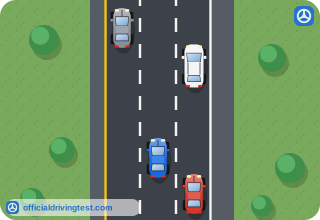
- The extreme right lane
- The center lane
- The extreme left lane
- The lane nearest the ramps
Show answer
Correct answer: The extreme left lane
On interstates with several lanes in one direction, the extreme left lane is left for faster traffic.
Source: Tennessee Comprehensive Driver License Manual (March 2025 printing), page 68 · Open this page in the manual (Manual page 68)
-
According to the manual, what is the benefit of driving at an even speed on the interstate?
- You may use the HOV lane while driving alone
- You will have less need to change lanes
- You may drive below the minimum speed limit
- You may follow the car ahead more closely
Show answer
Correct answer: You will have less need to change lanes
Holding an even speed means you have less need to change lanes.
Source: Tennessee Comprehensive Driver License Manual (March 2025 printing), page 68 · Open this page in the manual (Manual page 68)
-
What does the manual say about lane-hopping on the interstate?
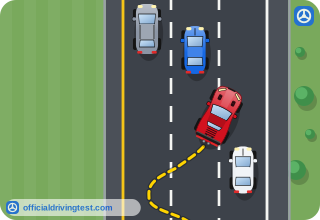
- It is safe as long as you signal before each change
- It is the best way to get through heavy traffic
- It is allowed only in the two left-most lanes
- It is dangerous and very seldom saves much time
Show answer
Correct answer: It is dangerous and very seldom saves much time
Lane-hopping is dangerous at any time, raises the risk of a collision and very seldom saves the driver any significant travel time.
Source: Tennessee Comprehensive Driver License Manual (March 2025 printing), page 68 · Open this page in the manual (Manual page 68)
-
Where should you keep your vehicle within your traffic lane on the interstate?
- In the middle of the lane
- Near the left lane line
- Near the right lane line
- Wherever traffic is lightest
Show answer
Correct answer: In the middle of the lane
The manual tells you to keep your vehicle in the middle of your traffic lane.
Source: Tennessee Comprehensive Driver License Manual (March 2025 printing), page 68 · Open this page in the manual (Manual page 68)
-
Why should you not travel alongside other vehicles at the same speed on the interstate?
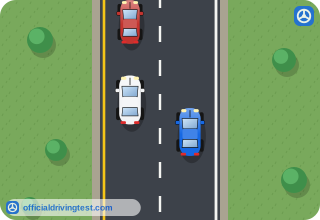
- It blocks drivers who want to use the HOV lane
- It makes your vehicle use more fuel than usual
- You risk being in the other drivers' blind spots
- It forces you below the minimum speed limit
Show answer
Correct answer: You risk being in the other drivers' blind spots
Riding beside another vehicle at the same speed can keep you in that driver's blind spot, where you may not be seen.
Source: Tennessee Comprehensive Driver License Manual (March 2025 printing), page 68 · Open this page in the manual (Manual page 68)
-
What does the manual say about cars moving in packs on the interstate?
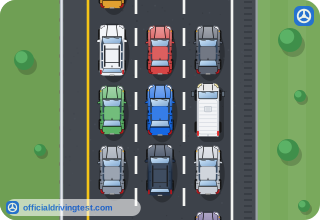
- Join the pack, since there is safety in numbers
- Avoid them and keep a safe space cushion around you
- Stay close behind the pack to save fuel
- Pass the pack on the paved shoulder
Show answer
Correct answer: Avoid them and keep a safe space cushion around you
Stay away from packs of cars and keep a safe space cushion around your vehicle so you have room for emergency maneuvers.
Source: Tennessee Comprehensive Driver License Manual (March 2025 printing), page 69 · Open this page in the manual (Manual page 69)
-
If you are going to exit the interstate, when should you move to the right lane?
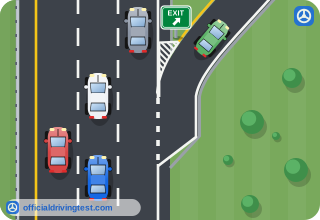
- At the last moment before the exit
- Only after you see the exit ramp
- When you reach the deceleration lane
- As early as possible
Show answer
Correct answer: As early as possible
Moving right as early as possible avoids hasty lane changes near the exit, which could lead to a dangerous situation or a crash.
Source: Tennessee Comprehensive Driver License Manual (March 2025 printing), page 69 · Open this page in the manual (Manual page 69)
-
How far ahead of your vehicle should you try to watch on the interstate for cars braking, entering or exiting?
- 15-20 seconds
- 2-4 seconds
- 5-8 seconds
- 45-60 seconds
Show answer
Correct answer: 15-20 seconds
Scan the road ahead and try to watch 15 to 20 seconds in front of your vehicle for cars that are braking, entering or exiting.
Source: Tennessee Comprehensive Driver License Manual (March 2025 printing), page 69 · Open this page in the manual (Manual page 69)
-
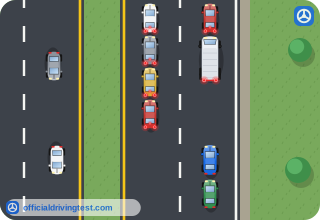
On the interstate you see the brake lights of cars ahead come on. What should you do?
- Change to the left lane at once
- Prepare to slow down
- Sound your horn
- Speed up and pass them
Show answer
Correct answer: Prepare to slow down
Brake lights ahead are a hint that traffic is not moving at a normal pace, so get ready to slow down.
Source: Tennessee Comprehensive Driver License Manual (March 2025 printing), page 69 · Open this page in the manual (Manual page 69)
-
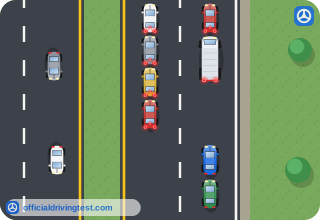
You spot a tie-up on the interstate that makes you slow down or stop. How should you alert drivers behind you?
- Sound your horn several times
- Flash your high beams several times
- Turn your headlights off and on
- Lightly tap your brake pedal several times
Show answer
Correct answer: Lightly tap your brake pedal several times
Tapping the brake pedal lightly a few times flashes your brake lights and warns the drivers behind you that you are slowing.
Source: Tennessee Comprehensive Driver License Manual (March 2025 printing), page 69 · Open this page in the manual (Manual page 69)
-
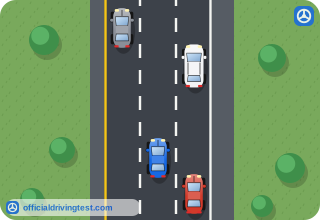
If you drive at a speed below the flow of traffic on the interstate, which lane must you use?
- The left lane
- The right lane
- The HOV lane
- The center lane
Show answer
Correct answer: The right lane
A driver going slower than the flow of traffic must use the right lane.
Source: Tennessee Comprehensive Driver License Manual (March 2025 printing), page 69 · Open this page in the manual (Manual page 69)
-
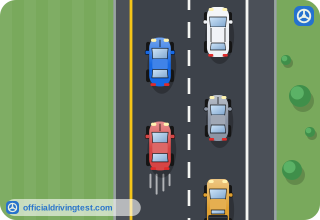
You are traveling in the left lane of the interstate and someone comes up behind you at a faster speed. What should you do?
- Speed up to stay ahead of the car
- Tap your brakes to slow the driver
- Stay in your lane and keep your speed
- Move one lane to your right
Show answer
Correct answer: Move one lane to your right
When a faster vehicle comes up behind you in the left lane, move one lane to the right and let it pass.
Source: Tennessee Comprehensive Driver License Manual (March 2025 printing), page 69 · Open this page in the manual (Manual page 69)
-
According to the manual, what is the left lane of the interstate for?
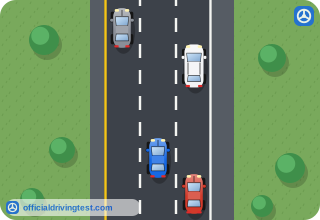
- Trucks and buses
- Slower traffic
- Passing only
- Exiting traffic
Show answer
Correct answer: Passing only
The manual says the left lane is for passing only; slower traffic uses the right lane.
Source: Tennessee Comprehensive Driver License Manual (March 2025 printing), page 69 · Open this page in the manual (Manual page 69)
-
Courteous and safe driving means drivers in every lane but one should be ready to move over so faster traffic can pass. Which lane is the exception?
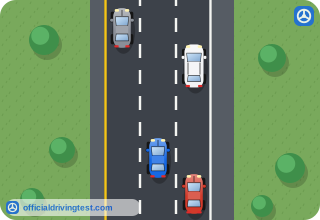
- The right lane
- The left lane
- The center lane
- The HOV lane
Show answer
Correct answer: The right lane
Drivers in any lane except the right lane, which is used for slower traffic, should be prepared to move to another lane to let faster traffic pass.
Source: Tennessee Comprehensive Driver License Manual (March 2025 printing), page 69 · Open this page in the manual (Manual page 69)
-
How does the manual describe High Occupancy Vehicle (HOV) lanes?
- Far right lanes kept for trucks, buses and other heavy vehicles
- Lanes on the shoulder opened to traffic during rush hour
- Lanes for drivers going below the minimum speed limit
- Specially marked far inside lanes for vehicles with two or more occupants
Show answer
Correct answer: Specially marked far inside lanes for vehicles with two or more occupants
HOV lanes are specially marked lanes on the far inside of the interstate, set aside for vehicles carrying two or more people.
Source: Tennessee Comprehensive Driver License Manual (March 2025 printing), page 69 · Open this page in the manual (Manual page 69)
-
What are HOV lanes designed to do?
- Encourage ridesharing and reduce rush-hour vehicles
- Give trucks a lane of their own in rush hour
- Give slower drivers a safe place to drive
- Give drivers a lane for leaving at the next exit
Show answer
Correct answer: Encourage ridesharing and reduce rush-hour vehicles
HOV lanes encourage ridesharing and cut the number of vehicles on the interstate during rush hour while moving more people through congested areas.
Source: Tennessee Comprehensive Driver License Manual (March 2025 printing), page 69 · Open this page in the manual (Manual page 69)
-
During which morning hours of high inbound traffic is the HOV lane reserved for its exclusive users?
- 6–8 a.m.
- 8–10 a.m.
- 7–9 a.m.
- 5–7 a.m.
Show answer
Correct answer: 7–9 a.m.
The HOV lane is reserved during the high inbound traffic hours of 7 to 9 a.m.
Source: Tennessee Comprehensive Driver License Manual (March 2025 printing), page 69 · Open this page in the manual (Manual page 69)
-
During which afternoon hours of high outbound traffic is the HOV lane reserved for its exclusive users?
- 3–5 p.m.
- 4–6 p.m.
- 5–7 p.m.
- 2–4 p.m.
Show answer
Correct answer: 4–6 p.m.
The HOV lane is reserved during the high outbound traffic hours of 4 to 6 p.m.
Source: Tennessee Comprehensive Driver License Manual (March 2025 printing), page 69 · Open this page in the manual (Manual page 69)
-
During HOV hours, does a baby in a car seat count as a passenger?
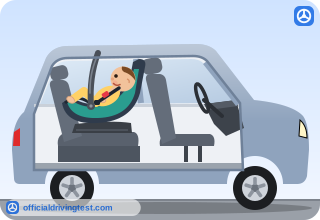
- No, only passengers who could drive count
- No, only adult passengers count
- Only if the baby rides in the front seat
- Yes, just like any other passenger
Show answer
Correct answer: Yes, just like any other passenger
A baby in a car seat qualifies just like any other passenger, so a driver with a baby in a car seat has two persons in the vehicle.
Source: Tennessee Comprehensive Driver License Manual (March 2025 printing), page 69 · Open this page in the manual (Manual page 69)
-
Which of these may use the HOV lane during its hours of operation?
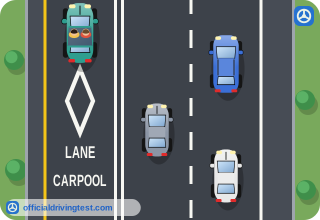
- A car with only the driver
- A pickup truck with only the driver
- A motorcycle with only its rider
- A driver alone who is passing traffic
Show answer
Correct answer: A motorcycle with only its rider
Motorcycles with one person may use the HOV lane during its hours, but persons driving alone may not, even to pass vehicles in the next lanes.
Source: Tennessee Comprehensive Driver License Manual (March 2025 printing), page 69 · Open this page in the manual (Manual page 69)
-
How do you get into the HOV lane?
- Merge onto the highway as usual, then safely merge to the far inside lane
- Cross the solid lines straight from the ramp into the inside lane
- Stop on the left shoulder until there is a gap in the HOV lane
- Drive in the right lane until the HOV hours are over
Show answer
Correct answer: Merge onto the highway as usual, then safely merge to the far inside lane
Enter the highway the normal way, then move safely across to the far inside lane, where the HOV lane is.
Source: Tennessee Comprehensive Driver License Manual (March 2025 printing), page 69 · Open this page in the manual (Manual page 69)
-
You are in the HOV lane and plan to exit the highway before the HOV lane ends. What must you do?
- Stay in the HOV lane until it ends
- Carefully merge over to the exit lane
- Exit straight from the HOV lane
- Cross all lanes at once to the exit
Show answer
Correct answer: Carefully merge over to the exit lane
To leave the highway before the HOV lane ends, you must carefully merge over to the exit lane.
Source: Tennessee Comprehensive Driver License Manual (March 2025 printing), page 69 · Open this page in the manual (Manual page 69)
-
When does the HOV lane serve as a general purpose lane?
- Only during weekday rush hours
- Only on state holidays and Sundays
- Only when a crash closes other lanes
- Weekends and non-peak weekday times
Show answer
Correct answer: Weekends and non-peak weekday times
Outside the weekday rush hours, on weekends and at non-peak times on weekdays, the HOV lane is open as a general purpose lane.
Source: Tennessee Comprehensive Driver License Manual (March 2025 printing), page 69 · Open this page in the manual (Manual page 69)
-
What are drivers found in violation of the HOV lane rules subject to?
- A $25 fine and court costs
- A $100 fine and court costs
- A $50 fine and court costs
- A $500 fine and court costs
Show answer
Correct answer: A $50 fine and court costs
An HOV lane violation carries a $50 fine plus court costs.
Source: Tennessee Comprehensive Driver License Manual (March 2025 printing), page 69 · Open this page in the manual (Manual page 69)
-
When you are preparing to leave the interstate, how does heavier traffic change what you do?
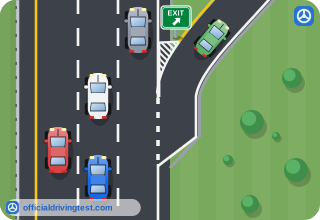
- Move into the proper lane earlier
- Wait longer before changing lanes
- Slow down well before the exit sign
- Stay in the left lane until the exit
Show answer
Correct answer: Move into the proper lane earlier
Be in the proper lane well before your exit; the heavier the traffic, the earlier you should move into it.
Source: Tennessee Comprehensive Driver License Manual (March 2025 printing), page 69 · Open this page in the manual (Manual page 69)
-
How far ahead of the exit turn-off are exit signs usually placed?
- At least 500 feet
- At least 1,000 feet
- At least five miles
- At least one mile
Show answer
Correct answer: At least one mile
Exit signs are usually placed at least one mile before the exit turn-off, giving you time to get into the proper lane.
Source: Tennessee Comprehensive Driver License Manual (March 2025 printing), page 69 · Open this page in the manual (Manual page 69)
-
When leaving the interstate, until what point should you maintain your speed?
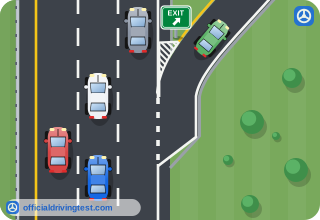
- Until you see the first exit sign
- Until you enter the deceleration lane
- Until you reach the end of the ramp
- Until you signal to change lanes
Show answer
Correct answer: Until you enter the deceleration lane
Signal, move to the lane nearest the exit and keep your speed until you are in the deceleration lane; then slow down.
Source: Tennessee Comprehensive Driver License Manual (March 2025 printing), page 69 · Open this page in the manual (Manual page 69)
-
When you leave the interstate, what usually outlines the deceleration lane?
- A series of yellow reflectors
- A series of red reflectors
- A series of white reflectors
- A row of orange cones
Show answer
Correct answer: A series of white reflectors
The deceleration lane, where you begin to slow down for the exit, is usually outlined by a series of white reflectors.
Source: Tennessee Comprehensive Driver License Manual (March 2025 printing), page 70 · Open this page in the manual (Manual page 70)
-
As you go down the exit ramp, to what speed should your vehicle be slowed?
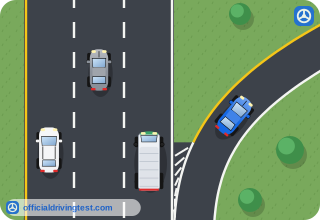
- The minimum speed posted on the interstate
- Half of the interstate's posted speed limit
- A walking pace of about 5 miles per hour
- The posted limit for the road you are entering
Show answer
Correct answer: The posted limit for the road you are entering
You first slow to the exit ramp's posted speed, then further on the ramp, until you are at the posted limit for the road you are about to enter.
Source: Tennessee Comprehensive Driver License Manual (March 2025 printing), page 70 · Open this page in the manual (Manual page 70)
-
When may the paved shoulder of the interstate be used for vehicle travel?
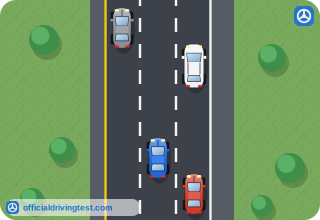
- For deceleration where marked, or for an emergency
- For passing slower traffic in heavy congestion
- For waiting to merge when the ramp is full
- For driving below the minimum speed limit
Show answer
Correct answer: For deceleration where marked, or for an emergency
The paved shoulder is not a travel lane; it may be used only for slowing down where it is marked for that, or in an emergency.
Source: Tennessee Comprehensive Driver License Manual (March 2025 printing), page 70 · Open this page in the manual (Manual page 70)
-
If you miss your exit on the interstate, what must you do?
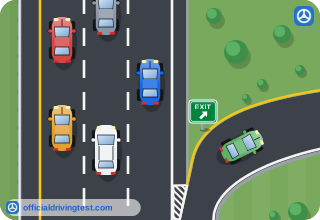
- Back up along the shoulder to the exit
- Go on to the next exit
- Stop on the shoulder and wait for a gap
- Use the paved shoulder to reach the exit
Show answer
Correct answer: Go on to the next exit
Backing up on the interstate is illegal, so after missing an exit you must continue to the next one.
Source: Tennessee Comprehensive Driver License Manual (March 2025 printing), page 70 · Open this page in the manual (Manual page 70)
-
Which of these is illegal on interstate highways?
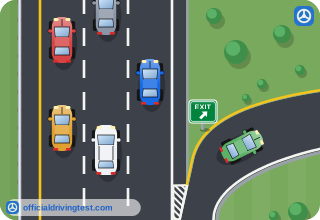
- Backing up
- Driving in the right lane
- Using the HOV lane on a weekend
- Tapping your brakes to warn others
Show answer
Correct answer: Backing up
It is illegal to back up on an interstate highway, even if you miss your exit.
Source: Tennessee Comprehensive Driver License Manual (March 2025 printing), page 70 · Open this page in the manual (Manual page 70)
-
When approaching any type of interchange, what should you follow?
- The vehicle directly in front of you
- The lane with the lightest traffic
- The signs telling you how to make your turn
- Your memory of the last time you used it
Show answer
Correct answer: The signs telling you how to make your turn
Interchanges come in many types, so at any of them follow the signs that tell you how to make the turn you want.
Source: Tennessee Comprehensive Driver License Manual (March 2025 printing), page 70 · Open this page in the manual (Manual page 70)
-
At a diamond interchange, you take the signed exit ramp and reach the cross roadway. What do you do there?
- Merge into cross traffic without stopping
- Obey the traffic sign or signal at the intersection
- Yield only to traffic coming from the left
- Turn right, since left turns are not allowed
Show answer
Correct answer: Obey the traffic sign or signal at the intersection
At the end of a diamond interchange exit ramp you obey the sign or signal at the intersection, then turn right or left as at any ordinary intersection.
Source: Tennessee Comprehensive Driver License Manual (March 2025 printing), page 70 · Open this page in the manual (Manual page 70)
-
With a diamond interchange, when will you always approach the exit ramp?
- Before passing over or under the intersecting road
- After passing over or under the intersecting road
- Only after you pass an entrance ramp
- At the point where the two roads cross
Show answer
Correct answer: Before passing over or under the intersecting road
At a diamond interchange the exit ramp always comes before the interstate passes over or under the crossing road.
Source: Tennessee Comprehensive Driver License Manual (March 2025 printing), page 70 · Open this page in the manual (Manual page 70)
-
You are on the cross road at a diamond interchange and want to turn right onto the interstate. Where is the right-turn entrance ramp?
- After you cross over or under the interstate
- Directly under the interstate overpass
- At the end of the exit ramp
- Before you cross over or under the interstate
Show answer
Correct answer: Before you cross over or under the interstate
The right-turn entrance ramp is always reached before you cross over or under the interstate; never turn right onto a ramp after crossing it.
Source: Tennessee Comprehensive Driver License Manual (March 2025 printing), page 70 · Open this page in the manual (Manual page 70)
-
You are on the cross road at a diamond interchange and want to turn left onto the interstate. Where is the left-turn entrance ramp?
- Before you cross over or under the interstate
- Directly under the interstate overpass
- After you cross over or under the interstate
- At the end of the exit ramp
Show answer
Correct answer: After you cross over or under the interstate
The left-turn entrance ramp is always reached after you cross over or under the interstate; never turn left onto a ramp before crossing it.
Source: Tennessee Comprehensive Driver License Manual (March 2025 printing), page 70 · Open this page in the manual (Manual page 70)
-
At a cloverleaf interchange, what kind of turns are made?
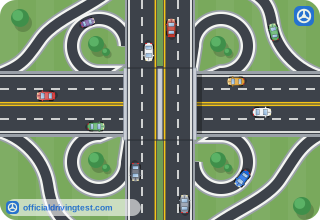
- All turns are left turns
- All turns are right turns
- Left turns to enter, right turns to exit
- Left turns through a median opening
Show answer
Correct answer: All turns are right turns
Every turn at a cloverleaf interchange is a right turn; even a left turn is made by taking a loop ramp to the right.
Source: Tennessee Comprehensive Driver License Manual (March 2025 printing), page 70 · Open this page in the manual (Manual page 70)
-
At a cloverleaf interchange, how do you turn left?
- Take the right turn just after the overpass
- Take the right turn just before the overpass
- Turn left across traffic before the overpass
- Turn left across traffic after the overpass
Show answer
Correct answer: Take the right turn just after the overpass
To go left at a cloverleaf, take the right turn just after the overpass; the loop carries you around onto the crossroad going the way a left turn would.
Source: Tennessee Comprehensive Driver License Manual (March 2025 printing), page 70 · Open this page in the manual (Manual page 70)
-
At a cloverleaf interchange, how do you turn right?
- Take the right turn just after the overpass
- Turn right only after you cross the overpass
- Turn left first and loop back to the right
- Take the right turn before you reach the overpass
Show answer
Correct answer: Take the right turn before you reach the overpass
To go right at a cloverleaf interchange, take the right turn before you get to the overpass.
Source: Tennessee Comprehensive Driver License Manual (March 2025 printing), page 70 · Open this page in the manual (Manual page 70)
-
What is the advantage of a cloverleaf interchange?
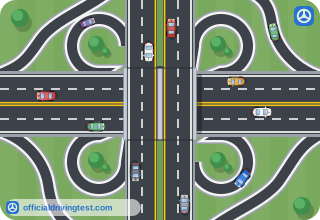
- You never need to slow down to make a turn
- Exiting and entering traffic share one lane
- You never cross the path of traffic to make a turn
- Traffic lights control every turn you make
Show answer
Correct answer: You never cross the path of traffic to make a turn
Because all turns at a cloverleaf are right turns, you do not have to cross the path of other traffic to make a turn.
Source: Tennessee Comprehensive Driver License Manual (March 2025 printing), page 70 · Open this page in the manual (Manual page 70)
-
What is a "weaving" interchange?
- One where all turns are made as right turns
- One where traffic exits and enters at the same lane
- One where two interstates cross with no ramps
- One where a traffic signal controls the ramps
Show answer
Correct answer: One where traffic exits and enters at the same lane
In a weaving interchange, interstate traffic both exits and enters at the same lane, one of the most hazardous lane situations.
Source: Tennessee Comprehensive Driver License Manual (March 2025 printing), page 70 · Open this page in the manual (Manual page 70)
-
Which of these does the manual list as something you may NOT do on the interstate?
- Drive in the right lane when you are slower
- Use the left lane to pass
- Keep to the middle of your lane
- Change lanes without signaling
Show answer
Correct answer: Change lanes without signaling
Changing lanes without signaling is on the manual's list of things you may not do on the interstate.
Source: Tennessee Comprehensive Driver License Manual (March 2025 printing), page 71 · Open this page in the manual (Manual page 71)
-
Instead of driving in another driver's blind spot on the interstate, what should you do?
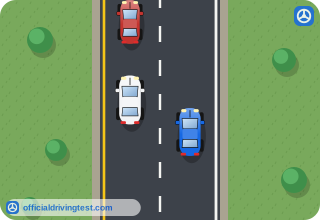
- Follow along at the driver's side
- Sound your horn and stay beside it
- Either stay behind or go around
- Match its speed so it can see you
Show answer
Correct answer: Either stay behind or go around
Riding where the driver ahead cannot see you is dangerous, so either stay behind the vehicle or pass it; do not follow to its side.
Source: Tennessee Comprehensive Driver License Manual (March 2025 printing), page 71 · Open this page in the manual (Manual page 71)
-
Where may you drive onto the interstate?
- At any point where the shoulder is paved
- Only through an opening provided for that entrance
- Across the median where no traffic is near
- At any crossroad, after a full stop
Show answer
Correct answer: Only through an opening provided for that entrance
You may not drive onto the interstate except through an opening provided for that purpose.
Source: Tennessee Comprehensive Driver License Manual (March 2025 printing), page 71 · Open this page in the manual (Manual page 71)
-
How does the manual tell you to make traffic checks on the interstate?
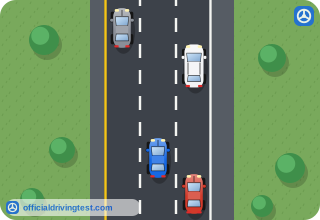
- Watch only the vehicle directly ahead of you
- Check behind you only before you exit
- Look in your rear view and side mirrors often
- Rely on other drivers to warn you
Show answer
Correct answer: Look in your rear view and side mirrors often
Make frequent traffic checks by looking often in your rear view and side-view mirrors.
Source: Tennessee Comprehensive Driver License Manual (March 2025 printing), page 71 · Open this page in the manual (Manual page 71)
-
On the interstate, what should you check your instruments for often?
- Oil level and tire tread
- Speed and fuel supply
- Radio and climate settings
- Mileage and trip time
Show answer
Correct answer: Speed and fuel supply
Check your instruments often for your speed and your fuel supply.
Source: Tennessee Comprehensive Driver License Manual (March 2025 printing), page 71 · Open this page in the manual (Manual page 71)
-
Besides other vehicles, what does the manual tell you to look out for on an interstate highway?
- Pedestrians from a vehicle breakdown, and animals
- Bicyclists riding along the left lane line
- Railroad crossings just beyond the exits
- Crossing guards at the interstate ramps
Show answer
Correct answer: Pedestrians from a vehicle breakdown, and animals
Be prepared for the unexpected: people may be on foot after a breakdown, and animals may be on the roadway.
Source: Tennessee Comprehensive Driver License Manual (March 2025 printing), page 71 · Open this page in the manual (Manual page 71)
-
To avoid lane wandering on the interstate, what does the manual tell you to do?
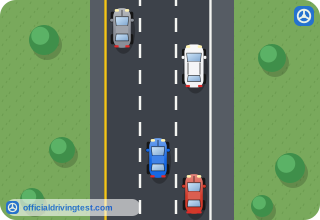
- Keep to the left unless you plan to exit
- Use the center lane for most of your trip
- Change lanes often to stay alert
- Keep to the right unless overtaking or passing
Show answer
Correct answer: Keep to the right unless overtaking or passing
Weaving and wandering are dangerous; keep to the right unless you are overtaking or passing another vehicle.
Source: Tennessee Comprehensive Driver License Manual (March 2025 printing), page 71 · Open this page in the manual (Manual page 71)
-
According to the manual, what is mainly responsible for the greater danger of night driving?
- Fatigue and sharply reduced vision
- Higher speed limits after dark
- Heavier truck traffic
- Fewer lanes open at night
Show answer
Correct answer: Fatigue and sharply reduced vision
Mile for mile, night driving is far more dangerous than day driving, mainly because of fatigue and sharply reduced vision.
Source: Tennessee Comprehensive Driver License Manual (March 2025 printing), page 71 · Open this page in the manual (Manual page 71)
-
What is "interstate hypnosis"?
- Blurred vision caused by the glare of oncoming headlights
- Anger that builds up when other drivers cut you off
- Dizziness caused by watching the passing lane lines
- Drowsiness or unawareness from reduced activity and steady sounds
Show answer
Correct answer: Drowsiness or unawareness from reduced activity and steady sounds
Interstate hypnosis is drowsiness or unawareness brought on by reduced activity and the steady sounds of wind, engine and tire hum.
Source: Tennessee Comprehensive Driver License Manual (March 2025 printing), page 71 · Open this page in the manual (Manual page 71)
-
To fight interstate hypnosis, what should you do with your eyes?
- Stare straight ahead at the center of your lane
- Keep shifting them left and right and check the mirror
- Keep them on the car directly ahead of you
- Look only at the road just past your hood
Show answer
Correct answer: Keep shifting them left and right and check the mirror
Look well ahead but avoid staring: keep shifting your eyes left and right and check your rear view mirror, since staring straight ahead can almost put you to sleep.
Source: Tennessee Comprehensive Driver License Manual (March 2025 printing), page 71 · Open this page in the manual (Manual page 71)
-
What does the manual tell you to do when you become drowsy while driving?
- Turn up the radio
- Chew gum and keep going
- Quit driving
- Speed up to arrive sooner
Show answer
Correct answer: Quit driving
Quit driving when you are drowsy, because drowsiness is the first step in falling asleep.
Source: Tennessee Comprehensive Driver License Manual (March 2025 printing), page 71 · Open this page in the manual (Manual page 71)
-
To help fight interstate hypnosis, how should you keep your car's interior?
- As cool as possible
- As warm as possible
- As dark as possible
- As quiet as possible
Show answer
Correct answer: As cool as possible
One of the manual's tips against interstate hypnosis is to keep the inside of the car as cool as possible.
Source: Tennessee Comprehensive Driver License Manual (March 2025 printing), page 71 · Open this page in the manual (Manual page 71)
-
According to the manual, it is safest for you and others if you drive no more than how many hours per day?
- Six hours
- Ten hours
- Twelve hours
- Eight hours
Show answer
Correct answer: Eight hours
The manual says it is safest not to drive more than eight hours per day.
Source: Tennessee Comprehensive Driver License Manual (March 2025 printing), page 71 · Open this page in the manual (Manual page 71)
-
What is "rubbernecking"?
- Following another vehicle too closely on the interstate
- Weaving in and out of lanes to get ahead of traffic
- Turning your head to check your blind spot
- Slowing down to look at crashes or other unusual sights
Show answer
Correct answer: Slowing down to look at crashes or other unusual sights
Rubbernecking means slowing down to look at crashes or almost anything else out of the ordinary, and it is one of the worst causes of congestion.
Source: Tennessee Comprehensive Driver License Manual (March 2025 printing), page 72 · Open this page in the manual (Manual page 72)
-
According to the manual, how does tailgating add to traffic congestion?
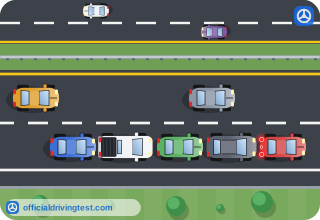
- It forces entering drivers to stop on the ramp
- It keeps other drivers out of the HOV lane
- It causes crashes that can clog major routes for hours
- It makes slower drivers leave the right lane
Show answer
Correct answer: It causes crashes that can clog major routes for hours
Following too closely accounts for many crashes, and those crashes clog major routes, often for hours.
Source: Tennessee Comprehensive Driver License Manual (March 2025 printing), page 72 · Open this page in the manual (Manual page 72)
-
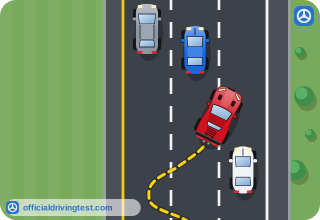
How much does weaving in and out of interstate lanes improve arrival or travel times?
- About 10 percent
- Virtually none
- Several minutes per trip
- Up to half an hour
Show answer
Correct answer: Virtually none
Unnecessary lane changes produce virtually no improvement in travel time; at best they slow all traffic and at worst cause crashes.
Source: Tennessee Comprehensive Driver License Manual (March 2025 printing), page 72 · Open this page in the manual (Manual page 72)
-
How can drivers who do not watch the fuel gauge or maintain their vehicles cause traffic congestion?
- Their vehicles must use the HOV lane in rush hour
- Their vehicles are barred from interstates at rush hour
- Their vehicles must leave at the next exit ramp
- Their vehicles can run out of gas or stall, causing bottlenecks
Show answer
Correct answer: Their vehicles can run out of gas or stall, causing bottlenecks
Such vehicles can run out of gas, malfunction or stall on the road, causing bottlenecks and major slowdowns.
Source: Tennessee Comprehensive Driver License Manual (March 2025 printing), page 72 · Open this page in the manual (Manual page 72)
-
Which of these are given as examples of new road features drivers need to become familiar with?
- Stop signs and yield signs
- HOV lanes and rumble strips
- Crosswalks and curbs
- Solid yellow center lines
Show answer
Correct answer: HOV lanes and rumble strips
As road designs change, drivers must learn new conditions such as HOV lanes and rumble strips.
Source: Tennessee Comprehensive Driver License Manual (March 2025 printing), page 101 · Open this page in the manual (Manual page 101)