Tennessee: Interstate driving — Part 1 Practice Test
Questions in this part include: “What is the minimum speed limit in the right lane(s) of the interstates?” · “According to the manual, which of these will you NOT find on an interstate?”
Independent educational site · not affiliated with any government agency or DMV
Ready? Test yourself
- Instant feedback with an explanation
- Every answer cites its source in the manual
- Your best score is saved on this device
- Keyboard: press 1 to 4 to answer and Enter for the next question
Questions are original and based on the official manual "Tennessee Comprehensive Driver License Manual" (March 2025 printing), Tennessee Department of Safety and Homeland Security.
All 17 questions in this practice test
Take the test above first, then use this list to study. Tap “Show answer” to see the correct answer and explanation.
Show the questions and answersHide the questions
-
What is the minimum speed in the left most lane of an interstate highway, unless traffic congestion and flow prevent safe driving at such speed?
- 55 m.p.h.
- 45 m.p.h.
- 35 m.p.h.
- 65 m.p.h.
Show answer
Correct answer: 55 m.p.h.
It is unlawful to drive less than 55 m.p.h. in the left most lane of any interstate, unless congestion and flow prevent safe driving at that speed.
Source: Tennessee Comprehensive Driver License Manual (March 2025 printing), page 47 · Open this page in the manual (Manual page 47)
-
What is the minimum speed limit in the right lane(s) of the interstates?
- 35 m.p.h.
- 55 m.p.h.
- 45 m.p.h.
- 25 m.p.h.
Show answer
Correct answer: 45 m.p.h.
Under normal driving conditions, all vehicles must travel at least 45 m.p.h. in the right lane(s) so they are not a hazard to other drivers.
Source: Tennessee Comprehensive Driver License Manual (March 2025 printing), page 47 · Open this page in the manual (Manual page 47)
-
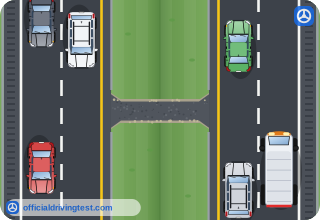
Who may use emergency crossovers on an interstate?
- Any driver stuck in a traffic jam on the road
- Drivers who have just missed an interstate exit
- Any driver when no other traffic is around
- Emergency vehicles and highway maintenance crews only
Show answer
Correct answer: Emergency vehicles and highway maintenance crews only
Emergency crossovers are for emergency vehicles and highway maintenance crews only.
Source: Tennessee Comprehensive Driver License Manual (March 2025 printing), page 59 · Open this page in the manual (Manual page 59)
-
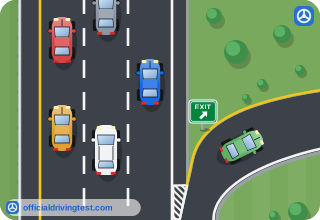
You missed your exit on an interstate. What should you do?
- Drive on to the next exit ramp
- Back up along the shoulder to the exit
- Use an emergency crossover to turn around
- Cross the median strip where it is flat
Show answer
Correct answer: Drive on to the next exit ramp
If you miss an exit, you drive on to the next exit ramp rather than turn around or cut across the median.
Source: Tennessee Comprehensive Driver License Manual (March 2025 printing), page 59 · Open this page in the manual (Manual page 59)
-
Where is a crossover on a four-lane highway permitted?
- At any gap in a median on an interstate road
- At any place the median looks passable to drivers
- Only at paved openings provided on four-lane highways
- Wherever two lanes meet at a ramp junction
Show answer
Correct answer: Only at paved openings provided on four-lane highways
A crossover is permitted only at paved openings provided on four-lane highways, and none are provided for interstate traffic.
Source: Tennessee Comprehensive Driver License Manual (March 2025 printing), page 60 · Open this page in the manual (Manual page 60)
-
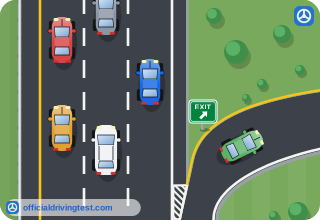
What does the manual say about backing up on the interstate?
- It is allowed on the shoulder with flashers on
- It is allowed if you missed your exit and no one is behind you
- It is allowed for no more than 100 feet
- It is illegal
Show answer
Correct answer: It is illegal
Backing up on the interstate is illegal, even if you missed your exit.
Source: Tennessee Comprehensive Driver License Manual (March 2025 printing), page 64 · Open this page in the manual (Manual page 64)
-
When may you stop on an interstate highway?
- To check your directions or map
- To let a passenger out
- Only for an emergency
- To rest briefly on the shoulder
Show answer
Correct answer: Only for an emergency
A stopped car on the interstate, even on the shoulder, is extremely dangerous, so stop only for an emergency.
Source: Tennessee Comprehensive Driver License Manual (March 2025 printing), page 66 · Open this page in the manual (Manual page 66)
-
What does the manual say about walking on the interstate?
- It is legal on the shoulder in daylight
- It is legal when your vehicle is disabled
- It is both illegal and dangerous
- It is legal if you wear bright clothing
Show answer
Correct answer: It is both illegal and dangerous
Walking on the interstate is both illegal and dangerous.
Source: Tennessee Comprehensive Driver License Manual (March 2025 printing), page 66 · Open this page in the manual (Manual page 66)
-
According to the manual, why does traffic on interstates usually move more safely and efficiently?
- Because access to the roadway is controlled
- Because the speed limit is the same on every section
- Because large trucks may not use them during rush hour
- Because police patrol every mile of the interstate
Show answer
Correct answer: Because access to the roadway is controlled
Interstates are controlled-access roads, and the manual gives that as the reason their traffic usually moves more safely and efficiently.
Source: Tennessee Comprehensive Driver License Manual (March 2025 printing), page 68 · Open this page in the manual (Manual page 68)
-
According to the manual, which of these will you NOT find on an interstate?
- Entrance ramps
- Interchanges
- Railroad crossings
- Deceleration lanes
Show answer
Correct answer: Railroad crossings
Interstates have no stop signs, no traffic lights and no railroad crossings; drivers enter and leave at interchanges using ramps.
Source: Tennessee Comprehensive Driver License Manual (March 2025 printing), page 68 · Open this page in the manual (Manual page 68)
-
What does "limited access" or "controlled access" mean on an interstate?
- Only cars and light trucks may use the road at any time
- Drivers enter or leave only at interchanges, without crossing traffic
- Drivers may enter at any crossroad if they first come to a stop
- Only drivers who live along the route may use its entrances
Show answer
Correct answer: Drivers enter or leave only at interchanges, without crossing traffic
On a limited-access road, drivers get on and off only at entrances and exits called interchanges, and never cross the path of other traffic.
Source: Tennessee Comprehensive Driver License Manual (March 2025 printing), page 68 · Open this page in the manual (Manual page 68)
-
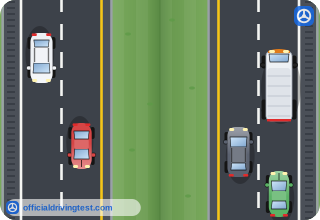
Interstates and divided highways have largely removed the chance of which kind of collision?
- Rear-end collisions
- Multiple-car collisions
- Sideswipe collisions
- Head-on collisions
Show answer
Correct answer: Head-on collisions
Because traffic going the other way is kept separate, interstates and divided highways have largely removed the chance of head-on collisions.
Source: Tennessee Comprehensive Driver License Manual (March 2025 printing), page 68 · Open this page in the manual (Manual page 68)
-
According to the manual, what does safe use of the interstates demand of the driver?
- Driving in the left lane except when you plan to exit
- A speed of at least 70 mph on every section of road
- Full awareness of higher-speed driving and constant alertness
- Changing lanes often to keep up with the fastest traffic
Show answer
Correct answer: Full awareness of higher-speed driving and constant alertness
Interstate driving is a higher-speed type of driving, so it calls for complete awareness of that and constant alertness.
Source: Tennessee Comprehensive Driver License Manual (March 2025 printing), page 68 · Open this page in the manual (Manual page 68)
-
Before driving on the interstate, what should you plan in advance?
- Your entrance, direction and exit
- Which single lane you will use all the way
- The rest areas where you will sleep
- The speed you will drive on each part
Show answer
Correct answer: Your entrance, direction and exit
The manual says to plan the trip ahead so you know where you will get on, which direction you will go and where you will get off.
Source: Tennessee Comprehensive Driver License Manual (March 2025 printing), page 68 · Open this page in the manual (Manual page 68)
-
Why does the manual say to check the gas gauge before getting on the interstate?
- Gas stations are not allowed near interstate exits
- Your fuel use doubles at interstate speeds
- Running low on fuel is a moving violation
- In rural areas it may be many miles between exits
Show answer
Correct answer: In rural areas it may be many miles between exits
Exits can be far apart in rural areas, so you could run out of gas before reaching another gas station.
Source: Tennessee Comprehensive Driver License Manual (March 2025 printing), page 68 · Open this page in the manual (Manual page 68)
-
How is entering an interstate different from entering most other busy roads?
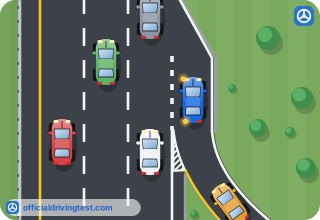
- You must stop at the end of the ramp before you enter
- You must wait for a driver on the interstate to wave you in
- You speed up to merge instead of slowing down or stopping
- You must enter at the speed of the road you just left
Show answer
Correct answer: You speed up to merge instead of slowing down or stopping
Before most busy roads you slow down or stop, but on an interstate you do the opposite and use the acceleration lane to speed up and merge.
Source: Tennessee Comprehensive Driver License Manual (March 2025 printing), page 68 · Open this page in the manual (Manual page 68)
-
What is the acceleration lane (entrance ramp) used for when you enter an interstate?
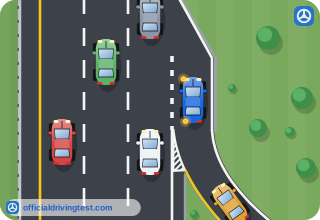
- To reach interstate speed so you can merge smoothly
- To stop and wait until the travel lane is empty
- To pass slower vehicles already on the interstate
- To slow down before you join the traffic lane
Show answer
Correct answer: To reach interstate speed so you can merge smoothly
You stay to the right and build up speed on the ramp so you can merge smoothly into the travel lane when the way is clear.
Source: Tennessee Comprehensive Driver License Manual (March 2025 printing), page 68 · Open this page in the manual (Manual page 68)