Tennessee: Parking rules — Part 1 Practice Test
Questions in this part include: “If you are stopping at a curb, within how many inches of the curb should you move for proper parking?” · “When parking next to a roadway outside the city limits, how far in either direction must your vehicle be visible?”
Independent educational site · not affiliated with any government agency or DMV
Ready? Test yourself
- Instant feedback with an explanation
- Every answer cites its source in the manual
- Your best score is saved on this device
- Keyboard: press 1 to 4 to answer and Enter for the next question
Questions are original and based on the official manual "Tennessee Comprehensive Driver License Manual" (March 2025 printing), Tennessee Department of Safety and Homeland Security.
All 21 questions in this practice test
Take the test above first, then use this list to study. Tap “Show answer” to see the correct answer and explanation.
Show the questions and answersHide the questions
-
If you are stopping at a curb, within how many inches of the curb should you move for proper parking?
- 18 inches
- 6 inches
- 12 inches
- 24 inches
Show answer
Correct answer: 18 inches
The manual says to move to within 18 inches of the curb when stopping at a curb for proper parking.
Source: Tennessee Comprehensive Driver License Manual (March 2025 printing), page 29 · Open this page in the manual (Manual page 29)
-
The use of reserved handicapped parking spaces by others than those entitled to them is:
- Allowed for 15 minutes
- Prohibited by law
- Allowed when no other spaces are open
- Allowed for loading only
Show answer
Correct answer: Prohibited by law
The manual says that use of reserved handicapped spaces by others is prohibited by law.
Source: Tennessee Comprehensive Driver License Manual (March 2025 printing), page 40 · Open this page in the manual (Manual page 40)
-
Which of these is another name for a vehicle's parking brake?
- Foot brake
- Service brake
- Emergency brake
- Anti-lock brake
Show answer
Correct answer: Emergency brake
The secondary braking system is commonly called the parking brake, also referred to as the emergency or hand brake.
Source: Tennessee Comprehensive Driver License Manual (March 2025 printing), page 65 · Open this page in the manual (Manual page 65)
-
The manual calls applying the parking brake particularly important when you are parked in which place?
- On level ground in an empty parking lot
- Beside a curb on a level street
- On a steep hill or incline
- In your own garage at night
Show answer
Correct answer: On a steep hill or incline
Using the parking brake is especially important when parked on steep hills or inclines.
Source: Tennessee Comprehensive Driver License Manual (March 2025 printing), page 65 · Open this page in the manual (Manual page 65)
-
The manual calls applying the parking brake particularly important when you are parked near which kind of place?
- A crosswalk where children are present
- An empty field beside a quiet road
- A level street with no pedestrians
- A highway on-ramp with no traffic
Show answer
Correct answer: A crosswalk where children are present
The parking brake is especially important near a crosswalk where children are present, such as at a school or playground.
Source: Tennessee Comprehensive Driver License Manual (March 2025 printing), page 65 · Open this page in the manual (Manual page 65)
-
Where does the manual say you should park so that your vehicle is not a hazard?
- Close to the travel lane so that you can pull out easily
- Shielded from view so other drivers are not distracted
- Where drivers from one direction can see it
- Far enough from any travel lane not to interfere with traffic
Show answer
Correct answer: Far enough from any travel lane not to interfere with traffic
A parked vehicle should be far enough from the travel lane not to interfere with traffic and easily visible from both directions.
Source: Tennessee Comprehensive Driver License Manual (March 2025 printing), page 65 · Open this page in the manual (Manual page 65)
-
When parking next to a roadway outside the city limits, what does the manual say about your wheels?
- Only the front wheels must be off the pavement
- All four wheels must be off the pavement, if possible
- Two wheels must be off the pavement
- Only the right-side wheels must be off the pavement
Show answer
Correct answer: All four wheels must be off the pavement, if possible
Outside city limits, park with all four wheels off the pavement when possible.
Source: Tennessee Comprehensive Driver License Manual (March 2025 printing), page 65 · Open this page in the manual (Manual page 65)
-
When parking next to a roadway outside the city limits, how much road width must you leave for other traffic to pass?
- At least 18 feet
- At least 8 feet
- At least 12 feet
- At least 25 feet
Show answer
Correct answer: At least 18 feet
You must leave at least 18 feet of road width so other traffic can pass your parked vehicle.
Source: Tennessee Comprehensive Driver License Manual (March 2025 printing), page 65 · Open this page in the manual (Manual page 65)
-
When parking next to a roadway outside the city limits, how far in either direction must your vehicle be visible?
- At least 100 feet
- At least 300 feet
- At least 200 feet
- At least 50 feet
Show answer
Correct answer: At least 200 feet
The parked vehicle must be visible for at least 200 feet in both directions.
Source: Tennessee Comprehensive Driver License Manual (March 2025 printing), page 65 · Open this page in the manual (Manual page 65)
-
In cities and towns, what usually marks a “NO PARKING ZONE”?
- Parking meters with expired time
- Signs or yellow painted curbs
- A broken white line along the curb
- Reflective orange posts at the roadside
Show answer
Correct answer: Signs or yellow painted curbs
Signs or yellow painted curbs usually mark a no parking zone in cities and towns.
Source: Tennessee Comprehensive Driver License Manual (March 2025 printing), page 65 · Open this page in the manual (Manual page 65)
-
What does the manual say about leaving the engine running in a parked unattended vehicle?
- It is allowed for up to five minutes
- It is allowed if the doors are locked
- It is allowed in cold weather
- It is against the law
Show answer
Correct answer: It is against the law
Leaving the engine running in a parked, unattended vehicle is against the law.
Source: Tennessee Comprehensive Driver License Manual (March 2025 printing), page 65 · Open this page in the manual (Manual page 65)
-
What should you do with the ignition keys of a parked and unattended vehicle?
- Leave them in the ignition if the doors are locked
- Hide them under the floor mat
- Leave them with a passenger in the vehicle
- Remove them
Show answer
Correct answer: Remove them
The manual says to remove the ignition keys from a parked and unattended vehicle.
Source: Tennessee Comprehensive Driver License Manual (March 2025 printing), page 65 · Open this page in the manual (Manual page 65)
-
What does the manual call a good safety habit when your vehicle is left parked and unattended?
- Leaving the windows down for air
- Locking the doors
- Leaving the interior lights on
- Leaving valuables on the seat
Show answer
Correct answer: Locking the doors
Locking the doors of a vehicle left parked and unattended is a good safety habit.
Source: Tennessee Comprehensive Driver License Manual (March 2025 printing), page 65 · Open this page in the manual (Manual page 65)
-
When you park a vehicle with an automatic transmission, how should you leave it?
- In park, with the parking brake set
- In neutral, with the parking brake off
- In drive, with the parking brake set
- In reverse, with the parking brake off
Show answer
Correct answer: In park, with the parking brake set
The manual says to set the parking brake and leave an automatic in park (a manual in gear).
Source: Tennessee Comprehensive Driver License Manual (March 2025 printing), page 65 · Open this page in the manual (Manual page 65)
-
When you park a vehicle with a manual transmission, how should you leave it?
- In neutral, with the parking brake set
- In gear, with the parking brake set
- In park, with the parking brake off
- In neutral, with the parking brake off
Show answer
Correct answer: In gear, with the parking brake set
The manual says to set the parking brake and leave a manual-transmission vehicle in gear.
Source: Tennessee Comprehensive Driver License Manual (March 2025 printing), page 65 · Open this page in the manual (Manual page 65)
-
What does the manual say about double parking?
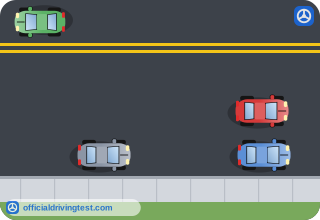
- It is prohibited by law
- It is allowed for up to five minutes
- It is allowed if your flashers are on
- It is allowed while you load or unload
Show answer
Correct answer: It is prohibited by law
Double parking is prohibited by law.
Source: Tennessee Comprehensive Driver License Manual (March 2025 printing), page 65 · Open this page in the manual (Manual page 65)
-
You are parked facing downhill next to a curb. How should you turn your front wheels?
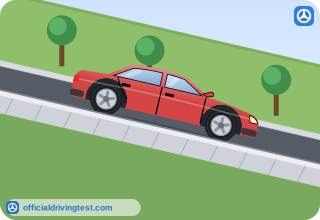
- Away from the curb (left)
- Straight ahead
- Toward the curb (right)
- Toward the center of the road
Show answer
Correct answer: Toward the curb (right)
Turning the wheels toward the curb means that if the car rolls, it rolls into the curb and not the roadway.
Source: Tennessee Comprehensive Driver License Manual (March 2025 printing), page 65 · Open this page in the manual (Manual page 65)
-
You are parked facing uphill next to a curb. How should you turn your front wheels?
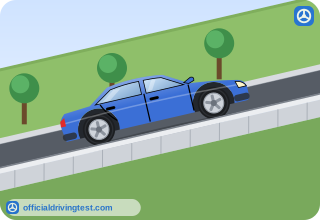
- Toward the curb (right)
- Straight ahead
- Away from the curb (left)
- Toward the center of the road
Show answer
Correct answer: Away from the curb (left)
Turning the wheels left, away from the curb, means a rolling-back car rolls into the curb instead of into traffic.
Source: Tennessee Comprehensive Driver License Manual (March 2025 printing), page 65 · Open this page in the manual (Manual page 65)
-
You are parked facing downhill where there is no curb. How should you turn your front wheels?
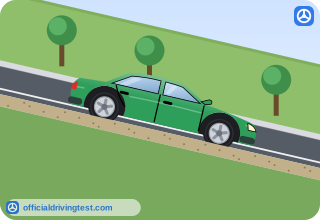
- Toward the edge of the roadway (right)
- Toward the center of the road (left)
- Straight ahead
- Away from the edge of the roadway
Show answer
Correct answer: Toward the edge of the roadway (right)
Turning the wheels toward the edge of the road keeps the vehicle from rolling into traffic if the brake fails.
Source: Tennessee Comprehensive Driver License Manual (March 2025 printing), page 65 · Open this page in the manual (Manual page 65)
-
You are parked facing uphill where there is no curb. What does the manual say about turning your front wheels toward the edge of the roadway (right)?
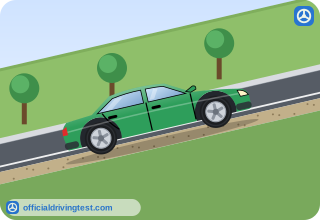
- It lets the car roll back into the center of the road if the brakes fail
- It keeps the front wheels from sinking into a soft shoulder
- It lets the parking brake hold the car without being set
- It lets the car roll away from the center of the road if the brakes fail
Show answer
Correct answer: It lets the car roll away from the center of the road if the brakes fail
Turning the wheels toward the edge of the roadway lets the car roll away from the center of the road if the brakes fail.
Source: Tennessee Comprehensive Driver License Manual (March 2025 printing), page 65 · Open this page in the manual (Manual page 65)
-
What does the manual say about parking in front of a public or private driveway?
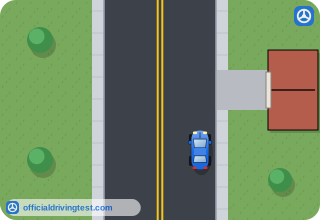
- It is allowed for up to 15 minutes
- It is illegal
- It is allowed on private driveways only
- It is allowed if you stay with the vehicle
Show answer
Correct answer: It is illegal
Parking in front of a public or private driveway is illegal.
Source: Tennessee Comprehensive Driver License Manual (March 2025 printing), page 65 · Open this page in the manual (Manual page 65)