South Carolina: Signals and vehicle controls — Part 6 Practice Test
Questions in this part include: “At night, what should you look for well ahead of your headlight beams?” · “Where should you keep heavy items in a trailer?”
Independent educational site · not affiliated with any government agency or DMV
Ready? Test yourself
- Instant feedback with an explanation
- Every answer cites its source in the manual
- Your best score is saved on this device
- Keyboard: press 1 to 4 to answer and Enter for the next question
Questions are original and based on the official manual "South Carolina Driver's Manual" (2026 (posted April 2026)), South Carolina Department of Motor Vehicles.
All 19 questions in this practice test
Take the test above first, then use this list to study. Tap “Show answer” to see the correct answer and explanation.
Show the questions and answersHide the questions
-
At night, what should you look for well ahead of your headlight beams?
- Bright reflections beside the road
- Lane markings only
- Dark shapes on the roadway
- Fog lights on other vehicles
Show answer
Correct answer: Dark shapes on the roadway
Searching well beyond your headlight beams for dark shapes on the road helps you spot hazards early.
Source: South Carolina Driver's Manual (2026 (posted April 2026)), page 11-2 · Open this page in the manual (Manual page 11-2)
-
Why should you glance occasionally to the right and left when driving at night?
- To find the pavement edge and hazards from the sides
- To confirm that your headlights are properly aimed
- To rest your eyes from the glare of the road ahead
- To look for street signs before you reach them
Show answer
Correct answer: To find the pavement edge and hazards from the sides
Glancing to each side shows where the edge of the pavement is and any hazards that may come from the sides.
Source: South Carolina Driver's Manual (2026 (posted April 2026)), page 11-2 · Open this page in the manual (Manual page 11-2)
-
What should you do about sunglasses or colored lenses when driving at night or on overcast days?
- Do not wear them, because tinted lenses reduce your vision
- Wear them to reduce the glare of oncoming headlights
- Wear them only if they are lightly tinted
- Wear them only on overcast days
Show answer
Correct answer: Do not wear them, because tinted lenses reduce your vision
Tinted or colored lenses reduce your vision, so you should not wear them at night or on overcast days.
Source: South Carolina Driver's Manual (2026 (posted April 2026)), page 11-2 · Open this page in the manual (Manual page 11-2)
-
When you begin to hook up a trailer, what should you do?
- Finish the process before doing anything else
- Pause to do other tasks and finish it later
- Hook up quickly and check the connection at the next stop
- Check the connection only after the first mile
Show answer
Correct answer: Finish the process before doing anything else
You should not pause or stop to do something else; always finish the hookup first.
Source: South Carolina Driver's Manual (2026 (posted April 2026)), page 11-9 · Open this page in the manual (Manual page 11-9)
-
Before leaving, what should you check when connecting a trailer?
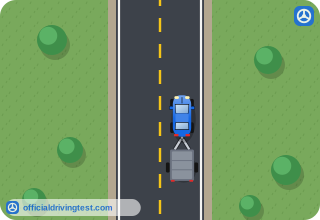
- That your side mirrors are folded in tightly
- That the gas tank is at least half full
- That the coupler and hitch-ball are connected
- That the trailer plate is clean and visible
Show answer
Correct answer: That the coupler and hitch-ball are connected
Before leaving you check that the coupler and hitch-ball are properly connected.
Source: South Carolina Driver's Manual (2026 (posted April 2026)), page 11-9 · Open this page in the manual (Manual page 11-9)
-
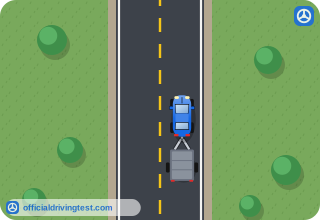
What should your vehicle be equipped with when towing a trailer?
- A rear camera mounted on the trailer
- Clean, undamaged mirrors on both sides
- Tinted side windows to reduce glare
- A mirror on the driver side only
Show answer
Correct answer: Clean, undamaged mirrors on both sides
Dirty or inadequate side mirrors restrict what you can see behind you.
Source: South Carolina Driver's Manual (2026 (posted April 2026)), page 11-9 · Open this page in the manual (Manual page 11-9)
-
How should a trailer be loaded?
- Heavier in the back
- Heavier on one side
- Evenly front to back
- Heavier in the front
Show answer
Correct answer: Heavier in the front
Trailers must be loaded heavier in the front.
Source: South Carolina Driver's Manual (2026 (posted April 2026)), page 11-10 · Open this page in the manual (Manual page 11-10)
-
What does loading heavier items in the front of a trailer reduce?
- Fuel use
- Tire wear
- The need for safety chains
- The possibility of sway
Show answer
Correct answer: The possibility of sway
Heavier loading in front reduces the chance that the trailer sways.
Source: South Carolina Driver's Manual (2026 (posted April 2026)), page 11-10 · Open this page in the manual (Manual page 11-10)
-
What share of a trailer's cargo weight should go in the front, nearest the towing vehicle?
- Fifty percent
- Sixty percent
- Forty percent
- Seventy-five percent
Show answer
Correct answer: Sixty percent
Sixty percent of the cargo weight goes in the front and 40 percent in the back.
Source: South Carolina Driver's Manual (2026 (posted April 2026)), page 11-10 · Open this page in the manual (Manual page 11-10)
-
Where should you keep heavy items in a trailer?
- On the floor of the trailer
- Packed on top of other items
- Hanging from the trailer roof
- Against the rear door
Show answer
Correct answer: On the floor of the trailer
Heavy items belong on the floor, not packed on top of other items.
Source: South Carolina Driver's Manual (2026 (posted April 2026)), page 11-11 · Open this page in the manual (Manual page 11-11)
-
How should you secure partial loads in a trailer?
- With a single rope tied around the hitch
- By leaving them loose to absorb bumps
- With tiedowns or straps and packing material
- By placing them against the rear door
Show answer
Correct answer: With tiedowns or straps and packing material
Partial loads are secured with tiedowns or straps and packing material.
Source: South Carolina Driver's Manual (2026 (posted April 2026)), page 11-11 · Open this page in the manual (Manual page 11-11)
-
What can exceeding a trailer manufacturer's maximum gross weight lead to?
- Improved stability when towing downhill
- Damage or failure of the trailer's components
- Longer tire life because of the load
- A shorter distance needed to stop the load
Show answer
Correct answer: Damage or failure of the trailer's components
Overloading a trailer can damage it or make its parts fail.
Source: South Carolina Driver's Manual (2026 (posted April 2026)), page 11-11 · Open this page in the manual (Manual page 11-11)
-
When backing up a trailer, where should you keep your hand on the steering wheel?
- At the top of the wheel
- At the bottom of the wheel
- At the left side only
- On the center of the wheel
Show answer
Correct answer: At the bottom of the wheel
You keep your hand at the bottom of the steering wheel.
Source: South Carolina Driver's Manual (2026 (posted April 2026)), page 11-12 · Open this page in the manual (Manual page 11-12)
-
When backing a trailer, which way should you move your hand to move the trailer to the left?
- Move your hand to the right
- Keep your hand still and use the mirrors only
- Move your hand to the left
- Move your hand toward the top of the wheel
Show answer
Correct answer: Move your hand to the left
The trailer follows your hand: left moves it left and right moves it right.
Source: South Carolina Driver's Manual (2026 (posted April 2026)), page 11-12 · Open this page in the manual (Manual page 11-12)
-
If you are unsure how to hook up, load, or drive with a trailer, what should you do?
- Seek advice from a trailer professional
- Practice at highway speed to learn faster
- Hook up without a safety chain to save time
- Tow only at night when traffic is light
Show answer
Correct answer: Seek advice from a trailer professional
The manual says to seek advice from a trailer professional.
Source: South Carolina Driver's Manual (2026 (posted April 2026)), page 11-12 · Open this page in the manual (Manual page 11-12)
-
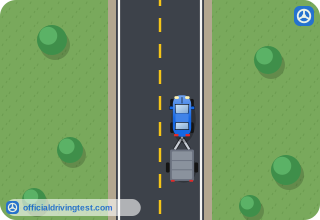
What should you recognize when you tow a trailer?
- You may drive as you would without a trailer
- A trailer handles the same as the tow vehicle
- You are driving a vehicle-trailer combination
- Only the trailer needs to be inspected
Show answer
Correct answer: You are driving a vehicle-trailer combination
You are no longer driving just a vehicle but a vehicle-trailer combination.
Source: South Carolina Driver's Manual (2026 (posted April 2026)), page 11-12 · Open this page in the manual (Manual page 11-12)
-
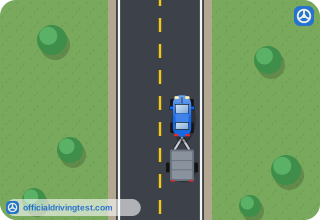
When should you walk around the vehicle-trailer combination to recheck it?
- Only once at the beginning of the day
- Before driving and at each fuel stop
- Only when you hear an unusual noise
- Only when the trailer is fully loaded
Show answer
Correct answer: Before driving and at each fuel stop
You walk around the combination before driving and at each fuel stop to recheck it.
Source: South Carolina Driver's Manual (2026 (posted April 2026)), page 11-12 · Open this page in the manual (Manual page 11-12)
-
Which of these should you recheck when you walk around the vehicle-trailer combination?
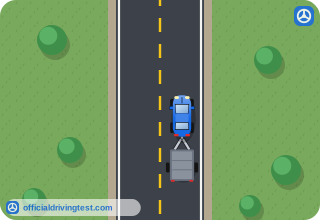
- Brake fluid level
- Windshield washer fluid
- Wiper blade condition
- Hitch and coupler tightness
Show answer
Correct answer: Hitch and coupler tightness
The recheck covers the hitch and coupler tightness, safety chains, lights, and tire pressures.
Source: South Carolina Driver's Manual (2026 (posted April 2026)), page 11-12 · Open this page in the manual (Manual page 11-12)
-
On a long trip with a trailer, what should you do instead of driving straight through?
- Drive through the night to arrive early
- Plan a rest stop to drive rested and in daylight
- Stop only when the fuel gauge is low
- Drive at a faster pace to shorten the trip
Show answer
Correct answer: Plan a rest stop to drive rested and in daylight
You plan a rest stop so you can drive in daylight while rested and alert.
Source: South Carolina Driver's Manual (2026 (posted April 2026)), page 11-13 · Open this page in the manual (Manual page 11-13)