South Carolina: Signals and vehicle controls — Part 5 Practice Test
Questions in this part include: “Under normal circumstances, how much horn use should be all that is needed?” · “Why should you use your horn only when you need to communicate with other road users?”
Independent educational site · not affiliated with any government agency or DMV
Ready? Test yourself
- Instant feedback with an explanation
- Every answer cites its source in the manual
- Your best score is saved on this device
- Keyboard: press 1 to 4 to answer and Enter for the next question
Questions are original and based on the official manual "South Carolina Driver's Manual" (2026 (posted April 2026)), South Carolina Department of Motor Vehicles.
All 19 questions in this practice test
Take the test above first, then use this list to study. Tap “Show answer” to see the correct answer and explanation.
Show the questions and answersHide the questions
-
Which of these is a time when turning on your headlights is especially important?
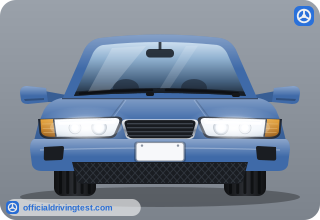
- When driving at noon in clear, dry weather
- When it begins to get dark
- When your vehicle is parked beside a building
- When you are in a parking space in daylight
Show answer
Correct answer: When it begins to get dark
Headlights help others see you, especially when it begins to get dark.
Source: South Carolina Driver's Manual (2026 (posted April 2026)), page 8-8 · Open this page in the manual (Manual page 8-8)
-
When is turning on your headlights especially important, besides bad weather and dusk?
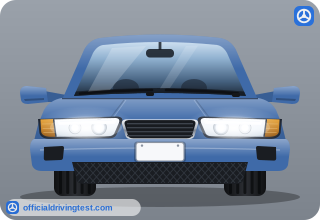
- When driving away from a rising or setting sun
- When driving at midday with the sun directly overhead
- When driving in light traffic on a dry, clear day
- When driving on a road with no curves or hills
Show answer
Correct answer: When driving away from a rising or setting sun
The manual lists driving away from a rising or setting sun as a time when headlights especially help others see you.
Source: South Carolina Driver's Manual (2026 (posted April 2026)), page 8-8 · Open this page in the manual (Manual page 8-8)
-
Under normal circumstances, how much horn use should be all that is needed?
- One long blast held until the other driver responds
- Two short blasts followed by one long blast
- A light tap on the horn
- Repeated taps until the other driver looks at you
Show answer
Correct answer: A light tap on the horn
A light tap on the horn should be all that is needed under normal circumstances.
Source: South Carolina Driver's Manual (2026 (posted April 2026)), page 8-8 · Open this page in the manual (Manual page 8-8)
-
Which driver might you give a light tap on the horn?
- One who is traveling at the speed limit ahead of you
- One who is not paying attention or may have trouble seeing you
- One who is waiting behind you at a red light
- One who is driving slowly in the right lane
Show answer
Correct answer: One who is not paying attention or may have trouble seeing you
A light tap can get the attention of a driver who is inattentive or may not see you.
Source: South Carolina Driver's Manual (2026 (posted April 2026)), page 8-9 · Open this page in the manual (Manual page 8-9)
-
While passing another vehicle, when may you want to give a light tap on the horn?
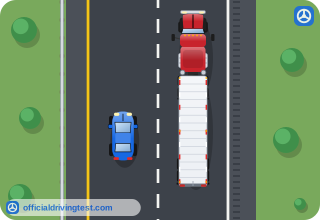
- When that driver is signaling a turn away from your lane
- When that driver is traveling at a steady speed
- When that driver is already well behind you
- When that driver starts to turn into your lane
Show answer
Correct answer: When that driver starts to turn into your lane
A light tap warns a driver who begins to turn into your lane while you pass.
Source: South Carolina Driver's Manual (2026 (posted April 2026)), page 8-9 · Open this page in the manual (Manual page 8-9)
-
Which of these may call for a light tap on the horn?
- A pedestrian who is waiting on the sidewalk
- A bicyclist riding in the same direction far ahead
- Pedestrians or bicyclists who appear to be moving into your lane
- Another driver who is signaling a turn at an intersection
Show answer
Correct answer: Pedestrians or bicyclists who appear to be moving into your lane
A light tap can warn pedestrians or bicyclists who appear to be moving into your lane of travel.
Source: South Carolina Driver's Manual (2026 (posted April 2026)), page 8-9 · Open this page in the manual (Manual page 8-9)
-
Why should you use your horn only when you need to communicate with other road users?
- Using it inappropriately could scare or anger another road user
- Using it too often can weaken the horn and drain the vehicle battery
- A horn sounded in traffic may be mistaken for an emergency siren
- Other drivers are not required to respond to a horn
Show answer
Correct answer: Using it inappropriately could scare or anger another road user
The manual says an inappropriate horn blast could scare or anger another road user.
Source: South Carolina Driver's Manual (2026 (posted April 2026)), page 8-9 · Open this page in the manual (Manual page 8-9)
-
When should you not use your horn?
- When a driver is not paying attention to you
- When you are passing a driver who starts to turn into your lane
- When you are in heavy traffic during daylight hours
- When you are near blind pedestrians
Show answer
Correct answer: When you are near blind pedestrians
The manual says you should not use your horn when near blind pedestrians.
Source: South Carolina Driver's Manual (2026 (posted April 2026)), page 8-9 · Open this page in the manual (Manual page 8-9)
-
Under state law, how far before changing lanes, turning, or merging into traffic must you use a turn signal?
- 25 feet or more
- 100 feet or more
- 50 feet or more
- 150 feet or more
Show answer
Correct answer: 100 feet or more
It is state law to signal 100 feet or more before changing lanes, turning left or right, or merging into traffic.
Source: South Carolina Driver's Manual (2026 (posted April 2026)), page 8-9 · Open this page in the manual (Manual page 8-9)
-
Why should you cancel your turn signal once your action is completed?
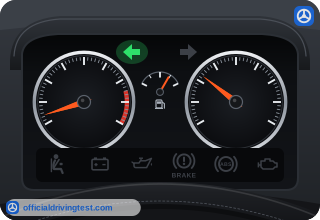
- To avoid confusing other drivers
- To keep the signal lever from sticking
- To save the turn signal bulbs from wear
- To reset the brake lights for the next turn
Show answer
Correct answer: To avoid confusing other drivers
A signal left on after your turn or lane change can confuse other drivers.
Source: South Carolina Driver's Manual (2026 (posted April 2026)), page 8-9 · Open this page in the manual (Manual page 8-9)
-
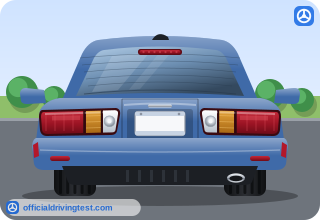
What do brake lights let other roadway users know?
- That the driver ahead is about to change lanes
- That the vehicle ahead is about to turn left
- That the vehicle in front is slowing down
- That the driver ahead is about to accelerate
Show answer
Correct answer: That the vehicle in front is slowing down
Brake lights tell other roadway users that the vehicle in front is slowing down.
Source: South Carolina Driver's Manual (2026 (posted April 2026)), page 8-10 · Open this page in the manual (Manual page 8-10)
-
Which of these is a time to signal before reducing speed?
- Driving straight at a steady speed on a road with light traffic
- Turning off a roadway that does not have separate turning or exiting lanes
- Accelerating away from a stop sign onto an empty roadway
- Continuing in your lane through a green light
Show answer
Correct answer: Turning off a roadway that does not have separate turning or exiting lanes
You should signal before slowing when you turn off a roadway that has no separate turning or exiting lanes.
Source: South Carolina Driver's Manual (2026 (posted April 2026)), page 8-10 · Open this page in the manual (Manual page 8-10)
-
Which of these is a time to signal before you reduce speed?
- Driving straight at a steady speed on an open road
- Following a slower car in your own lane
- Continuing in your lane through a green light
- Parking or turning before an intersection
Show answer
Correct answer: Parking or turning before an intersection
Signal before slowing when you are parking or turning before an intersection.
Source: South Carolina Driver's Manual (2026 (posted April 2026)), page 8-10 · Open this page in the manual (Manual page 8-10)
-
How far can you see with high beams compared with low beams?
- Twice as far
- Half as far
- One and a half times as far
- Three times as far
Show answer
Correct answer: Twice as far
High beams light the road about twice as far ahead as low beams do.
Source: South Carolina Driver's Manual (2026 (posted April 2026)), page 11-1 · Open this page in the manual (Manual page 11-1)
-
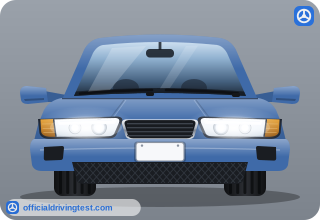
At night, when should you use your high beams?
- Whenever you are following another vehicle
- Whenever it is foggy, rainy, or snowy
- Whenever there are no oncoming vehicles
- Only when you are driving on a freeway
Show answer
Correct answer: Whenever there are no oncoming vehicles
Use your high beams whenever there are no oncoming vehicles; they let you see twice as far as low beams.
Source: South Carolina Driver's Manual (2026 (posted April 2026)), page 11-1 · Open this page in the manual (Manual page 11-1)
-
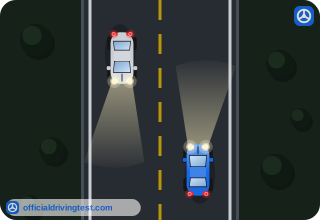
At about what distance from an oncoming vehicle should you dim your high beams?
- 100 feet
- 500 feet or more
- 200 feet
- 50 feet
Show answer
Correct answer: 500 feet or more
You should dim your high beams when you are 500 feet or more away from any oncoming vehicle.
Source: South Carolina Driver's Manual (2026 (posted April 2026)), page 11-1 · Open this page in the manual (Manual page 11-1)
-
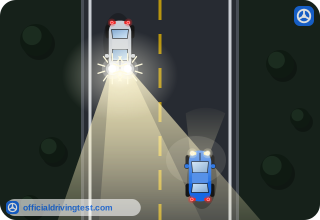
If an oncoming vehicle has its high beams on, where should you glance to avoid being blinded?
- Toward the left side of the road
- Directly at the oncoming headlights
- Down at your dashboard
- Toward the right side of the road
Show answer
Correct answer: Toward the right side of the road
Looking toward the right side of the road keeps you from being distracted or briefly blinded by the oncoming headlights.
Source: South Carolina Driver's Manual (2026 (posted April 2026)), page 11-1 · Open this page in the manual (Manual page 11-1)
-
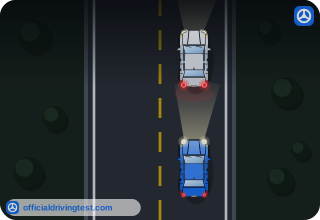
Which headlights should you use when following another vehicle that is less than 200 feet in front of you?
- High beams
- Parking lights only
- Hazard flashers
- Low beams
Show answer
Correct answer: Low beams
Use your low beams when the vehicle you are following is less than 200 feet ahead.
Source: South Carolina Driver's Manual (2026 (posted April 2026)), page 11-2 · Open this page in the manual (Manual page 11-2)
-
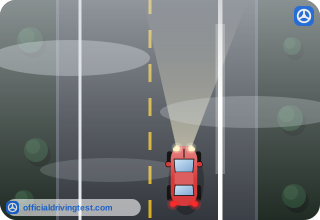
Which headlight setting should you use in fog, rain, or snow?
- High beams
- Low beams
- Parking lights only
- Headlights turned off
Show answer
Correct answer: Low beams
Light from high beams can cause glare and make it harder to see ahead in fog, rain, or snow.
Source: South Carolina Driver's Manual (2026 (posted April 2026)), page 11-2 · Open this page in the manual (Manual page 11-2)