Oregon: Sharing the road
People riding bicycles and motorcycles, large vehicles, buses, passing and being passed, and other road users. Split into 5 shorter tests so you're not stuck in one long quiz.
Independent educational site · not affiliated with any government agency or DMV
Choose a part
Sharing the road — Part 1
Questions in this part include: “When passing another vehicle on a two-lane road, on which side should you pass?”
StartSharing the road — Part 2
Questions in this part include: “May you use your hands or lights to signal other drivers when to pass?”
StartSharing the road — Part 3
Questions in this part include: “How does the distance a large vehicle needs to stop compare with a smaller vehicle traveling at the same speed?”
StartSharing the road — Part 4
Questions in this part include: “If you are following a pilot vehicle, what should you do?”
StartSharing the road — Part 5
Questions in this part include: “How far may a load on a passenger vehicle extend beyond the sides of the right fenders?”
StartAll 88 Sharing the road questions with answers
Choose a part above to take a practice test, or study every question and answer here.
Show the questions and answersHide the questions
-
Why should you avoid following vehicles too closely, especially large trucks and trailers, before passing?
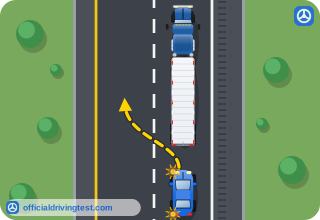
- It lets you use the shoulder to pass more easily
- It lets you pass without signaling
- It allows you to pass on the right
- It gives you a good view of the road ahead
Show answer
Correct answer: It gives you a good view of the road ahead
The manual says not following vehicles too closely gives you a good view of the road ahead.
Source: Oregon Driver Manual (2026-2027), page 31 · Open this page in the manual (Manual page 31)
-
What is the risk if you cut back into your lane too soon after passing?
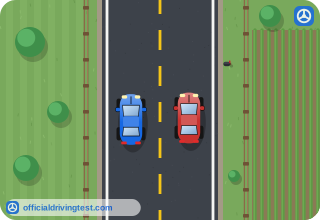
- Sideswiping the vehicle you are passing
- A head-on collision with an oncoming vehicle
- Being hit from behind by a tailgater
- Losing your right of way at the next intersection
Show answer
Correct answer: Sideswiping the vehicle you are passing
If you cut back into your lane too soon, you risk sideswiping the vehicle you are passing.
Source: Oregon Driver Manual (2026-2027), page 31 · Open this page in the manual (Manual page 31)
-
What is the risk if you do not get back into your lane soon enough after passing?
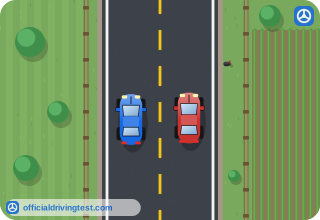
- Sideswiping the vehicle you have just passed
- Being hit from behind by a driver who is tailgating you
- A head-on collision with an oncoming vehicle
- Losing your space cushion to the side of your vehicle
Show answer
Correct answer: A head-on collision with an oncoming vehicle
If you do not get back into your lane soon enough, you risk a head-on collision with an oncoming vehicle.
Source: Oregon Driver Manual (2026-2027), page 31 · Open this page in the manual (Manual page 31)
-
If you are in doubt about whether you can pass safely, what should you do?
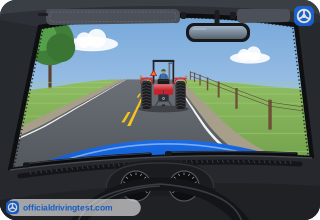
- Pass quickly and signal after
- Pass on the right
- Flash your headlights
- Stay in your lane
Show answer
Correct answer: Stay in your lane
The manual says that when in doubt, stay in your lane.
Source: Oregon Driver Manual (2026-2027), page 31 · Open this page in the manual (Manual page 31)
-
When passing another vehicle on a two-lane road, on which side should you pass?
- Only to the left of the vehicle
- Only to the right of the vehicle
- To either side, whichever has more room
- To the right if the vehicle ahead is slower
Show answer
Correct answer: Only to the left of the vehicle
On a two-lane road, you should pass only to the left of the vehicle.
Source: Oregon Driver Manual (2026-2027), page 31 · Open this page in the manual (Manual page 31)
-
On a two-lane road, when may your pass begin?
- Anywhere you can see no oncoming traffic
- Only after you cross an intersection
- Not before the start of a passing zone
- Anywhere after you have signaled
Show answer
Correct answer: Not before the start of a passing zone
Your pass may not begin before the start of a passing zone.
Source: Oregon Driver Manual (2026-2027), page 31 · Open this page in the manual (Manual page 31)
-
On a two-lane road, before what must you complete your pass?
- Reaching the next mile marker
- Entering a no-passing zone
- Meeting the next vehicle going the same way
- Reaching a speed of 5 mph over the limit
Show answer
Correct answer: Entering a no-passing zone
A pass must be completed before you enter a no-passing zone.
Source: Oregon Driver Manual (2026-2027), page 31 · Open this page in the manual (Manual page 31)
-
May you exceed the speed limit in order to pass another vehicle?
- Yes, but only on a two-lane road with a passing zone
- Yes, but only by 5 mph over the posted speed limit
- No, exceeding speed limits is against the law at any time
- Yes, if no oncoming traffic is in sight on the road
Show answer
Correct answer: No, exceeding speed limits is against the law at any time
The manual says not to exceed the speed limit when passing, since it is against the law to exceed speed limits at any time.
Source: Oregon Driver Manual (2026-2027), page 31 · Open this page in the manual (Manual page 31)
-
Before you start to pass, how do you check your vehicle’s blind spot?
- Look only in your rearview mirror and then move over at once
- Glance over your shoulder in the direction of the lane change
- Sound your horn and watch for a response from the other driver
- Glance over the shoulder opposite the direction of the lane change
Show answer
Correct answer: Glance over your shoulder in the direction of the lane change
Check your mirrors and the blind spot by glancing over your shoulder in the direction of the lane change.
Source: Oregon Driver Manual (2026-2027), page 31 · Open this page in the manual (Manual page 31)
-
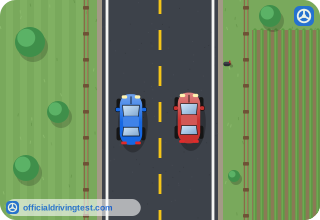
When may you signal and return to your lane after passing a vehicle?
- As soon as your front bumper is even with the vehicle you passed
- After you have driven past the vehicle for at least a quarter mile
- When the vehicle you passed signals that it is safe
- When you can see the vehicle you passed in your rearview mirror
Show answer
Correct answer: When you can see the vehicle you passed in your rearview mirror
The manual says to signal and return to your lane once you can see the vehicle you passed in your rearview mirror.
Source: Oregon Driver Manual (2026-2027), page 31 · Open this page in the manual (Manual page 31)
-
After you have turned on your signal to pass, what should you do?
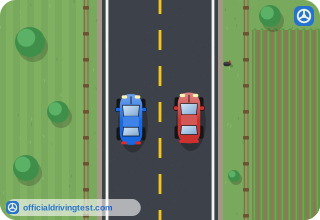
- Increase your speed and complete your pass as soon as possible
- Stay beside the vehicle for a few moments to check oncoming traffic
- Keep your speed steady so that you do not attract attention to the pass
- Slow down until the vehicle ahead of you has moved over to the right
Show answer
Correct answer: Increase your speed and complete your pass as soon as possible
The manual says to turn on your signal, increase your speed and complete the pass as soon as possible.
Source: Oregon Driver Manual (2026-2027), page 31 · Open this page in the manual (Manual page 31)
-
In an area where your view of oncoming traffic is limited, what does the manual say about passing?
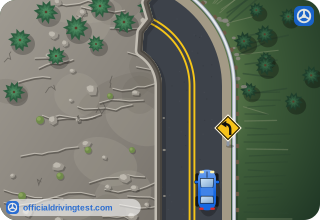
- Do not pass
- Pass only if you signal first
- Pass only at a reduced speed
- Pass only if the vehicle ahead is slow
Show answer
Correct answer: Do not pass
The manual says not to pass in any area where your view of oncoming traffic is limited.
Source: Oregon Driver Manual (2026-2027), page 32 · Open this page in the manual (Manual page 32)
-
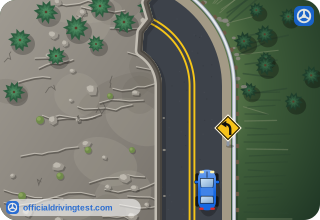
Why must you not cross the center line to pass when you are on a hill or in a curve?
- Vehicles ahead must be allowed to stay in the lane
- Your view of oncoming traffic is blocked
- The lane is narrower on hills and curves
- Passing is only for multilane roads
Show answer
Correct answer: Your view of oncoming traffic is blocked
On hills and curves your view of oncoming traffic is blocked, so you must not cross the center line to pass.
Source: Oregon Driver Manual (2026-2027), page 32 · Open this page in the manual (Manual page 32)
-
You must not cross the center line to pass when you are approaching, at or in what?
- A rest area or parking lot entrance
- A freeway on-ramp or off-ramp
- A bike lane or a wide shoulder
- An intersection or railroad crossing
Show answer
Correct answer: An intersection or railroad crossing
The manual lists intersections and railroad crossings as places where you must not cross the center line to pass.
Source: Oregon Driver Manual (2026-2027), page 32 · Open this page in the manual (Manual page 32)
-
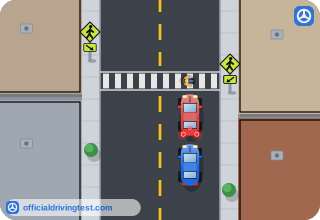
The vehicle ahead is stopped at a crosswalk to let a pedestrian cross. May you cross the center line to pass it?
- Yes, if there is no oncoming traffic in sight
- No, you must not cross the center line to pass it
- Yes, if you pass on the right side of the vehicle
- Yes, if you sound your horn as you pass the vehicle
Show answer
Correct answer: No, you must not cross the center line to pass it
Do not cross the center line to pass when the vehicle ahead is stopped at a crosswalk to permit a pedestrian to cross.
Source: Oregon Driver Manual (2026-2027), page 32 · Open this page in the manual (Manual page 32)
-
On a road with two or more lanes traveling in the same direction, when may you pass a vehicle on the right?
- When the vehicle you are passing is in the left lane
- When the vehicle you are passing is in the right lane
- When the vehicle you are passing is slower than the speed limit
- When you have signaled and there is no oncoming traffic
Show answer
Correct answer: When the vehicle you are passing is in the left lane
You may pass on the right on a road with two or more lanes in the same direction if the vehicle you are passing is in the left lane.
Source: Oregon Driver Manual (2026-2027), page 33 · Open this page in the manual (Manual page 33)
-
You may pass a vehicle on the right when the vehicle you are passing is doing which of these?
- Making or having signaled for a right turn
- Slowing down as it approaches a school zone
- Making or having signaled for a left turn
- Stopped in a traffic lane for any reason at all
Show answer
Correct answer: Making or having signaled for a left turn
One condition for passing on the right is that the vehicle you are passing is making or has signaled for a left turn.
Source: Oregon Driver Manual (2026-2027), page 33 · Open this page in the manual (Manual page 33)
-
You may pass on the right of a vehicle making a left turn only if there is enough space to the right. What does that space need to allow?
- Passing without crossing a crosswalk or a railroad crossing
- Passing while staying at least one lane width from the vehicle
- Passing without slowing below the speed limit on the road
- Passing without leaving the pavement or driving in a bike lane
Show answer
Correct answer: Passing without leaving the pavement or driving in a bike lane
There must be sufficient space to the right to pass without leaving the paved portion of the road or driving in a bike lane.
Source: Oregon Driver Manual (2026-2027), page 33 · Open this page in the manual (Manual page 33)
-
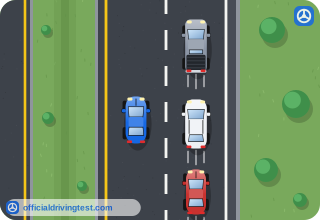
Why should you use extra care when you pass on the right?
- Other drivers do not expect to be passed on the right
- Passing on the right is only allowed on roads at night
- Vehicles on the right cannot see your turn signal at all
- Passing on the right is allowed above the speed limit
Show answer
Correct answer: Other drivers do not expect to be passed on the right
The manual says other drivers do not expect to be passed on the right.
Source: Oregon Driver Manual (2026-2027), page 33 · Open this page in the manual (Manual page 33)
-
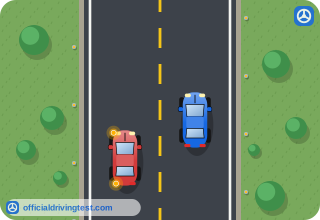
When another driver starts to pass you, what should you do?
- Move to the center of the road
- Speed up to stay ahead of the passing vehicle
- Stay to the right
- Move to the left lane
Show answer
Correct answer: Stay to the right
The manual says that when another driver starts to pass, you should stay to the right.
Source: Oregon Driver Manual (2026-2027), page 33 · Open this page in the manual (Manual page 33)
-
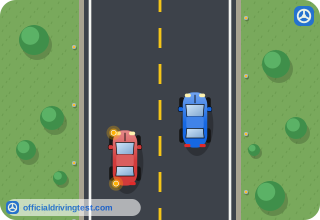
How can you help another driver pass you safely?
- Flash your headlights to show the driver when it is clear to pass you
- Check oncoming traffic and adjust your speed so it can move back sooner
- Speed up so the passing vehicle has to stay alongside you for longer
- Wave the passing driver ahead as soon as oncoming traffic is clear
Show answer
Correct answer: Check oncoming traffic and adjust your speed so it can move back sooner
Checking oncoming traffic and adjusting your speed lets the other vehicle move back into the right lane as soon as possible.
Source: Oregon Driver Manual (2026-2027), page 33 · Open this page in the manual (Manual page 33)
-
May you use your hands or lights to signal other drivers when to pass?
- Yes, but only with a hand signal given through the driver’s window
- Yes, but only at night when it is hard to see other drivers
- No, the law prohibits flashing any signal to tell drivers when to pass
- Yes, but only with your turn signal on the side of the passing vehicle
Show answer
Correct answer: No, the law prohibits flashing any signal to tell drivers when to pass
The manual says not to use your hands or lights to signal when to pass, and the law prohibits flashing any signals for that purpose.
Source: Oregon Driver Manual (2026-2027), page 33 · Open this page in the manual (Manual page 33)
-
Why does the manual call pedestrians, people riding bicycles and motorcycles, and highway workers vulnerable users of the road?
- They can be hard to see and may not have protection against injury in a collision
- They are not required to obey the same traffic laws as drivers of passenger vehicles
- They travel too fast for drivers of passenger vehicles to react in time
- They use public roads at night more often than drivers of passenger vehicles
Show answer
Correct answer: They can be hard to see and may not have protection against injury in a collision
The manual says these users are vulnerable because they can be hard to see and may lack protection against injury in a collision.
Source: Oregon Driver Manual (2026-2027), page 46 · Open this page in the manual (Manual page 46)
-
Why can people riding bicycles be easily missed by drivers?
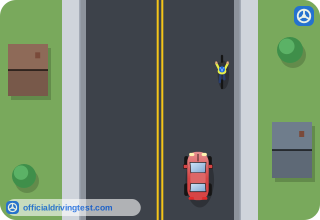
- They are harder to see than other vehicles and can hide in your blind spot
- They are not allowed to use signals, so their moves are hard to predict
- They are required to ride in the lane farthest from the curb
- They usually ride faster than the traffic around them
Show answer
Correct answer: They are harder to see than other vehicles and can hide in your blind spot
The manual says people riding bicycles are more difficult to see and can be hidden in your blind spot.
Source: Oregon Driver Manual (2026-2027), page 50 · Open this page in the manual (Manual page 50)
-
Which of these road hazards can cause a person riding a bicycle to move into your path or to slow down?
- Storm grates
- A wide paved shoulder
- A dry, smooth road surface
- A solid white edge line
Show answer
Correct answer: Storm grates
Hazards such as potholes, glass, litter, storm grates, railroad tracks and opened doors of parked vehicles can make a bicyclist move into your path or slow down.
Source: Oregon Driver Manual (2026-2027), page 50 · Open this page in the manual (Manual page 50)
-
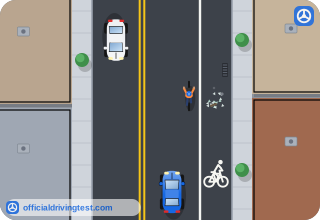
When you see road hazards that affect a person riding a bicycle, what should you do?
- Move into the bike lane so the person can ride around you
- Honk to warn the person that you are approaching
- Give the person plenty of room to move around the hazards
- Stay close behind so the person knows you are there
Show answer
Correct answer: Give the person plenty of room to move around the hazards
The manual says to give people riding bicycles plenty of room to move around hazards.
Source: Oregon Driver Manual (2026-2027), page 50 · Open this page in the manual (Manual page 50)
-
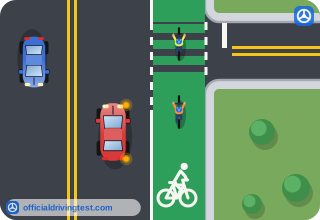
When may you cross a bike lane?
- Whenever the bike lane is empty and you need to pass another vehicle on the right
- When turning or when entering or leaving an alley, driveway, or private road
- Only when you are parking at the curb
- Only when the bike lane is painted green
Show answer
Correct answer: When turning or when entering or leaving an alley, driveway, or private road
You may cross a bike lane when turning or when entering or leaving an alley, driveway, or private road, but not drive or park in it.
Source: Oregon Driver Manual (2026-2027), page 50 · Open this page in the manual (Manual page 50)
-
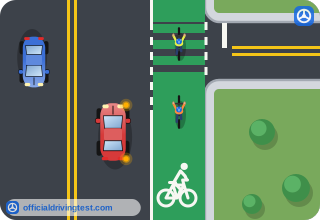
You will turn right soon and there is a bike lane beside your lane. Which is correct?
- Move into the bike lane early so you are ready to turn
- Travel in the bike lane for the last block or two before you make the turn
- Move into the bike lane only if no one is riding in it
- Do not move into or travel in the bike lane in preparation for the turn
Show answer
Correct answer: Do not move into or travel in the bike lane in preparation for the turn
The manual says not to move into or travel in a bike lane in preparation for a turn.
Source: Oregon Driver Manual (2026-2027), page 50 · Open this page in the manual (Manual page 50)
-
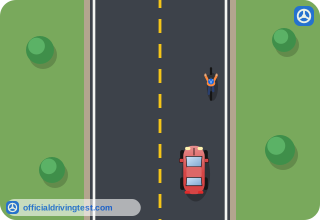
At speeds greater than 35 mph, when may you pass a person on a bicycle traveling in your lane?
- Only if you pass on the right side of the person and then move back
- Only if the person is riding in a bike lane next to your lane
- Only if you sound your horn and signal before you pass
- Only if you leave enough room to prevent contact if the person falls
Show answer
Correct answer: Only if you leave enough room to prevent contact if the person falls
Above 35 mph you may pass only if you leave enough distance to prevent contact with the person if they were to fall.
Source: Oregon Driver Manual (2026-2027), page 50 · Open this page in the manual (Manual page 50)
-
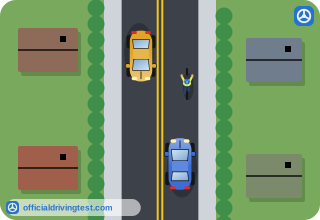
You cannot pass a person riding a bicycle safely. What must you do?
- Pass on the right using the bike lane if it is empty
- Slow down and remain behind the bicycle until it is safe to pass
- Pass with your right wheels on the shoulder if the road is too narrow
- Honk to make the person move out of your way
Show answer
Correct answer: Slow down and remain behind the bicycle until it is safe to pass
The same rules as for passing other vehicles apply, so if you cannot pass safely you must slow down and stay behind the bicycle.
Source: Oregon Driver Manual (2026-2027), page 51 · Open this page in the manual (Manual page 51)
-
Operators of motorized wheelchairs, scooters and personal assistive mobility devices may use bike lanes and paths. How must you treat them?
- Pass them closely, since they move slowly
- Yield to them as you would a person riding a bicycle
- Pass them before an intersection so they cannot delay you
- Ignore them, since they are not allowed to use the road
Show answer
Correct answer: Yield to them as you would a person riding a bicycle
These operators are permitted to use bike lanes and paths, and you must yield to them as you would to a person riding a bicycle.
Source: Oregon Driver Manual (2026-2027), page 51 · Open this page in the manual (Manual page 51)
-
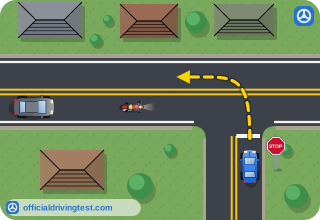
Why should you take extra care to look for a person riding a motorcycle or moped?
- It is harder to see than other vehicles and can hide in your blind spot
- It is usually driven on the shoulder of the road, away from other traffic
- It cannot use turn signals, so its moves are hard to predict on the road
- It travels in the bike lane next to your vehicle, outside your mirrors
Show answer
Correct answer: It is harder to see than other vehicles and can hide in your blind spot
A motorcycle or moped is more difficult to see than other vehicles and can be hidden in your blind spot.
Source: Oregon Driver Manual (2026-2027), page 52 · Open this page in the manual (Manual page 52)
-
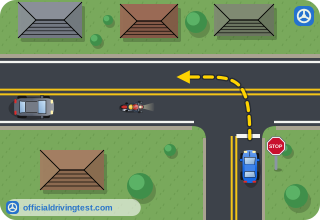
What is the safest thing to do when you want to turn and a motorcycle is approaching?
- Turn quickly before the motorcycle reaches you
- Flash your headlights so the rider slows down
- Wait until it passes before you make the turn
- Turn in front of it if its turn signal is on
Show answer
Correct answer: Wait until it passes before you make the turn
Because it is hard to judge a motorcycle's distance and speed, the manual says it is safest to wait until it passes to make a turn.
Source: Oregon Driver Manual (2026-2027), page 52 · Open this page in the manual (Manual page 52)
-
An oncoming motorcycle has its turn signal on and you want to turn in front of it. What should you do first?
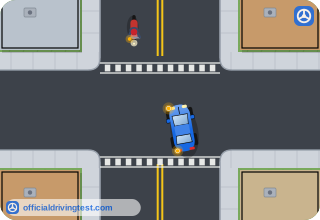
- Assume the rider is going to turn and go ahead of the motorcycle
- Assume the signal is on by mistake and go ahead of the rider
- Flash your headlights to ask the rider to confirm the turn
- Make sure the rider is really slowing to turn before you turn
Show answer
Correct answer: Make sure the rider is really slowing to turn before you turn
Turn signals do not automatically cancel on some motorcycles, so make sure the rider is actually slowing to turn.
Source: Oregon Driver Manual (2026-2027), page 52 · Open this page in the manual (Manual page 52)
-
What does the manual say about sharing a lane with a person riding a motorcycle or moped?
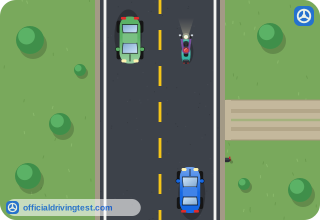
- It is allowed if you leave at least three feet of space beside the rider
- It is allowed on roads with a speed limit below 25 mph
- It is against the law, and when passing you must allow them a full lane
- It is allowed if the rider moves to the edge of the lane
Show answer
Correct answer: It is against the law, and when passing you must allow them a full lane
It is against the law to share a lane with a motorcycle or moped, and you must allow them a full lane when passing.
Source: Oregon Driver Manual (2026-2027), page 52 · Open this page in the manual (Manual page 52)
-
Which road surface can cause a person riding a motorcycle to change speed or direction?
- Grooved pavement
- Dry, smooth asphalt
- A freshly painted white line
- A wide, level shoulder
Show answer
Correct answer: Grooved pavement
The manual lists gravel, debris, pavement seams, grooved pavement and manhole covers as surfaces that affect motorcycles.
Source: Oregon Driver Manual (2026-2027), page 52 · Open this page in the manual (Manual page 52)
-
What can strong winds do to a person riding a motorcycle?
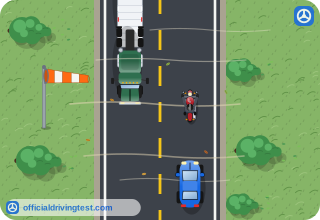
- Make the rider's headlight too dim to see
- Cancel the rider's turn signal automatically
- Force the rider to stop on the shoulder
- Move the rider out of their lane of travel
Show answer
Correct answer: Move the rider out of their lane of travel
Strong winds can move a person riding a motorcycle out of their lane of travel.
Source: Oregon Driver Manual (2026-2027), page 52 · Open this page in the manual (Manual page 52)
-
How does the distance a large vehicle needs to stop compare with a smaller vehicle traveling at the same speed?
- About the same distance
- About three times the distance
- About half the distance
- About one and a half times the distance
Show answer
Correct answer: About three times the distance
Large vehicles take about three times the distance to stop than smaller vehicles at the same speed.
Source: Oregon Driver Manual (2026-2027), page 53 · Open this page in the manual (Manual page 53)
-
How do large vehicles such as trucks and commercial buses compare with smaller vehicles when accelerating and maneuvering?
- They accelerate faster but require more room to stop
- They take longer to accelerate but need less room to maneuver
- They need the same room but take longer to stop
- They take longer to accelerate and require more room to maneuver
Show answer
Correct answer: They take longer to accelerate and require more room to maneuver
Large vehicles take longer to accelerate and require more room to maneuver.
Source: Oregon Driver Manual (2026-2027), page 53 · Open this page in the manual (Manual page 53)
-
You cannot see the driver of a large vehicle in its side mirror. What does this mean?
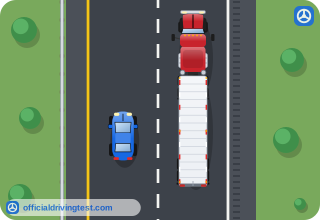
- The driver cannot see you
- The driver can see you but you cannot see the driver
- The driver can see you in the rearview mirror only
- The driver will see you if you sound your horn
Show answer
Correct answer: The driver cannot see you
If you can't see the driver in the side mirror of the large vehicle, the driver can't see you.
Source: Oregon Driver Manual (2026-2027), page 53 · Open this page in the manual (Manual page 53)
-
Why should you not pull up too close behind a stopped large vehicle?
- It may turn on its brake lights without warning
- It may open its rear doors into your lane
- It may roll back slightly when starting forward
- It may swing wide into the next lane
Show answer
Correct answer: It may roll back slightly when starting forward
The manual says a stopped large vehicle may roll back slightly when starting forward.
Source: Oregon Driver Manual (2026-2027), page 53 · Open this page in the manual (Manual page 53)
-
When you are passing a large vehicle, what should you do?
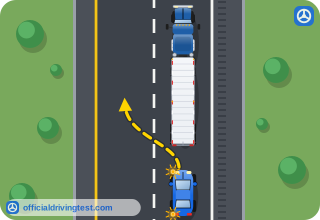
- Stay alongside the large vehicle so the driver can see you in the mirror
- Pass slowly so you can watch the driver in the side mirror the whole time
- Stay in the blind spot until the road ahead of the vehicle is clear
- Complete your pass as quickly as possible and do not stay alongside it
Show answer
Correct answer: Complete your pass as quickly as possible and do not stay alongside it
The manual says to complete the pass as quickly as possible, because staying in a blind spot too long is dangerous.
Source: Oregon Driver Manual (2026-2027), page 53 · Open this page in the manual (Manual page 53)
-
After passing a large vehicle, what should you see in your rearview mirror before pulling in front?
- The driver looking back at you in the mirror
- The entire front of the vehicle
- The vehicle's rear wheels and cargo area
- The vehicle's side mirror and rear wheels
Show answer
Correct answer: The entire front of the vehicle
Look for the entire front of the large vehicle in your rearview mirror before pulling in front of it.
Source: Oregon Driver Manual (2026-2027), page 53 · Open this page in the manual (Manual page 53)
-
There is water on the road. What should you do to stay out of the spray of a large vehicle?
- Pass it right away, even if you must exceed the speed limit to do so
- Move onto the shoulder to get away from it
- Keep as far away from the vehicle as you can while staying in your lane
- Follow it closely so the spray cannot reach your windshield
Show answer
Correct answer: Keep as far away from the vehicle as you can while staying in your lane
Spray from a large vehicle seriously reduces vision, so keep as far away as you can while staying in your lane.
Source: Oregon Driver Manual (2026-2027), page 53 · Open this page in the manual (Manual page 53)
-
A large vehicle is about to make a turn. What should you not do?
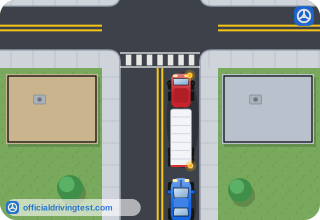
- Cut in between the large vehicle and the curb or shoulder
- Observe the vehicle's turn signals
- Allow the vehicle to complete the turn
- Watch for long loads that may extend into adjacent lanes
Show answer
Correct answer: Cut in between the large vehicle and the curb or shoulder
The manual says not to cut in between a large vehicle and the curb or shoulder when it is turning.
Source: Oregon Driver Manual (2026-2027), page 53 · Open this page in the manual (Manual page 53)
-
Why must you watch for large vehicles that are turning?
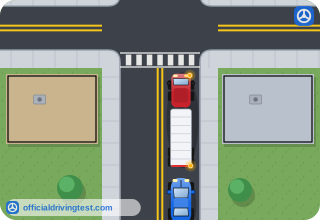
- They may need to swing wide and use more than one lane to turn
- They always turn from the lane next to the curb or shoulder of the road
- They are required to come to a full stop before they start every turn
- They can turn in a narrower space than a passenger car can turn in
Show answer
Correct answer: They may need to swing wide and use more than one lane to turn
Large vehicles may need to swing wide and use more than one lane to start or finish a turn.
Source: Oregon Driver Manual (2026-2027), page 53 · Open this page in the manual (Manual page 53)
-
When you see a large vehicle making a turn, what should you do?
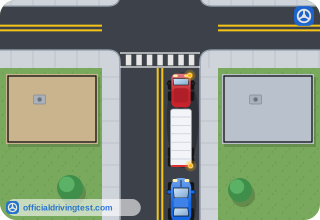
- Pull alongside it so the driver can see where you are in the turn
- Pass it on the right before it finishes the turn
- Not crowd the intersection and allow it to complete the turn
- Move up close behind it so the driver can see you
Show answer
Correct answer: Not crowd the intersection and allow it to complete the turn
The manual says not to crowd the intersection and to allow the large vehicle to complete its turn.
Source: Oregon Driver Manual (2026-2027), page 53 · Open this page in the manual (Manual page 53)
-
What should you do around a large vehicle that is preparing to back up or is already backing?
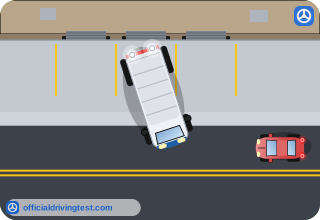
- Never cross behind it
- Cross behind it while it is still
- Cross behind it after honking
- Cross behind it if you see the driver
Show answer
Correct answer: Never cross behind it
A backing large vehicle may need to block the street, and the manual says never to cross behind it when it is preparing to back or is backing.
Source: Oregon Driver Manual (2026-2027), page 54 · Open this page in the manual (Manual page 54)
-
Why might a large vehicle that is backing block the street?
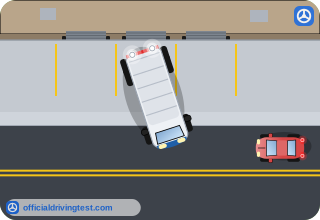
- It must stop traffic to check its mirrors
- The law requires it to block all lanes
- It may need to block the street to maneuver
- It must wait for a flagger's signal
Show answer
Correct answer: It may need to block the street to maneuver
The manual says a backing large vehicle may need to block the street to maneuver.
Source: Oregon Driver Manual (2026-2027), page 54 · Open this page in the manual (Manual page 54)
-
How do large vehicles behave on hills and mountain roads?
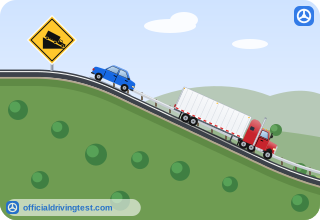
- They keep the same speed uphill and downhill
- They cannot keep speed climbing and must go slowly down hills
- They go faster downhill to keep control
- They climb at any speed but stop on downhill grades
Show answer
Correct answer: They cannot keep speed climbing and must go slowly down hills
Large vehicles lose speed when climbing and must go slowly down hills to stay under control.
Source: Oregon Driver Manual (2026-2027), page 54 · Open this page in the manual (Manual page 54)
-
Smoking wheels or a high speed on a large vehicle going down a hill can be a sign of what?
- A flat tire
- Engine overheating
- A loose load
- Brake loss
Show answer
Correct answer: Brake loss
The manual says smoking wheels or a high speed can be a sign of brake loss.
Source: Oregon Driver Manual (2026-2027), page 54 · Open this page in the manual (Manual page 54)
-
If you see signs that a large vehicle on a hill may have lost its brakes, what should you do?
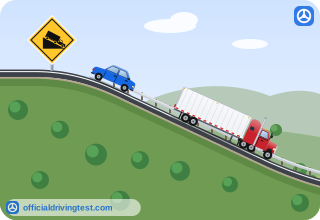
- Pass it quickly to get ahead of it
- Drive close behind it to stay clear
- Leave more space and do not pass
- Move beside it and signal the driver
Show answer
Correct answer: Leave more space and do not pass
For a large vehicle that may have lost its brakes, the manual says to leave more space and not pass.
Source: Oregon Driver Manual (2026-2027), page 54 · Open this page in the manual (Manual page 54)
-
What is a pilot vehicle?
- A marked vehicle that leads or follows a very large load
- A police car that escorts any vehicle on a freeway
- A bus that loads and unloads passengers at the curb
- A work zone truck that places and picks up cones
Show answer
Correct answer: A marked vehicle that leads or follows a very large load
The manual defines pilot vehicles as specially marked vehicles that lead or follow a vehicle with an especially large load.
Source: Oregon Driver Manual (2026-2027), page 54 · Open this page in the manual (Manual page 54)
-
If you see a pilot vehicle in oncoming traffic, what should you do?
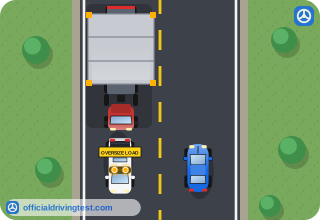
- Keep your speed and drive in the center of your lane
- Stop in the road until the pilot vehicle passes
- Move onto the left shoulder to give it room
- Slow down and move as far right as you can in your lane
Show answer
Correct answer: Slow down and move as far right as you can in your lane
For an oncoming pilot vehicle the manual says to slow down and move as far right as possible while staying in your lane.
Source: Oregon Driver Manual (2026-2027), page 54 · Open this page in the manual (Manual page 54)
-
If you are following a pilot vehicle, what should you do?
- Decrease your following distance
- Increase your following distance
- Follow as closely as you can
- Pass it as soon as possible
Show answer
Correct answer: Increase your following distance
The manual says to increase your following distance when following a pilot vehicle.
Source: Oregon Driver Manual (2026-2027), page 54 · Open this page in the manual (Manual page 54)
-
Where are the flashing amber and red lights on a school bus?
- Near the top of the bus on the front and rear
- On the sides of the bus near the wheels
- Only on the front bumper of the bus
- Near the bottom of the bus on the rear only
Show answer
Correct answer: Near the top of the bus on the front and rear
The manual says school buses have flashing amber and red lights near the top of the bus on the front and rear.
Source: Oregon Driver Manual (2026-2027), page 55 · Open this page in the manual (Manual page 55)
-
A school bus may have a stop arm. When does it extend from the bus near the driver's window?
- When the amber lights begin to flash
- When the bus doors are locked
- When the red lights begin to flash
- When the bus passes a school zone sign
Show answer
Correct answer: When the red lights begin to flash
The manual says the stop arm may extend when the red lights begin to flash.
Source: Oregon Driver Manual (2026-2027), page 55 · Open this page in the manual (Manual page 55)
-
What do flashing amber lights on a school bus warn traffic?
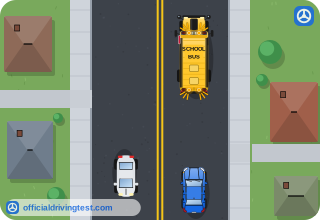
- The bus is turning around in the road
- The bus is about to stop to load or unload children
- The bus has stopped and children are crossing
- The bus driver is signaling traffic to pass
Show answer
Correct answer: The bus is about to stop to load or unload children
Flashing amber lights warn that the bus is about to stop on the road to load or unload children.
Source: Oregon Driver Manual (2026-2027), page 55 · Open this page in the manual (Manual page 55)
-
What should you do when you see flashing amber lights on a school bus?
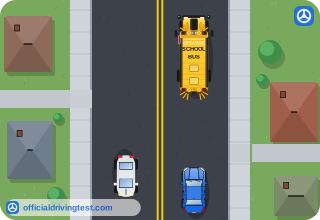
- Speed up to pass before it stops
- Stop immediately and stay stopped
- Change lanes and keep your speed
- Prepare to stop
Show answer
Correct answer: Prepare to stop
The manual tells drivers to prepare to stop when the amber lights flash.
Source: Oregon Driver Manual (2026-2027), page 55 · Open this page in the manual (Manual page 55)
-
When the red lights on a school bus flash, how long must you remain stopped?
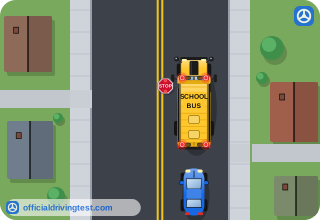
- Until all of the children have crossed the road
- Until the bus driver waves you forward
- Until the driver turns off the flashing red lights
- Until the bus has moved 500 feet away
Show answer
Correct answer: Until the driver turns off the flashing red lights
The manual says to stop before reaching the bus and stay stopped until the driver turns off the flashing red lights.
Source: Oregon Driver Manual (2026-2027), page 55 · Open this page in the manual (Manual page 55)
-
A school bus has stopped with red lights flashing on a divided highway whose two roads are separated by an unpaved median strip or barrier. When must you stop?
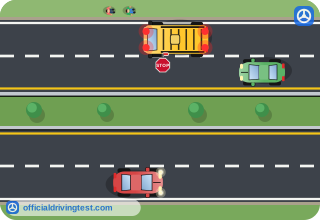
- Only if you are on the same side of the road as the bus
- Only if you are on the opposite side from the bus
- Always, no matter which side you are on
- Only if children are visible near the bus
Show answer
Correct answer: Only if you are on the same side of the road as the bus
On a divided highway with an unpaved median or barrier, you must stop only if you are on the same side of the road as the bus.
Source: Oregon Driver Manual (2026-2027), page 55 · Open this page in the manual (Manual page 55)
-
A school bus is stopped with its red lights flashing on a road that has only a painted median strip or turn lane. Who must stop?
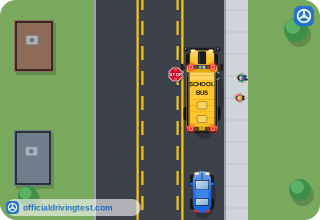
- Only traffic behind the bus
- Only traffic in the lanes next to the bus
- No traffic needs to stop
- Traffic in all lanes
Show answer
Correct answer: Traffic in all lanes
A painted median strip or turn lane does not create two separate roads, so all lanes of traffic must stop.
Source: Oregon Driver Manual (2026-2027), page 55 · Open this page in the manual (Manual page 55)
-
Flashing amber or red lights are permitted on which buses besides school buses?
- City transit buses and airport shuttles
- Places of worship and worker transport buses
- Taxis, ride-share and delivery vehicles
- Charter buses and long-distance buses
Show answer
Correct answer: Places of worship and worker transport buses
The manual permits flashing amber and red lights on places of worship and worker transport buses.
Source: Oregon Driver Manual (2026-2027), page 56 · Open this page in the manual (Manual page 56)
-
A places of worship bus or worker transport bus turns on flashing amber or red lights. How must you treat these lights?
- The same as you would treat a school bus
- As a warning to pass with caution
- As a signal that the bus is broken down
- They do not require any action from you
Show answer
Correct answer: The same as you would treat a school bus
The manual says to treat these lights the same as you would a school bus.
Source: Oregon Driver Manual (2026-2027), page 56 · Open this page in the manual (Manual page 56)
-
When must vehicles approaching a public transit bus from the rear yield?
- Whenever a bus is stopped at the curb with its doors open
- Only when the bus has its hazard lights on
- When the driver signals to re-enter and a sign flashes "yield"
- Whenever the bus is within 500 feet ahead of you
Show answer
Correct answer: When the driver signals to re-enter and a sign flashes "yield"
Vehicles approaching from the rear must yield when the bus driver signals to re-enter a lane and the electric sign on the back flashes yield.
Source: Oregon Driver Manual (2026-2027), page 56 · Open this page in the manual (Manual page 56)
-
What must slow moving vehicles, such as farm equipment, display when using a public highway?
- A flashing blue light
- The SLOW MOVING VEHICLE emblem
- A red and white striped panel
- A green triangle flag
Show answer
Correct answer: The SLOW MOVING VEHICLE emblem
The manual says slow moving vehicles must display the SLOW MOVING VEHICLE emblem on a public highway.
Source: Oregon Driver Manual (2026-2027), page 56 · Open this page in the manual (Manual page 56)
-
What colors does the SLOW MOVING VEHICLE emblem have?
- A reflective yellow border and a black center
- A fluorescent orange border and a red center
- A reflective white border and an orange center
- A reflective red border and a fluorescent orange center
Show answer
Correct answer: A reflective red border and a fluorescent orange center
The manual says the emblem has a reflective, red border and a fluorescent orange center.
Source: Oregon Driver Manual (2026-2027), page 56 · Open this page in the manual (Manual page 56)
-
What should you be prepared to do when you see the SLOW MOVING VEHICLE emblem?
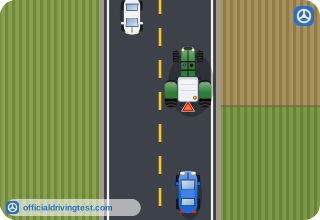
- Stop and wait for the vehicle to turn off
- Sound your horn and pass at once
- Slow down or adjust your position
- Move to the shoulder and let it go by
Show answer
Correct answer: Slow down or adjust your position
The manual says to be prepared to slow down or adjust your position when you see the emblem.
Source: Oregon Driver Manual (2026-2027), page 56 · Open this page in the manual (Manual page 56)
-
A red flag must be shown at the end of any load that extends how far beyond the rear of the vehicle?
- 4 feet or more
- 1 foot or more
- 2 feet or more
- 6 feet or more
Show answer
Correct answer: 4 feet or more
The manual requires a red flag at the end of any load extending 4 feet or more beyond the rear of the vehicle.
Source: Oregon Driver Manual (2026-2027), page 56 · Open this page in the manual (Manual page 56)
-
What is the minimum size of the red flag shown at the end of a load that extends 4 feet or more beyond the rear of a vehicle?
- 6 inches square
- 18 inches square
- 24 inches square
- 12 inches square
Show answer
Correct answer: 12 inches square
The red flag must be at least 12 inches square.
Source: Oregon Driver Manual (2026-2027), page 56 · Open this page in the manual (Manual page 56)
-
What must replace the red flag on an over-length load when limited visibility conditions exist?
- A white light visible for 500 feet to the front
- A red light visible for 500 feet to the rear and sides
- A red light visible for 200 feet to the rear only
- A second red flag at the front of the load
Show answer
Correct answer: A red light visible for 500 feet to the rear and sides
A red light, visible for 500 feet to the rear and sides, replaces the flag in limited visibility.
Source: Oregon Driver Manual (2026-2027), page 56 · Open this page in the manual (Manual page 56)
-
How far may a load on a passenger vehicle extend beyond the sides of the right fenders?
- No more than 6 inches
- No more than 1 foot
- No more than 2 feet
- It may not extend beyond them at all
Show answer
Correct answer: No more than 6 inches
Loads may not extend more than 6 inches beyond the sides of the right fenders.
Source: Oregon Driver Manual (2026-2027), page 56 · Open this page in the manual (Manual page 56)
-
How far may a load on a passenger vehicle extend beyond the sides of the fenders on the left side?
- No more than 6 inches beyond them
- No more than 12 inches beyond them
- It must not extend beyond them
- No more than 4 feet beyond them
Show answer
Correct answer: It must not extend beyond them
Passenger vehicles must not carry loads that extend beyond the sides of the fenders on the left side.
Source: Oregon Driver Manual (2026-2027), page 56 · Open this page in the manual (Manual page 56)
-
How far may a load extend in front of any vehicle?
- No more than 1 foot
- No more than 4 feet
- No more than 2 feet
- No more than 6 feet
Show answer
Correct answer: No more than 4 feet
Loads may not extend more than 4 feet in front of any vehicle.
Source: Oregon Driver Manual (2026-2027), page 56 · Open this page in the manual (Manual page 56)
-
How does the manual describe streetcars and light rail trains?
- Electric buses that run on overhead wires without any tracks
- Diesel passenger trains that run only on separate rail lines
- Electric transit vehicles that run on tracks embedded in the streets
- Freight trains that share the city streets with cars
Show answer
Correct answer: Electric transit vehicles that run on tracks embedded in the streets
Streetcars and light rail trains are electric transit vehicles that run on tracks embedded in the streets.
Source: Oregon Driver Manual (2026-2027), page 65 · Open this page in the manual (Manual page 65)
-
Who should go first when you share the road with a streetcar or light rail train?
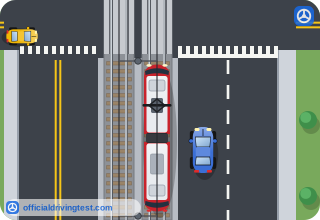
- The vehicle that arrived first
- The streetcar or train
- The vehicle that is moving faster
- The vehicle on the right
Show answer
Correct answer: The streetcar or train
The manual says to always let streetcars and trains go first.
Source: Oregon Driver Manual (2026-2027), page 65 · Open this page in the manual (Manual page 65)
-
A streetcar or train has stopped to pick up or drop off people. What should you do?
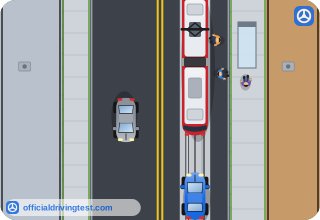
- Drive around it quickly before it starts moving again
- Pass it on the right once no one is in sight near the vehicle
- Stop beside it and wait for the passengers to finish crossing
- Stay behind it until it moves again or the people are safely away
Show answer
Correct answer: Stay behind it until it moves again or the people are safely away
You stay behind it until it moves again or the people are safely away.
Source: Oregon Driver Manual (2026-2027), page 65 · Open this page in the manual (Manual page 65)
-
Why should you check for streetcars and trains before changing lanes?
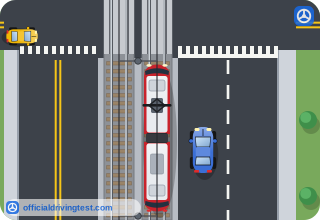
- They are never in the lane beside you
- They move out of the way when you signal
- They sound a horn before they pass you
- You may not be aware they are close behind you
Show answer
Correct answer: You may not be aware they are close behind you
You may not realize a streetcar or train is close behind you.
Source: Oregon Driver Manual (2026-2027), page 66 · Open this page in the manual (Manual page 66)
-
Streetcars and trains cannot stop quickly. How should you drive in front of or around them?
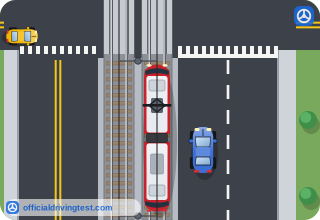
- Avoid braking suddenly or making unpredictable moves
- Brake hard so the operator sees your brake lights
- Stay close beside them to stay out of their path
- Change lanes often to stay ahead of them
Show answer
Correct answer: Avoid braking suddenly or making unpredictable moves
Because they cannot stop quickly, you avoid sudden braking and unpredictable moves in front of or around them.
Source: Oregon Driver Manual (2026-2027), page 66 · Open this page in the manual (Manual page 66)
-
What should you do if you make contact with a streetcar or train?
- Leave the scene and report it to the DMV later
- Push your vehicle off the tracks right away
- Wait for the operator or police to give you direction
- Get out and flag down other drivers for help
Show answer
Correct answer: Wait for the operator or police to give you direction
After contact with a streetcar or train you wait for the operator or police to tell you what to do.
Source: Oregon Driver Manual (2026-2027), page 66 · Open this page in the manual (Manual page 66)
-
What should you be prepared to do when you see signs warning of animal crossings?
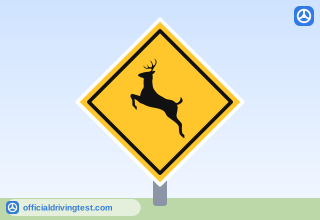
- Sound your horn to scare the animal away
- Flash your headlights at the animal to warn it
- Speed up to get past the animal quickly
- Brake or slow down as you pass an animal
Show answer
Correct answer: Brake or slow down as you pass an animal
The manual says to watch for animal-crossing signs and be prepared to brake or slow down as you pass an animal.
Source: Oregon Driver Manual (2026-2027), page 75 · Open this page in the manual (Manual page 75)
-
What must you do if you hit and injure a domestic animal?
- Stop and make a reasonable effort to check its injuries
- Continue driving and report it later to the owner
- Move the animal off the road and then drive on
- Drive on if the animal is able to walk away on its own
Show answer
Correct answer: Stop and make a reasonable effort to check its injuries
You must stop and make a reasonable effort to check the animal’s injuries.
Source: Oregon Driver Manual (2026-2027), page 75 · Open this page in the manual (Manual page 75)
-
If you hit and injure a domestic animal and cannot locate its owner, whom must you report the incident to?
- The nearest animal shelter only
- The DMV
- Local law enforcement
- No one, if the animal runs away
Show answer
Correct answer: Local law enforcement
If you are unable to locate the owner, you must report the incident to local law enforcement.
Source: Oregon Driver Manual (2026-2027), page 75 · Open this page in the manual (Manual page 75)
-
When must you stop your vehicle for a person riding on horseback or leading an animal?
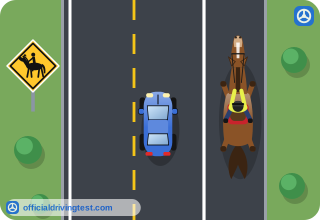
- Only when they step into the roadway directly in front of your vehicle and stop
- When they raise a hand or the animal is frightened, unless stopping causes a collision
- Only when they sound a horn or call out to you from the roadside
- Only when they are leading the animal along a divided road
Show answer
Correct answer: When they raise a hand or the animal is frightened, unless stopping causes a collision
The manual says to stop if the person raises a hand or it is obvious the animal is frightened, unless stopping would cause a collision.
Source: Oregon Driver Manual (2026-2027), page 75 · Open this page in the manual (Manual page 75)
-
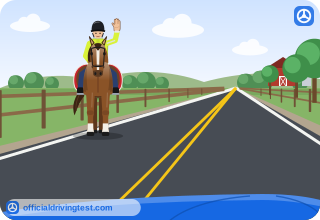
What does it mean when a person riding on horseback or leading an animal raises a hand?
- The person wants to turn
- The person is waving you past
- The person is asking you to speed up
- The animal is frightened
Show answer
Correct answer: The animal is frightened
The manual says a raised hand means the animal is frightened.
Source: Oregon Driver Manual (2026-2027), page 75 · Open this page in the manual (Manual page 75)
-
What should you not do near a frightened animal?
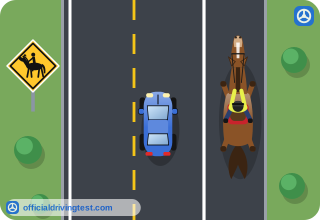
- Use your horn or make other loud, sudden noises
- Slow down and be prepared to brake as you pass
- Watch for signs warning of animal crossings
- Stop when a rider raises a hand to signal you
Show answer
Correct answer: Use your horn or make other loud, sudden noises
The manual says not to use your horn or make other loud, sudden noises near the animal.
Source: Oregon Driver Manual (2026-2027), page 75 · Open this page in the manual (Manual page 75)
-
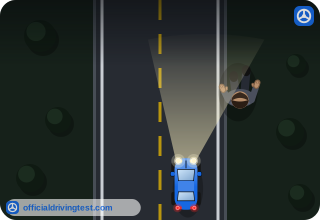
Why should you be especially alert for people riding bicycles and pedestrians at night?
- They always ride in the center of the road
- They are harder to see
- They are not required to use sidewalks
- They drive faster at night
Show answer
Correct answer: They are harder to see
The manual says vulnerable road users such as people riding bicycles and pedestrians are harder to see at night.
Source: Oregon Driver Manual (2026-2027), page 77 · Open this page in the manual (Manual page 77)
-
If you see an aggressive driver, what should you do?
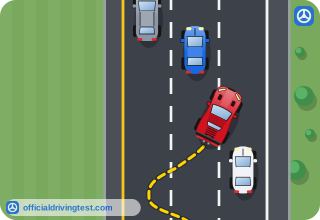
- Go faster to stay ahead of them
- Stay out of the way
- Try to out-drive them
- Block their lane so they slow down
Show answer
Correct answer: Stay out of the way
The manual says to stay out of the way and not to challenge an aggressive driver by going faster or trying to out-drive them.
Source: Oregon Driver Manual (2026-2027), page 81 · Open this page in the manual (Manual page 81)