Oregon: Sharing the road — Part 3 Practice Test
Questions in this part include: “How does the distance a large vehicle needs to stop compare with a smaller vehicle traveling at the same speed?” · “There is water on the road. What should you do to stay out of the spray of a large vehicle?”
Independent educational site · not affiliated with any government agency or DMV
Ready? Test yourself
- Instant feedback with an explanation
- Every answer cites its source in the manual
- Your best score is saved on this device
Questions are original and based on the official manual "Oregon Driver Manual" (2026-2027), Oregon Driver and Motor Vehicle Services (DMV).
All 18 questions in this practice test
Take the test above first, then use this list to study. Tap “Show answer” to see the correct answer and explanation.
Show the questions and answersHide the questions
-
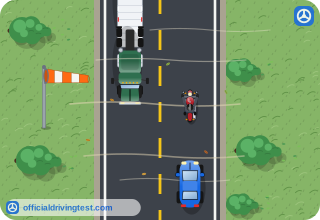
What can strong winds do to a person riding a motorcycle?
- Make the rider's headlight too dim to see
- Cancel the rider's turn signal automatically
- Force the rider to stop on the shoulder
- Move the rider out of their lane of travel
Show answer
Correct answer: Move the rider out of their lane of travel
Strong winds can move a person riding a motorcycle out of their lane of travel.
Source: Oregon Driver Manual (2026-2027), page 52 · Open this page in the manual (Manual page 52)
-
How does the distance a large vehicle needs to stop compare with a smaller vehicle traveling at the same speed?
- About the same distance
- About three times the distance
- About half the distance
- About one and a half times the distance
Show answer
Correct answer: About three times the distance
Large vehicles take about three times the distance to stop than smaller vehicles at the same speed.
Source: Oregon Driver Manual (2026-2027), page 53 · Open this page in the manual (Manual page 53)
-
How do large vehicles such as trucks and commercial buses compare with smaller vehicles when accelerating and maneuvering?
- They accelerate faster but require more room to stop
- They take longer to accelerate but need less room to maneuver
- They need the same room but take longer to stop
- They take longer to accelerate and require more room to maneuver
Show answer
Correct answer: They take longer to accelerate and require more room to maneuver
Large vehicles take longer to accelerate and require more room to maneuver.
Source: Oregon Driver Manual (2026-2027), page 53 · Open this page in the manual (Manual page 53)
-
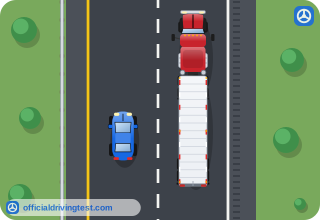
You cannot see the driver of a large vehicle in its side mirror. What does this mean?
- The driver cannot see you
- The driver can see you but you cannot see the driver
- The driver can see you in the rearview mirror only
- The driver will see you if you sound your horn
Show answer
Correct answer: The driver cannot see you
If you can't see the driver in the side mirror of the large vehicle, the driver can't see you.
Source: Oregon Driver Manual (2026-2027), page 53 · Open this page in the manual (Manual page 53)
-
Why should you not pull up too close behind a stopped large vehicle?
- It may turn on its brake lights without warning
- It may open its rear doors into your lane
- It may roll back slightly when starting forward
- It may swing wide into the next lane
Show answer
Correct answer: It may roll back slightly when starting forward
The manual says a stopped large vehicle may roll back slightly when starting forward.
Source: Oregon Driver Manual (2026-2027), page 53 · Open this page in the manual (Manual page 53)
-
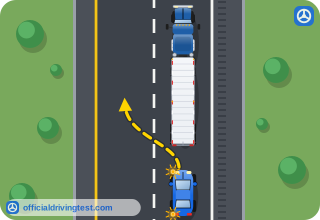
When you are passing a large vehicle, what should you do?
- Stay alongside the large vehicle so the driver can see you in the mirror
- Pass slowly so you can watch the driver in the side mirror the whole time
- Stay in the blind spot until the road ahead of the vehicle is clear
- Complete your pass as quickly as possible and do not stay alongside it
Show answer
Correct answer: Complete your pass as quickly as possible and do not stay alongside it
The manual says to complete the pass as quickly as possible, because staying in a blind spot too long is dangerous.
Source: Oregon Driver Manual (2026-2027), page 53 · Open this page in the manual (Manual page 53)
-
After passing a large vehicle, what should you see in your rearview mirror before pulling in front?
- The driver looking back at you in the mirror
- The entire front of the vehicle
- The vehicle's rear wheels and cargo area
- The vehicle's side mirror and rear wheels
Show answer
Correct answer: The entire front of the vehicle
Look for the entire front of the large vehicle in your rearview mirror before pulling in front of it.
Source: Oregon Driver Manual (2026-2027), page 53 · Open this page in the manual (Manual page 53)
-
There is water on the road. What should you do to stay out of the spray of a large vehicle?
- Pass it right away, even if you must exceed the speed limit to do so
- Move onto the shoulder to get away from it
- Keep as far away from the vehicle as you can while staying in your lane
- Follow it closely so the spray cannot reach your windshield
Show answer
Correct answer: Keep as far away from the vehicle as you can while staying in your lane
Spray from a large vehicle seriously reduces vision, so keep as far away as you can while staying in your lane.
Source: Oregon Driver Manual (2026-2027), page 53 · Open this page in the manual (Manual page 53)
-
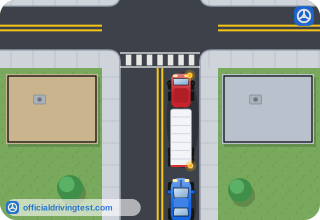
A large vehicle is about to make a turn. What should you not do?
- Cut in between the large vehicle and the curb or shoulder
- Observe the vehicle's turn signals
- Allow the vehicle to complete the turn
- Watch for long loads that may extend into adjacent lanes
Show answer
Correct answer: Cut in between the large vehicle and the curb or shoulder
The manual says not to cut in between a large vehicle and the curb or shoulder when it is turning.
Source: Oregon Driver Manual (2026-2027), page 53 · Open this page in the manual (Manual page 53)
-
Why must you watch for large vehicles that are turning?
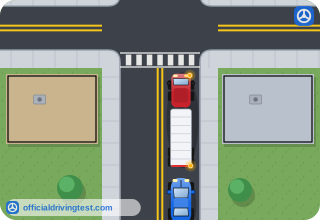
- They may need to swing wide and use more than one lane to turn
- They always turn from the lane next to the curb or shoulder of the road
- They are required to come to a full stop before they start every turn
- They can turn in a narrower space than a passenger car can turn in
Show answer
Correct answer: They may need to swing wide and use more than one lane to turn
Large vehicles may need to swing wide and use more than one lane to start or finish a turn.
Source: Oregon Driver Manual (2026-2027), page 53 · Open this page in the manual (Manual page 53)
-
When you see a large vehicle making a turn, what should you do?
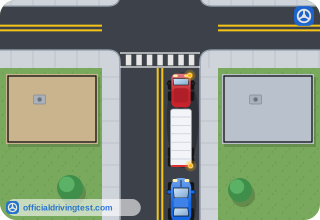
- Pull alongside it so the driver can see where you are in the turn
- Pass it on the right before it finishes the turn
- Not crowd the intersection and allow it to complete the turn
- Move up close behind it so the driver can see you
Show answer
Correct answer: Not crowd the intersection and allow it to complete the turn
The manual says not to crowd the intersection and to allow the large vehicle to complete its turn.
Source: Oregon Driver Manual (2026-2027), page 53 · Open this page in the manual (Manual page 53)
-
What should you do around a large vehicle that is preparing to back up or is already backing?
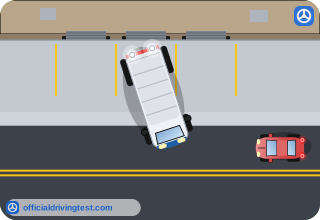
- Never cross behind it
- Cross behind it while it is still
- Cross behind it after honking
- Cross behind it if you see the driver
Show answer
Correct answer: Never cross behind it
A backing large vehicle may need to block the street, and the manual says never to cross behind it when it is preparing to back or is backing.
Source: Oregon Driver Manual (2026-2027), page 54 · Open this page in the manual (Manual page 54)
-
Why might a large vehicle that is backing block the street?
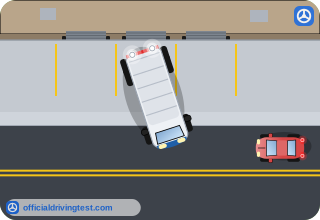
- It must stop traffic to check its mirrors
- The law requires it to block all lanes
- It may need to block the street to maneuver
- It must wait for a flagger's signal
Show answer
Correct answer: It may need to block the street to maneuver
The manual says a backing large vehicle may need to block the street to maneuver.
Source: Oregon Driver Manual (2026-2027), page 54 · Open this page in the manual (Manual page 54)
-
How do large vehicles behave on hills and mountain roads?
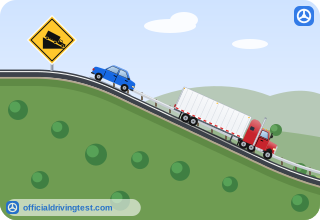
- They keep the same speed uphill and downhill
- They cannot keep speed climbing and must go slowly down hills
- They go faster downhill to keep control
- They climb at any speed but stop on downhill grades
Show answer
Correct answer: They cannot keep speed climbing and must go slowly down hills
Large vehicles lose speed when climbing and must go slowly down hills to stay under control.
Source: Oregon Driver Manual (2026-2027), page 54 · Open this page in the manual (Manual page 54)
-
Smoking wheels or a high speed on a large vehicle going down a hill can be a sign of what?
- A flat tire
- Engine overheating
- A loose load
- Brake loss
Show answer
Correct answer: Brake loss
The manual says smoking wheels or a high speed can be a sign of brake loss.
Source: Oregon Driver Manual (2026-2027), page 54 · Open this page in the manual (Manual page 54)
-
If you see signs that a large vehicle on a hill may have lost its brakes, what should you do?
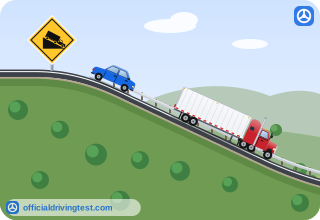
- Pass it quickly to get ahead of it
- Drive close behind it to stay clear
- Leave more space and do not pass
- Move beside it and signal the driver
Show answer
Correct answer: Leave more space and do not pass
For a large vehicle that may have lost its brakes, the manual says to leave more space and not pass.
Source: Oregon Driver Manual (2026-2027), page 54 · Open this page in the manual (Manual page 54)
-
What is a pilot vehicle?
- A marked vehicle that leads or follows a very large load
- A police car that escorts any vehicle on a freeway
- A bus that loads and unloads passengers at the curb
- A work zone truck that places and picks up cones
Show answer
Correct answer: A marked vehicle that leads or follows a very large load
The manual defines pilot vehicles as specially marked vehicles that lead or follow a vehicle with an especially large load.
Source: Oregon Driver Manual (2026-2027), page 54 · Open this page in the manual (Manual page 54)
-
If you see a pilot vehicle in oncoming traffic, what should you do?
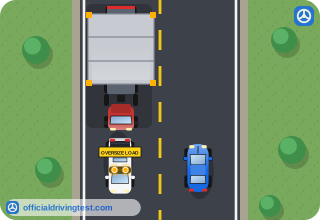
- Keep your speed and drive in the center of your lane
- Stop in the road until the pilot vehicle passes
- Move onto the left shoulder to give it room
- Slow down and move as far right as you can in your lane
Show answer
Correct answer: Slow down and move as far right as you can in your lane
For an oncoming pilot vehicle the manual says to slow down and move as far right as possible while staying in your lane.
Source: Oregon Driver Manual (2026-2027), page 54 · Open this page in the manual (Manual page 54)