Oregon: Sharing the road — Part 4 Practice Test
Questions in this part include: “If you are following a pilot vehicle, what should you do?” · “When must vehicles approaching a public transit bus from the rear yield?”
Independent educational site · not affiliated with any government agency or DMV
Ready? Test yourself
- Instant feedback with an explanation
- Every answer cites its source in the manual
- Your best score is saved on this device
Questions are original and based on the official manual "Oregon Driver Manual" (2026-2027), Oregon Driver and Motor Vehicle Services (DMV).
All 17 questions in this practice test
Take the test above first, then use this list to study. Tap “Show answer” to see the correct answer and explanation.
Show the questions and answersHide the questions
-
If you are following a pilot vehicle, what should you do?
- Decrease your following distance
- Increase your following distance
- Follow as closely as you can
- Pass it as soon as possible
Show answer
Correct answer: Increase your following distance
The manual says to increase your following distance when following a pilot vehicle.
Source: Oregon Driver Manual (2026-2027), page 54 · Open this page in the manual (Manual page 54)
-
Where are the flashing amber and red lights on a school bus?
- Near the top of the bus on the front and rear
- On the sides of the bus near the wheels
- Only on the front bumper of the bus
- Near the bottom of the bus on the rear only
Show answer
Correct answer: Near the top of the bus on the front and rear
The manual says school buses have flashing amber and red lights near the top of the bus on the front and rear.
Source: Oregon Driver Manual (2026-2027), page 55 · Open this page in the manual (Manual page 55)
-
A school bus may have a stop arm. When does it extend from the bus near the driver's window?
- When the amber lights begin to flash
- When the bus doors are locked
- When the red lights begin to flash
- When the bus passes a school zone sign
Show answer
Correct answer: When the red lights begin to flash
The manual says the stop arm may extend when the red lights begin to flash.
Source: Oregon Driver Manual (2026-2027), page 55 · Open this page in the manual (Manual page 55)
-
What do flashing amber lights on a school bus warn traffic?
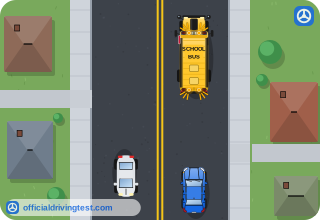
- The bus is turning around in the road
- The bus is about to stop to load or unload children
- The bus has stopped and children are crossing
- The bus driver is signaling traffic to pass
Show answer
Correct answer: The bus is about to stop to load or unload children
Flashing amber lights warn that the bus is about to stop on the road to load or unload children.
Source: Oregon Driver Manual (2026-2027), page 55 · Open this page in the manual (Manual page 55)
-
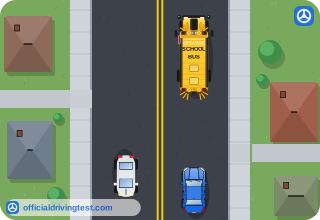
What should you do when you see flashing amber lights on a school bus?
- Speed up to pass before it stops
- Stop immediately and stay stopped
- Change lanes and keep your speed
- Prepare to stop
Show answer
Correct answer: Prepare to stop
The manual tells drivers to prepare to stop when the amber lights flash.
Source: Oregon Driver Manual (2026-2027), page 55 · Open this page in the manual (Manual page 55)
-
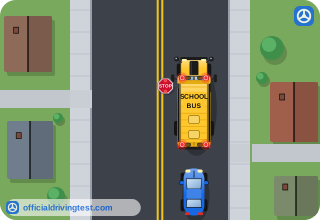
When the red lights on a school bus flash, how long must you remain stopped?
- Until all of the children have crossed the road
- Until the bus driver waves you forward
- Until the driver turns off the flashing red lights
- Until the bus has moved 500 feet away
Show answer
Correct answer: Until the driver turns off the flashing red lights
The manual says to stop before reaching the bus and stay stopped until the driver turns off the flashing red lights.
Source: Oregon Driver Manual (2026-2027), page 55 · Open this page in the manual (Manual page 55)
-
A school bus has stopped with red lights flashing on a divided highway whose two roads are separated by an unpaved median strip or barrier. When must you stop?
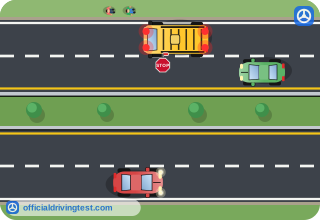
- Only if you are on the same side of the road as the bus
- Only if you are on the opposite side from the bus
- Always, no matter which side you are on
- Only if children are visible near the bus
Show answer
Correct answer: Only if you are on the same side of the road as the bus
On a divided highway with an unpaved median or barrier, you must stop only if you are on the same side of the road as the bus.
Source: Oregon Driver Manual (2026-2027), page 55 · Open this page in the manual (Manual page 55)
-
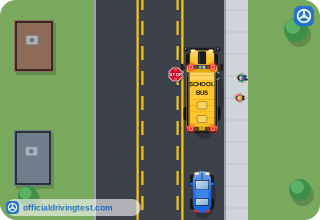
A school bus is stopped with its red lights flashing on a road that has only a painted median strip or turn lane. Who must stop?
- Only traffic behind the bus
- Only traffic in the lanes next to the bus
- No traffic needs to stop
- Traffic in all lanes
Show answer
Correct answer: Traffic in all lanes
A painted median strip or turn lane does not create two separate roads, so all lanes of traffic must stop.
Source: Oregon Driver Manual (2026-2027), page 55 · Open this page in the manual (Manual page 55)
-
Flashing amber or red lights are permitted on which buses besides school buses?
- City transit buses and airport shuttles
- Places of worship and worker transport buses
- Taxis, ride-share and delivery vehicles
- Charter buses and long-distance buses
Show answer
Correct answer: Places of worship and worker transport buses
The manual permits flashing amber and red lights on places of worship and worker transport buses.
Source: Oregon Driver Manual (2026-2027), page 56 · Open this page in the manual (Manual page 56)
-
A places of worship bus or worker transport bus turns on flashing amber or red lights. How must you treat these lights?
- The same as you would treat a school bus
- As a warning to pass with caution
- As a signal that the bus is broken down
- They do not require any action from you
Show answer
Correct answer: The same as you would treat a school bus
The manual says to treat these lights the same as you would a school bus.
Source: Oregon Driver Manual (2026-2027), page 56 · Open this page in the manual (Manual page 56)
-
When must vehicles approaching a public transit bus from the rear yield?
- Whenever a bus is stopped at the curb with its doors open
- Only when the bus has its hazard lights on
- When the driver signals to re-enter and a sign flashes "yield"
- Whenever the bus is within 500 feet ahead of you
Show answer
Correct answer: When the driver signals to re-enter and a sign flashes "yield"
Vehicles approaching from the rear must yield when the bus driver signals to re-enter a lane and the electric sign on the back flashes yield.
Source: Oregon Driver Manual (2026-2027), page 56 · Open this page in the manual (Manual page 56)
-
What must slow moving vehicles, such as farm equipment, display when using a public highway?
- A flashing blue light
- The SLOW MOVING VEHICLE emblem
- A red and white striped panel
- A green triangle flag
Show answer
Correct answer: The SLOW MOVING VEHICLE emblem
The manual says slow moving vehicles must display the SLOW MOVING VEHICLE emblem on a public highway.
Source: Oregon Driver Manual (2026-2027), page 56 · Open this page in the manual (Manual page 56)
-
What colors does the SLOW MOVING VEHICLE emblem have?
- A reflective yellow border and a black center
- A fluorescent orange border and a red center
- A reflective white border and an orange center
- A reflective red border and a fluorescent orange center
Show answer
Correct answer: A reflective red border and a fluorescent orange center
The manual says the emblem has a reflective, red border and a fluorescent orange center.
Source: Oregon Driver Manual (2026-2027), page 56 · Open this page in the manual (Manual page 56)
-
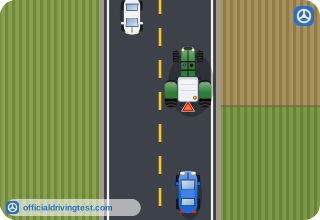
What should you be prepared to do when you see the SLOW MOVING VEHICLE emblem?
- Stop and wait for the vehicle to turn off
- Sound your horn and pass at once
- Slow down or adjust your position
- Move to the shoulder and let it go by
Show answer
Correct answer: Slow down or adjust your position
The manual says to be prepared to slow down or adjust your position when you see the emblem.
Source: Oregon Driver Manual (2026-2027), page 56 · Open this page in the manual (Manual page 56)
-
A red flag must be shown at the end of any load that extends how far beyond the rear of the vehicle?
- 4 feet or more
- 1 foot or more
- 2 feet or more
- 6 feet or more
Show answer
Correct answer: 4 feet or more
The manual requires a red flag at the end of any load extending 4 feet or more beyond the rear of the vehicle.
Source: Oregon Driver Manual (2026-2027), page 56 · Open this page in the manual (Manual page 56)
-
What is the minimum size of the red flag shown at the end of a load that extends 4 feet or more beyond the rear of a vehicle?
- 6 inches square
- 18 inches square
- 24 inches square
- 12 inches square
Show answer
Correct answer: 12 inches square
The red flag must be at least 12 inches square.
Source: Oregon Driver Manual (2026-2027), page 56 · Open this page in the manual (Manual page 56)
-
What must replace the red flag on an over-length load when limited visibility conditions exist?
- A white light visible for 500 feet to the front
- A red light visible for 500 feet to the rear and sides
- A red light visible for 200 feet to the rear only
- A second red flag at the front of the load
Show answer
Correct answer: A red light visible for 500 feet to the rear and sides
A red light, visible for 500 feet to the rear and sides, replaces the flag in limited visibility.
Source: Oregon Driver Manual (2026-2027), page 56 · Open this page in the manual (Manual page 56)