Oregon: Sharing the road — Part 1 Practice Test
Questions in this part include: “When passing another vehicle on a two-lane road, on which side should you pass?” · “Before you start to pass, how do you check your vehicle’s blind spot?”
Independent educational site · not affiliated with any government agency or DMV
Ready? Test yourself
- Instant feedback with an explanation
- Every answer cites its source in the manual
- Your best score is saved on this device
Questions are original and based on the official manual "Oregon Driver Manual" (2026-2027), Oregon Driver and Motor Vehicle Services (DMV).
All 18 questions in this practice test
Take the test above first, then use this list to study. Tap “Show answer” to see the correct answer and explanation.
Show the questions and answersHide the questions
-
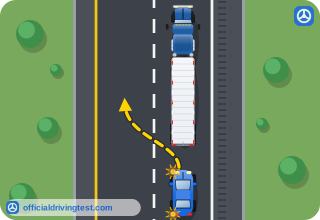
Why should you avoid following vehicles too closely, especially large trucks and trailers, before passing?
- It lets you use the shoulder to pass more easily
- It lets you pass without signaling
- It allows you to pass on the right
- It gives you a good view of the road ahead
Show answer
Correct answer: It gives you a good view of the road ahead
The manual says not following vehicles too closely gives you a good view of the road ahead.
Source: Oregon Driver Manual (2026-2027), page 31 · Open this page in the manual (Manual page 31)
-
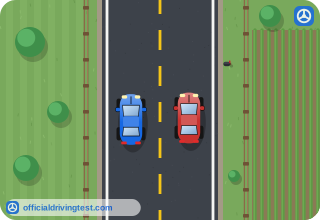
What is the risk if you cut back into your lane too soon after passing?
- Sideswiping the vehicle you are passing
- A head-on collision with an oncoming vehicle
- Being hit from behind by a tailgater
- Losing your right of way at the next intersection
Show answer
Correct answer: Sideswiping the vehicle you are passing
If you cut back into your lane too soon, you risk sideswiping the vehicle you are passing.
Source: Oregon Driver Manual (2026-2027), page 31 · Open this page in the manual (Manual page 31)
-
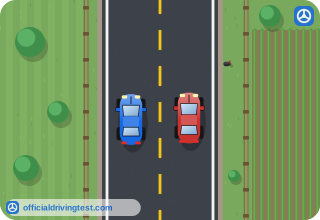
What is the risk if you do not get back into your lane soon enough after passing?
- Sideswiping the vehicle you have just passed
- Being hit from behind by a driver who is tailgating you
- A head-on collision with an oncoming vehicle
- Losing your space cushion to the side of your vehicle
Show answer
Correct answer: A head-on collision with an oncoming vehicle
If you do not get back into your lane soon enough, you risk a head-on collision with an oncoming vehicle.
Source: Oregon Driver Manual (2026-2027), page 31 · Open this page in the manual (Manual page 31)
-
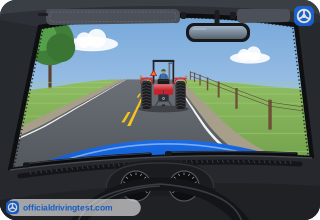
If you are in doubt about whether you can pass safely, what should you do?
- Pass quickly and signal after
- Pass on the right
- Flash your headlights
- Stay in your lane
Show answer
Correct answer: Stay in your lane
The manual says that when in doubt, stay in your lane.
Source: Oregon Driver Manual (2026-2027), page 31 · Open this page in the manual (Manual page 31)
-
When passing another vehicle on a two-lane road, on which side should you pass?
- Only to the left of the vehicle
- Only to the right of the vehicle
- To either side, whichever has more room
- To the right if the vehicle ahead is slower
Show answer
Correct answer: Only to the left of the vehicle
On a two-lane road, you should pass only to the left of the vehicle.
Source: Oregon Driver Manual (2026-2027), page 31 · Open this page in the manual (Manual page 31)
-
On a two-lane road, when may your pass begin?
- Anywhere you can see no oncoming traffic
- Only after you cross an intersection
- Not before the start of a passing zone
- Anywhere after you have signaled
Show answer
Correct answer: Not before the start of a passing zone
Your pass may not begin before the start of a passing zone.
Source: Oregon Driver Manual (2026-2027), page 31 · Open this page in the manual (Manual page 31)
-
On a two-lane road, before what must you complete your pass?
- Reaching the next mile marker
- Entering a no-passing zone
- Meeting the next vehicle going the same way
- Reaching a speed of 5 mph over the limit
Show answer
Correct answer: Entering a no-passing zone
A pass must be completed before you enter a no-passing zone.
Source: Oregon Driver Manual (2026-2027), page 31 · Open this page in the manual (Manual page 31)
-
May you exceed the speed limit in order to pass another vehicle?
- Yes, but only on a two-lane road with a passing zone
- Yes, but only by 5 mph over the posted speed limit
- No, exceeding speed limits is against the law at any time
- Yes, if no oncoming traffic is in sight on the road
Show answer
Correct answer: No, exceeding speed limits is against the law at any time
The manual says not to exceed the speed limit when passing, since it is against the law to exceed speed limits at any time.
Source: Oregon Driver Manual (2026-2027), page 31 · Open this page in the manual (Manual page 31)
-
Before you start to pass, how do you check your vehicle’s blind spot?
- Look only in your rearview mirror and then move over at once
- Glance over your shoulder in the direction of the lane change
- Sound your horn and watch for a response from the other driver
- Glance over the shoulder opposite the direction of the lane change
Show answer
Correct answer: Glance over your shoulder in the direction of the lane change
Check your mirrors and the blind spot by glancing over your shoulder in the direction of the lane change.
Source: Oregon Driver Manual (2026-2027), page 31 · Open this page in the manual (Manual page 31)
-
When may you signal and return to your lane after passing a vehicle?
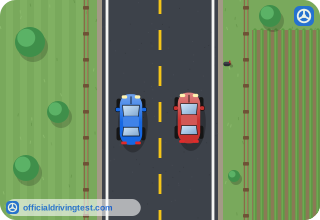
- As soon as your front bumper is even with the vehicle you passed
- After you have driven past the vehicle for at least a quarter mile
- When the vehicle you passed signals that it is safe
- When you can see the vehicle you passed in your rearview mirror
Show answer
Correct answer: When you can see the vehicle you passed in your rearview mirror
The manual says to signal and return to your lane once you can see the vehicle you passed in your rearview mirror.
Source: Oregon Driver Manual (2026-2027), page 31 · Open this page in the manual (Manual page 31)
-
After you have turned on your signal to pass, what should you do?
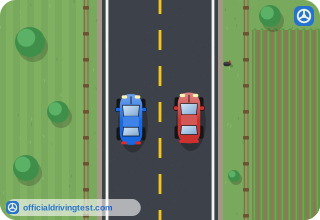
- Increase your speed and complete your pass as soon as possible
- Stay beside the vehicle for a few moments to check oncoming traffic
- Keep your speed steady so that you do not attract attention to the pass
- Slow down until the vehicle ahead of you has moved over to the right
Show answer
Correct answer: Increase your speed and complete your pass as soon as possible
The manual says to turn on your signal, increase your speed and complete the pass as soon as possible.
Source: Oregon Driver Manual (2026-2027), page 31 · Open this page in the manual (Manual page 31)
-
In an area where your view of oncoming traffic is limited, what does the manual say about passing?
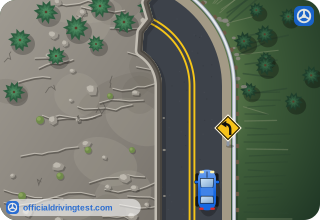
- Do not pass
- Pass only if you signal first
- Pass only at a reduced speed
- Pass only if the vehicle ahead is slow
Show answer
Correct answer: Do not pass
The manual says not to pass in any area where your view of oncoming traffic is limited.
Source: Oregon Driver Manual (2026-2027), page 32 · Open this page in the manual (Manual page 32)
-
Why must you not cross the center line to pass when you are on a hill or in a curve?
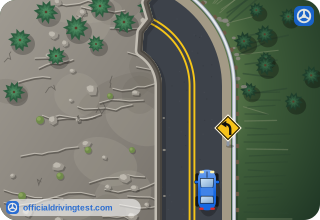
- Vehicles ahead must be allowed to stay in the lane
- Your view of oncoming traffic is blocked
- The lane is narrower on hills and curves
- Passing is only for multilane roads
Show answer
Correct answer: Your view of oncoming traffic is blocked
On hills and curves your view of oncoming traffic is blocked, so you must not cross the center line to pass.
Source: Oregon Driver Manual (2026-2027), page 32 · Open this page in the manual (Manual page 32)
-
You must not cross the center line to pass when you are approaching, at or in what?
- A rest area or parking lot entrance
- A freeway on-ramp or off-ramp
- A bike lane or a wide shoulder
- An intersection or railroad crossing
Show answer
Correct answer: An intersection or railroad crossing
The manual lists intersections and railroad crossings as places where you must not cross the center line to pass.
Source: Oregon Driver Manual (2026-2027), page 32 · Open this page in the manual (Manual page 32)
-
The vehicle ahead is stopped at a crosswalk to let a pedestrian cross. May you cross the center line to pass it?
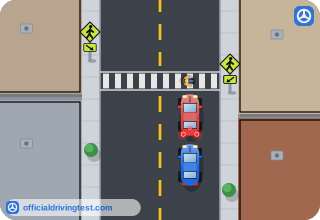
- Yes, if there is no oncoming traffic in sight
- No, you must not cross the center line to pass it
- Yes, if you pass on the right side of the vehicle
- Yes, if you sound your horn as you pass the vehicle
Show answer
Correct answer: No, you must not cross the center line to pass it
Do not cross the center line to pass when the vehicle ahead is stopped at a crosswalk to permit a pedestrian to cross.
Source: Oregon Driver Manual (2026-2027), page 32 · Open this page in the manual (Manual page 32)
-
On a road with two or more lanes traveling in the same direction, when may you pass a vehicle on the right?
- When the vehicle you are passing is in the left lane
- When the vehicle you are passing is in the right lane
- When the vehicle you are passing is slower than the speed limit
- When you have signaled and there is no oncoming traffic
Show answer
Correct answer: When the vehicle you are passing is in the left lane
You may pass on the right on a road with two or more lanes in the same direction if the vehicle you are passing is in the left lane.
Source: Oregon Driver Manual (2026-2027), page 33 · Open this page in the manual (Manual page 33)
-
You may pass a vehicle on the right when the vehicle you are passing is doing which of these?
- Making or having signaled for a right turn
- Slowing down as it approaches a school zone
- Making or having signaled for a left turn
- Stopped in a traffic lane for any reason at all
Show answer
Correct answer: Making or having signaled for a left turn
One condition for passing on the right is that the vehicle you are passing is making or has signaled for a left turn.
Source: Oregon Driver Manual (2026-2027), page 33 · Open this page in the manual (Manual page 33)
-
You may pass on the right of a vehicle making a left turn only if there is enough space to the right. What does that space need to allow?
- Passing without crossing a crosswalk or a railroad crossing
- Passing while staying at least one lane width from the vehicle
- Passing without slowing below the speed limit on the road
- Passing without leaving the pavement or driving in a bike lane
Show answer
Correct answer: Passing without leaving the pavement or driving in a bike lane
There must be sufficient space to the right to pass without leaving the paved portion of the road or driving in a bike lane.
Source: Oregon Driver Manual (2026-2027), page 33 · Open this page in the manual (Manual page 33)