Oregon: Sharing the road — Part 2 Practice Test
Questions in this part include: “May you use your hands or lights to signal other drivers when to pass?” · “Which of these road hazards can cause a person riding a bicycle to move into your path or to slow down?”
Independent educational site · not affiliated with any government agency or DMV
Ready? Test yourself
- Instant feedback with an explanation
- Every answer cites its source in the manual
- Your best score is saved on this device
Questions are original and based on the official manual "Oregon Driver Manual" (2026-2027), Oregon Driver and Motor Vehicle Services (DMV).
All 18 questions in this practice test
Take the test above first, then use this list to study. Tap “Show answer” to see the correct answer and explanation.
Show the questions and answersHide the questions
-
Why should you use extra care when you pass on the right?
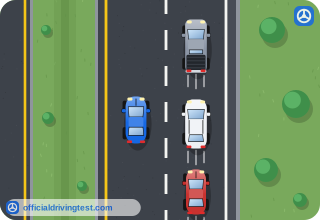
- Other drivers do not expect to be passed on the right
- Passing on the right is only allowed on roads at night
- Vehicles on the right cannot see your turn signal at all
- Passing on the right is allowed above the speed limit
Show answer
Correct answer: Other drivers do not expect to be passed on the right
The manual says other drivers do not expect to be passed on the right.
Source: Oregon Driver Manual (2026-2027), page 33 · Open this page in the manual (Manual page 33)
-
When another driver starts to pass you, what should you do?
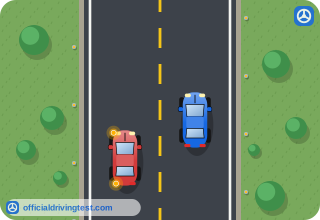
- Move to the center of the road
- Speed up to stay ahead of the passing vehicle
- Stay to the right
- Move to the left lane
Show answer
Correct answer: Stay to the right
The manual says that when another driver starts to pass, you should stay to the right.
Source: Oregon Driver Manual (2026-2027), page 33 · Open this page in the manual (Manual page 33)
-
How can you help another driver pass you safely?
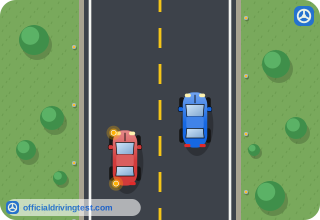
- Flash your headlights to show the driver when it is clear to pass you
- Check oncoming traffic and adjust your speed so it can move back sooner
- Speed up so the passing vehicle has to stay alongside you for longer
- Wave the passing driver ahead as soon as oncoming traffic is clear
Show answer
Correct answer: Check oncoming traffic and adjust your speed so it can move back sooner
Checking oncoming traffic and adjusting your speed lets the other vehicle move back into the right lane as soon as possible.
Source: Oregon Driver Manual (2026-2027), page 33 · Open this page in the manual (Manual page 33)
-
May you use your hands or lights to signal other drivers when to pass?
- Yes, but only with a hand signal given through the driver’s window
- Yes, but only at night when it is hard to see other drivers
- No, the law prohibits flashing any signal to tell drivers when to pass
- Yes, but only with your turn signal on the side of the passing vehicle
Show answer
Correct answer: No, the law prohibits flashing any signal to tell drivers when to pass
The manual says not to use your hands or lights to signal when to pass, and the law prohibits flashing any signals for that purpose.
Source: Oregon Driver Manual (2026-2027), page 33 · Open this page in the manual (Manual page 33)
-
Why does the manual call pedestrians, people riding bicycles and motorcycles, and highway workers vulnerable users of the road?
- They can be hard to see and may not have protection against injury in a collision
- They are not required to obey the same traffic laws as drivers of passenger vehicles
- They travel too fast for drivers of passenger vehicles to react in time
- They use public roads at night more often than drivers of passenger vehicles
Show answer
Correct answer: They can be hard to see and may not have protection against injury in a collision
The manual says these users are vulnerable because they can be hard to see and may lack protection against injury in a collision.
Source: Oregon Driver Manual (2026-2027), page 46 · Open this page in the manual (Manual page 46)
-
Why can people riding bicycles be easily missed by drivers?
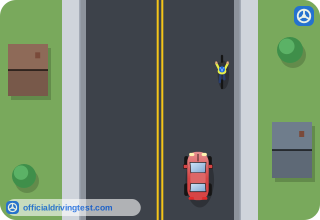
- They are harder to see than other vehicles and can hide in your blind spot
- They are not allowed to use signals, so their moves are hard to predict
- They are required to ride in the lane farthest from the curb
- They usually ride faster than the traffic around them
Show answer
Correct answer: They are harder to see than other vehicles and can hide in your blind spot
The manual says people riding bicycles are more difficult to see and can be hidden in your blind spot.
Source: Oregon Driver Manual (2026-2027), page 50 · Open this page in the manual (Manual page 50)
-
Which of these road hazards can cause a person riding a bicycle to move into your path or to slow down?
- Storm grates
- A wide paved shoulder
- A dry, smooth road surface
- A solid white edge line
Show answer
Correct answer: Storm grates
Hazards such as potholes, glass, litter, storm grates, railroad tracks and opened doors of parked vehicles can make a bicyclist move into your path or slow down.
Source: Oregon Driver Manual (2026-2027), page 50 · Open this page in the manual (Manual page 50)
-
When you see road hazards that affect a person riding a bicycle, what should you do?
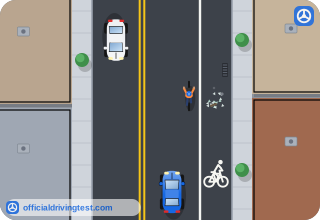
- Move into the bike lane so the person can ride around you
- Honk to warn the person that you are approaching
- Give the person plenty of room to move around the hazards
- Stay close behind so the person knows you are there
Show answer
Correct answer: Give the person plenty of room to move around the hazards
The manual says to give people riding bicycles plenty of room to move around hazards.
Source: Oregon Driver Manual (2026-2027), page 50 · Open this page in the manual (Manual page 50)
-
When may you cross a bike lane?
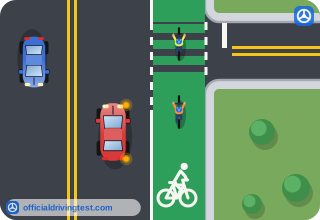
- Whenever the bike lane is empty and you need to pass another vehicle on the right
- When turning or when entering or leaving an alley, driveway, or private road
- Only when you are parking at the curb
- Only when the bike lane is painted green
Show answer
Correct answer: When turning or when entering or leaving an alley, driveway, or private road
You may cross a bike lane when turning or when entering or leaving an alley, driveway, or private road, but not drive or park in it.
Source: Oregon Driver Manual (2026-2027), page 50 · Open this page in the manual (Manual page 50)
-
You will turn right soon and there is a bike lane beside your lane. Which is correct?
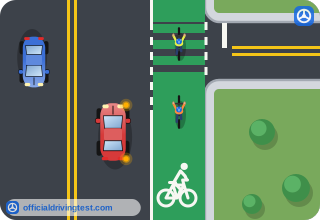
- Move into the bike lane early so you are ready to turn
- Travel in the bike lane for the last block or two before you make the turn
- Move into the bike lane only if no one is riding in it
- Do not move into or travel in the bike lane in preparation for the turn
Show answer
Correct answer: Do not move into or travel in the bike lane in preparation for the turn
The manual says not to move into or travel in a bike lane in preparation for a turn.
Source: Oregon Driver Manual (2026-2027), page 50 · Open this page in the manual (Manual page 50)
-
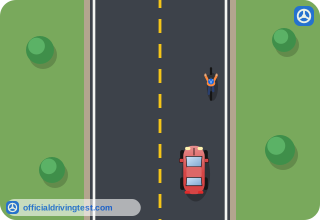
At speeds greater than 35 mph, when may you pass a person on a bicycle traveling in your lane?
- Only if you pass on the right side of the person and then move back
- Only if the person is riding in a bike lane next to your lane
- Only if you sound your horn and signal before you pass
- Only if you leave enough room to prevent contact if the person falls
Show answer
Correct answer: Only if you leave enough room to prevent contact if the person falls
Above 35 mph you may pass only if you leave enough distance to prevent contact with the person if they were to fall.
Source: Oregon Driver Manual (2026-2027), page 50 · Open this page in the manual (Manual page 50)
-
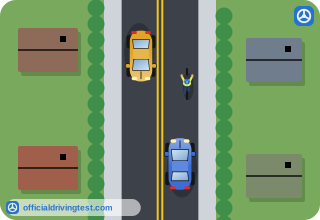
You cannot pass a person riding a bicycle safely. What must you do?
- Pass on the right using the bike lane if it is empty
- Slow down and remain behind the bicycle until it is safe to pass
- Pass with your right wheels on the shoulder if the road is too narrow
- Honk to make the person move out of your way
Show answer
Correct answer: Slow down and remain behind the bicycle until it is safe to pass
The same rules as for passing other vehicles apply, so if you cannot pass safely you must slow down and stay behind the bicycle.
Source: Oregon Driver Manual (2026-2027), page 51 · Open this page in the manual (Manual page 51)
-
Operators of motorized wheelchairs, scooters and personal assistive mobility devices may use bike lanes and paths. How must you treat them?
- Pass them closely, since they move slowly
- Yield to them as you would a person riding a bicycle
- Pass them before an intersection so they cannot delay you
- Ignore them, since they are not allowed to use the road
Show answer
Correct answer: Yield to them as you would a person riding a bicycle
These operators are permitted to use bike lanes and paths, and you must yield to them as you would to a person riding a bicycle.
Source: Oregon Driver Manual (2026-2027), page 51 · Open this page in the manual (Manual page 51)
-
Why should you take extra care to look for a person riding a motorcycle or moped?
- It is harder to see than other vehicles and can hide in your blind spot
- It is usually driven on the shoulder of the road, away from other traffic
- It cannot use turn signals, so its moves are hard to predict on the road
- It travels in the bike lane next to your vehicle, outside your mirrors
Show answer
Correct answer: It is harder to see than other vehicles and can hide in your blind spot
A motorcycle or moped is more difficult to see than other vehicles and can be hidden in your blind spot.
Source: Oregon Driver Manual (2026-2027), page 52 · Open this page in the manual (Manual page 52)
-
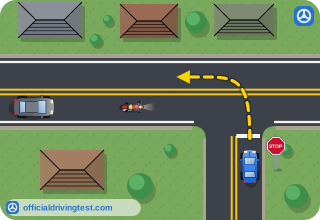
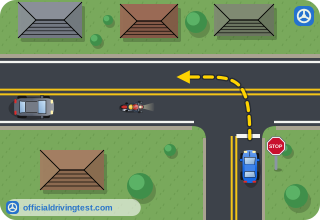
What is the safest thing to do when you want to turn and a motorcycle is approaching?
- Turn quickly before the motorcycle reaches you
- Flash your headlights so the rider slows down
- Wait until it passes before you make the turn
- Turn in front of it if its turn signal is on
Show answer
Correct answer: Wait until it passes before you make the turn
Because it is hard to judge a motorcycle's distance and speed, the manual says it is safest to wait until it passes to make a turn.
Source: Oregon Driver Manual (2026-2027), page 52 · Open this page in the manual (Manual page 52)
-
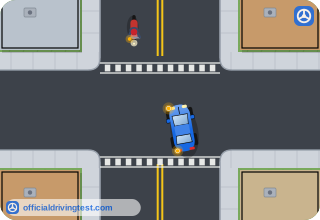
An oncoming motorcycle has its turn signal on and you want to turn in front of it. What should you do first?
- Assume the rider is going to turn and go ahead of the motorcycle
- Assume the signal is on by mistake and go ahead of the rider
- Flash your headlights to ask the rider to confirm the turn
- Make sure the rider is really slowing to turn before you turn
Show answer
Correct answer: Make sure the rider is really slowing to turn before you turn
Turn signals do not automatically cancel on some motorcycles, so make sure the rider is actually slowing to turn.
Source: Oregon Driver Manual (2026-2027), page 52 · Open this page in the manual (Manual page 52)
-
What does the manual say about sharing a lane with a person riding a motorcycle or moped?
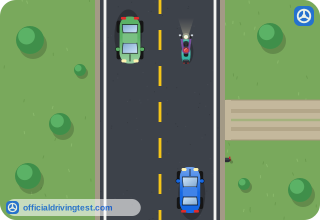
- It is allowed if you leave at least three feet of space beside the rider
- It is allowed on roads with a speed limit below 25 mph
- It is against the law, and when passing you must allow them a full lane
- It is allowed if the rider moves to the edge of the lane
Show answer
Correct answer: It is against the law, and when passing you must allow them a full lane
It is against the law to share a lane with a motorcycle or moped, and you must allow them a full lane when passing.
Source: Oregon Driver Manual (2026-2027), page 52 · Open this page in the manual (Manual page 52)
-
Which road surface can cause a person riding a motorcycle to change speed or direction?
- Grooved pavement
- Dry, smooth asphalt
- A freshly painted white line
- A wide, level shoulder
Show answer
Correct answer: Grooved pavement
The manual lists gravel, debris, pavement seams, grooved pavement and manhole covers as surfaces that affect motorcycles.
Source: Oregon Driver Manual (2026-2027), page 52 · Open this page in the manual (Manual page 52)