Oregon: Sharing the road — Part 5 Practice Test
Questions in this part include: “How far may a load on a passenger vehicle extend beyond the sides of the right fenders?” · “How does the manual describe streetcars and light rail trains?”
Independent educational site · not affiliated with any government agency or DMV
Ready? Test yourself
- Instant feedback with an explanation
- Every answer cites its source in the manual
- Your best score is saved on this device
Questions are original and based on the official manual "Oregon Driver Manual" (2026-2027), Oregon Driver and Motor Vehicle Services (DMV).
All 17 questions in this practice test
Take the test above first, then use this list to study. Tap “Show answer” to see the correct answer and explanation.
Show the questions and answersHide the questions
-
How far may a load on a passenger vehicle extend beyond the sides of the right fenders?
- No more than 6 inches
- No more than 1 foot
- No more than 2 feet
- It may not extend beyond them at all
Show answer
Correct answer: No more than 6 inches
Loads may not extend more than 6 inches beyond the sides of the right fenders.
Source: Oregon Driver Manual (2026-2027), page 56 · Open this page in the manual (Manual page 56)
-
How far may a load on a passenger vehicle extend beyond the sides of the fenders on the left side?
- No more than 6 inches beyond them
- No more than 12 inches beyond them
- It must not extend beyond them
- No more than 4 feet beyond them
Show answer
Correct answer: It must not extend beyond them
Passenger vehicles must not carry loads that extend beyond the sides of the fenders on the left side.
Source: Oregon Driver Manual (2026-2027), page 56 · Open this page in the manual (Manual page 56)
-
How far may a load extend in front of any vehicle?
- No more than 1 foot
- No more than 4 feet
- No more than 2 feet
- No more than 6 feet
Show answer
Correct answer: No more than 4 feet
Loads may not extend more than 4 feet in front of any vehicle.
Source: Oregon Driver Manual (2026-2027), page 56 · Open this page in the manual (Manual page 56)
-
How does the manual describe streetcars and light rail trains?
- Electric buses that run on overhead wires without any tracks
- Diesel passenger trains that run only on separate rail lines
- Electric transit vehicles that run on tracks embedded in the streets
- Freight trains that share the city streets with cars
Show answer
Correct answer: Electric transit vehicles that run on tracks embedded in the streets
Streetcars and light rail trains are electric transit vehicles that run on tracks embedded in the streets.
Source: Oregon Driver Manual (2026-2027), page 65 · Open this page in the manual (Manual page 65)
-
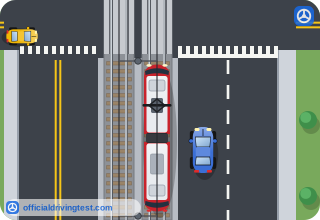
Who should go first when you share the road with a streetcar or light rail train?
- The vehicle that arrived first
- The streetcar or train
- The vehicle that is moving faster
- The vehicle on the right
Show answer
Correct answer: The streetcar or train
The manual says to always let streetcars and trains go first.
Source: Oregon Driver Manual (2026-2027), page 65 · Open this page in the manual (Manual page 65)
-
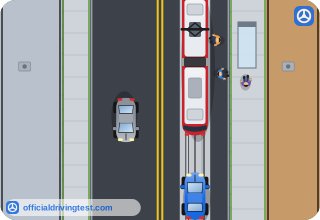
A streetcar or train has stopped to pick up or drop off people. What should you do?
- Drive around it quickly before it starts moving again
- Pass it on the right once no one is in sight near the vehicle
- Stop beside it and wait for the passengers to finish crossing
- Stay behind it until it moves again or the people are safely away
Show answer
Correct answer: Stay behind it until it moves again or the people are safely away
You stay behind it until it moves again or the people are safely away.
Source: Oregon Driver Manual (2026-2027), page 65 · Open this page in the manual (Manual page 65)
-
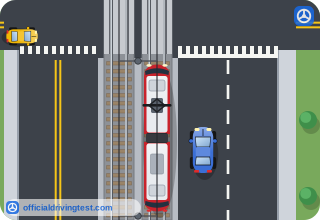
Why should you check for streetcars and trains before changing lanes?
- They are never in the lane beside you
- They move out of the way when you signal
- They sound a horn before they pass you
- You may not be aware they are close behind you
Show answer
Correct answer: You may not be aware they are close behind you
You may not realize a streetcar or train is close behind you.
Source: Oregon Driver Manual (2026-2027), page 66 · Open this page in the manual (Manual page 66)
-
Streetcars and trains cannot stop quickly. How should you drive in front of or around them?
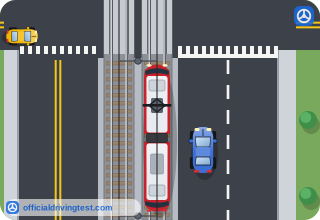
- Avoid braking suddenly or making unpredictable moves
- Brake hard so the operator sees your brake lights
- Stay close beside them to stay out of their path
- Change lanes often to stay ahead of them
Show answer
Correct answer: Avoid braking suddenly or making unpredictable moves
Because they cannot stop quickly, you avoid sudden braking and unpredictable moves in front of or around them.
Source: Oregon Driver Manual (2026-2027), page 66 · Open this page in the manual (Manual page 66)
-
What should you do if you make contact with a streetcar or train?
- Leave the scene and report it to the DMV later
- Push your vehicle off the tracks right away
- Wait for the operator or police to give you direction
- Get out and flag down other drivers for help
Show answer
Correct answer: Wait for the operator or police to give you direction
After contact with a streetcar or train you wait for the operator or police to tell you what to do.
Source: Oregon Driver Manual (2026-2027), page 66 · Open this page in the manual (Manual page 66)
-
What should you be prepared to do when you see signs warning of animal crossings?
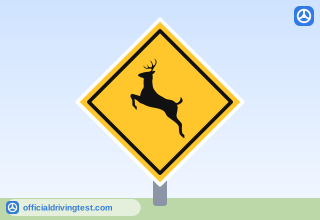
- Sound your horn to scare the animal away
- Flash your headlights at the animal to warn it
- Speed up to get past the animal quickly
- Brake or slow down as you pass an animal
Show answer
Correct answer: Brake or slow down as you pass an animal
The manual says to watch for animal-crossing signs and be prepared to brake or slow down as you pass an animal.
Source: Oregon Driver Manual (2026-2027), page 75 · Open this page in the manual (Manual page 75)
-
What must you do if you hit and injure a domestic animal?
- Stop and make a reasonable effort to check its injuries
- Continue driving and report it later to the owner
- Move the animal off the road and then drive on
- Drive on if the animal is able to walk away on its own
Show answer
Correct answer: Stop and make a reasonable effort to check its injuries
You must stop and make a reasonable effort to check the animal’s injuries.
Source: Oregon Driver Manual (2026-2027), page 75 · Open this page in the manual (Manual page 75)
-
If you hit and injure a domestic animal and cannot locate its owner, whom must you report the incident to?
- The nearest animal shelter only
- The DMV
- Local law enforcement
- No one, if the animal runs away
Show answer
Correct answer: Local law enforcement
If you are unable to locate the owner, you must report the incident to local law enforcement.
Source: Oregon Driver Manual (2026-2027), page 75 · Open this page in the manual (Manual page 75)
-
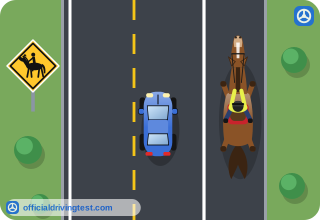
When must you stop your vehicle for a person riding on horseback or leading an animal?
- Only when they step into the roadway directly in front of your vehicle and stop
- When they raise a hand or the animal is frightened, unless stopping causes a collision
- Only when they sound a horn or call out to you from the roadside
- Only when they are leading the animal along a divided road
Show answer
Correct answer: When they raise a hand or the animal is frightened, unless stopping causes a collision
The manual says to stop if the person raises a hand or it is obvious the animal is frightened, unless stopping would cause a collision.
Source: Oregon Driver Manual (2026-2027), page 75 · Open this page in the manual (Manual page 75)
-
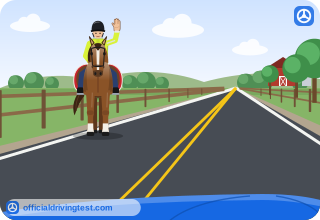
What does it mean when a person riding on horseback or leading an animal raises a hand?
- The person wants to turn
- The person is waving you past
- The person is asking you to speed up
- The animal is frightened
Show answer
Correct answer: The animal is frightened
The manual says a raised hand means the animal is frightened.
Source: Oregon Driver Manual (2026-2027), page 75 · Open this page in the manual (Manual page 75)
-
What should you not do near a frightened animal?
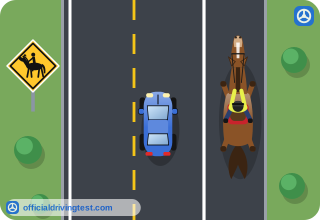
- Use your horn or make other loud, sudden noises
- Slow down and be prepared to brake as you pass
- Watch for signs warning of animal crossings
- Stop when a rider raises a hand to signal you
Show answer
Correct answer: Use your horn or make other loud, sudden noises
The manual says not to use your horn or make other loud, sudden noises near the animal.
Source: Oregon Driver Manual (2026-2027), page 75 · Open this page in the manual (Manual page 75)
-
Why should you be especially alert for people riding bicycles and pedestrians at night?
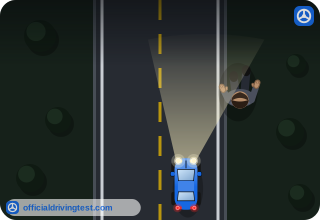
- They always ride in the center of the road
- They are harder to see
- They are not required to use sidewalks
- They drive faster at night
Show answer
Correct answer: They are harder to see
The manual says vulnerable road users such as people riding bicycles and pedestrians are harder to see at night.
Source: Oregon Driver Manual (2026-2027), page 77 · Open this page in the manual (Manual page 77)
-
If you see an aggressive driver, what should you do?
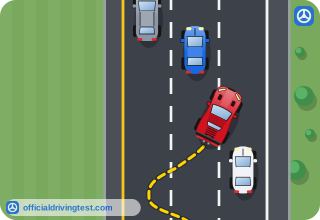
- Go faster to stay ahead of them
- Stay out of the way
- Try to out-drive them
- Block their lane so they slow down
Show answer
Correct answer: Stay out of the way
The manual says to stay out of the way and not to challenge an aggressive driver by going faster or trying to out-drive them.
Source: Oregon Driver Manual (2026-2027), page 81 · Open this page in the manual (Manual page 81)