New York: Right of way & turning
Who goes first at intersections, and the rules for turning safely. Split into 2 shorter tests so you're not stuck in one long quiz.
Independent educational site · not affiliated with any government agency or DMV
Choose a part
Right of way & turning — Part 1
Who goes first at intersections, and the rules for turning safely. — Part 1
Right of way & turning — Part 2
Questions in this part include: “Can you ever make a U-turn on a limited access expressway, even if paths connect your side with the other side?”
Questions are original and based on the official manual "New York State Driver's Manual" (Form MV-21), New York State Department of Motor Vehicles (DMV).
All 36 Right of way & turning questions with answers
Choose a part above to take a practice test, or study every question and answer here.
Show the questions and answersHide the questions
1Part 118 questions
-
According to the New York State Driver's Manual, a driver who approaches an intersection must yield the right-of-way to:
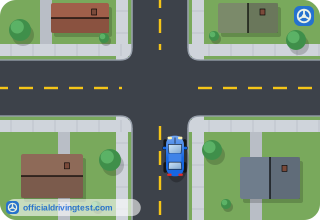
- Traffic that is already in the intersection
- Any vehicle waiting behind them
- Only vehicles making a right turn
- Traffic that has not yet reached the intersection
Show answer
Correct answer: Traffic that is already in the intersection
The manual states a driver who approaches an intersection must yield the right-of-way to traffic that is already in the intersection.
Source: New York State Driver's Manual (Form MV-21), page 34 · Open this page in the manual (Manual page 34)
-
When you make a left turn, including turning left into a driveway or parking lot, the law requires you to yield to:
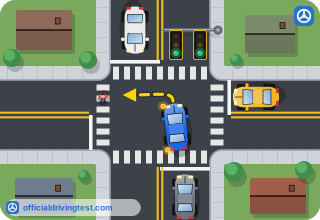
- Oncoming traffic close enough to be a hazard
- Only vehicles that have their turn signal on
- Traffic behind you
- Only pedestrians, never vehicles
Show answer
Correct answer: Oncoming traffic close enough to be a hazard
The manual says for any left turn, the law requires you to yield to any traffic headed toward you that is close enough to be a hazard, even into a driveway or parking lot without signs or signals.
Source: New York State Driver's Manual (Form MV-21), page 34 · Open this page in the manual (Manual page 34)
-
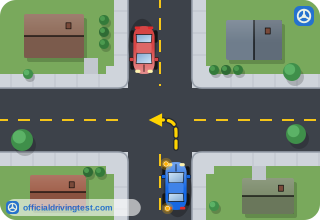
If drivers approaching from opposite directions reach an intersection at about the same time, a driver who turns left must yield to:
- Traffic behind them in the same lane
- Pedestrians only
- Traffic that moves straight ahead or turns right
- No one; left-turning traffic always has the right-of-way
Show answer
Correct answer: Traffic that moves straight ahead or turns right
The manual states that when drivers meet at an intersection at about the same time, a driver turning left must yield to traffic that moves straight or turns right.
Source: New York State Driver's Manual (Form MV-21), page 34 · Open this page in the manual (Manual page 34)
-
At an intersection not controlled by signs or signals, which of two drivers approaching on roads at right angles must yield the right-of-way?
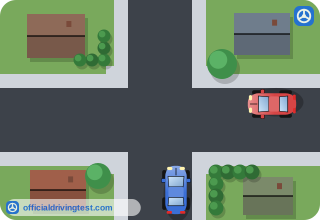
- The driver on the right must yield to the driver on the left
- The driver on the left must yield to the driver on the right
- The driver on the busier road has the right-of-way
- Neither driver needs to yield
Show answer
Correct answer: The driver on the left must yield to the driver on the right
The manual states that at intersections not controlled by signs or signals, or where drivers stop at STOP signs at the same time at right angles, the driver on the left must yield to the driver on the right.
Source: New York State Driver's Manual (Form MV-21), page 34 · Open this page in the manual (Manual page 34)
-
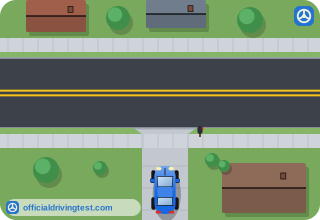
A vehicle entering a roadway from a driveway or private road must:
- Proceed without stopping if no other cars are visible
- Sound the horn before entering
- Stop and yield to traffic on the roadway and to pedestrians
- Yield only to larger vehicles
Show answer
Correct answer: Stop and yield to traffic on the roadway and to pedestrians
The manual states a vehicle entering a roadway from a driveway, private road, or another place that is not a roadway must stop and yield the right-of-way to traffic on the roadway and to pedestrians.
Source: New York State Driver's Manual (Form MV-21), page 34 · Open this page in the manual (Manual page 34)
-
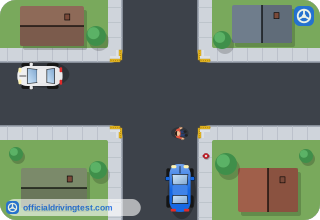
According to the manual, drivers must yield to pedestrians who legally use marked or unmarked crosswalks, which means drivers must:
- Honk to warn the pedestrian to hurry
- Slow down or stop if necessary
- Slow down only if the pedestrian is a child
- Yield only in marked crosswalks, not unmarked ones
Show answer
Correct answer: Slow down or stop if necessary
The manual states drivers must yield to pedestrians in marked or unmarked crosswalks, slowing down or stopping if necessary, and must take care to avoid colliding with pedestrians and bicyclists.
Source: New York State Driver's Manual (Form MV-21), page 34 · Open this page in the manual (Manual page 34)
-
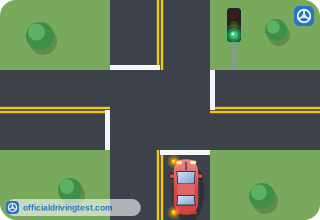
When preparing for a left turn at a green light, if no other vehicle ahead of you plans to turn left, you may enter the intersection to prepare for your turn. While waiting, you should:
- Turn your wheels toward your turn so you're ready to go
- Keep to the right of the center line and keep your wheels straight
- Move as far left as possible, even past the center line
- Stop with your wheels turned left to save time
Show answer
Correct answer: Keep to the right of the center line and keep your wheels straight
The manual instructs that when you enter the intersection to prepare for a left turn, keep to the right of the center line and keep your wheels straight to prevent being pushed into oncoming traffic if hit from behind.
Source: New York State Driver's Manual (Form MV-21), page 34 · Open this page in the manual (Manual page 34)
-
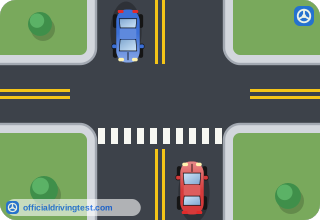
According to the manual, you cannot enter an intersection if:
- There is a bicycle anywhere nearby
- The light has been green for more than 10 seconds
- Traffic is backed up and you cannot get completely through
- You are the first car at the light
Show answer
Correct answer: Traffic is backed up and you cannot get completely through
The manual states you cannot enter an intersection if traffic is backed up on the other side and you cannot get completely through; you must wait until traffic ahead clears so you do not block the intersection.
Source: New York State Driver's Manual (Form MV-21), page 35 · Open this page in the manual (Manual page 35)
-
A driver who approaches a traffic circle or rotary must:
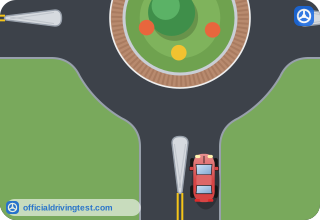
- Yield the right-of-way to drivers already in the circle
- Have the right-of-way over drivers already in the circle
- Stop completely regardless of other traffic
- Enter as fast as possible to merge with traffic
Show answer
Correct answer: Yield the right-of-way to drivers already in the circle
The manual states a driver who approaches a traffic circle or rotary must yield the right-of-way to drivers already in the circle.
Source: New York State Driver's Manual (Form MV-21), page 35 · Open this page in the manual (Manual page 35)
-
The law requires you to signal a turn or lane change with your turn lights or hand signals at least how far ahead?
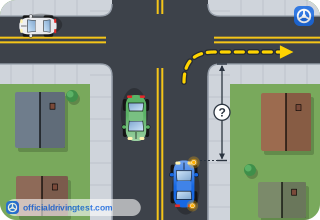
- 50 feet (15 m)
- 200 feet (60 m)
- 100 feet (30 m)
- 500 feet (150 m)
Show answer
Correct answer: 100 feet (30 m)
The manual states the law requires you to signal a turn or lane change with your turn lights or hand signals at least 100 feet (30 m) ahead.
Source: New York State Driver's Manual (Form MV-21), page 36 · Open this page in the manual (Manual page 36)
-
According to the manual, a good safety tip is to:
- Brake hard first, then signal your turn
- Signal only after you have completed the turn
- Never signal if no other cars are visible
- Signal before you begin to brake or make the turn
Show answer
Correct answer: Signal before you begin to brake or make the turn
The manual says a good safety tip is, when possible, to signal your intention to turn before you begin to brake or make the turn.
Source: New York State Driver's Manual (Form MV-21), page 36 · Open this page in the manual (Manual page 36)
-
Which of the following is listed as a tip to remember when you prepare to turn?
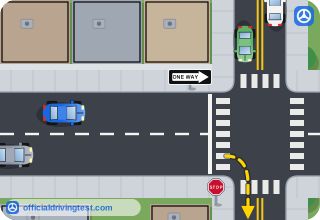
- Reduce your speed
- Increase your speed to clear the turn quickly
- Turn your wheels early, before you begin the turn
- Honk before turning
Show answer
Correct answer: Reduce your speed
The manual lists 'Reduce your speed' as one of the tips to remember when you prepare to turn.
Source: New York State Driver's Manual (Form MV-21), page 36 · Open this page in the manual (Manual page 36)
-
According to the manual, most crashes that involve motorcycles and other vehicles are caused because:
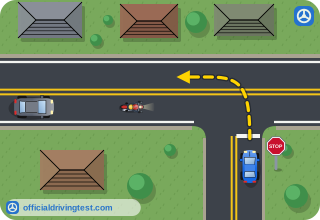
- Motorcyclists ride too fast
- Motorcycles do not have working brake lights
- The other driver failed to see the motorcycle
- Motorcyclists do not signal turns
Show answer
Correct answer: The other driver failed to see the motorcycle
The manual states most crashes that involve motorcycles and other vehicles are caused because the driver of the other vehicle failed to see the motorcycle.
Source: New York State Driver's Manual (Form MV-21), page 36 · Open this page in the manual (Manual page 36)
-
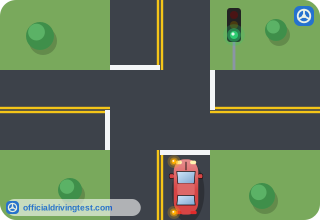
Why does the manual say you should keep your wheels straight until you actually begin to make your turn?
- It makes the turn signal work properly
- It is required only for left turns, not right turns
- It helps the engine idle more smoothly
- If hit from behind, you could be pushed into oncoming traffic
Show answer
Correct answer: If hit from behind, you could be pushed into oncoming traffic
The manual explains that if your wheels are turned and you are hit from behind, your vehicle could be pushed into the oncoming lane of traffic.
Source: New York State Driver's Manual (Form MV-21), page 36 · Open this page in the manual (Manual page 36)
-
According to the manual, your rear wheels will travel inside the path of your front wheels, meaning they travel nearer to:
- The opposite curb on every turn, left or right
- The curb on right turns, oncoming traffic on left turns
- The center line on right turns, the curb on left turns
- Pedestrians only on left turns
Show answer
Correct answer: The curb on right turns, oncoming traffic on left turns
The manual states rear wheels will travel inside the path of the front wheels, nearer to the curb on a right turn, or to traffic headed toward you on a left turn.
Source: New York State Driver's Manual (Form MV-21), page 36 · Open this page in the manual (Manual page 36)
-
The manual advises drivers to watch for pedestrians, bicyclists, and moped riders especially:
- Only on left turns
- Only at night
- On right turns
- Only in school zones
Show answer
Correct answer: On right turns
The manual advises drivers to watch for pedestrians, bicyclists, and moped riders, especially on right turns, as they are often difficult to see in traffic.
Source: New York State Driver's Manual (Form MV-21), page 36 · Open this page in the manual (Manual page 36)
-
Why does the manual say to be especially alert to individuals in wheelchairs, people pushing strollers, or someone pulling a wheeled suitcase?
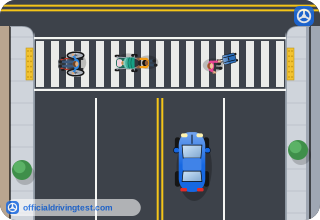
- They may be closer to the ground and hidden behind a car
- They are required to wear reflective clothing
- They always have the right-of-way over emergency vehicles
- They move faster than other pedestrians
Show answer
Correct answer: They may be closer to the ground and hidden behind a car
The manual explains these individuals may be closer to the ground and hidden behind a car, so drivers should be especially alert to them.
Source: New York State Driver's Manual (Form MV-21), page 36 · Open this page in the manual (Manual page 36)
-
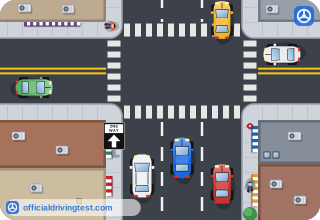
When making a right turn, the manual instructs you to:
- Swing wide to the left first for a better angle
- Stay in the center of the lane throughout the turn
- Turn into whichever lane is open, regardless of signs
- Keep far right, avoid wide turns, and turn into the right lane
Show answer
Correct answer: Keep far right, avoid wide turns, and turn into the right lane
The manual instructs that as you prepare to turn right, get as far to the right as possible, do not make wide sweeping turns, and unless signs direct otherwise, turn into the right lane of the road you enter.
Source: New York State Driver's Manual (Form MV-21), page 36 · Open this page in the manual (Manual page 36)
2Part 218 questions
-
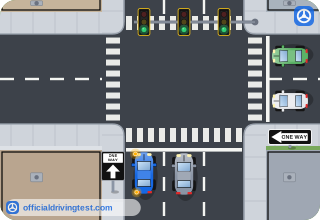
When turning left from a one-way road into another one-way road, if the road you enter has two lanes, you must:
- Turn into either lane, driver's choice
- Turn into its left lane
- Turn into its right lane
- Stop in the center of the intersection first
Show answer
Correct answer: Turn into its left lane
The manual states that when turning left from a one-way road into a one-way road, if the road you enter has two lanes, you must turn into its left lane.
Source: New York State Driver's Manual (Form MV-21), page 36 · Open this page in the manual (Manual page 36)
-
When turning left from a one-way road into a two-way road, you should enter the two-way road:
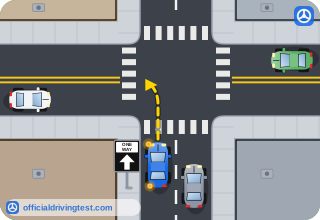
- To the left of its center line
- In the far-right lane only
- Just to the right of its center line
- Straddling the center line
Show answer
Correct answer: Just to the right of its center line
The manual states that when turning left from a one-way road into a two-way road, you enter the two-way road to the right of its center line, but as close as possible to the center line.
Source: New York State Driver's Manual (Form MV-21), page 36 · Open this page in the manual (Manual page 36)
-
When turning left from a two-way road into another two-way road, you should approach the turn from:
- The right half of the roadway closest to the center
- The far-left lane, regardless of the centerline
- The shoulder of the road
- Any lane, since it does not matter
Show answer
Correct answer: The right half of the roadway closest to the center
The manual states you should approach the turn from the right half of the roadway closest to the center, keeping to the right of the centerline of the road you enter.
Source: New York State Driver's Manual (Form MV-21), page 37 · Open this page in the manual (Manual page 37)
-
When turning left from a two-way road into a four-lane highway, you should enter which lane, and what may you do once traffic permits?
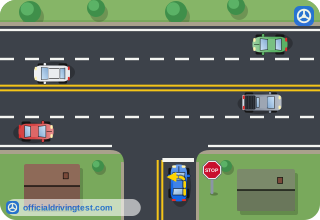
- Enter the right lane; then move left when possible
- Enter any lane; then stay there permanently
- Enter the left lane; then move right when traffic permits
- Enter the shoulder; then merge left
Show answer
Correct answer: Enter the left lane; then move right when traffic permits
The manual states you should enter the left lane, to the right of the center line, and when traffic permits, you can move out of the left lane.
Source: New York State Driver's Manual (Form MV-21), page 37 · Open this page in the manual (Manual page 37)
-
When turning left from a two-way road into a one-way road, you should make the turn:
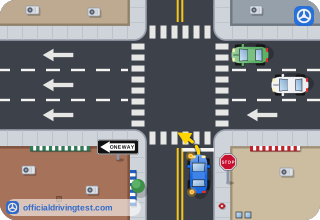
- After passing the center of the intersection
- Only from the far-right lane
- While straddling both lanes of the road you enter
- Before the center of the intersection, into the left lane
Show answer
Correct answer: Before the center of the intersection, into the left lane
The manual states you should make the turn before you reach the center of the intersection and turn into the left lane of the road you enter.
Source: New York State Driver's Manual (Form MV-21), page 37 · Open this page in the manual (Manual page 37)
-
According to the manual, a "U-turn" is defined as:
- A turn made only in a parking lot
- Any turn made to go in the opposite direction
- A turn made exclusively at a red light
- A three-point turn performed on a highway
Show answer
Correct answer: Any turn made to go in the opposite direction
The manual defines a U-turn as any turn you make so you can proceed in the opposite direction.
Source: New York State Driver's Manual (Form MV-21), page 37 · Open this page in the manual (Manual page 37)
-
If you must turn around and it is not absolutely necessary to do so on a highway, the manual advises you to:
- Perform a U-turn on the highway shoulder
- Back up along the highway shoulder to the nearest exit
- Wait for a police escort before turning around on the highway
- Use a parking lot or driveway, and re-enter moving forward if possible
Show answer
Correct answer: Use a parking lot or driveway, and re-enter moving forward if possible
The manual advises that if you must turn around, use a parking lot, driveway, or other area, and if possible enter the roadway as you move forward, not backing up.
Source: New York State Driver's Manual (Form MV-21), page 37 · Open this page in the manual (Manual page 37)
-
You can make a U-turn only from:
- The left part of the lane nearest the centerline
- Any lane at all, as long as you signal first
- The right lane only, after signaling
- The shoulder of the road, after stopping
Show answer
Correct answer: The left part of the lane nearest the centerline
The manual states you can make a U-turn only from the left portion of the lane nearest to the centerline of the roadway, never from the right lane.
Source: New York State Driver's Manual (Form MV-21), page 37 · Open this page in the manual (Manual page 37)
-
Unless signs tell you otherwise, when can you make a U-turn according to the manual?
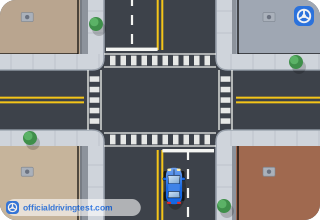
- Whenever the light is red, after coming to a full stop
- Only during a yellow light, before it turns red
- On a green left-turn arrow, if allowed, yielding to traffic
- Only when no other cars are on the road
Show answer
Correct answer: On a green left-turn arrow, if allowed, yielding to traffic
The manual states that unless signs tell you otherwise, you can make a U-turn when you get permission to proceed by a green arrow left turn traffic signal, provided it is allowed and you yield to other traffic.
Source: New York State Driver's Manual (Form MV-21), page 37 · Open this page in the manual (Manual page 37)
-
You cannot make a U-turn near the top of a hill, a curve, or any other location where other drivers cannot see your vehicle from how far away in either direction?
- 100 feet (30 m)
- 500 feet (150 m)
- 1,000 feet (300 m)
- 50 feet (15 m)
Show answer
Correct answer: 500 feet (150 m)
The manual states you cannot make a U-turn near the top of a hill, a curve, or any other location where other drivers cannot see your vehicle from 500 feet (150 m) away in either direction.
Source: New York State Driver's Manual (Form MV-21), page 37 · Open this page in the manual (Manual page 37)
-
According to the manual, U-turns are illegal in:
- NYC business districts and at NO U-TURN signs
- Only residential neighborhoods statewide
- Only rural areas
- Only parking lots
Show answer
Correct answer: NYC business districts and at NO U-TURN signs
The manual states U-turns are illegal in business districts of New York City and where NO U-TURN signs are provided.
Source: New York State Driver's Manual (Form MV-21), page 37 · Open this page in the manual (Manual page 37)
-
Can you ever make a U-turn on a limited access expressway, even if paths connect your side with the other side?
- Yes, if traffic is light
- Yes, but only at night
- Yes, if there is a connecting path
- No, never, even with connecting paths
Show answer
Correct answer: No, never, even with connecting paths
The manual states you can never make a U-turn on a limited access expressway, even if paths connect your side of the expressway with the other side.
Source: New York State Driver's Manual (Form MV-21), page 37 · Open this page in the manual (Manual page 37)
-
According to the manual, is it legal to make a U-turn in a school zone?
- Yes, if school is not in session
- Yes, if a crossing guard allows it
- No, it is prohibited in a school zone
- Yes, if done slowly
Show answer
Correct answer: No, it is prohibited in a school zone
The manual states it is prohibited for a vehicle to make a U-turn in a school zone.
Source: New York State Driver's Manual (Form MV-21), page 37 · Open this page in the manual (Manual page 37)
-
Unless prohibited, when can a three-point turn be used according to the manual?
- Only on a limited access expressway
- To turn around on a narrow, two-way street
- Only in a school zone
- Only when a police officer directs it
Show answer
Correct answer: To turn around on a narrow, two-way street
The manual states that unless prohibited, a three-point turn can be used to turn around on a narrow, two-way street, and you may be required to make one on your road test.
Source: New York State Driver's Manual (Form MV-21), page 37 · Open this page in the manual (Manual page 37)
-
What is the first step of a three-point turn according to the manual?
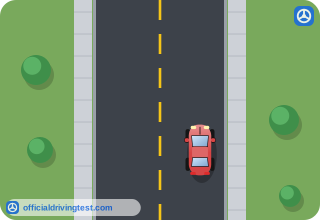
- Signal right, pull over and stop, then signal left and check for traffic
- Turn the steering wheel all the way to the left immediately
- Back up before signaling
- Drive to the nearest intersection and make three separate right turns
Show answer
Correct answer: Signal right, pull over and stop, then signal left and check for traffic
The manual's first step for a three-point turn is to signal with your right turn signal, pull over to the right and stop, then signal with your left turn signal and check carefully for traffic from all directions.
Source: New York State Driver's Manual (Form MV-21), page 38 · Open this page in the manual (Manual page 38)
-
In step 2 of a three-point turn, what should you do?
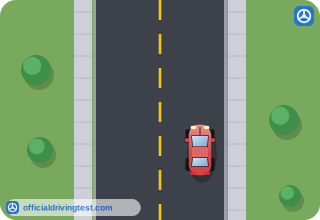
- Reverse straight back without turning
- Turn right and stop while facing the right curb
- Turn left, cross the road and stop facing the left curb
- Complete the full turn without stopping
Show answer
Correct answer: Turn left, cross the road and stop facing the left curb
The manual's step 2 is to turn left, go across the road so you come to a stop while you face the left curb or edge of the road.
Source: New York State Driver's Manual (Form MV-21), page 38 · Open this page in the manual (Manual page 38)
-
In step 3 of a three-point turn, after looking for traffic again, what should you do?
- Turn the steering wheel all the way to the left and pull forward
- Turn the wheel fully right and back up, stopping before the right curb
- Honk your horn and proceed forward
- Signal left and merge into traffic
Show answer
Correct answer: Turn the wheel fully right and back up, stopping before the right curb
The manual's step 3 is to turn your steering wheel as far to the right as possible, then look behind you as you back up, stopping before you reach the right curb or any obstacle.
Source: New York State Driver's Manual (Form MV-21), page 38 · Open this page in the manual (Manual page 38)
-
In the final step of a three-point turn, what should you do?
- Continue backing up until you reach the original lane
- Turn the wheel to the right again
- Wait for another vehicle to pass before doing anything else
- Check traffic, turn the wheel fully left and pull forward when safe
Show answer
Correct answer: Check traffic, turn the wheel fully left and pull forward when safe
The manual's final step is to stop, check again for other traffic, then turn your steering wheel all the way to the left and pull forward to complete your turn when it is safe.
Source: New York State Driver's Manual (Form MV-21), page 38 · Open this page in the manual (Manual page 38)