New York: Right of way & turning — Part 1 Practice Test
Who goes first at intersections, and the rules for turning safely. — Part 1
Independent educational site · not affiliated with any government agency or DMV
Ready? Test yourself
- Instant feedback with an explanation
- Every answer cites its source in the manual
- Your best score is saved on this device
Questions are original and based on the official manual "New York State Driver's Manual" (Form MV-21), New York State Department of Motor Vehicles (DMV).
All 18 questions in this practice test
Take the test above first, then use this list to study. Tap “Show answer” to see the correct answer and explanation.
Show the questions and answersHide the questions
-
According to the New York State Driver's Manual, a driver who approaches an intersection must yield the right-of-way to:
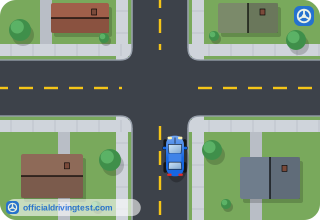
- Traffic that is already in the intersection
- Any vehicle waiting behind them
- Only vehicles making a right turn
- Traffic that has not yet reached the intersection
Show answer
Correct answer: Traffic that is already in the intersection
The manual states a driver who approaches an intersection must yield the right-of-way to traffic that is already in the intersection.
Source: New York State Driver's Manual (Form MV-21), page 34 · Open this page in the manual (Manual page 34)
-
When you make a left turn, including turning left into a driveway or parking lot, the law requires you to yield to:
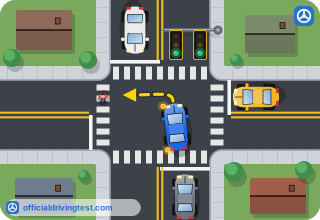
- Oncoming traffic close enough to be a hazard
- Only vehicles that have their turn signal on
- Traffic behind you
- Only pedestrians, never vehicles
Show answer
Correct answer: Oncoming traffic close enough to be a hazard
The manual says for any left turn, the law requires you to yield to any traffic headed toward you that is close enough to be a hazard, even into a driveway or parking lot without signs or signals.
Source: New York State Driver's Manual (Form MV-21), page 34 · Open this page in the manual (Manual page 34)
-
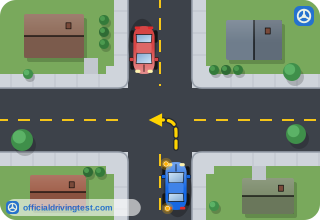
If drivers approaching from opposite directions reach an intersection at about the same time, a driver who turns left must yield to:
- Traffic behind them in the same lane
- Pedestrians only
- Traffic that moves straight ahead or turns right
- No one; left-turning traffic always has the right-of-way
Show answer
Correct answer: Traffic that moves straight ahead or turns right
The manual states that when drivers meet at an intersection at about the same time, a driver turning left must yield to traffic that moves straight or turns right.
Source: New York State Driver's Manual (Form MV-21), page 34 · Open this page in the manual (Manual page 34)
-
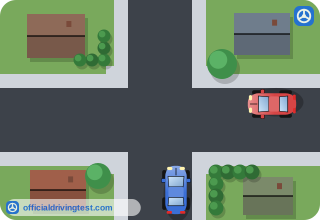
At an intersection not controlled by signs or signals, which of two drivers approaching on roads at right angles must yield the right-of-way?
- The driver on the right must yield to the driver on the left
- The driver on the left must yield to the driver on the right
- The driver on the busier road has the right-of-way
- Neither driver needs to yield
Show answer
Correct answer: The driver on the left must yield to the driver on the right
The manual states that at intersections not controlled by signs or signals, or where drivers stop at STOP signs at the same time at right angles, the driver on the left must yield to the driver on the right.
Source: New York State Driver's Manual (Form MV-21), page 34 · Open this page in the manual (Manual page 34)
-
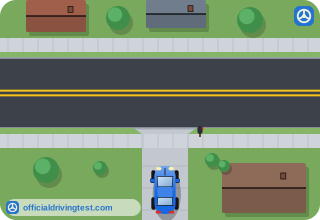
A vehicle entering a roadway from a driveway or private road must:
- Proceed without stopping if no other cars are visible
- Sound the horn before entering
- Stop and yield to traffic on the roadway and to pedestrians
- Yield only to larger vehicles
Show answer
Correct answer: Stop and yield to traffic on the roadway and to pedestrians
The manual states a vehicle entering a roadway from a driveway, private road, or another place that is not a roadway must stop and yield the right-of-way to traffic on the roadway and to pedestrians.
Source: New York State Driver's Manual (Form MV-21), page 34 · Open this page in the manual (Manual page 34)
-
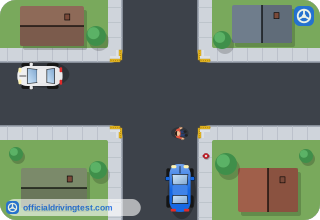
According to the manual, drivers must yield to pedestrians who legally use marked or unmarked crosswalks, which means drivers must:
- Honk to warn the pedestrian to hurry
- Slow down or stop if necessary
- Slow down only if the pedestrian is a child
- Yield only in marked crosswalks, not unmarked ones
Show answer
Correct answer: Slow down or stop if necessary
The manual states drivers must yield to pedestrians in marked or unmarked crosswalks, slowing down or stopping if necessary, and must take care to avoid colliding with pedestrians and bicyclists.
Source: New York State Driver's Manual (Form MV-21), page 34 · Open this page in the manual (Manual page 34)
-
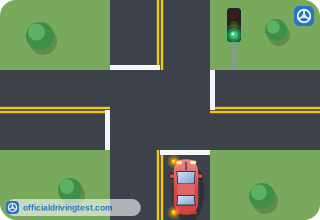
When preparing for a left turn at a green light, if no other vehicle ahead of you plans to turn left, you may enter the intersection to prepare for your turn. While waiting, you should:
- Turn your wheels toward your turn so you're ready to go
- Keep to the right of the center line and keep your wheels straight
- Move as far left as possible, even past the center line
- Stop with your wheels turned left to save time
Show answer
Correct answer: Keep to the right of the center line and keep your wheels straight
The manual instructs that when you enter the intersection to prepare for a left turn, keep to the right of the center line and keep your wheels straight to prevent being pushed into oncoming traffic if hit from behind.
Source: New York State Driver's Manual (Form MV-21), page 34 · Open this page in the manual (Manual page 34)
-
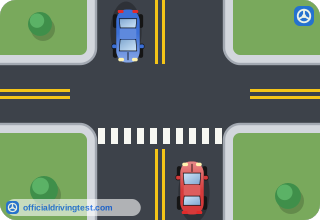
According to the manual, you cannot enter an intersection if:
- There is a bicycle anywhere nearby
- The light has been green for more than 10 seconds
- Traffic is backed up and you cannot get completely through
- You are the first car at the light
Show answer
Correct answer: Traffic is backed up and you cannot get completely through
The manual states you cannot enter an intersection if traffic is backed up on the other side and you cannot get completely through; you must wait until traffic ahead clears so you do not block the intersection.
Source: New York State Driver's Manual (Form MV-21), page 35 · Open this page in the manual (Manual page 35)
-
A driver who approaches a traffic circle or rotary must:
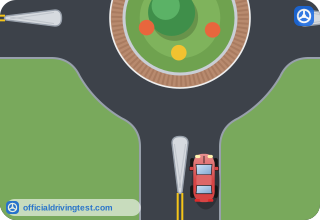
- Yield the right-of-way to drivers already in the circle
- Have the right-of-way over drivers already in the circle
- Stop completely regardless of other traffic
- Enter as fast as possible to merge with traffic
Show answer
Correct answer: Yield the right-of-way to drivers already in the circle
The manual states a driver who approaches a traffic circle or rotary must yield the right-of-way to drivers already in the circle.
Source: New York State Driver's Manual (Form MV-21), page 35 · Open this page in the manual (Manual page 35)
-
The law requires you to signal a turn or lane change with your turn lights or hand signals at least how far ahead?
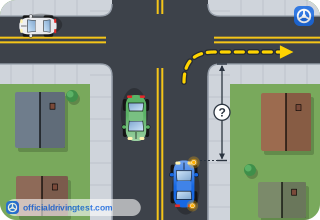
- 50 feet (15 m)
- 200 feet (60 m)
- 100 feet (30 m)
- 500 feet (150 m)
Show answer
Correct answer: 100 feet (30 m)
The manual states the law requires you to signal a turn or lane change with your turn lights or hand signals at least 100 feet (30 m) ahead.
Source: New York State Driver's Manual (Form MV-21), page 36 · Open this page in the manual (Manual page 36)
-
According to the manual, a good safety tip is to:
- Brake hard first, then signal your turn
- Signal only after you have completed the turn
- Never signal if no other cars are visible
- Signal before you begin to brake or make the turn
Show answer
Correct answer: Signal before you begin to brake or make the turn
The manual says a good safety tip is, when possible, to signal your intention to turn before you begin to brake or make the turn.
Source: New York State Driver's Manual (Form MV-21), page 36 · Open this page in the manual (Manual page 36)
-
Which of the following is listed as a tip to remember when you prepare to turn?
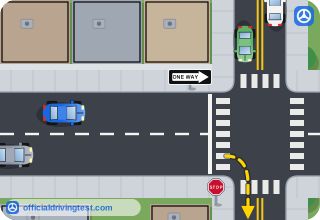
- Reduce your speed
- Increase your speed to clear the turn quickly
- Turn your wheels early, before you begin the turn
- Honk before turning
Show answer
Correct answer: Reduce your speed
The manual lists 'Reduce your speed' as one of the tips to remember when you prepare to turn.
Source: New York State Driver's Manual (Form MV-21), page 36 · Open this page in the manual (Manual page 36)
-
According to the manual, most crashes that involve motorcycles and other vehicles are caused because:
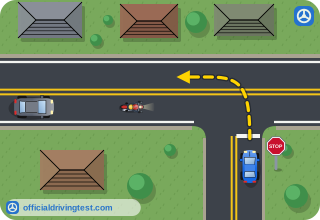
- Motorcyclists ride too fast
- Motorcycles do not have working brake lights
- The other driver failed to see the motorcycle
- Motorcyclists do not signal turns
Show answer
Correct answer: The other driver failed to see the motorcycle
The manual states most crashes that involve motorcycles and other vehicles are caused because the driver of the other vehicle failed to see the motorcycle.
Source: New York State Driver's Manual (Form MV-21), page 36 · Open this page in the manual (Manual page 36)
-
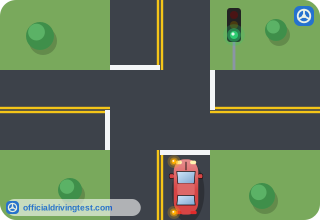
Why does the manual say you should keep your wheels straight until you actually begin to make your turn?
- It makes the turn signal work properly
- It is required only for left turns, not right turns
- It helps the engine idle more smoothly
- If hit from behind, you could be pushed into oncoming traffic
Show answer
Correct answer: If hit from behind, you could be pushed into oncoming traffic
The manual explains that if your wheels are turned and you are hit from behind, your vehicle could be pushed into the oncoming lane of traffic.
Source: New York State Driver's Manual (Form MV-21), page 36 · Open this page in the manual (Manual page 36)
-
According to the manual, your rear wheels will travel inside the path of your front wheels, meaning they travel nearer to:
- The opposite curb on every turn, left or right
- The curb on right turns, oncoming traffic on left turns
- The center line on right turns, the curb on left turns
- Pedestrians only on left turns
Show answer
Correct answer: The curb on right turns, oncoming traffic on left turns
The manual states rear wheels will travel inside the path of the front wheels, nearer to the curb on a right turn, or to traffic headed toward you on a left turn.
Source: New York State Driver's Manual (Form MV-21), page 36 · Open this page in the manual (Manual page 36)
-
The manual advises drivers to watch for pedestrians, bicyclists, and moped riders especially:
- Only on left turns
- Only at night
- On right turns
- Only in school zones
Show answer
Correct answer: On right turns
The manual advises drivers to watch for pedestrians, bicyclists, and moped riders, especially on right turns, as they are often difficult to see in traffic.
Source: New York State Driver's Manual (Form MV-21), page 36 · Open this page in the manual (Manual page 36)
-
Why does the manual say to be especially alert to individuals in wheelchairs, people pushing strollers, or someone pulling a wheeled suitcase?
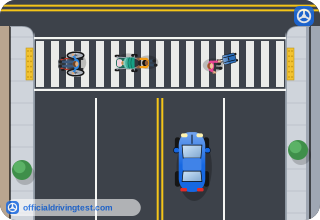
- They may be closer to the ground and hidden behind a car
- They are required to wear reflective clothing
- They always have the right-of-way over emergency vehicles
- They move faster than other pedestrians
Show answer
Correct answer: They may be closer to the ground and hidden behind a car
The manual explains these individuals may be closer to the ground and hidden behind a car, so drivers should be especially alert to them.
Source: New York State Driver's Manual (Form MV-21), page 36 · Open this page in the manual (Manual page 36)
-
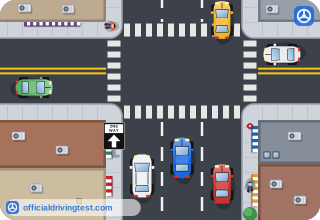
When making a right turn, the manual instructs you to:
- Swing wide to the left first for a better angle
- Stay in the center of the lane throughout the turn
- Turn into whichever lane is open, regardless of signs
- Keep far right, avoid wide turns, and turn into the right lane
Show answer
Correct answer: Keep far right, avoid wide turns, and turn into the right lane
The manual instructs that as you prepare to turn right, get as far to the right as possible, do not make wide sweeping turns, and unless signs direct otherwise, turn into the right lane of the road you enter.
Source: New York State Driver's Manual (Form MV-21), page 36 · Open this page in the manual (Manual page 36)