New York: Railroad & light rail crossings Practice Test
Safety rules for crossing train tracks and sharing the road with light rail.
Independent educational site · not affiliated with any government agency or DMV
Ready? Test yourself
Answer to start, or tap Start below:
What makes a grade crossing an "active" grade crossing?
- Instant feedback with an explanation
- Every answer cites its source in the manual
- Your best score is saved on this device
- Keyboard: press 1 to 4 to answer and Enter for the next question
Questions are original and based on the official manual "New York State Driver's Manual" (Form MV-21), New York State Department of Motor Vehicles (DMV).
All 16 questions in this practice test
Take the test above first, then use this list to study. Tap “Show answer” to see the correct answer and explanation.
Show the questions and answersHide the questions
-
A grade crossing is the point where train tracks intersect a roadway. What is it considered, and what should you always expect as you approach one?
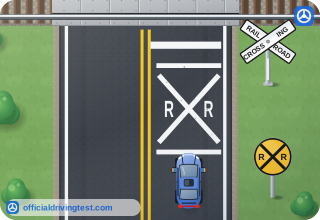
- An intersection; you should always expect a train
- A parking area; you should always expect pedestrians
- A toll plaza; you should always expect to stop and pay
- A rest stop; you should always expect construction
Show answer
Correct answer: An intersection; you should always expect a train
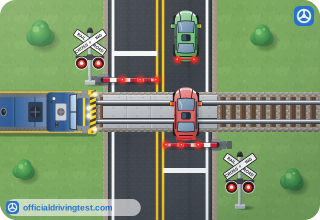
A grade crossing is the point at which train tracks intersect with a roadway and is considered an intersection. As you approach a crossing, always expect a train, because trains can run on any track, at any time, from either direction.
Source: New York State Driver's Manual (Form MV-21), page 60 · Open this page in the manual (Manual page 60)
-
Which of these should you NEVER do at a railroad crossing?
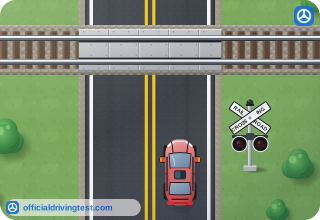
- Race a train or drive around lowered gates
- Slow down early to check for trains
- Stay in the same gear while crossing
- Stay in your lane while crossing
Show answer
Correct answer: Race a train or drive around lowered gates
Never race a train to a crossing, never drive around lowered gates, and do not stop on the tracks. When crossing tracks, always stay in your lane and in the same gear.
Source: New York State Driver's Manual (Form MV-21), page 60 · Open this page in the manual (Manual page 60)
-
What should you do if your vehicle is actually crossing railroad tracks?
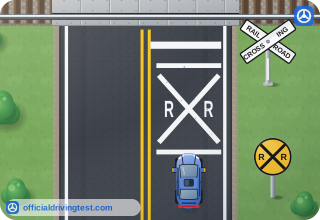
- Speed up as much as possible
- Shift gears to find the best one
- Stay in your lane and in the same gear
- Change lanes to pass slower vehicles
Show answer
Correct answer: Stay in your lane and in the same gear
When crossing tracks, always stay in your lane and in the same gear.
Source: New York State Driver's Manual (Form MV-21), page 60 · Open this page in the manual (Manual page 60)
-
What makes a grade crossing an "active" grade crossing?
- It has flashing red lights or gates
- It is used only during rush hour
- It has no signs at all
- It is only for pedestrian use
Show answer
Correct answer: It has flashing red lights or gates
Some grade crossings have flashing red lights or lowering gates when a train approaches; these are called "active" grade crossings.
Source: New York State Driver's Manual (Form MV-21), page 60 · Open this page in the manual (Manual page 60)
-
When approaching a marked (active) grade crossing with gates, when may you proceed?
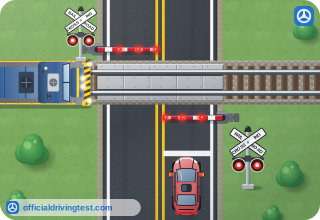
- When gates are fully up and lights are off
- As soon as the lights start flashing
- As soon as you can see around the gate
- Whenever there is no visible train
Show answer
Correct answer: When gates are fully up and lights are off
When approaching marked, or active, grade crossings, do not proceed until the gates are completely raised and the lights are off. It is illegal and dangerous to go around lowered gates or cross while the lights are still flashing.
Source: New York State Driver's Manual (Form MV-21), page 60 · Open this page in the manual (Manual page 60)
-
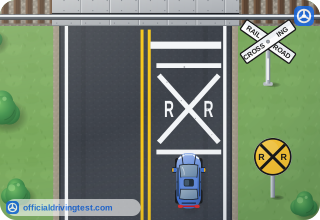
At an unmarked (passive) grade crossing with no gates or flashing lights, what should you do?
- Speed up to cross quickly
- Ignore it since there are no signals
- Slow down, be ready to stop, and check for trains
- Honk your horn and proceed without stopping
Show answer
Correct answer: Slow down, be ready to stop, and check for trains
When approaching unmarked, or passive, grade crossings, slow down and be prepared to stop. Before you cross, be sure that a train is not coming; if you see one, wait until it passes and cross when it is safe to do so.
Source: New York State Driver's Manual (Form MV-21), page 60 · Open this page in the manual (Manual page 60)
-
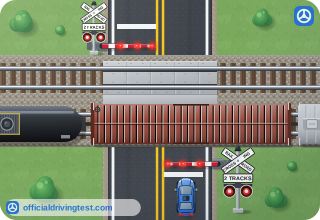
If there are multiple sets of tracks at a crossing, what should you do before crossing?
- Cross as soon as the nearest track is clear
- Follow the vehicle ahead of you closely
- Wait until you can see down all tracks in both directions
- Stop in the middle of the tracks to look both ways
Show answer
Correct answer: Wait until you can see down all tracks in both directions
If there are multiple tracks, wait until you can clearly see down all sets of tracks in both directions for another approaching train before crossing.
Source: New York State Driver's Manual (Form MV-21), page 60 · Open this page in the manual (Manual page 60)
-
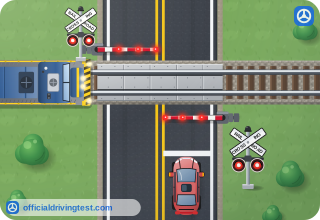
Why should you never assume you can beat an approaching train across the tracks?
- Trains always have the same speed limit as cars
- Trains are required to stop for cars
- The train is closer and faster than you think
- Trains only run during the daytime
Show answer
Correct answer: The train is closer and faster than you think
Remember that the train you see is closer and faster-moving than you think, and be aware that trains cannot stop quickly.
Source: New York State Driver's Manual (Form MV-21), page 60 · Open this page in the manual (Manual page 60)
-
What color and symbols appear on the Railroad Crossing Warning Sign, and what does it mean?
- Red with white letters; it means stop immediately
- Orange with black letters; it means road work ahead
- Yellow with black "RR" and "X"; a railroad crossing is ahead
- Green with white letters; it means yield to trains only
Show answer
Correct answer: Yellow with black "RR" and "X"; a railroad crossing is ahead
The Railroad Crossing Warning Sign is yellow with black letters and an "RR" and "X" symbol. It means there is a railroad crossing ahead — use caution and be prepared to stop.
Source: New York State Driver's Manual (Form MV-21), page 61 · Open this page in the manual (Manual page 61)
-
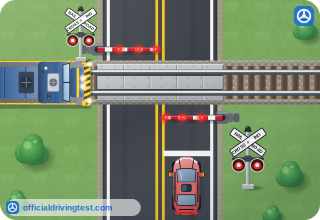
How close to the tracks must you stop when flashing red lights, lowered gates, and/or a bell activate at a railroad crossing?
- At least 50 feet (15 m) from the tracks
- As close to the tracks as possible
- At least 15 feet (5 m) from the tracks
- There is no minimum distance required
Show answer
Correct answer: At least 15 feet (5 m) from the tracks
Flashing red lights, lowered crossing gates, and/or a bell at a railroad crossing indicate that you must stop at least 15 feet (5 m) from the tracks.
Source: New York State Driver's Manual (Form MV-21), page 61 · Open this page in the manual (Manual page 61)
-
Is it ever acceptable to drive around or under a railroad crossing gate that is moving up or down?
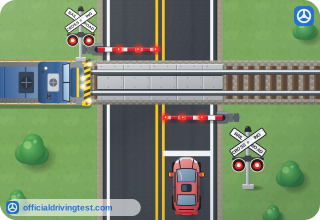
- Yes, if you are in a hurry
- Yes, only if the gate is going up
- No, never drive around or under it
- Yes, if no train is visible
Show answer
Correct answer: No, never drive around or under it
Do not go across the tracks until the lights and bell have stopped and the crossing gates are completely up. Do not drive around or under a gate that is moving up or down.
Source: New York State Driver's Manual (Form MV-21), page 61 · Open this page in the manual (Manual page 61)
-
What does a crossbuck sign look like, and what must you do when you see one?
- It is round and yellow; you must slow to 10 mph
- It is a square blue sign; you must stop completely for 5 seconds
- It is a sign shaped like an "X" reading "RAILROAD CROSSING"; you must yield, and it shows the number of tracks if there is more than one
- It is a triangular orange sign; it applies only to trucks
Show answer
Correct answer: It is a sign shaped like an "X" reading "RAILROAD CROSSING"; you must yield, and it shows the number of tracks if there is more than one
Yield when you see a crossbuck sign, which is shaped like an "X" with "RAILROAD CROSSING" printed on it. If there are multiple train tracks, the sign will show the number of tracks.
Source: New York State Driver's Manual (Form MV-21), page 61 · Open this page in the manual (Manual page 61)
-
If there are no working signals at a crossing but an approaching train is near enough or fast enough to be dangerous, what should you do?
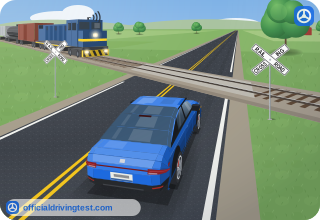
- Cross quickly since there are no signals to obey
- Sound your horn and proceed
- Only trucks need to stop in this case
- Do not cross the tracks, even without working signals
Show answer
Correct answer: Do not cross the tracks, even without working signals
Look and listen for trains before crossing any railroad tracks. If an approaching train is near enough or going fast enough to be a danger, you cannot go across the tracks, even if they have no signals or the signals are not working.
Source: New York State Driver's Manual (Form MV-21), page 61 · Open this page in the manual (Manual page 61)
-
Before crossing any railroad tracks, what must you be certain of?
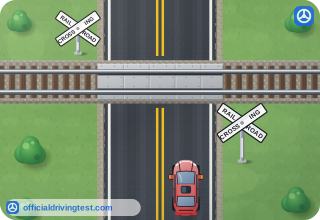
- That your entire vehicle will clear all tracks
- That there are no other cars behind you
- That the crossing has an active signal
- That your headlights are on
Show answer
Correct answer: That your entire vehicle will clear all tracks
Do not, under any circumstances, attempt to cross any railroad tracks unless you are certain your entire vehicle will clear all of the tracks at the crossing. You cannot go across unless there is room for your vehicle on the other side.
Source: New York State Driver's Manual (Form MV-21), page 61 · Open this page in the manual (Manual page 61)
-
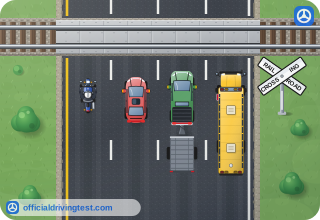
Which of these vehicles must stop at ALL railroad crossings?
- Motorcycles only
- Compact cars only
- School buses, even when empty
- Only vehicles towing trailers
Show answer
Correct answer: School buses, even when empty
School buses with or without passengers, other buses with passengers on board, and vehicles with explosives or flammable cargo must stop at all railroad crossings.
Source: New York State Driver's Manual (Form MV-21), page 61 · Open this page in the manual (Manual page 61)
-
If your vehicle stalls on railroad tracks, what should you do first, second, and third?
- Stay inside, lock the doors, then call for help
- Try to restart the engine repeatedly before doing anything else
- Get everyone out, move away from the tracks, then call the posted number
- Push the vehicle forward across the tracks yourself immediately
Show answer
Correct answer: Get everyone out, move away from the tracks, then call the posted number
If you stall on the tracks: 1) Get out — everyone in the car, including children, babies, and elderly passengers; 2) Get away from the tracks, even if you do not see a train; 3) Locate the Emergency Notification System sign and call the number provided, telling them about the stalled vehicle.
Source: New York State Driver's Manual (Form MV-21), page 61 · Open this page in the manual (Manual page 61)