New York: Pedestrian rights Practice Test
Crosswalk rules and a driver's duty to yield to people on foot.
Independent educational site · not affiliated with any government agency or DMV
Ready? Test yourself
Answer to start, or tap Start below:
Why does the manual say drivers must be extra careful around pedestrians?
- Instant feedback with an explanation
- Every answer cites its source in the manual
- Your best score is saved on this device
- Keyboard: press 1 to 4 to answer and Enter for the next question
Questions are original and based on the official manual "New York State Driver's Manual" (Form MV-21), New York State Department of Motor Vehicles (DMV).
All 18 questions in this practice test
Take the test above first, then use this list to study. Tap “Show answer” to see the correct answer and explanation.
Show the questions and answersHide the questions
-
Why does the manual say drivers must be extra careful around pedestrians?
- Because pedestrians are exempt from all traffic laws
- Because pedestrians never have the right-of-way
- Because pedestrians are required to wear reflective clothing
- Because pedestrians are at high risk in traffic
Show answer
Correct answer: Because pedestrians are at high risk in traffic
Pedestrians are at high risk in traffic, and the law requires drivers to be extra careful to avoid a collision with them.
Source: New York State Driver's Manual (Form MV-21), page 67 · Open this page in the manual (Manual page 67)
-
Near which locations does the manual say drivers should especially look out for children?
- Gas stations, car washes, banks and parking garages
- Shopping malls, office parks, banks and car dealerships
- Schools, bus stops, playgrounds, parks and ice cream trucks
- Office buildings, warehouses, factories and toll booths
Show answer
Correct answer: Schools, bus stops, playgrounds, parks and ice cream trucks
Drivers should look out for children near schools, bus stops, playgrounds, parks and ice cream trucks.
Source: New York State Driver's Manual (Form MV-21), page 67 · Open this page in the manual (Manual page 67)
-
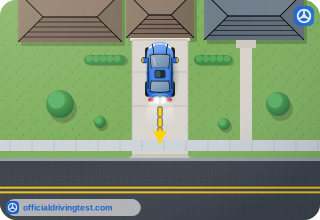
What should you do when backing up your car or truck, especially when children are near?
- Rely only on your side and rearview mirrors
- Sound your horn continuously instead of looking back
- Look through the back window; do not rely only on mirrors
- Ask a passenger to honk if needed
Show answer
Correct answer: Look through the back window; do not rely only on mirrors
When you back up your car or truck, look through your back window for pedestrians. Do not rely only on mirrors when children are near.
Source: New York State Driver's Manual (Form MV-21), page 67 · Open this page in the manual (Manual page 67)
-
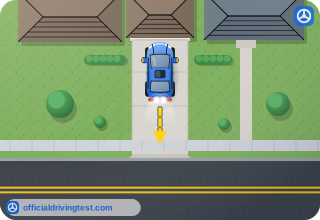
What should you do before you back into a driveway, or out of it?
- Turn on the radio to alert others
- Simply check the rearview mirror
- Flash your headlights twice
- Get out and check behind your vehicle
Show answer
Correct answer: Get out and check behind your vehicle
Before you back into a driveway, or out of it, get out of the vehicle and check behind your vehicle.
Source: New York State Driver's Manual (Form MV-21), page 67 · Open this page in the manual (Manual page 67)
-
When there is no sidewalk, how are pedestrians supposed to walk along the road?
- With their backs to traffic, in the center of the road
- Anywhere on the roadway they choose
- On the side of the road, facing the traffic in the lane nearest them
- Only on the shoulder with their backs to oncoming traffic
Show answer
Correct answer: On the side of the road, facing the traffic in the lane nearest them
Pedestrians are supposed to walk on the side of the road and face the traffic in the lane nearest them.
Source: New York State Driver's Manual (Form MV-21), page 67 · Open this page in the manual (Manual page 67)
-
When you make a right turn, which pedestrians should you watch for?
- Pedestrians on your right
- Pedestrians behind your vehicle only
- Pedestrians on the far side of the road only
- No pedestrians, since you have the right-of-way
Show answer
Correct answer: Pedestrians on your right
When you make a right turn, watch for pedestrians on your right. When you make a left turn, watch for pedestrians on the other side of the road on your left.
Source: New York State Driver's Manual (Form MV-21), page 67 · Open this page in the manual (Manual page 67)
-
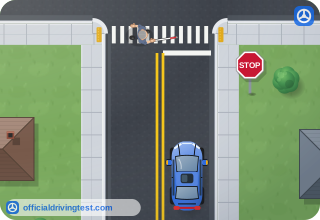
What special right-of-way rule applies to a blind pedestrian using a guide dog or a white or metal cane?
- You only need to yield if the traffic signal favors the pedestrian
- You must yield only if they are inside a marked crosswalk
- The rule only applies during daylight hours
- You must always yield at any crosswalk, even if the signals are against them
Show answer
Correct answer: You must always yield at any crosswalk, even if the signals are against them
A special right-of-way law allows blind pedestrians to cross with a guide dog or a white or metal cane. You must always give them the right-of-way when they are trying to cross at a marked or unmarked crosswalk, even if traffic signals or other right-of-way rules are not in their favor.
Source: New York State Driver's Manual (Form MV-21), page 67 · Open this page in the manual (Manual page 67)
-
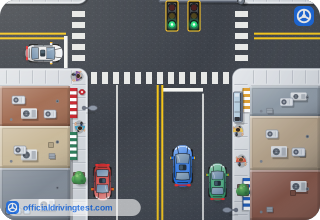
What does the manual recommend you do with your eyes as you drive, to help spot pedestrians?
- Keep your eyes fixed straight ahead at all times
- Look down at the dashboard frequently
- Check your mirrors only once a minute
- Move your eyes, looking to either side every few seconds
Show answer
Correct answer: Move your eyes, looking to either side every few seconds
Remember to move your eyes as you drive. Look to either side every few seconds to help you spot pedestrians near or approaching the roadway.
Source: New York State Driver's Manual (Form MV-21), page 67 · Open this page in the manual (Manual page 67)
-
The law requires pedestrians to obey which of the following?
- Only posted speed limits and parking signs
- Only pavement markings and crosswalk lines
- Traffic and pedestrian signals, traffic officers and official signs
- Nothing, since pedestrians are not regulated by traffic law
Show answer
Correct answer: Traffic and pedestrian signals, traffic officers and official signs
The law requires pedestrians to obey traffic and pedestrian signals, traffic officers and official signs.
Source: New York State Driver's Manual (Form MV-21), page 67 · Open this page in the manual (Manual page 67)
-
According to the manual, what are pedestrians never supposed to do?
- Walk on the sidewalk when one is available next to the road
- Wear bright or reflective clothing when walking at night
- Cross the street at a marked crosswalk
- Stand in the road to hitchhike or conduct business with motorists
Show answer
Correct answer: Stand in the road to hitchhike or conduct business with motorists
Pedestrians should never stand in the road to hitchhike or conduct business with motorists.
Source: New York State Driver's Manual (Form MV-21), page 67 · Open this page in the manual (Manual page 67)
-
What does the manual mean when it tells drivers to "expect the unexpected" regarding pedestrians?
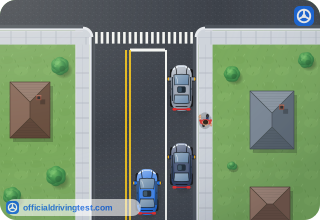
- A pedestrian may enter the roadway at any time, anywhere
- Pedestrians will always cross only at marked crosswalks
- Pedestrians will always obey the rules of the road
- Pedestrians never cross at intersections
Show answer
Correct answer: A pedestrian may enter the roadway at any time, anywhere
Do not expect a pedestrian to always follow the rules of the road; expect that a pedestrian may be entering the roadway at any time, anywhere, including outside of crosswalks.
Source: New York State Driver's Manual (Form MV-21), page 67 · Open this page in the manual (Manual page 67)
-
According to the manual, more than what percentage of NYC pedestrian injury crashes occur when a driver is attempting to make a left turn?
- 10%
- 20%
- 35%
- 60%
Show answer
Correct answer: 35%
More than 35% of NYC pedestrian injury crashes occur when a driver is attempting to make a left turn, which the manual notes can be a very dangerous maneuver.
Source: New York State Driver's Manual (Form MV-21), page 67 · Open this page in the manual (Manual page 67)
-
At which crosswalks do pedestrians have the right of way, according to the manual?
- Only crosswalks with a traffic signal
- Only crosswalks marked with paint
- All crosswalks, whether marked or unmarked
- Only crosswalks near schools
Show answer
Correct answer: All crosswalks, whether marked or unmarked
Pedestrians have the right of way at all crosswalks, whether marked or unmarked, and drivers must yield to them at all crosswalks and intersections.
Source: New York State Driver's Manual (Form MV-21), page 68 · Open this page in the manual (Manual page 68)
-
When there is no traffic control signal at an intersection, what must drivers do regarding pedestrians?
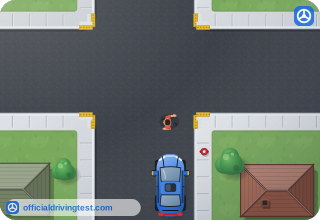
- Proceed first since no signal means no right-of-way rules apply
- Sound the horn and proceed
- Yield to pedestrians, especially one in a crosswalk or in potential danger
- Only yield to pedestrians who are running
Show answer
Correct answer: Yield to pedestrians, especially one in a crosswalk or in potential danger
When there is no traffic control signal, drivers must yield the right-of-way to pedestrians, particularly if a pedestrian is in a crosswalk, or there is potential danger to the pedestrian.
Source: New York State Driver's Manual (Form MV-21), page 68 · Open this page in the manual (Manual page 68)
-
What may happen to a driver who is involved in a crash with a pedestrian or fails to exercise due care?
- Nothing, since pedestrian crashes are not the driver's responsibility
- The driver's license is instantly revoked with no review
- The driver's vehicle is automatically impounded
- The driver may be issued a ticket
Show answer
Correct answer: The driver may be issued a ticket
Drivers may be issued a ticket if they are involved in a crash with a pedestrian, injure a pedestrian or bicyclist, or fail to exercise due care.
Source: New York State Driver's Manual (Form MV-21), page 68 · Open this page in the manual (Manual page 68)
-
Why should you stop well back from a crossing when approaching it?
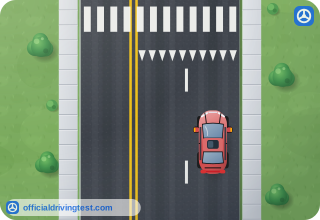
- To let other vehicles see the crossing pedestrians and stop too
- To use less fuel when you drive off again
- Because it is required only in school zones
- To allow faster acceleration once the crossing is clear
Show answer
Correct answer: To let other vehicles see the crossing pedestrians and stop too
Stop well back from the crossing to give other vehicles an opportunity to see the crossing pedestrians so they can stop too.
Source: New York State Driver's Manual (Form MV-21), page 68 · Open this page in the manual (Manual page 68)
-
What must you always do when you encounter a school bus with flashing red lights?
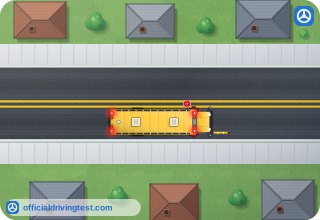
- Stop, and never pass a vehicle stopped for pedestrians
- Slow down slightly and continue driving past it
- Pass quickly before children exit the bus
- Only stop if you are directly behind the school bus
Show answer
Correct answer: Stop, and never pass a vehicle stopped for pedestrians
Always stop for a school bus with flashing red lights. Never pass or overtake a vehicle that is stopped for pedestrians, since there may be people crossing where you can't see.
Source: New York State Driver's Manual (Form MV-21), page 68 · Open this page in the manual (Manual page 68)
-
Why should you never pass a vehicle that is stopped at a crosswalk?
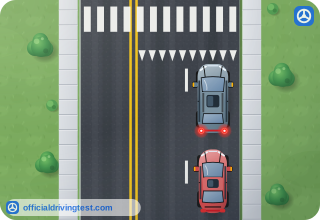
- There may be people crossing where you can't see
- It is only a matter of courtesy, not safety
- It saves the other driver time
- It is only illegal near schools
Show answer
Correct answer: There may be people crossing where you can't see
Never pass vehicles stopped at a crosswalk. There may be people crossing where you can't see.
Source: New York State Driver's Manual (Form MV-21), page 68 · Open this page in the manual (Manual page 68)