New Mexico: Speed and following distance — Part 2 Practice Test
Questions in this part include: “Which of these does the manual say scanning helps you to see?” · “What does the manual say about the condition of your tires?”
Independent educational site · not affiliated with any government agency or DMV
Ready? Test yourself
- Instant feedback with an explanation
- Every answer cites its source in the manual
- Your best score is saved on this device
- Keyboard: press 1 to 4 to answer and Enter for the next question
Questions are original and based on the official manual "New Mexico Driver Manual" (Version 11.19.19), New Mexico Motor Vehicle Division (MVD).
All 18 questions in this practice test
Take the test above first, then use this list to study. Tap “Show answer” to see the correct answer and explanation.
Show the questions and answersHide the questions
-
Which of these does the manual say scanning helps you to see?
- The exact speed of every vehicle that is traveling near your vehicle
- How many passengers are riding in each of the vehicles around you
- Where the nearest open parking space is along your planned route
- Vehicles and people that may be in the road by the time you reach them
Show answer
Correct answer: Vehicles and people that may be in the road by the time you reach them
Scanning helps you see problems ahead, vehicles and people that may be in the road by the time you reach them, and signs that warn or give directions.
Source: New Mexico Driver Manual (Version 11.19.19), page 15
-
Which of these is a benefit of looking well ahead and being ready to stop or change lanes?
- You can save on fuel
- You will not need to use your mirrors
- You will not need to check your speedometer
- You can use your horn less often
Show answer
Correct answer: You can save on fuel
The manual says looking well ahead lets you drive more safely, save on fuel, help keep traffic moving at a steady pace and see better around your vehicle.
Source: New Mexico Driver Manual (Version 11.19.19), page 15
-
How far ahead of their vehicle do safer drivers tend to look?
- At least 5 seconds
- At least 10 seconds
- At least 6 seconds
- At least 8 seconds
Show answer
Correct answer: At least 10 seconds
The manual says safer drivers tend to look at least 10 seconds ahead of their vehicle.
Source: New Mexico Driver Manual (Version 11.19.19), page 15
-
In the city, about how far ahead is 10 seconds?
- About half a block
- About two blocks
- About five blocks
- About one block
Show answer
Correct answer: About one block
The manual says that in the city 10 seconds is about one block, so in city traffic you should try to look at least one block ahead.
Source: New Mexico Driver Manual (Version 11.19.19), page 15
-
How does your speed affect the distance it takes to turn, slow or stop?
- The faster you go, the less distance it takes
- Speed changes only the distance to stop, not to turn
- The faster you go, the more distance it takes
- Speed does not change the distance on dry roads
Show answer
Correct answer: The faster you go, the more distance it takes
The manual says the faster your vehicle is going, the more distance it will take to turn, slow or stop.
Source: New Mexico Driver Manual (Version 11.19.19), page 20
-
Which of these is a road condition where the manual says you must slow down?
- When there is standing water on the road
- When the road is dry, straight and empty
- When the road is wide and empty
- When the sky is clear
Show answer
Correct answer: When there is standing water on the road
The manual says you must slow down before a sharp curve, when the roadway is slippery and when there is standing water on the road.
Source: New Mexico Driver Manual (Version 11.19.19), page 20
-
What is your vehicle’s only contact with the road?
- Its tires
- Its brakes
- Its springs
- Its steering
Show answer
Correct answer: Its tires
The manual says the only contact your vehicle has with the road is through the tires.
Source: New Mexico Driver Manual (Version 11.19.19), page 20
-
What does the manual say about the condition of your tires?
- They matter only when the road is wet
- Only the front tires need enough air in them
- They should be in good condition and have enough air
- They matter less than the condition of the road surface
Show answer
Correct answer: They should be in good condition and have enough air
The manual says it is important that the tires be in good condition and have enough air in them.
Source: New Mexico Driver Manual (Version 11.19.19), page 20
-
On gravel or dirt roads, what happens compared with concrete or asphalt roads?
- Stopping is quicker because the surface is loose
- Stopping takes much longer and skidding is easier
- Skidding is less likely because of the rough surface
- Traction is the same, but dust hides the road
Show answer
Correct answer: Stopping takes much longer and skidding is easier
The manual says you have less traction on gravel or dirt, so you must slow down: it takes much longer to stop and it is easier to skid when turning.
Source: New Mexico Driver Manual (Version 11.19.19), page 20
-
How should you handle a curve?
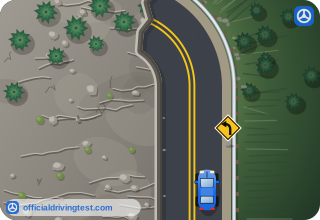
- Brake gently in the middle of the curve to control your speed
- Speed up halfway through the curve so the tires keep gripping
- Hold your speed and brake only if the vehicle starts to skid out of the curve
- Slow down before you enter the curve so you do not have to brake in it
Show answer
Correct answer: Slow down before you enter the curve so you do not have to brake in it
The manual says to always slow down before entering a curve, because braking in a curve can cause the vehicle to skid.
Source: New Mexico Driver Manual (Version 11.19.19), page 20
-
When should you slow down on roads that may become slippery?
- Only after the road is covered with water or snow
- Only after the tires start to slide
- At the first sign of rain, snow or sleet
- Only when the rain becomes heavy
Show answer
Correct answer: At the first sign of rain, snow or sleet
The manual says to slow down at the first sign of rain, snow or sleet because all of these make the roadway slippery.
Source: New Mexico Driver Manual (Version 11.19.19), page 20
-
On a wet road, by about how much should you reduce your speed?
- About 10 mph
- About 5 mph
- About 20 mph
- About 30 mph
Show answer
Correct answer: About 10 mph
The manual says that on a wet road you should reduce your speed about 10 mph.
Source: New Mexico Driver Manual (Version 11.19.19), page 20
-
On packed snow, how much should you cut your speed?
- By about 10 mph
- By one-quarter
- By one-third
- In half
Show answer
Correct answer: In half
The manual says that on packed snow you should cut your speed in half.
Source: New Mexico Driver Manual (Version 11.19.19), page 20
-
What does the manual say to use when the road has snow on it?
- Tires with less air for more grip
- Snow tires or chains
- Smooth tires that grip the pavement
- Cruise control to hold a steady speed
Show answer
Correct answer: Snow tires or chains
The manual says to use snow tires or chains when the road has snow on it.
Source: New Mexico Driver Manual (Version 11.19.19), page 20
-
How slow should you drive on ice?
- Cut your speed in half
- Slow to a crawl
- Reduce your speed by about 10 mph
- Slow to about 35 mph
Show answer
Correct answer: Slow to a crawl
The manual says that on ice you must slow to a crawl, and that it is very dangerous to drive on ice.
Source: New Mexico Driver Manual (Version 11.19.19), page 20
-
Why are studded tires not allowed in many areas or on certain roads?
- They make vehicles harder to steer
- They wear out too quickly
- They make too much noise
- They can cause road damage
Show answer
Correct answer: They can cause road damage
The manual says studded tires are allowed in some icy areas, but they can cause road damage so they are not allowed in many areas or on certain roads.
Source: New Mexico Driver Manual (Version 11.19.19), page 20
-
Why can shady spots be icy on cold, wet days?
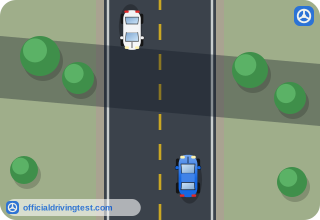
- They freeze first and dry out last
- They freeze last and dry out first
- They collect oil from passing traffic
- They hold more snow than other areas
Show answer
Correct answer: They freeze first and dry out last
The manual says shady spots can be icy on cold, wet days because they freeze first and dry out last.
Source: New Mexico Driver Manual (Version 11.19.19), page 20
-
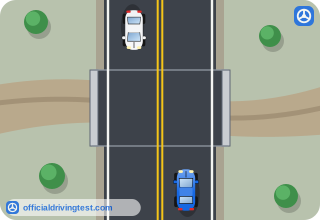
Why can the pavement on a bridge be icy even when other pavement is not?
- Bridges are built of smoother materials that hold ice longer
- Bridges are higher so the wind freezes water much faster
- Bridges have no earth underneath to insulate them against the cold
- Bridges are shaded by the cables and supports above them all day long
Show answer
Correct answer: Bridges have no earth underneath to insulate them against the cold
The manual says bridges do not have earth underneath to insulate them against the cold, so they can be colder and icier than other roadways.
Source: New Mexico Driver Manual (Version 11.19.19), page 20