New Mexico: Speed and following distance
New Mexico speed limits, adjusting to wet roads, curves and traffic, the three-second following distance, scanning ahead and seeing well enough to stop. Split into 4 shorter tests so you're not stuck in one long quiz.
Independent educational site · not affiliated with any government agency or DMV
Choose a part
Speed and following distance — Part 1
Questions in this part include: “In which conditions should you drive at the posted maximum speed limit?”
StartSpeed and following distance — Part 2
Questions in this part include: “Which of these does the manual say scanning helps you to see?”
StartSpeed and following distance — Part 3
Questions in this part include: “When is ice more slippery?”
StartSpeed and following distance — Part 4
Questions in this part include: “What do you do to use the “Four Second Sight Distance Rule”?”
StartAll 72 Speed and following distance questions with answers
Choose a part above to take a practice test, or study every question and answer here.
Show the questions and answersHide the questions
-
What do speed limit signs indicate?
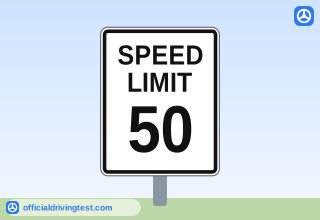
- The maximum safe speed allowed or the minimum safe speed required
- Only the average speed of all the traffic around you
- Only the maximum speed allowed, and never a minimum speed
- The speed at which most drivers feel comfortable on that road
Show answer
Correct answer: The maximum safe speed allowed or the minimum safe speed required
Speed limit signs indicate the maximum safe speed allowed or the minimum safe speed required.
Source: New Mexico Driver Manual (Version 11.19.19), page 6
-
In which conditions should you drive at the posted maximum speed limit?
- In all weather and road conditions
- Only at night on a lighted road
- Only in ideal driving conditions
- Only on highways and freeways
Show answer
Correct answer: Only in ideal driving conditions
The maximum limit should be driven only in ideal driving conditions, and you must reduce speed when conditions require it.
Source: New Mexico Driver Manual (Version 11.19.19), page 6
-
In which situation should you reduce your speed below the posted limit?
- When the roadway is dry, straight, flat and well lit
- When it is foggy and difficult to see clearly down the road
- When traffic is light and the day is clear and sunny
- When the vehicle has just been serviced at a repair shop
Show answer
Correct answer: When it is foggy and difficult to see clearly down the road
You should reduce speed when the roadway is slippery, during rain, snow or icy conditions, or when it is foggy and difficult to see down the road.
Source: New Mexico Driver Manual (Version 11.19.19), page 6
-
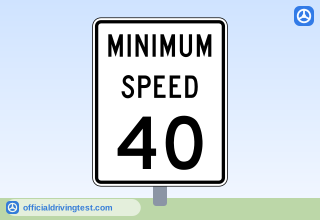
Some high-speed roads have minimum speed limits. What are you required to do on them?
- Travel exactly at the minimum speed at all times
- Travel at least 10 mph under the minimum
- Travel at the minimum only during daylight hours
- Travel at least that fast
Show answer
Correct answer: Travel at least that fast
On roads with minimum speed limits you are required to travel at least that fast so as not to be a hazard to other drivers.
Source: New Mexico Driver Manual (Version 11.19.19), page 7
-
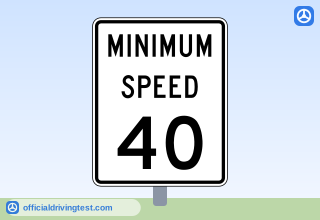
The minimum posted speed on a road is too fast for you. What should you do?
- Drive on the shoulder
- Use another road
- Drive slowly with your hazard lights on
- Follow a faster vehicle closely
Show answer
Correct answer: Use another road
If the minimum posted speed is too fast for you, you should use another road.
Source: New Mexico Driver Manual (Version 11.19.19), page 7
-
What is the maximum speed within a school zone that has a posted speed limit?
- 15 mph
- 20 mph
- 35 mph
- 40 mph
Show answer
Correct answer: 15 mph
The maximum speed within a school zone with a posted speed limit is 15 mph.
Source: New Mexico Driver Manual (Version 11.19.19), page 12
-
What is the maximum speed in business or residential areas, unless posted otherwise?
- 20 mph
- 30 mph
- 40 mph
- 50 mph
Show answer
Correct answer: 30 mph
The maximum speed in business or residential areas is 30 mph unless posted otherwise.
Source: New Mexico Driver Manual (Version 11.19.19), page 12
-
What is the maximum speed on public highways, unless posted otherwise?
- 45 mph
- 60 mph
- 65 mph
- 55 mph
Show answer
Correct answer: 55 mph
The maximum speed on public highways is 55 mph unless posted otherwise.
Source: New Mexico Driver Manual (Version 11.19.19), page 12
-
What is the maximum speed on rural interstate highways, unless posted otherwise?
- 65 mph
- 75 mph
- 70 mph
- 80 mph
Show answer
Correct answer: 75 mph
The maximum speed on rural interstate highways is 75 mph unless posted otherwise.
Source: New Mexico Driver Manual (Version 11.19.19), page 12
-
If no minimum speed is posted, how should you drive?
- At the maximum speed limit at all times, whatever other traffic does
- In the left-most lane so that faster traffic must pass you on the right
- So that you do not interfere with regular traffic flow
- At no more than half of the maximum speed limit
Show answer
Correct answer: So that you do not interfere with regular traffic flow
If no minimum speed is posted, you should drive so that you do not interfere with regular traffic flow.
Source: New Mexico Driver Manual (Version 11.19.19), page 12
-
According to the manual, speed should be adjusted for which of these?
- Adverse conditions and the type of vehicle
- The color of the vehicle and the time of day
- The number of passengers and the driver's age
- The length of the trip and the type of fuel
Show answer
Correct answer: Adverse conditions and the type of vehicle
Speed should be adjusted for adverse conditions and for the type of vehicle, and to avoid accidents.
Source: New Mexico Driver Manual (Version 11.19.19), page 13
-
When is it especially easy to be traveling much faster than you think?
- When you leave high-speed roads and drive on much slower local roads
- When you drive uphill behind a slow truck in heavy traffic
- When you drive on a crowded city street during the day
- When you first start the vehicle after it has been parked
Show answer
Correct answer: When you leave high-speed roads and drive on much slower local roads
People are not very good at judging speed, and this is especially true when leaving high-speed roads for much slower local roads.
Source: New Mexico Driver Manual (Version 11.19.19), page 15
-
What should you do about your speed, since people are not very good at judging how fast they are going?
- Compare your speed with the vehicles around you
- Estimate it by the sound of the engine
- Check the speedometer often
- Check the speedometer only when you enter a highway
Show answer
Correct answer: Check the speedometer often
The manual says to be aware of your speed and check the speedometer often.
Source: New Mexico Driver Manual (Version 11.19.19), page 15
-
How does the manual say you should treat speed limit signs?
- Follow them only when a police officer is nearby
- Follow them, because they are there for your safety
- Ignore them whenever the road is clear and dry
- Treat them as advice that only slow drivers need to follow
Show answer
Correct answer: Follow them, because they are there for your safety
The manual says to follow the speed limit signs because they are there for your safety.
Source: New Mexico Driver Manual (Version 11.19.19), page 15
-
What does stopping suddenly usually indicate?
- A driver who has a better view of the road
- A driver who is running late for an appointment
- A driver who is new to the area
- A driver who is not paying attention
Show answer
Correct answer: A driver who is not paying attention
The manual says stopping suddenly is dangerous and usually indicates a driver who is not paying attention.
Source: New Mexico Driver Manual (Version 11.19.19), page 15
-
What could happen when you brake quickly?
- You could skid and lose control of your vehicle
- It could make it easier for drivers behind you to stop
- Your brake pedal could stick to the floor
- Your headlights could turn off automatically
Show answer
Correct answer: You could skid and lose control of your vehicle
When you brake quickly you could skid and lose control, and you also make it harder for drivers behind you to stop without hitting you.
Source: New Mexico Driver Manual (Version 11.19.19), page 15
-
How can you try to avoid panic stops?
- By braking only at the last moment
- By following the vehicle ahead more closely
- By seeing events well in advance
- By driving a little faster than traffic
Show answer
Correct answer: By seeing events well in advance
The manual says to try to avoid panic stops by seeing events well in advance.
Source: New Mexico Driver Manual (Version 11.19.19), page 15
-
What may let you avoid having to stop at all?
- Speeding up and sounding your horn
- Slowing down or changing lanes
- Braking hard and then accelerating
- Moving onto the shoulder and parking
Show answer
Correct answer: Slowing down or changing lanes
By slowing down or changing lanes you may not have to stop at all, and if you do stop you can make a more gradual and safer stop.
Source: New Mexico Driver Manual (Version 11.19.19), page 15
-
Which of these does the manual say scanning helps you to see?
- The exact speed of every vehicle that is traveling near your vehicle
- How many passengers are riding in each of the vehicles around you
- Where the nearest open parking space is along your planned route
- Vehicles and people that may be in the road by the time you reach them
Show answer
Correct answer: Vehicles and people that may be in the road by the time you reach them
Scanning helps you see problems ahead, vehicles and people that may be in the road by the time you reach them, and signs that warn or give directions.
Source: New Mexico Driver Manual (Version 11.19.19), page 15
-
Which of these is a benefit of looking well ahead and being ready to stop or change lanes?
- You can save on fuel
- You will not need to use your mirrors
- You will not need to check your speedometer
- You can use your horn less often
Show answer
Correct answer: You can save on fuel
The manual says looking well ahead lets you drive more safely, save on fuel, help keep traffic moving at a steady pace and see better around your vehicle.
Source: New Mexico Driver Manual (Version 11.19.19), page 15
-
How far ahead of their vehicle do safer drivers tend to look?
- At least 5 seconds
- At least 10 seconds
- At least 6 seconds
- At least 8 seconds
Show answer
Correct answer: At least 10 seconds
The manual says safer drivers tend to look at least 10 seconds ahead of their vehicle.
Source: New Mexico Driver Manual (Version 11.19.19), page 15
-
In the city, about how far ahead is 10 seconds?
- About half a block
- About two blocks
- About five blocks
- About one block
Show answer
Correct answer: About one block
The manual says that in the city 10 seconds is about one block, so in city traffic you should try to look at least one block ahead.
Source: New Mexico Driver Manual (Version 11.19.19), page 15
-
How does your speed affect the distance it takes to turn, slow or stop?
- The faster you go, the less distance it takes
- Speed changes only the distance to stop, not to turn
- The faster you go, the more distance it takes
- Speed does not change the distance on dry roads
Show answer
Correct answer: The faster you go, the more distance it takes
The manual says the faster your vehicle is going, the more distance it will take to turn, slow or stop.
Source: New Mexico Driver Manual (Version 11.19.19), page 20
-
Which of these is a road condition where the manual says you must slow down?
- When there is standing water on the road
- When the road is dry, straight and empty
- When the road is wide and empty
- When the sky is clear
Show answer
Correct answer: When there is standing water on the road
The manual says you must slow down before a sharp curve, when the roadway is slippery and when there is standing water on the road.
Source: New Mexico Driver Manual (Version 11.19.19), page 20
-
What is your vehicle’s only contact with the road?
- Its tires
- Its brakes
- Its springs
- Its steering
Show answer
Correct answer: Its tires
The manual says the only contact your vehicle has with the road is through the tires.
Source: New Mexico Driver Manual (Version 11.19.19), page 20
-
What does the manual say about the condition of your tires?
- They matter only when the road is wet
- Only the front tires need enough air in them
- They should be in good condition and have enough air
- They matter less than the condition of the road surface
Show answer
Correct answer: They should be in good condition and have enough air
The manual says it is important that the tires be in good condition and have enough air in them.
Source: New Mexico Driver Manual (Version 11.19.19), page 20
-
On gravel or dirt roads, what happens compared with concrete or asphalt roads?
- Stopping is quicker because the surface is loose
- Stopping takes much longer and skidding is easier
- Skidding is less likely because of the rough surface
- Traction is the same, but dust hides the road
Show answer
Correct answer: Stopping takes much longer and skidding is easier
The manual says you have less traction on gravel or dirt, so you must slow down: it takes much longer to stop and it is easier to skid when turning.
Source: New Mexico Driver Manual (Version 11.19.19), page 20
-
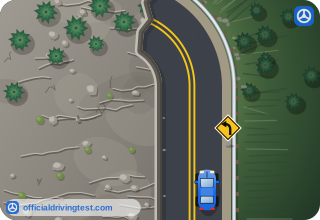
How should you handle a curve?
- Brake gently in the middle of the curve to control your speed
- Speed up halfway through the curve so the tires keep gripping
- Hold your speed and brake only if the vehicle starts to skid out of the curve
- Slow down before you enter the curve so you do not have to brake in it
Show answer
Correct answer: Slow down before you enter the curve so you do not have to brake in it
The manual says to always slow down before entering a curve, because braking in a curve can cause the vehicle to skid.
Source: New Mexico Driver Manual (Version 11.19.19), page 20
-
When should you slow down on roads that may become slippery?
- Only after the road is covered with water or snow
- Only after the tires start to slide
- At the first sign of rain, snow or sleet
- Only when the rain becomes heavy
Show answer
Correct answer: At the first sign of rain, snow or sleet
The manual says to slow down at the first sign of rain, snow or sleet because all of these make the roadway slippery.
Source: New Mexico Driver Manual (Version 11.19.19), page 20
-
On a wet road, by about how much should you reduce your speed?
- About 10 mph
- About 5 mph
- About 20 mph
- About 30 mph
Show answer
Correct answer: About 10 mph
The manual says that on a wet road you should reduce your speed about 10 mph.
Source: New Mexico Driver Manual (Version 11.19.19), page 20
-
On packed snow, how much should you cut your speed?
- By about 10 mph
- By one-quarter
- By one-third
- In half
Show answer
Correct answer: In half
The manual says that on packed snow you should cut your speed in half.
Source: New Mexico Driver Manual (Version 11.19.19), page 20
-
What does the manual say to use when the road has snow on it?
- Tires with less air for more grip
- Snow tires or chains
- Smooth tires that grip the pavement
- Cruise control to hold a steady speed
Show answer
Correct answer: Snow tires or chains
The manual says to use snow tires or chains when the road has snow on it.
Source: New Mexico Driver Manual (Version 11.19.19), page 20
-
How slow should you drive on ice?
- Cut your speed in half
- Slow to a crawl
- Reduce your speed by about 10 mph
- Slow to about 35 mph
Show answer
Correct answer: Slow to a crawl
The manual says that on ice you must slow to a crawl, and that it is very dangerous to drive on ice.
Source: New Mexico Driver Manual (Version 11.19.19), page 20
-
Why are studded tires not allowed in many areas or on certain roads?
- They make vehicles harder to steer
- They wear out too quickly
- They make too much noise
- They can cause road damage
Show answer
Correct answer: They can cause road damage
The manual says studded tires are allowed in some icy areas, but they can cause road damage so they are not allowed in many areas or on certain roads.
Source: New Mexico Driver Manual (Version 11.19.19), page 20
-
Why can shady spots be icy on cold, wet days?
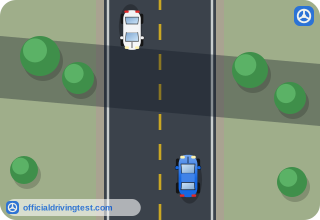
- They freeze first and dry out last
- They freeze last and dry out first
- They collect oil from passing traffic
- They hold more snow than other areas
Show answer
Correct answer: They freeze first and dry out last
The manual says shady spots can be icy on cold, wet days because they freeze first and dry out last.
Source: New Mexico Driver Manual (Version 11.19.19), page 20
-
Why can the pavement on a bridge be icy even when other pavement is not?
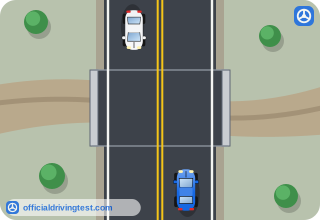
- Bridges are built of smoother materials that hold ice longer
- Bridges are higher so the wind freezes water much faster
- Bridges have no earth underneath to insulate them against the cold
- Bridges are shaded by the cables and supports above them all day long
Show answer
Correct answer: Bridges have no earth underneath to insulate them against the cold
The manual says bridges do not have earth underneath to insulate them against the cold, so they can be colder and icier than other roadways.
Source: New Mexico Driver Manual (Version 11.19.19), page 20
-
When is ice more slippery?
- When the temperature is well below the freezing point
- When the sun is shining directly on it
- When it is covered with fresh snow
- When the temperature is around the freezing point
Show answer
Correct answer: When the temperature is around the freezing point
The manual says that around the freezing point ice can become wet, which makes it more slippery than at temperatures well below freezing.
Source: New Mexico Driver Manual (Version 11.19.19), page 20
-
Why can pavement be very slippery for the first few minutes when it starts to rain on a hot day?
- Hot pavement turns the rain into ice
- Heat brings the oil in the asphalt to the surface
- The rain washes sand onto the road
- Hot tires lose their grip on the wet, hot pavement
Show answer
Correct answer: Heat brings the oil in the asphalt to the surface
The manual says heat causes the oil in the asphalt to come to the surface, so the road is more slippery until the oil is washed off.
Source: New Mexico Driver Manual (Version 11.19.19), page 20
-
When the road is wet, up to about what speed do most tires have good traction?
- About 20 mph
- About 25 mph
- About 35 mph
- About 45 mph
Show answer
Correct answer: About 35 mph
The manual says that when it is raining or the road is wet, most tires have good traction up to about 35 mph.
Source: New Mexico Driver Manual (Version 11.19.19), page 20
-
What is it called when your tires start to ride up on the water, like water skis?
- Hydroplaning
- Skidding
- Overdriving
- Fishtailing
Show answer
Correct answer: Hydroplaning
The manual calls it hydroplaning when tires ride up on the water like water skis.
Source: New Mexico Driver Manual (Version 11.19.19), page 20
-
In a heavy rain, at about what speed can your tires lose all traction with the road?
- About 50 mph
- About 30 mph
- About 40 mph
- About 65 mph
Show answer
Correct answer: About 50 mph
The manual says that in a heavy rain your tires can lose all traction with the road at about 50 mph.
Source: New Mexico Driver Manual (Version 11.19.19), page 20
-
If your tires have lost traction, what should you do with the gas pedal?
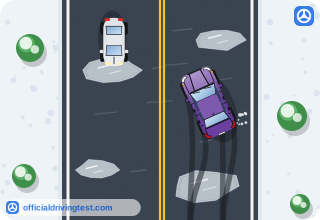
- Press it harder
- Tap it again and again
- Ease your foot off it
- Hold it steady
Show answer
Correct answer: Ease your foot off it
The manual says that if it feels like your tires have lost traction, you should ease your foot off the gas pedal.
Source: New Mexico Driver Manual (Version 11.19.19), page 21
-
If your tires have lost traction, how should you handle the steering wheel?
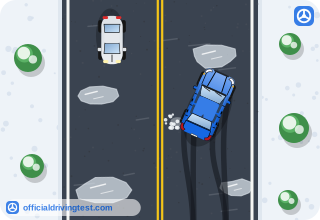
- Turn it sharply in the direction you want to go
- Keep it straight, and if you must turn, do it slowly
- Turn it back and forth to regain grip
- Hold it loosely and let the vehicle straighten itself
Show answer
Correct answer: Keep it straight, and if you must turn, do it slowly
The manual says to keep the steering wheel straight and only turn in an emergency; turning quickly will cause the vehicle to skid.
Source: New Mexico Driver Manual (Version 11.19.19), page 21
-
If your tires have lost traction, when should you try to stop or turn?
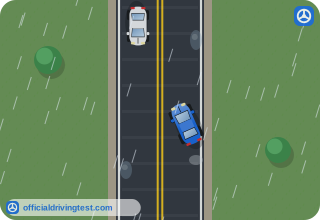
- As soon as you notice that the vehicle is skidding
- After you have sounded your horn and signaled
- Right after you have braked as hard as you can
- Not until your tires are gripping the road again
Show answer
Correct answer: Not until your tires are gripping the road again
The manual says not to try to stop or turn until your tires are gripping the road again.
Source: New Mexico Driver Manual (Version 11.19.19), page 21
-
How much time does speeding save, according to the manual?
- About fifteen minutes every hour
- About half an hour on a long trip
- Not more than a few minutes an hour
- Several hours on a long trip
Show answer
Correct answer: Not more than a few minutes an hour
The manual says that speeding does not save more than a few minutes an hour, and that going faster than traffic means passing others again and again.
Source: New Mexico Driver Manual (Version 11.19.19), page 21
-
What can going much slower than other vehicles do?
- Make vehicles bunch up behind you
- Help other traffic keep a steady pace
- Make passing safer for the vehicles behind you
- Give other drivers more room to merge
Show answer
Correct answer: Make vehicles bunch up behind you
The manual says going much slower than other vehicles can be just as bad as speeding, because it makes vehicles bunch up behind you and causes other traffic to pass you.
Source: New Mexico Driver Manual (Version 11.19.19), page 21
-
If vehicles are piled up behind you, what should you do?
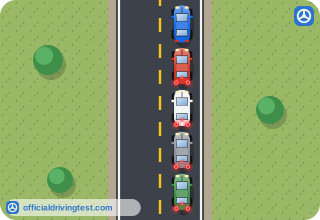
- Pull over when it is safe and let them pass
- Speed up until you can leave them behind
- Stay in your lane and slow down further
- Stop in the lane and wave them around you
Show answer
Correct answer: Pull over when it is safe and let them pass
The manual says to pull over when safe to do so and let them pass.
Source: New Mexico Driver Manual (Version 11.19.19), page 21
-
What should you do when you turn from a high speed, two-lane roadway with traffic following you?
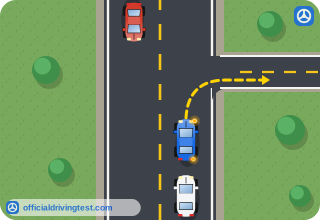
- Slow down gradually over a long distance before the turn
- Stop on the shoulder first and then make your turn
- Turn on your flashers and slow down to a crawl well ahead
- Tap your brakes and reduce your speed quickly but safely
Show answer
Correct answer: Tap your brakes and reduce your speed quickly but safely
The manual says to try not to slow down too early with traffic following you, and to tap your brakes and reduce your speed quickly but safely.
Source: New Mexico Driver Manual (Version 11.19.19), page 22
-
When should you watch for large trucks and small underpowered cars?
- On flat, straight highways in light traffic
- On steep grades or when they are entering traffic
- On straight roads at night when there are no hills
- On wet roads in the early morning only
Show answer
Correct answer: On steep grades or when they are entering traffic
The manual says these vehicles can lose speed on long or steep hills and take longer to get up to speed when they enter traffic.
Source: New Mexico Driver Manual (Version 11.19.19), page 22
-
Wherever people or traffic gather, what should you do?
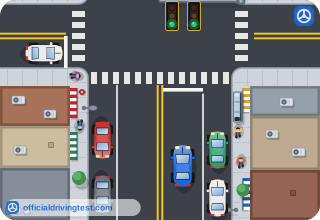
- Lower your speed to have time to react in a crowded space
- Keep your speed so you do not hold up the traffic behind you
- Move to the lane farthest from the curb
- Follow the vehicle ahead more closely
Show answer
Correct answer: Lower your speed to have time to react in a crowded space
The manual says that wherever people or traffic gather your room to maneuver is limited, so you need to lower your speed.
Source: New Mexico Driver Manual (Version 11.19.19), page 22
-
Why may you need to slow down at narrow bridges and tunnels?
- The pavement there is always icy
- Slow-moving vehicles always use them
- Vehicles approaching each other are closer together
- Crosswinds there always push vehicles off their course
Show answer
Correct answer: Vehicles approaching each other are closer together
The manual lists narrow bridges and tunnels as places to slow down because vehicles approaching each other are closer together.
Source: New Mexico Driver Manual (Version 11.19.19), page 22
-
Why may you need to slow down at toll plazas?
- Vehicles there always travel in a single lane
- Vehicles there are not allowed to use their brakes
- The lanes there are always much wider than normal
- Vehicles change lanes, stop and then speed up again
Show answer
Correct answer: Vehicles change lanes, stop and then speed up again
The manual says that at toll plazas vehicles are changing lanes and preparing to stop and then speeding up again, and the number of lanes could change.
Source: New Mexico Driver Manual (Version 11.19.19), page 22
-
With good tires and brakes and dry pavement, about how far can it take to react and stop at 30 mph?
- About 200 feet
- About 100 feet
- About 300 feet
- About 50 feet
Show answer
Correct answer: About 200 feet
The manual says that at 30 mph it can take about 200 feet to stop, which is almost half a city block.
Source: New Mexico Driver Manual (Version 11.19.19), page 22
-
At night, within what distance must you be able to stop?
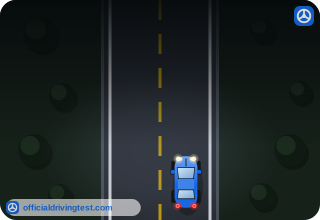
- The distance you can see ahead with your headlights
- The distance to the next intersection ahead of your car
- The distance to the vehicle ahead of you
- The distance to the next road sign you can read
Show answer
Correct answer: The distance you can see ahead with your headlights
The manual says you must be able to stop within the distance you can see ahead with your headlights.
Source: New Mexico Driver Manual (Version 11.19.19), page 22
-
In very heavy rain, snow or thick fog, when you cannot see farther than about 200 feet, what is the fastest you can safely drive?
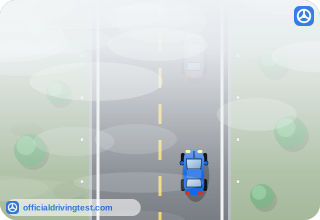
- 20 mph
- 40 mph
- 30 mph
- 45 mph
Show answer
Correct answer: 30 mph
The manual says that when you cannot see any farther than about 200 feet, you cannot safely drive faster than 30 mph.
Source: New Mexico Driver Manual (Version 11.19.19), page 23
-
Whenever you come to a hill or curve where you cannot see over or around, what should you do?
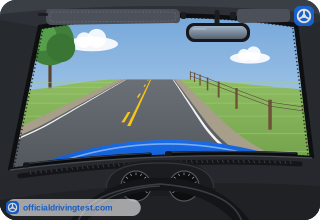
- Keep your speed so traffic behind you does not bunch up
- Speed up to clear the hill or curve quickly
- Move to the center of the road for a better view
- Adjust your speed so you can stop if necessary
Show answer
Correct answer: Adjust your speed so you can stop if necessary
The manual says a vehicle may be stalled just over a hill or around a curve, so you should adjust your speed so you can stop if necessary.
Source: New Mexico Driver Manual (Version 11.19.19), page 23
-
How much room should you give vehicles parked along the side of the road?
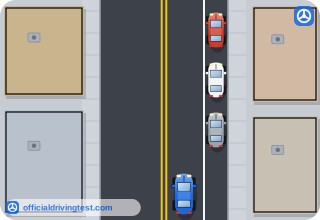
- Just enough to clear their mirrors
- Only enough to avoid touching them
- As much room as you can
- None, if no one is in them
Show answer
Correct answer: As much room as you can
The manual says parked vehicles may block your view and people may walk out from between them, so give them as much room as you can.
Source: New Mexico Driver Manual (Version 11.19.19), page 23
-
What do you do to use the “Four Second Sight Distance Rule”?
- Pick a stationary object far ahead and count four seconds
- Count the seconds between you and the moving vehicle ahead
- Count how long the vehicle behind you takes to reach a mark
- Count four seconds after you see the next road sign
Show answer
Correct answer: Pick a stationary object far ahead and count four seconds
The manual says to pick out a stationary object as far ahead as you can clearly see and start counting “one-one-thousand” up to “four-one-thousand.”
Source: New Mexico Driver Manual (Version 11.19.19), page 23
-
With the Four Second Sight Distance Rule, what does it mean if you reach the object before you finish counting?
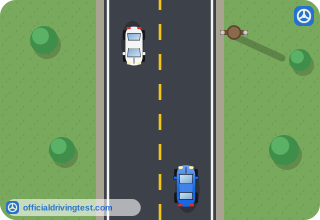
- You are following the vehicle ahead too closely and must drop back at once
- You may speed up because the road ahead is clear
- You may pass the vehicle ahead because you have enough room
- You are going too fast for your sight distance and need to slow down
Show answer
Correct answer: You are going too fast for your sight distance and need to slow down
The manual says that reaching the object before finishing “four-one-thousand” means you are going too fast for your sight distance and must slow down.
Source: New Mexico Driver Manual (Version 11.19.19), page 23
-
When should you also use the “Four Second Sight Distance Rule”?
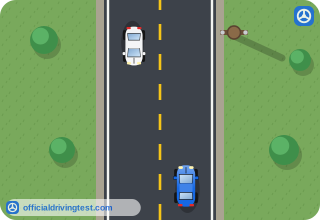
- Only in daylight on dry roads
- At night, to avoid overdriving your headlights
- Only when you are following another vehicle
- Only on roads with a speed limit above 50 mph
Show answer
Correct answer: At night, to avoid overdriving your headlights
The manual says to use the Four Second Sight Distance Rule at night too, to make sure you are not overdriving your headlights.
Source: New Mexico Driver Manual (Version 11.19.19), page 23
-
What causes rear-end crashes, according to the manual?
- Drivers speeding up when the vehicle ahead begins to slow down
- Following too closely to stop if the vehicle ahead stops
- Drivers changing lanes without checking mirrors
- Drivers braking too gently when the light turns red
Show answer
Correct answer: Following too closely to stop if the vehicle ahead stops
The manual says rear-end crashes are very common and are caused by drivers following too closely to stop before hitting the vehicle ahead when it suddenly stops.
Source: New Mexico Driver Manual (Version 11.19.19), page 23
-
What does the “three-second rule” help you tell?
- Whether you are driving too fast for your headlights
- How long to wait at a stop sign
- How far ahead to signal a turn
- Whether you are following too closely
Show answer
Correct answer: Whether you are following too closely
The manual calls the three-second rule an easy way to tell if you are following too closely.
Source: New Mexico Driver Manual (Version 11.19.19), page 23
-
At what speeds does the “three-second rule” work?
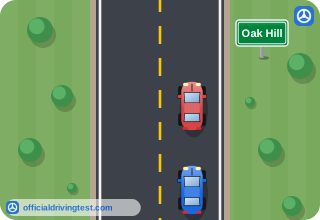
- At any speed
- Only above 40 mph
- Only below 35 mph
- Only on dry roads
Show answer
Correct answer: At any speed
The manual says the three-second rule works at any speed.
Source: New Mexico Driver Manual (Version 11.19.19), page 23
-
When using the three-second rule, how do you know you are following too closely?
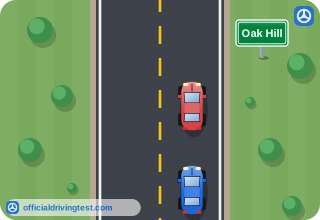
- You reach the mark after you finish counting
- The vehicle behind you passes the mark first
- You pass the mark before you finish counting
- You count to four before you reach the mark
Show answer
Correct answer: You pass the mark before you finish counting
The manual says you are following too closely if you pass the mark before you finish counting.
Source: New Mexico Driver Manual (Version 11.19.19), page 24
-
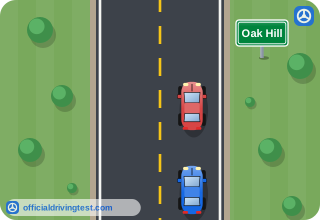
If the three-second rule shows you are following too closely, what should you do?
- Speed up and pass the vehicle ahead
- Stay where you are and watch the vehicle ahead
- Tap your brakes and flash your headlights
- Drop back and count again at another spot
Show answer
Correct answer: Drop back and count again at another spot
The manual says to drop back and count again at another spot, repeating until you are following no closer than three seconds.
Source: New Mexico Driver Manual (Version 11.19.19), page 24
-
In which situation may you need a four second following distance?
- When driving on a dry road with light traffic
- When you have a heavy load or are pulling a trailer
- When driving alone in daylight
- When driving at a steady speed on a clear day
Show answer
Correct answer: When you have a heavy load or are pulling a trailer
The manual lists a heavy load or pulling a trailer among the situations where you may need a four second following distance.
Source: New Mexico Driver Manual (Version 11.19.19), page 24
-
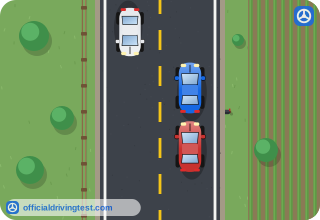
How can you help keep the driver behind you at a safe distance?
- Tap your brakes often so the driver stays alert
- Drive slightly faster than the traffic around you
- Keep a steady speed and signal before you slow or turn
- Move to the left lane whenever another driver follows you
Show answer
Correct answer: Keep a steady speed and signal before you slow or turn
The manual says you can help by keeping a steady speed and signaling in advance when you have to slow down or turn.
Source: New Mexico Driver Manual (Version 11.19.19), page 24
-
How should a motorcyclist's speed at night compare with the speed used during the day?
- The same as during the day, because the headlight shows the road
- Even slower than during the day, especially on unfamiliar roads
- Faster than during the day, to get through the dark sooner
- Slower only when the rider is following another vehicle
Show answer
Correct answer: Even slower than during the day, especially on unfamiliar roads
At night a rider should ride even slower than during the day, particularly on roads not known well, to improve the chance of avoiding a hazard.
Source: New Mexico Driver Manual (Version 11.19.19), page 38
-
What following distance should a motorcyclist open up at night?
- One second
- Five seconds
- Eight seconds
- Three seconds
Show answer
Correct answer: Three seconds
At night a motorcyclist should open up a three second following distance and allow more distance to pass and to be passed.
Source: New Mexico Driver Manual (Version 11.19.19), page 38
-
In a staggered formation, where does the second rider stay in relation to the leader?
- Two seconds behind, in the left side of the lane
- Three seconds behind, in the right side of the lane
- One second behind, in the left side of the lane
- One second behind, in the right side of the lane
Show answer
Correct answer: One second behind, in the right side of the lane
The leader rides in the left side of the lane, while the second rider stays one second behind in the right side of the lane.
Source: New Mexico Driver Manual (Version 11.19.19), page 38
-
In a staggered formation, where does the third rider ride?
- In the left position, two seconds behind the first rider
- In the right position, one second behind the second rider
- In the left position, one second behind the first rider
- In the right position, three seconds behind the first rider
Show answer
Correct answer: In the left position, two seconds behind the first rider
The third rider maintains the left position, two seconds behind the first rider.
Source: New Mexico Driver Manual (Version 11.19.19), page 38
-
In a staggered formation, how far behind the second rider does the fourth rider keep?
- One second
- Three seconds
- Two seconds
- Five seconds
Show answer
Correct answer: Two seconds
The fourth rider keeps a two second distance behind the second rider.
Source: New Mexico Driver Manual (Version 11.19.19), page 38