New Mexico: Signals and vehicle controls — Part 4 Practice Test
Questions in this part include: “After you have made a turn or lane change, what should you make sure of?” · “What do the integrated braking systems on some motorcycles do?”
Independent educational site · not affiliated with any government agency or DMV
Ready? Test yourself
- Instant feedback with an explanation
- Every answer cites its source in the manual
- Your best score is saved on this device
- Keyboard: press 1 to 4 to answer and Enter for the next question
Questions are original and based on the official manual "New Mexico Driver Manual" (Version 11.19.19), New Mexico Motor Vehicle Division (MVD).
All 18 questions in this practice test
Take the test above first, then use this list to study. Tap “Show answer” to see the correct answer and explanation.
Show the questions and answersHide the questions
-
If another vehicle is about to enter the street between you and where you plan to turn, what should you do?
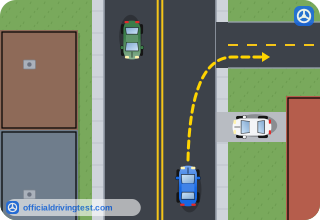
- Signal right away so the other driver knows your plan
- Flash your headlights, then signal after turning
- Slow down and signal as soon as it turns in
- Wait until you have passed it to signal your turn
Show answer
Correct answer: Wait until you have passed it to signal your turn
If you signal earlier, the other driver may think you plan to turn where they are and might pull into your path.
Source: New Mexico Driver Manual (Version 11.19.19), page 19
-
After you have made a turn or lane change, what should you make sure of?
- That your turn signal is off
- That your emergency flashers are on
- That your high beams are on
- That your horn is working
Show answer
Correct answer: That your turn signal is off
After small turns the signal may not turn off by itself, and if it stays on others might think you plan to turn again.
Source: New Mexico Driver Manual (Version 11.19.19), page 19
-
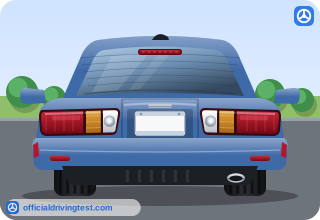
What do your brake lights tell other people?
- That you are about to turn
- That you are about to park
- That you are slowing down
- That you are speeding up
Show answer
Correct answer: That you are slowing down
The manual says your brake lights let people know that you are slowing down.
Source: New Mexico Driver Manual (Version 11.19.19), page 20
-
When should you slow down, according to the manual?
- Only at the last moment before stopping
- Only after the driver behind you honks
- Only after you have passed the hazard
- As early as it is safe to do so
Show answer
Correct answer: As early as it is safe to do so
The manual says to always slow down as early as it is safe to do so.
Source: New Mexico Driver Manual (Version 11.19.19), page 20
-
If you have time, what should you do before you slow down or stop suddenly?
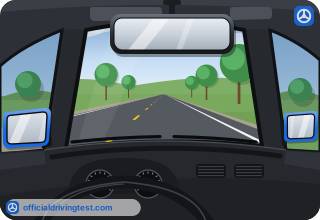
- Sound your horn
- Signal the driver behind you
- Move over into the left lane
- Turn on your high beams
Show answer
Correct answer: Signal the driver behind you
The manual says not to slow down or stop suddenly without signaling to the driver behind you, if you have time.
Source: New Mexico Driver Manual (Version 11.19.19), page 20
-
How should a motorcyclist use the front and rear brakes?
- Use only the rear brake for normal stops
- Use only the front brake for every stop
- Use both brakes at the same time
- Use the rear brake first, then add the front brake later
Show answer
Correct answer: Use both brakes at the same time
The motorcycle has two brakes and the manual says to use both of them at the same time.
Source: New Mexico Driver Manual (Version 11.19.19), page 35
-
Up to how much of a motorcycle's total stopping power can the front brake provide?
- One-quarter
- Three-quarters
- One-half
- All of it
Show answer
Correct answer: Three-quarters
The front brake is more powerful and can provide as much as three-quarters of the total stopping power.
Source: New Mexico Driver Manual (Version 11.19.19), page 35
-
Why should a motorcyclist not use only the rear brake for "normal" stops?
- The rear brake wears out much faster than the front brake does
- Using the rear brake alone for normal stops is against New Mexico law
- The rear brake cannot slow a motorcycle on dry pavement at all
- It will not build the habit of using the front brake in an emergency
Show answer
Correct answer: It will not build the habit of using the front brake in an emergency
Using only the rear brake for normal stops will not let the rider develop the habit or skill of using the front brake properly in an emergency.
Source: New Mexico Driver Manual (Version 11.19.19), page 35
-
What can happen if a rider grabs at the front brake or jams down on the rear brake?
- The brake can lock, resulting in control problems
- The motorcycle will stop in a shorter distance
- The brake lights will stay on after the brake is released
- The integrated braking system will shut off
Show answer
Correct answer: The brake can lock, resulting in control problems
Grabbing at the front brake or jamming down on the rear can cause the brake to lock, resulting in control problems.
Source: New Mexico Driver Manual (Version 11.19.19), page 35
-
Why should a rider use both brakes in a turn only very carefully?
- Brakes do not work at all while the motorcycle is leaning
- The front brake cannot be used until the motorcycle is upright
- Some traction is used for cornering, so less is available for stopping
- Both brakes lock together as soon as the rider leans
Show answer
Correct answer: Some traction is used for cornering, so less is available for stopping
When leaning the motorcycle, some of the traction is used for cornering, so less traction is available for stopping and a skid can occur.
Source: New Mexico Driver Manual (Version 11.19.19), page 35
-
What do the integrated braking systems on some motorcycles do?
- Apply the front brake only when the rider squeezes the lever
- Link the front and rear brakes together by applying the rear brake pedal
- Release both brakes automatically when a skid starts
- Keep the rider from using the rear brake pedal
Show answer
Correct answer: Link the front and rear brakes together by applying the rear brake pedal
Integrated braking systems link the front and rear brakes together by applying the rear brake pedal.
Source: New Mexico Driver Manual (Version 11.19.19), page 36
-
When should a motorcyclist use turn signals?
- Only when other vehicles are clearly visible close by
- Anytime a lane change is planned, even if no one seems near
- Only when the rider is riding on a freeway or highway
- Only when turning at an intersection or driveway
Show answer
Correct answer: Anytime a lane change is planned, even if no one seems near
Because a rider is more vulnerable, signals are even more important: use them anytime you plan to change lanes, even if you think no one is around.
Source: New Mexico Driver Manual (Version 11.19.19), page 37
-
Why should a motorcyclist make sure the signal is off once a turn is made?
- The signal drains the power the headlight needs to stay bright
- A signal left on after a turn is a violation of New Mexico law
- The signal can cause the front wheel to start to wobble at speed
- A driver may pull into the rider's path, thinking the rider will turn again
Show answer
Correct answer: A driver may pull into the rider's path, thinking the rider will turn again
If the signal stays on, a driver may pull directly into the rider's path, thinking the rider plans to turn again.
Source: New Mexico Driver Manual (Version 11.19.19), page 37
-
Why does signaling help a motorcyclist who enters a freeway?
- Drivers behind are more likely to see the signal and make room
- Drivers behind must stop whenever a motorcycle signals
- The signal lets the rider enter without checking the mirrors
- The signal makes the motorcycle seem faster than it is
Show answer
Correct answer: Drivers behind are more likely to see the signal and make room
When a rider enters a freeway, drivers approaching from behind are more likely to see the signal blinking and make room.
Source: New Mexico Driver Manual (Version 11.19.19), page 37
-
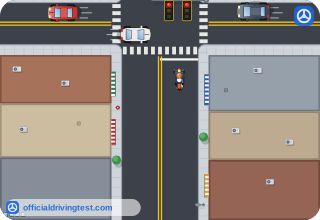
When a motorcyclist is stopped at an intersection, what should the rider watch in the mirrors?
- Cars waiting on the cross street
- Pedestrians behind the motorcycle
- Traffic signals behind the rider
- Cars coming up from behind
Show answer
Correct answer: Cars coming up from behind
The rider should watch cars coming up from behind, because an inattentive driver could be on top of the rider before seeing the motorcycle.
Source: New Mexico Driver Manual (Version 11.19.19), page 37
-
Why should a motorcyclist check the mirrors before slowing down?
- The driver behind may not expect the rider to slow
- The rider must signal to the driver ahead first
- A slowing motorcycle can lose its rear brake
- The mirrors show how far away the next turn is
Show answer
Correct answer: The driver behind may not expect the rider to slow
The driver behind may not expect the rider to slow, or may be unsure about where the rider will slow.
Source: New Mexico Driver Manual (Version 11.19.19), page 37
-
How do the rounded (convex) mirrors on most motorcycles affect what the rider sees?
- They give a narrower view behind and make cars seem closer than they are
- They show exactly the same view as flat mirrors do
- They give a wider view behind but make cars seem farther away than they really are
- They give a wider view behind and make cars seem closer than they are
Show answer
Correct answer: They give a wider view behind but make cars seem farther away than they really are
Convex mirrors provide a wider view of the road behind than flat mirrors do, but they make cars seem farther away than they really are.
Source: New Mexico Driver Manual (Version 11.19.19), page 37
-
When should a motorcyclist use the high beam at night?
- Whenever not following or meeting a car
- Only when passing another vehicle
- Only on roads inside a city
- Only when following a car closely
Show answer
Correct answer: Whenever not following or meeting a car
The manual says to use the high beam whenever you are not following or meeting a car, to get all the light you can.
Source: New Mexico Driver Manual (Version 11.19.19), page 38