New Mexico: Signals and vehicle controls — Part 3 Practice Test
Questions in this part include: “Within what distance should you use your low beams when following another vehicle or when in heavy traffic?” · “If there is danger, what does the manual say to do with your horn?”
Independent educational site · not affiliated with any government agency or DMV
Ready? Test yourself
- Instant feedback with an explanation
- Every answer cites its source in the manual
- Your best score is saved on this device
- Keyboard: press 1 to 4 to answer and Enter for the next question
Questions are original and based on the official manual "New Mexico Driver Manual" (Version 11.19.19), New Mexico Motor Vehicle Division (MVD).
All 18 questions in this practice test
Take the test above first, then use this list to study. Tap “Show answer” to see the correct answer and explanation.
Show the questions and answersHide the questions
-
Within what distance should you use your low beams when following another vehicle or when in heavy traffic?
- Within 50 feet
- Within 200 feet
- Within 100 feet
- Within 300 feet
Show answer
Correct answer: Within 200 feet
The manual says to use your low beams within 200 feet when following another vehicle or when in heavy traffic.
Source: New Mexico Driver Manual (Version 11.19.19), page 18
-
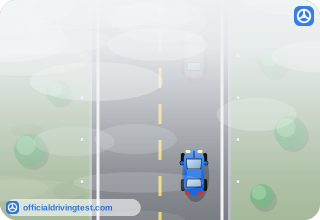
Which beams should you use in fog or when it is snowing or raining hard?
- High beams
- Parking lights only
- Flashing hazard lights
- Low beams
Show answer
Correct answer: Low beams
The manual says to use the low beams in fog or when it is snowing or raining hard.
Source: New Mexico Driver Manual (Version 11.19.19), page 18
-
Why should you not use high beams in fog or when it is snowing or raining hard?
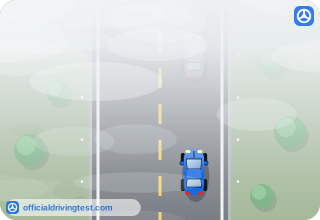
- Their light reflects back, causing glare and making it harder to see ahead
- Their light is too dim to be of much use when the weather is bad
- They make the other drivers think that you are going to turn soon
- They can freeze and stop working in snow or in very cold weather
Show answer
Correct answer: Their light reflects back, causing glare and making it harder to see ahead
The manual says light from high beams reflects back, causing glare and making it more difficult to see ahead.
Source: New Mexico Driver Manual (Version 11.19.19), page 18
-
If your vehicle has fog lights, when should you also use them?
- Whenever you drive at night on any road
- Whenever an oncoming vehicle is within one block
- In fog or when it is snowing or raining hard
- Only when you are parked at the roadside
Show answer
Correct answer: In fog or when it is snowing or raining hard
The manual says some vehicles have fog lights that you also should use in fog or when it is snowing or raining hard.
Source: New Mexico Driver Manual (Version 11.19.19), page 18
-
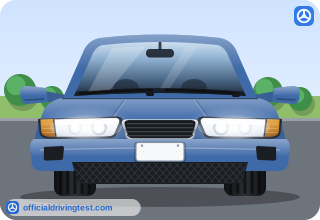
When is it acceptable to drive with only your parking lights on?
- At dusk
- At no time
- In light rain
- On a street with streetlights
Show answer
Correct answer: At no time
The manual says not to drive at any time with only your parking lights on, because parking lights are for parking only.
Source: New Mexico Driver Manual (Version 11.19.19), page 18
-
According to the manual, why do crashes often happen?
- A driver does not see another, or does something unexpected
- Drivers use their horns too often when they are in a hurry
- Drivers keep too much space between their vehicle and others
- Drivers check their mirrors too often while driving
Show answer
Correct answer: A driver does not see another, or does something unexpected
The manual says crashes often happen because one driver does not see another driver, or when one driver does something the other does not expect.
Source: New Mexico Driver Manual (Version 11.19.19), page 18
-
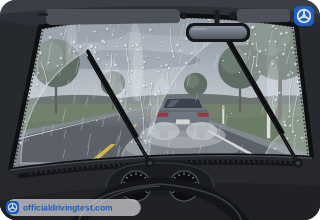
What should you do whenever you turn on your windshield wipers?
- Turn on your parking lights only
- Turn on your high beams
- Turn on your headlights
- Turn on your emergency flashers
Show answer
Correct answer: Turn on your headlights
The manual says that if you turn on your wipers, you should turn on your headlights, because they make your vehicle easier to see in rain, snow or fog.
Source: New Mexico Driver Manual (Version 11.19.19), page 18
-
When does the manual say you should turn on your headlights as evening comes?
- Only after it is completely dark
- When it begins to get dark
- Only when you can no longer see the road ahead
- Only when another driver flashes their lights at you
Show answer
Correct answer: When it begins to get dark
The manual says to turn on your headlights when it begins to get dark, and that turning them on a little early helps other drivers see you.
Source: New Mexico Driver Manual (Version 11.19.19), page 18
-
What should you do when driving away from a rising or setting sun?
- Keep your headlights off because the sun gives light
- Turn on your parking lights so drivers behind see you
- Turn on your headlights so oncoming drivers can see you
- Flash your brake lights to warn the drivers who are behind you
Show answer
Correct answer: Turn on your headlights so oncoming drivers can see you
Drivers coming toward you may have trouble seeing your vehicle in that light, and your headlights help them see you.
Source: New Mexico Driver Manual (Version 11.19.19), page 18
-
If needed, how can you use your lights to alert other road users that you are there?
- Flick your headlights
- Leave your parking lights on
- Turn on your interior dome light
- Keep your high beams on at all times
Show answer
Correct answer: Flick your headlights
The manual says that, if needed, you can flick your headlights to alert other road users you are there.
Source: New Mexico Driver Manual (Version 11.19.19), page 18
-
If there is no immediate danger, how should you use your horn?
- Hold it down until the other driver reacts
- Sound a sharp blast
- Do not use it at all
- Give it a light tap
Show answer
Correct answer: Give it a light tap
The manual says that when there is no immediate danger, a light tap on the horn should be all you need.
Source: New Mexico Driver Manual (Version 11.19.19), page 18
-
If there is danger, what does the manual say to do with your horn?
- Give it a light tap
- Sound a sharp blast
- Flash your headlights instead
- Avoid using it
Show answer
Correct answer: Sound a sharp blast
The manual says that if there is danger, you should not be afraid to sound a sharp blast on your horn.
Source: New Mexico Driver Manual (Version 11.19.19), page 18
-
In which situation should you give your horn a light tap?
- When you are waiting behind a car at a red light
- When a driver starts to turn into your lane as you pass
- When another driver is following you at a safe distance
- When you see a vehicle parked at the curb ahead
Show answer
Correct answer: When a driver starts to turn into your lane as you pass
The manual lists passing a driver who starts to turn into your lane as a time for a light tap on the horn.
Source: New Mexico Driver Manual (Version 11.19.19), page 18
-
In which situation does the manual say to sound a sharp blast on your horn?
- A driver ahead is traveling slower than you
- A bicyclist is riding at the edge of the road
- You are waiting at a red light
- A child is about to run into the street
Show answer
Correct answer: A child is about to run into the street
The manual lists a child or older person about to walk, run or ride into the street as a time to sound a sharp blast.
Source: New Mexico Driver Manual (Version 11.19.19), page 19
-
What do other drivers generally expect you to do?
- Keep doing what you are doing
- Slow down at every intersection
- Move over for faster traffic
- Signal before every stop
Show answer
Correct answer: Keep doing what you are doing
The manual says other drivers generally expect you to keep doing what you are doing, so you must warn them when you change direction or slow down.
Source: New Mexico Driver Manual (Version 11.19.19), page 19
-
According to the manual, when should you use your turn signals?
- Only before turning right or left at intersections
- Only when you see another vehicle nearby
- Only when changing lanes on a freeway
- Before you change lanes, turn, merge or park
Show answer
Correct answer: Before you change lanes, turn, merge or park
The manual says to use your turn signals before you change lanes, turn right or left, merge into traffic or park.
Source: New Mexico Driver Manual (Version 11.19.19), page 19
-
What does the manual say about signaling when you do not see anyone else around?
- Signaling is not needed on empty roads or highways
- Signal anyway; it is easy to miss someone
- Signal only after dark
- Signal only before left turns
Show answer
Correct answer: Signal anyway; it is easy to miss someone
The manual says to get into the habit of signaling every time you change direction, even when you see no one else around.
Source: New Mexico Driver Manual (Version 11.19.19), page 19
-
At least how far before your turn should you signal?
- 25 feet
- 100 feet
- 50 feet
- 300 feet
Show answer
Correct answer: 100 feet
The manual says to signal at least 100 feet before you make your turn.
Source: New Mexico Driver Manual (Version 11.19.19), page 19