New Mexico: Right-of-way and turning — Part 4 Practice Test
Questions in this part include: “Where is the greatest potential for conflict between a motorcyclist and other traffic?” · “What can a motorcyclist do to increase the chance of being seen at intersections?”
Independent educational site · not affiliated with any government agency or DMV
Ready? Test yourself
- Instant feedback with an explanation
- Every answer cites its source in the manual
- Your best score is saved on this device
- Keyboard: press 1 to 4 to answer and Enter for the next question
Questions are original and based on the official manual "New Mexico Driver Manual" (Version 11.19.19), New Mexico Motor Vehicle Division (MVD).
All 18 questions in this practice test
Take the test above first, then use this list to study. Tap “Show answer” to see the correct answer and explanation.
Show the questions and answersHide the questions
-
As a general rule, how many vehicles should you pass at one time?
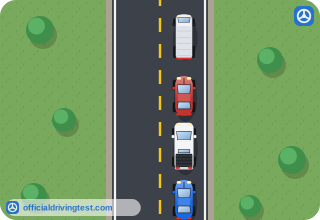
- Two vehicles
- Three vehicles
- As many as space allows
- Only one vehicle
Show answer
Correct answer: Only one vehicle
The manual says not to count on having enough time to pass several vehicles at once, and as a general rule to pass only one vehicle at a time.
Source: New Mexico Driver Manual (Version 11.19.19), page 24
-
At a speed of 55 mph, about how long do you need to pass?
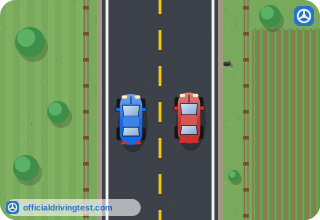
- About 10 seconds
- About 4 seconds
- About 6 seconds
- About 20 seconds
Show answer
Correct answer: About 10 seconds
The manual says that at 55 mph you need about 10 seconds to pass, so you need a 10 second gap in oncoming traffic and sight-distance.
Source: New Mexico Driver Manual (Version 11.19.19), page 25
-
What should you assume when your view is blocked by a curve or a hill?
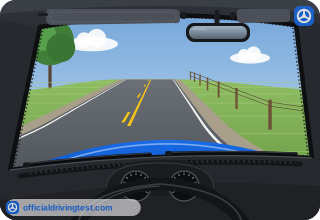
- That the road beyond is clear
- That drivers beyond it will be able to see you first
- That there is an oncoming vehicle just out of sight
- That the road beyond is a no-passing zone
Show answer
Correct answer: That there is an oncoming vehicle just out of sight
The manual says that when your view is blocked by a curve or a hill you should assume there is an oncoming vehicle just out of sight.
Source: New Mexico Driver Manual (Version 11.19.19), page 25
-
You should not start to pass if you are within what distance of a hill or curve?
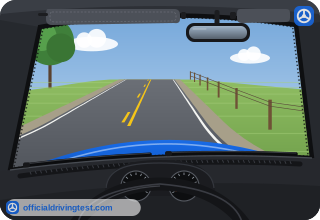
- One-tenth of a mile
- Half a mile
- 500 feet
- One-third of a mile
Show answer
Correct answer: One-third of a mile
The manual says you have to be able to see at least one-third of a mile ahead, so you should not start to pass if you are within one-third of a mile of a hill or curve.
Source: New Mexico Driver Manual (Version 11.19.19), page 25
-
Where does the manual say it is dangerous to pass?
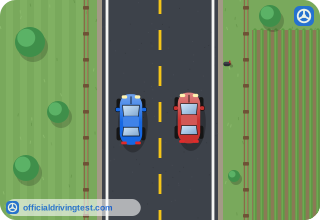
- On a straight road with no side streets or driveways
- Where a vehicle is likely to enter or cross the road
- On a road with a wide paved shoulder
- In a lane with no vehicles ahead
Show answer
Correct answer: Where a vehicle is likely to enter or cross the road
The manual says it is dangerous to pass where a vehicle is likely to enter or cross the road, such as intersections, railroad crossings and shopping center entrances.
Source: New Mexico Driver Manual (Version 11.19.19), page 25
-
Why is it dangerous to pass near an intersection when drivers may turn right into the approaching lane?
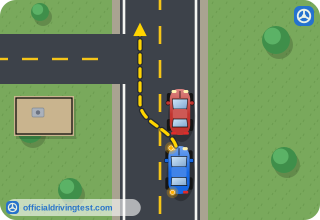
- They always stop and wait for passing vehicles
- They are required to signal a full mile before they begin to turn
- They will not expect to find you approaching in their lane
- They can see your vehicle in their mirrors
Show answer
Correct answer: They will not expect to find you approaching in their lane
The manual says drivers turning right into the approaching lane will not expect to find you in their lane and may not even look your way.
Source: New Mexico Driver Manual (Version 11.19.19), page 25
-
Which of these may cause you to lose your space, making it unsafe to pass?
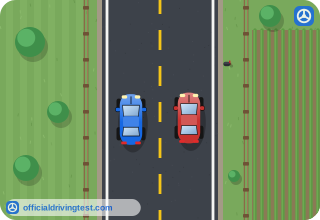
- A patch of ice, a pothole or something on the road
- A clear lane ahead of the vehicle you are passing
- A road with a wide paved shoulder
- A passing lane that is free of traffic
Show answer
Correct answer: A patch of ice, a pothole or something on the road
The manual lists a patch of ice, a pothole or something on the road among the lane restrictions that may make it unsafe to pass.
Source: New Mexico Driver Manual (Version 11.19.19), page 25
-
Before you pass, what must you be sure you have?
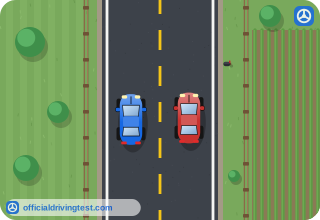
- Enough space to return to the driving lane
- A faster vehicle following right behind you
- A signal from the driver of the vehicle ahead
- A clear view of the next town on the road
Show answer
Correct answer: Enough space to return to the driving lane
The manual says not to pass unless you have enough space to return to the driving lane, and not to count on other drivers to make room for you.
Source: New Mexico Driver Manual (Version 11.19.19), page 25
-
After passing, when is it safe to return to the driving lane?
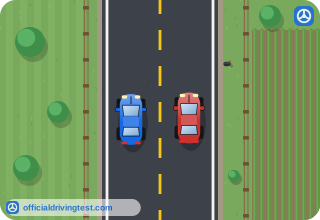
- As soon as the passed vehicle is even with your rear door
- When you can see both headlights of the passed vehicle in your mirror
- Once you have driven about one full car length past the vehicle you passed
- When the passed driver flashes lights to let you back in
Show answer
Correct answer: When you can see both headlights of the passed vehicle in your mirror
The manual says that when you can see both headlights of the vehicle you just passed in your rear-view mirror, it is safe to return to the driving lane.
Source: New Mexico Driver Manual (Version 11.19.19), page 25
-
Where is the greatest potential for conflict between a motorcyclist and other traffic?
- On freeways
- At intersections
- On long straight roads
- On mountain curves
Show answer
Correct answer: At intersections
The manual says the greatest potential for conflict between a rider and other traffic is at intersections.
Source: New Mexico Driver Manual (Version 11.19.19), page 38
-
Which is one of the two biggest dangers to a motorcyclist at an intersection?
- Cars stopped at a red light behind the rider
- Pedestrians waiting at the corner
- Bicyclists riding in the crosswalk
- Oncoming cars that turn left in front of the rider
Show answer
Correct answer: Oncoming cars that turn left in front of the rider
Oncoming cars that turn left in front of you, and cars on side streets that pull into your lane, are the two biggest dangers.
Source: New Mexico Driver Manual (Version 11.19.19), page 39
-
How should a motorcyclist treat "eye contact" with a driver at an intersection?
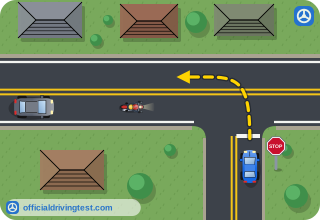
- Never count on it as a sign that the driver will yield
- As a sure sign that the driver will yield to the rider
- As proof that the driver will stay stopped for the rider
- As a signal that the rider can safely speed up and go
Show answer
Correct answer: Never count on it as a sign that the driver will yield
A driver may look right at a motorcyclist and still fail to see the rider, so never count on eye contact as a sign the driver will yield.
Source: New Mexico Driver Manual (Version 11.19.19), page 39
-
What can a motorcyclist do to increase the chance of being seen at intersections?
- Ride with the headlight off so it does not distract oncoming drivers
- Ride on the lane line so that both lanes of cars can see the rider
- Keep the headlight on and choose the lane position with the best view
- Ride in the portion of the lane farthest from oncoming traffic
Show answer
Correct answer: Keep the headlight on and choose the lane position with the best view
To be seen at intersections, ride with your headlight on in a lane position that provides the best view of oncoming traffic.
Source: New Mexico Driver Manual (Version 11.19.19), page 39
-
As a motorcyclist approaches an intersection, what should be covered to reduce reaction time?
- The horn and the headlight
- The clutch and both brakes
- The throttle and the mirrors
- The signal switch and the horn
Show answer
Correct answer: The clutch and both brakes
Cover the clutch and both brakes to reduce reaction time as you approach the intersection.
Source: New Mexico Driver Manual (Version 11.19.19), page 39
-
After entering an intersection, what should a motorcyclist do about oncoming vehicles preparing to turn?
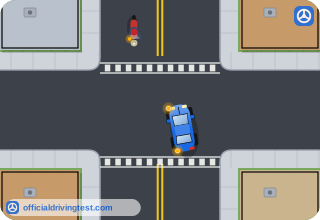
- Move toward them to be seen
- Stop in front of them
- Speed up and sound the horn
- Move away from them
Show answer
Correct answer: Move away from them
After entering the intersection, the rider should move away from oncoming vehicles preparing to turn.
Source: New Mexico Driver Manual (Version 11.19.19), page 39
-
Why should a motorcyclist not change speed or position radically in an intersection?
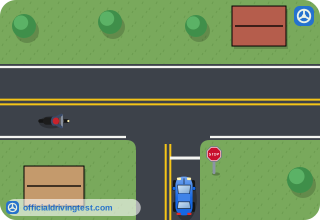
- The driver might think the rider is preparing to turn
- Tires lose traction on the painted lines and crosswalks
- Other riders behind the motorcycle may run into it
- The horn may not be heard over the sound of the engine
Show answer
Correct answer: The driver might think the rider is preparing to turn
Radical changes in speed or position may make a driver think the rider is preparing to turn.
Source: New Mexico Driver Manual (Version 11.19.19), page 39
-
At a blind intersection where there is a stop sign or stoplight, what should a motorcyclist do?
- Stop with the front wheel in the cross lane so that traffic can be seen
- Slow down and roll through to get a view of the cross street
- Stop there first, then edge forward and stop again short of the cross lane
- Sound the horn once and enter the intersection at low speed
Show answer
Correct answer: Stop there first, then edge forward and stop again short of the cross lane
The rider stops at the sign or light first, then edges forward and stops again just short of where the cross-traffic lane meets the rider's lane.
Source: New Mexico Driver Manual (Version 11.19.19), page 39
-
While leaning forward to look around buildings, parked cars or bushes at a blind intersection, what must stay out of the cross lane of travel?
- The rear wheel
- The front wheel
- The rider's left foot
- The side mirror
Show answer
Correct answer: The front wheel
The rider must make sure the front wheel stays out of the cross lane of travel while looking.
Source: New Mexico Driver Manual (Version 11.19.19), page 39