New Mexico: Right-of-way and turning — Part 2 Practice Test
Questions in this part include: “What does the law say about the right-of-way?” · “What must the State do if it turns a public road into a one-way road?”
Independent educational site · not affiliated with any government agency or DMV
Ready? Test yourself
- Instant feedback with an explanation
- Every answer cites its source in the manual
- Your best score is saved on this device
- Keyboard: press 1 to 4 to answer and Enter for the next question
Questions are original and based on the official manual "New Mexico Driver Manual" (Version 11.19.19), New Mexico Motor Vehicle Division (MVD).
All 18 questions in this practice test
Take the test above first, then use this list to study. Tap “Show answer” to see the correct answer and explanation.
Show the questions and answersHide the questions
-
If signs or lane markings allow two or more turning lanes, what should you do during the turn?
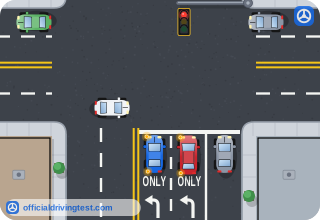
- Move into the left-most turning lane
- Move to the outside lane
- Change to the lane with fewer cars
- Stay in your lane
Show answer
Correct answer: Stay in your lane
Where signs or lane markings allow two or more turning lanes, you should stay in your lane during the turn.
Source: New Mexico Driver Manual (Version 11.19.19), page 11
-
What does the law say about the right-of-way?
- It says who must yield; it does not give anyone the right-of-way
- It gives the right-of-way to whichever driver is traveling faster
- It gives the right-of-way to the driver in the larger vehicle
- It gives the right-of-way to the driver who is turning right
Show answer
Correct answer: It says who must yield; it does not give anyone the right-of-way
The law says who must yield the right-of-way but does not give anyone the right-of-way.
Source: New Mexico Driver Manual (Version 11.19.19), page 11
-
Regardless of the circumstances, what must you do?
- Hold your speed and position whenever you have the right-of-way
- Sound your horn and continue when a pedestrian is in your path
- Do everything you can to avoid striking a pedestrian or another vehicle
- Stop only if the other driver has already come to a stop
Show answer
Correct answer: Do everything you can to avoid striking a pedestrian or another vehicle
You must do everything you can to prevent striking a pedestrian or another vehicle, regardless of the circumstances.
Source: New Mexico Driver Manual (Version 11.19.19), page 11
-
Whom must a driver turning left yield to?
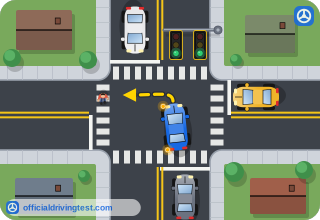
- Vehicles stopped behind the driver
- Only pedestrians in the crosswalk
- No one, because a turning driver goes first
- Oncoming vehicles going straight ahead
Show answer
Correct answer: Oncoming vehicles going straight ahead
Drivers turning left must yield to oncoming vehicles going straight ahead.
Source: New Mexico Driver Manual (Version 11.19.19), page 11
-
When entering a traffic circle or rotary, who must you yield to?
- Drivers entering the circle behind you
- Drivers already in the circle
- Only drivers who signal an exit
- No one, since you are entering the circle
Show answer
Correct answer: Drivers already in the circle
Drivers entering a traffic circle or rotary must yield to drivers already in the circle.
Source: New Mexico Driver Manual (Version 11.19.19), page 11
-
At an intersection with no stop sign, yield sign or traffic signal, who must you yield to?
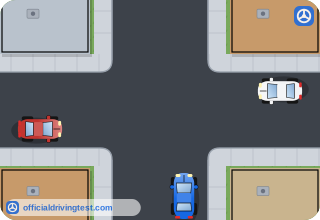
- Vehicles coming from the left
- Vehicles coming from behind
- Vehicles coming from the right
- Only the largest vehicle
Show answer
Correct answer: Vehicles coming from the right
At an intersection with no stop sign, yield sign or traffic signal, drivers must yield to vehicles coming from the right.
Source: New Mexico Driver Manual (Version 11.19.19), page 11
-
At a 4-way stop, who goes first?
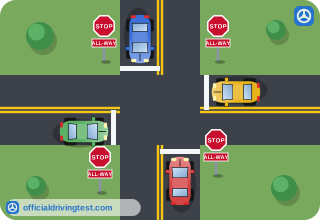
- The driver who arrives first, after stopping completely
- The driver in the largest vehicle at the intersection
- The driver who is traveling at the highest speed
- The driver who is on the main road through the area
Show answer
Correct answer: The driver who arrives first, after stopping completely
At a 4-way stop, the driver reaching the intersection first goes first, after coming to a complete stop.
Source: New Mexico Driver Manual (Version 11.19.19), page 11
-
If more than one vehicle arrives at a 4-way stop at the same time, which vehicle goes first?
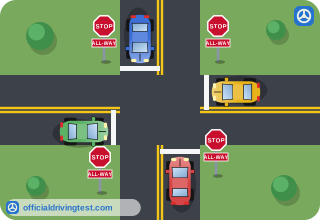
- The vehicle on the right
- The vehicle on the left
- The vehicle that signaled first
- The largest vehicle
Show answer
Correct answer: The vehicle on the right
If more than one vehicle arrives at a 4-way stop at the same time, the vehicle on the right goes first.
Source: New Mexico Driver Manual (Version 11.19.19), page 11
-
Whom must a driver entering a road from a driveway, alley or roadside yield to?
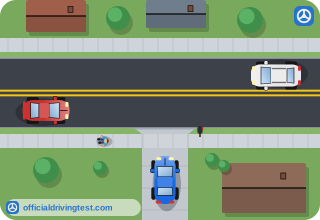
- Only vehicles coming from the right
- Vehicles already on the main road
- Only vehicles that are turning left
- No one, if the driver signals first
Show answer
Correct answer: Vehicles already on the main road
Drivers entering a road from a driveway, alley or roadside must yield to vehicles already on the main road.
Source: New Mexico Driver Manual (Version 11.19.19), page 11
-
What should you do before entering an intersection when traffic ahead is backed up?
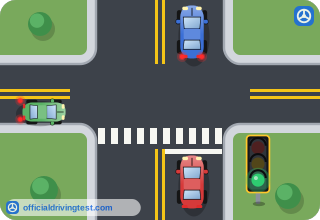
- Move into the intersection and stop behind the car ahead of you
- Enter the intersection and stop in the middle until traffic moves
- Wait until traffic ahead clears so you do not block the intersection
- Enter if your signal is green, whatever traffic is ahead
Show answer
Correct answer: Wait until traffic ahead clears so you do not block the intersection
You should wait until traffic ahead clears so that you are not blocking the intersection.
Source: New Mexico Driver Manual (Version 11.19.19), page 11
-
A driver is overtaking a vehicle traveling in the same direction, and that vehicle is slowing or coming to a stop. What must the overtaking driver do?
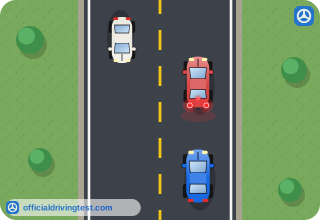
- Pass it on the right
- Sound the horn and pass quickly
- Assume it will yield
- Yield to that vehicle
Show answer
Correct answer: Yield to that vehicle
Drivers overtaking a vehicle traveling in the same direction must yield to that vehicle, even if it is slowing or coming to a stop.
Source: New Mexico Driver Manual (Version 11.19.19), page 12
-
On a road that has been made one-way, in which direction may you drive?
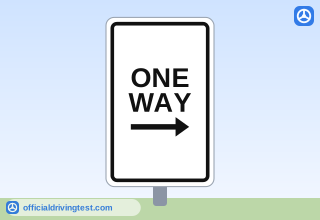
- Only in the direction the sign tells you to drive
- In either direction if no other vehicles are in sight
- In either direction when you are passing
- In either direction on the left side only
Show answer
Correct answer: Only in the direction the sign tells you to drive
You may only drive on a one-way road in the direction the sign tells you to drive.
Source: New Mexico Driver Manual (Version 11.19.19), page 12
-
What must the State do if it turns a public road into a one-way road?
- Mail a notice to every driver in the area
- Post signs that tell drivers it is one-way
- Paint the curbs along the road yellow
- Close the road for a trial period first
Show answer
Correct answer: Post signs that tell drivers it is one-way
If the State turns a public road into a one-way road, it must post signs that tell drivers it is one-way.
Source: New Mexico Driver Manual (Version 11.19.19), page 12
-
When you drive around a traffic circle, which side of the island must you drive on?
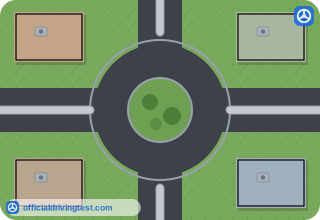
- The left side
- Either side
- The right side
- The side with the least traffic
Show answer
Correct answer: The right side
When you drive around a traffic circle you must drive on the right side of the island.
Source: New Mexico Driver Manual (Version 11.19.19), page 12
-
Where is looking to the sides especially important, because other vehicles or pedestrians may cross or enter your path?
- At intersections and railroad crossings
- On long, empty stretches of highway
- On roads with no side streets
- In your own driveway when parked
Show answer
Correct answer: At intersections and railroad crossings
The manual says you should look to the sides to make sure no one is coming, especially at intersections and railroad crossings.
Source: New Mexico Driver Manual (Version 11.19.19), page 15
-
How does the manual define intersections?
- Only places where two named streets cross
- Only places that have a traffic signal or a stop sign
- Any place where traffic merges or crosses
- Only places where a crosswalk is painted
Show answer
Correct answer: Any place where traffic merges or crosses
The manual says intersections are any place where traffic merges or crosses, including cross streets, side streets, driveways and shopping center or parking lot entrances.
Source: New Mexico Driver Manual (Version 11.19.19), page 16
-
Before you enter an intersection, in which direction should you look for approaching vehicles and crossing pedestrians?
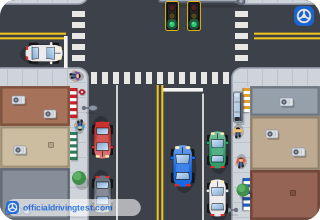
- Only to the left of your vehicle
- To both the left and right
- Only to the right of your vehicle
- Only straight ahead of your vehicle
Show answer
Correct answer: To both the left and right
The manual says to look to both the left and right for approaching vehicles and/or crossing pedestrians before you enter an intersection.
Source: New Mexico Driver Manual (Version 11.19.19), page 16
-
If you are stopped at an intersection, when should you look to both the left and right?
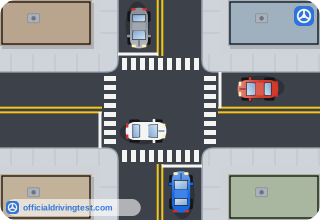
- Only once, when you first stop
- Only after you have started across
- Not at all, if you have a green light
- Just before you start moving
Show answer
Correct answer: Just before you start moving
The manual says that if stopped, you should look to both the left and right just before you start moving.
Source: New Mexico Driver Manual (Version 11.19.19), page 16