New Mexico: Emergencies and crashes — Part 2 Practice Test
Questions in this part include: “When should you pull off the road after your headlights fail?” · “When may it be best or necessary to speed up to avoid a collision?”
Independent educational site · not affiliated with any government agency or DMV
Ready? Test yourself
- Instant feedback with an explanation
- Every answer cites its source in the manual
- Your best score is saved on this device
- Keyboard: press 1 to 4 to answer and Enter for the next question
Questions are original and based on the official manual "New Mexico Driver Manual" (Version 11.19.19), New Mexico Motor Vehicle Division (MVD).
All 18 questions in this practice test
Take the test above first, then use this list to study. Tap “Show answer” to see the correct answer and explanation.
Show the questions and answersHide the questions
-
If your headlights go out and the switch does not help, what does the manual say to put on?
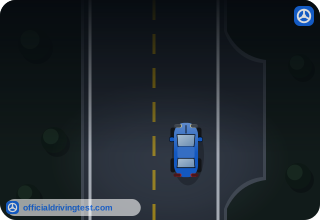
- Emergency flashers, turn signals or fog lights
- The dome light and the interior radio lights
- Only the parking brake, pulled all the way
- The horn, sounded continuously until you stop
Show answer
Correct answer: Emergency flashers, turn signals or fog lights
If trying the switch does not work, put on the emergency flashers, turn signals or fog lights if you have them, and pull off the road as soon as possible.
Source: New Mexico Driver Manual (Version 11.19.19), page 31
-
When should you pull off the road after your headlights fail?
- Only when you reach a gas station
- Only after the sun comes up
- As soon as possible
- Not until you reach your destination
Show answer
Correct answer: As soon as possible
After a headlight failure you should pull off the road as soon as possible.
Source: New Mexico Driver Manual (Version 11.19.19), page 31
-
If the gas pedal sticks and the motor keeps going faster and faster, what should you quickly do?
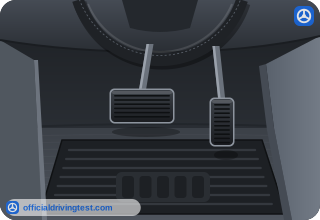
- Shift into park
- Shift to neutral
- Shift into reverse
- Pull the parking brake all the way
Show answer
Correct answer: Shift to neutral
With a stuck gas pedal, keep your eyes on the road and quickly shift to neutral.
Source: New Mexico Driver Manual (Version 11.19.19), page 31
-
After you shift to neutral because the gas pedal is stuck, what should you do?
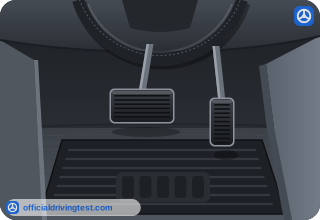
- Keep driving in neutral to a repair shop
- Shift back into drive and brake gently
- Stop in your lane and leave the engine running
- Pull off the road when safe and turn off the engine
Show answer
Correct answer: Pull off the road when safe and turn off the engine
After shifting to neutral, pull off the road when safe to do so and turn off the engine.
Source: New Mexico Driver Manual (Version 11.19.19), page 32
-
In avoiding a collision, what three options do drivers have?
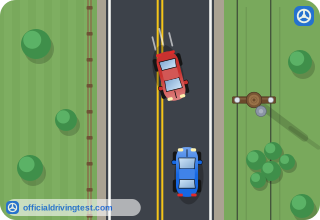
- Stop, back up or honk
- Turn, honk or flash the lights
- Slow down, stop or reverse
- Stop, turn or speed up
Show answer
Correct answer: Stop, turn or speed up
The manual says that in avoiding a collision, drivers have three options: stop, turn or speed up.
Source: New Mexico Driver Manual (Version 11.19.19), page 32
-
With an antilock braking system (ABS), what should you do if you need to stop quickly?
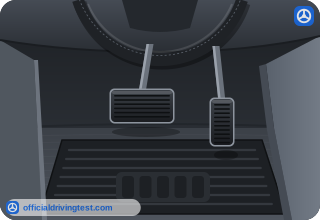
- Pump the brake pedal repeatedly
- Press on the brake pedal as hard as you can and keep pressing on it
- Press the brake lightly and then let up
- Press the brake and let up as soon as you feel it push back
Show answer
Correct answer: Press on the brake pedal as hard as you can and keep pressing on it
With ABS, press on the brake pedal as hard as you can and keep pressing on it.
Source: New Mexico Driver Manual (Version 11.19.19), page 32
-
If you feel the brake pedal pushing back while the ABS is working, what should you do?
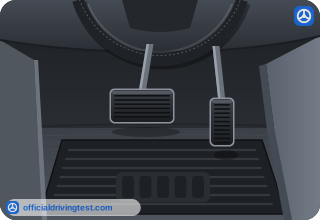
- Let up and press again
- Ease off the pedal until it stops pushing back
- Do not let up on the brake pedal
- Pump the pedal several times
Show answer
Correct answer: Do not let up on the brake pedal
The ABS system will only work with the brake pedal pushed down, so do not let up on the pedal when you feel it pushing back.
Source: New Mexico Driver Manual (Version 11.19.19), page 32
-
How hard should you brake to stop quickly in a vehicle without an antilock braking system?
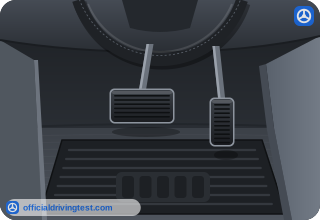
- As hard as you can without locking the brakes
- As hard as you can, locking the wheels on purpose
- Lightly, never more than halfway down
- Only with the parking brake
Show answer
Correct answer: As hard as you can without locking the brakes
Without ABS, apply the brakes as hard as you can without locking them.
Source: New Mexico Driver Manual (Version 11.19.19), page 32
-
Without ABS, what should you do when the brakes lock up and the vehicle starts to skid?
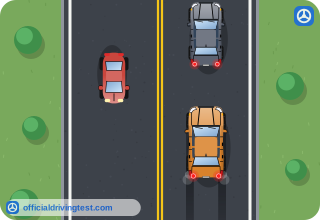
- Keep the brake pedal pushed down as hard as you can
- Let up on the pedal, then push down after the skid stops
- Shift to neutral and pull the parking brake all the way
- Turn the steering wheel sharply in both directions
Show answer
Correct answer: Let up on the pedal, then push down after the skid stops
If the brakes lock up, quickly let up on the pedal; as soon as the vehicle stops skidding, push down again and keep doing this until it has stopped.
Source: New Mexico Driver Manual (Version 11.19.19), page 32
-
In most cases, which can you do quicker?
- Stop the vehicle than turn it
- Stop and turn in about the same time
- Back up than turn
- Turn the vehicle than stop it
Show answer
Correct answer: Turn the vehicle than stop it
In most cases, you can turn the vehicle quicker than you can stop it, so you should consider turning to avoid a collision.
Source: New Mexico Driver Manual (Version 11.19.19), page 32
-
What can you do with ABS that you cannot safely do without it?
- Turn your vehicle while braking without skidding
- Stop without using the brake pedal
- Drive through a curve at any speed without a skid
- Turn the steering wheel sharply and plow ahead
Show answer
Correct answer: Turn your vehicle while braking without skidding
One aspect of having ABS is that you can turn your vehicle while braking without skidding.
Source: New Mexico Driver Manual (Version 11.19.19), page 32
-
Without ABS, how do you turn quickly to avoid a collision?
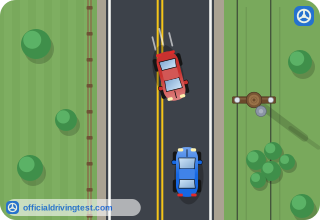
- Turn the steering wheel first, then brake hard
- Brake hard while turning the steering wheel
- Brake, then let up and turn the steering wheel
- Lock the front wheels, then turn sharply
Show answer
Correct answer: Brake, then let up and turn the steering wheel
Without ABS you should step on the brake pedal, then let up and turn the steering wheel.
Source: New Mexico Driver Manual (Version 11.19.19), page 32
-
Without ABS, why does braking before a quick turn help?
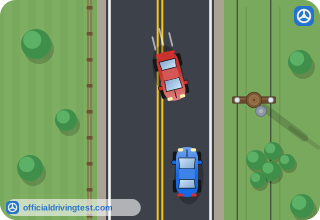
- It puts more weight on the rear tires for a better grip
- It locks the front wheels so the vehicle can pivot
- It puts more weight on the front tires for a quicker turn
- It turns off the skid control system while you turn
Show answer
Correct answer: It puts more weight on the front tires for a quicker turn
Braking will slow the vehicle, put more weight on the front tires, and allow for a quicker turn.
Source: New Mexico Driver Manual (Version 11.19.19), page 32
-
When may it be best or necessary to speed up to avoid a collision?
- When a vehicle is about to hit you from the side or behind
- When another vehicle is about to hit you from the front
- When you are approaching a red light at high speed
- When you are following another vehicle too closely
Show answer
Correct answer: When a vehicle is about to hit you from the side or behind
Speeding up may help when another vehicle is about to hit you from the side or from behind and there is room to the front to get out of danger.
Source: New Mexico Driver Manual (Version 11.19.19), page 32
-
After you speed up to avoid a collision, what should you be sure to do?
- Keep going at the higher speed for a while
- Stop in the nearest lane
- Switch to the left lane
- Slow down once the danger has passed
Show answer
Correct answer: Slow down once the danger has passed
The manual says to be sure to slow down once the danger has passed.
Source: New Mexico Driver Manual (Version 11.19.19), page 32
-
What causes skids?
- The engine is too hot
- The tires can no longer grip the road
- The brakes are too new
- The steering wheel is turned too slowly
Show answer
Correct answer: The tires can no longer grip the road
Skids are caused when the tires can no longer grip the road.
Source: New Mexico Driver Manual (Version 11.19.19), page 33
-
According to the manual, skids are caused by drivers doing what?
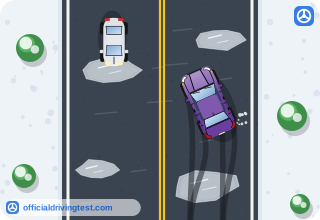
- Traveling too fast for conditions
- Driving too slowly on dry roads
- Using the horn too often
- Driving with ABS
Show answer
Correct answer: Traveling too fast for conditions
The manual states that skids are caused by drivers traveling too fast for conditions.
Source: New Mexico Driver Manual (Version 11.19.19), page 33
-
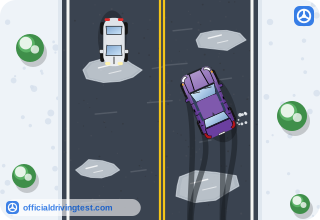
If your vehicle begins to skid, what should you do about the brake?
- Brake as hard as you can
- Pump the brake pedal quickly
- Stay off the brake
- Pull the parking brake all the way
Show answer
Correct answer: Stay off the brake
The manual says to stay off the brake because until the vehicle slows, your brakes will not work and could cause you to skid more.
Source: New Mexico Driver Manual (Version 11.19.19), page 33