New Mexico: Emergencies and crashes — Part 3 Practice Test
Questions in this part include: “When should you stop at an accident you are not involved in?” · “What does the manual say a basic vehicle emergency kit has?”
Independent educational site · not affiliated with any government agency or DMV
Ready? Test yourself
- Instant feedback with an explanation
- Every answer cites its source in the manual
- Your best score is saved on this device
- Keyboard: press 1 to 4 to answer and Enter for the next question
Questions are original and based on the official manual "New Mexico Driver Manual" (Version 11.19.19), New Mexico Motor Vehicle Division (MVD).
All 18 questions in this practice test
Take the test above first, then use this list to study. Tap “Show answer” to see the correct answer and explanation.
Show the questions and answersHide the questions
-
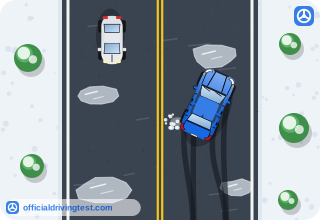
If your vehicle begins to skid, in which direction should you turn the steering wheel?
- Away from the direction you want to go
- In the direction you want the vehicle to go
- Toward the nearest ditch
- Toward the center line
Show answer
Correct answer: In the direction you want the vehicle to go
In a skid, turn the steering wheel in the direction you want the vehicle to go.
Source: New Mexico Driver Manual (Version 11.19.19), page 33
-
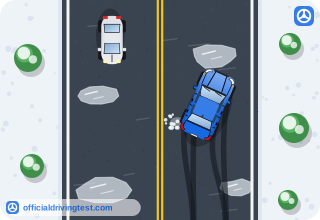
What can happen if you do not turn the steering wheel back the other way as the skidding vehicle straightens out?
- The brakes may lock and the vehicle may stop quickly
- The engine may stall and the steering may lock up
- The ABS may turn off and the brakes may fail
- It may swing around the other way and start a new skid
Show answer
Correct answer: It may swing around the other way and start a new skid
As soon as the vehicle begins to straighten out, turn the steering wheel back the other way, or it may swing around and start a new skid.
Source: New Mexico Driver Manual (Version 11.19.19), page 33
-
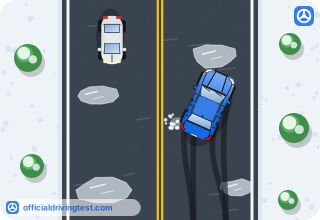
How long should you continue to correct your steering, left and right, during a skid?
- Until the vehicle comes to a complete stop
- Until you have reached the side of the road
- For at least ten seconds after the skid starts
- Until the vehicle is moving under your control
Show answer
Correct answer: Until the vehicle is moving under your control
Continue to correct your steering, left and right, until the vehicle is again moving down the road under your control.
Source: New Mexico Driver Manual (Version 11.19.19), page 33
-
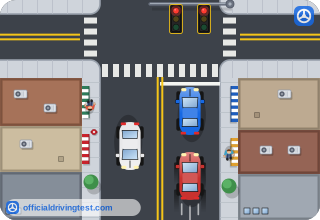
If your vehicle is hit from the rear, what should you do?
- Lean forward and brace against the steering wheel
- Slide down low in the seat and cover your head with your arms
- Press back into your seat, head against the head restraint
- Turn around and look out the rear window at the vehicle
Show answer
Correct answer: Press back into your seat, head against the head restraint
When hit from the rear, press yourself against the back of your seat with your head against the head restraint, and be ready to apply your brakes.
Source: New Mexico Driver Manual (Version 11.19.19), page 33
-
If your vehicle is hit from the side, your body will be thrown in which direction?
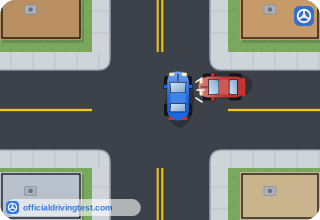
- Toward the side that is hit
- Away from the side that is hit
- Straight backward
- Straight forward
Show answer
Correct answer: Toward the side that is hit
If your vehicle is hit from the side, your body will be thrown towards the side that is hit.
Source: New Mexico Driver Manual (Version 11.19.19), page 33
-
If your vehicle is about to be hit from the front, what should you try to do?
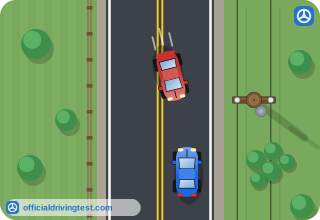
- Brake as hard as you can and hold your course
- Try to turn to get a glancing blow, not a head-on hit
- Steer straight ahead into the other vehicle's path
- Speed up as much as you can to reduce the impact
Show answer
Correct answer: Try to turn to get a glancing blow, not a head-on hit
If a collision is going to happen, try to turn the vehicle to have a "glancing blow" rather than being struck head on.
Source: New Mexico Driver Manual (Version 11.19.19), page 33
-
If your vehicle has an air bag, what happens to it after a crash?
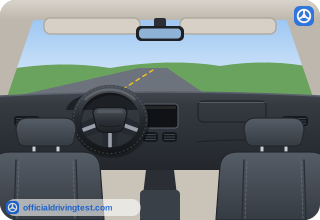
- It stays inflated and protects you until help arrives
- It inflates again if the vehicle has a second crash
- It must be reset by a mechanic before you can brake
- It deflates, so be ready to keep from hitting something
Show answer
Correct answer: It deflates, so be ready to keep from hitting something
The air bag will deflate following the crash, so be ready to prevent your vehicle from hitting something else.
Source: New Mexico Driver Manual (Version 11.19.19), page 33
-
When should you stop at an accident you are not involved in?
- Only if emergency help has not yet arrived
- Whenever you are able to see the crash
- Whenever you have a first aid kit
- Never, under any circumstances
Show answer
Correct answer: Only if emergency help has not yet arrived
The manual says not to stop at an accident unless you are involved or emergency help has not yet arrived.
Source: New Mexico Driver Manual (Version 11.19.19), page 33
-
Why should you never drive to the scene of an accident, fire or other disaster just to look?
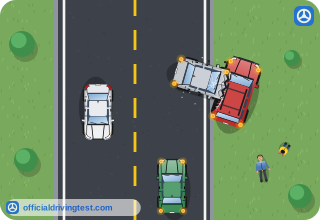
- You may be fined by the police officer at the scene
- You may damage your vehicle on debris in the road
- You may block the way for police and other rescue vehicles
- You may be asked to give a statement to the police
Show answer
Correct answer: You may block the way for police and other rescue vehicles
Driving to a scene just to look may block the way for police, firefighters, ambulances, tow trucks and other rescue vehicles.
Source: New Mexico Driver Manual (Version 11.19.19), page 33
-
If you are involved in an accident, what must you do?
- Stop only if someone is injured
- Stop only if the police are present
- Stop
- Stop only if the damage is large
Show answer
Correct answer: Stop
The manual states that if you are involved in an accident you must stop.
Source: New Mexico Driver Manual (Version 11.19.19), page 34
-
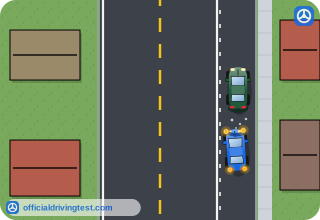
If you are involved in an accident with a parked vehicle, what must you try to do?
- Locate the owner
- Move the parked vehicle off the road
- Call the police and leave
- Leave a note and drive away without searching
Show answer
Correct answer: Locate the owner
If you are involved in an accident with a parked vehicle, you must try and locate the owner.
Source: New Mexico Driver Manual (Version 11.19.19), page 34
-
What does the manual say a basic vehicle emergency kit has?
- A spare tire, a jack, a flashlight and a tire gauge
- Jumper cables, a tow rope and a can of motor oil
- A fire extinguisher, a blanket and drinking water
- Emergency flares, first aid supplies and basic tools
Show answer
Correct answer: Emergency flares, first aid supplies and basic tools
These kits have emergency flares, first aid supplies and basic tools.
Source: New Mexico Driver Manual (Version 11.19.19), page 34
-
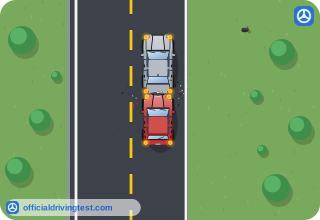
At an accident scene, what should you do with your vehicle if it can move?
- Leave it in the lane so other drivers can see it
- Get it off the road so it does not block traffic
- Move it to the left lane next to the median
- Move it at least a mile away from the crash
Show answer
Correct answer: Get it off the road so it does not block traffic
If your vehicle can move, get it off the road so that it does not block traffic or cause another crash.
Source: New Mexico Driver Manual (Version 11.19.19), page 34
-
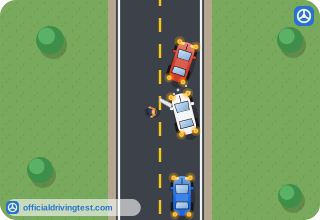
At an accident scene, why should you not stand or walk in traffic lanes?
- You could be struck by another vehicle
- You could block the view of other drivers
- You could be fined by the police
- You could be asked to direct traffic
Show answer
Correct answer: You could be struck by another vehicle
The manual says not to stand or walk in traffic lanes because you could be struck by another vehicle.
Source: New Mexico Driver Manual (Version 11.19.19), page 34
-
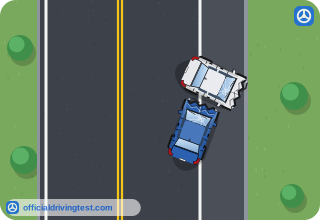
At an accident scene, what should you do about the ignition of wrecked vehicles?
- Leave the engines running
- Turn on the emergency flashers only
- Turn it off
- Disconnect the battery of every vehicle
Show answer
Correct answer: Turn it off
The manual says to turn off the ignition of wrecked vehicles.
Source: New Mexico Driver Manual (Version 11.19.19), page 34
-
Why should you not smoke around wrecked vehicles?
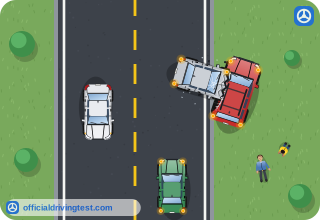
- Smoke can block the view of other drivers
- Fuel could have spilled and fire is a real danger
- Smoke can set off the air bags of the vehicles
- It is against the law only at night or in towns
Show answer
Correct answer: Fuel could have spilled and fire is a real danger
Do not smoke around wrecked vehicles because fuel could have spilled and fire is a real danger.
Source: New Mexico Driver Manual (Version 11.19.19), page 34
-
If power lines are down with wires in the road at an accident scene, what should you do?
- Move them off the road with a long stick
- Drive over them slowly
- Pull them aside with a rope
- Do not go near them
Show answer
Correct answer: Do not go near them
The manual says that if there are power lines down with wires in the road, you should not go near them.
Source: New Mexico Driver Manual (Version 11.19.19), page 34
-
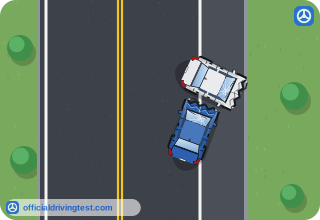
How can you alert traffic of an accident so other vehicles will not be involved in the crash?
- Stand in the lane and wave your arms
- Leave your doors open and your engine on
- Turn off your own headlights and wait
- Use flares or other warning devices
Show answer
Correct answer: Use flares or other warning devices
Make sure other traffic will not be involved in the crash by using flares or other warning devices to alert traffic of the accident.
Source: New Mexico Driver Manual (Version 11.19.19), page 34