New Hampshire: Sharing the road — Part 3 Practice Test
Questions in this part include: “Under ideal conditions, a loaded truck at 55 mph needs a stopping distance of how many times that of a car?”
Independent educational site · not affiliated with any government agency or DMV
Ready? Test yourself
- Instant feedback with an explanation
- Every answer cites its source in the manual
- Your best score is saved on this device
- Keyboard: press 1 to 4 to answer and Enter for the next question
Questions are original and based on the official manual "New Hampshire Driver’s Manual" (DSMV 360 (Rev. 11/25)), New Hampshire Division of Motor Vehicles (DMV).
All 18 questions in this practice test
Take the test above first, then use this list to study. Tap “Show answer” to see the correct answer and explanation.
Show the questions and answersHide the questions
-
Compared with a car, what do commercial vehicles need?
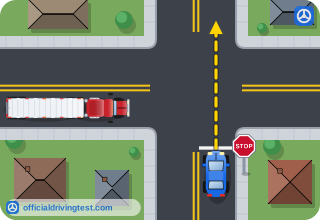
- Shorter stopping distances but a lot more room to turn
- Longer stopping and accelerating distances and more room to turn
- Less room to turn but much longer accelerating distances
- The same stopping distance but wider lanes to turn
Show answer
Correct answer: Longer stopping and accelerating distances and more room to turn
Commercial vehicles have longer stopping and accelerating distances and need more room to turn.
Source: New Hampshire Driver’s Manual (DSMV 360 (Rev. 11/25)), page 38 · Open this page in the manual (Manual page 38)
-
What is the No-Zone?
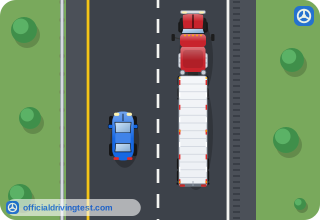
- The area where passing a large truck is against the law
- The distance a large truck needs to come to a stop
- The lane reserved for trucks on steep hills
- The blind-spot area around large trucks and buses
Show answer
Correct answer: The blind-spot area around large trucks and buses
The No-Zone is the area around large trucks or buses where vehicles disappear from the commercial driver's view into blind spots.
Source: New Hampshire Driver’s Manual (DSMV 360 (Rev. 11/25)), page 38 · Open this page in the manual (Manual page 38)
-
Where are the blind spots of a large truck or bus?
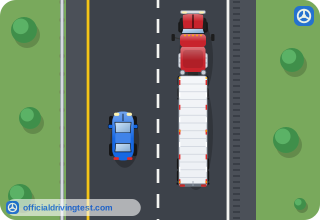
- On the sides, rear and front
- Only directly behind it
- Only on the right side
- Only on the left side and rear
Show answer
Correct answer: On the sides, rear and front
The No-Zone blind spots are on the sides, rear and front of the large vehicle.
Source: New Hampshire Driver’s Manual (DSMV 360 (Rev. 11/25)), page 38 · Open this page in the manual (Manual page 38)
-
If you cannot see the truck driver's face in the truck's side view mirror, what does that mean?
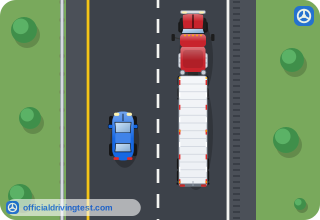
- The truck driver is about to change lanes
- The truck driver is slowing down
- The truck driver cannot see your vehicle
- The truck driver is looking in the rear-view mirror
Show answer
Correct answer: The truck driver cannot see your vehicle
If the truck driver's face cannot be seen in the side view mirror, then the truck driver cannot see the other vehicle.
Source: New Hampshire Driver’s Manual (DSMV 360 (Rev. 11/25)), page 39 · Open this page in the manual (Manual page 39)
-
Where does a truck's large blind spot on its right side extend?
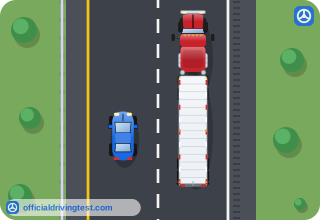
- Only beside the front tires
- From behind the cab up to the length of the truck
- Only at the rear bumper
- From the front bumper to the middle of the trailer
Show answer
Correct answer: From behind the cab up to the length of the truck
Trucks have a large blind spot on their right side starting behind the cab and extending up to the length of the truck.
Source: New Hampshire Driver’s Manual (DSMV 360 (Rev. 11/25)), page 39 · Open this page in the manual (Manual page 39)
-
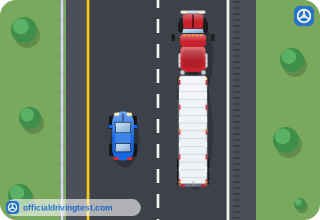
How long should a driver stay alongside a large vehicle?
- At least as long as it takes to pass twice
- Until the truck driver waves
- As long as traffic allows
- No longer than required
Show answer
Correct answer: No longer than required
If the truck driver needs to swerve or change lanes, the chances of a collision are greatly increased, so drivers should avoid driving alongside a large vehicle for any longer than required.
Source: New Hampshire Driver’s Manual (DSMV 360 (Rev. 11/25)), page 39 · Open this page in the manual (Manual page 39)
-
Under ideal conditions, a loaded truck with good tires and properly adjusted brakes traveling at 55 mph needs at least how many feet to come to a complete stop?
- 335 feet
- 235 feet
- 285 feet
- 435 feet
Show answer
Correct answer: 335 feet
A loaded truck with good tires and properly adjusted brakes, under ideal conditions, traveling at 55 mph requires a minimum of 335 feet before coming to a complete stop.
Source: New Hampshire Driver’s Manual (DSMV 360 (Rev. 11/25)), page 39 · Open this page in the manual (Manual page 39)
-
Under ideal conditions, a loaded truck at 55 mph needs a stopping distance of how many times that of a car?
- About the same distance
- Exactly twice
- Greater than 1½ times
- Less than half
Show answer
Correct answer: Greater than 1½ times
A loaded truck traveling at 55 mph needs a minimum of 335 feet to stop, or greater than 1½ times the stopping distance of a car.
Source: New Hampshire Driver’s Manual (DSMV 360 (Rev. 11/25)), page 39 · Open this page in the manual (Manual page 39)
-
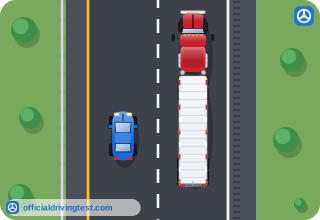
When passing a large vehicle, what should a driver see in the rear-view mirror before pulling in front?
- The truck's rear wheels
- The whole front of the vehicle
- The truck's headlights only
- The truck driver's hands
Show answer
Correct answer: The whole front of the vehicle
When passing a large vehicle, look for the whole front of the vehicle in the rear-view mirror before pulling in front and maintaining speed.
Source: New Hampshire Driver’s Manual (DSMV 360 (Rev. 11/25)), page 39 · Open this page in the manual (Manual page 39)
-
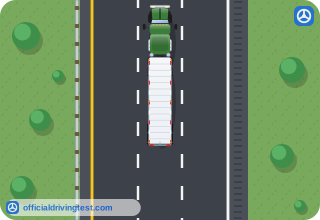
How far behind a large vehicle can its huge blind spot extend?
- Up to 50 feet
- Up to 100 feet
- Up to 500 feet
- Up to 200 feet
Show answer
Correct answer: Up to 200 feet
Large vehicles have huge blind spots directly behind them that extend up to 200 feet.
Source: New Hampshire Driver’s Manual (DSMV 360 (Rev. 11/25)), page 39 · Open this page in the manual (Manual page 39)
-
How should a driver position their vehicle when following a large vehicle?
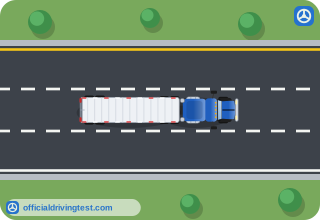
- So the truck driver can see it in the side mirrors
- Directly in the middle of the truck's rear bumper
- As close as possible behind the trailer
- Only in the lane to the right of the truck
Show answer
Correct answer: So the truck driver can see it in the side mirrors
Drivers should avoid following too closely and position their vehicle so the truck driver can see the vehicle in their side mirrors.
Source: New Hampshire Driver’s Manual (DSMV 360 (Rev. 11/25)), page 39 · Open this page in the manual (Manual page 39)
-
Which lane should drivers avoid, if possible, when traveling up or down hills or near truck weigh stations?
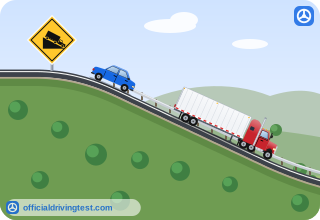
- The left lane
- The center of a three-lane road
- The right lane
- The lane next to the median
Show answer
Correct answer: The right lane
Large vehicles typically use the right lane on steep hills and near truck weigh stations, so avoiding the right lane there reduces the chance of a crash.
Source: New Hampshire Driver’s Manual (DSMV 360 (Rev. 11/25)), page 39 · Open this page in the manual (Manual page 39)
-
When a truck or bus needs to make a right turn, what may it need to do?
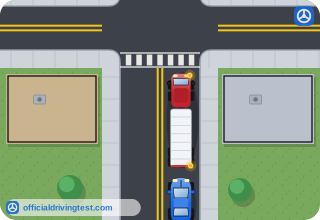
- Stay close to the curb
- Swing wide to the left
- Stop in the middle of the intersection
- Turn from the left lane only
Show answer
Correct answer: Swing wide to the left
When a truck or bus makes a right turn, it may need to swing wide to the left to clear the corner of a curb or other obstruction.
Source: New Hampshire Driver’s Manual (DSMV 360 (Rev. 11/25)), page 39 · Open this page in the manual (Manual page 39)
-
To avoid a crash near a turning truck or bus, when should a driver turn?
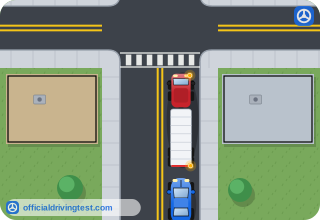
- As soon as the truck's turn signal comes on
- Between the truck and the curb
- Right after the truck begins to swing wide
- Not until the truck or bus has completed its turn
Show answer
Correct answer: Not until the truck or bus has completed its turn
If a driver tries to get between the truck or bus and the curb, the vehicle can be squeezed and suffer a serious crash, so do not turn until the truck or bus has completed its turn.
Source: New Hampshire Driver’s Manual (DSMV 360 (Rev. 11/25)), page 39 · Open this page in the manual (Manual page 39)
-
When meeting a truck coming from the opposite direction, where should a driver keep the vehicle?
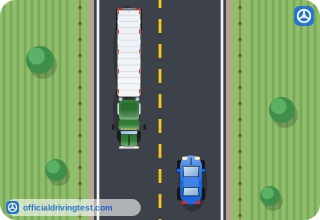
- As far to the right as possible
- Close to the center line
- On the left side of the lane
- On the shoulder with hazard flashers on
Show answer
Correct answer: As far to the right as possible
Keeping as far as possible to the right side avoids a sideswipe crash and reduces the wind turbulence between the two vehicles.
Source: New Hampshire Driver’s Manual (DSMV 360 (Rev. 11/25)), page 39 · Open this page in the manual (Manual page 39)
-
What should a driver do when in doubt about the speed of an oncoming truck or bus before a left turn?
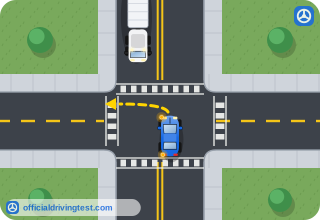
- Turn quickly before it arrives
- Flash the headlights and turn
- Not turn left in its path
- Turn left once its driver waves you on
Show answer
Correct answer: Not turn left in its path
When in doubt about the speed of an oncoming truck or bus, do not turn left in its path, since it takes a longer stopping distance than a car.
Source: New Hampshire Driver’s Manual (DSMV 360 (Rev. 11/25)), page 40 · Open this page in the manual (Manual page 40)
-
What do stop lines at many intersections help give larger vehicles?
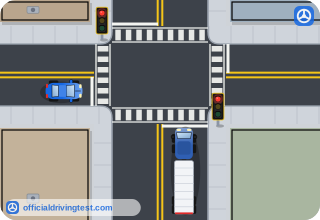
- Longer green signals
- More turning space
- Shorter stopping distances
- A separate turning lane
Show answer
Correct answer: More turning space
Stop lines help to set a vehicle farther back at an intersection to give larger vehicles more turning space, so drivers should always stop behind them.
Source: New Hampshire Driver’s Manual (DSMV 360 (Rev. 11/25)), page 40 · Open this page in the manual (Manual page 40)
-
What should a driver not do to a large vehicle in traffic or on the highway?
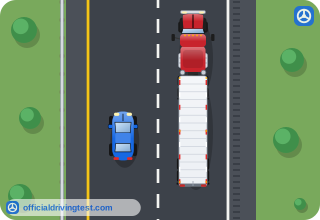
- Pass it on its left side
- Follow it at a safe distance
- Stay behind the stop line when it is turning
- Cut it off to reach an exit or turn
Show answer
Correct answer: Cut it off to reach an exit or turn
The manual says not to cut off a large vehicle to reach an exit or turn or to beat a truck into a single-lane construction zone.
Source: New Hampshire Driver’s Manual (DSMV 360 (Rev. 11/25)), page 40 · Open this page in the manual (Manual page 40)