New Hampshire: Speed and following distance — Part 1 Practice Test
Questions in this part include: “Which of these helps determine a safe speed?” · “What is total stopping distance?”
Independent educational site · not affiliated with any government agency or DMV
Ready? Test yourself
- Instant feedback with an explanation
- Every answer cites its source in the manual
- Your best score is saved on this device
- Keyboard: press 1 to 4 to answer and Enter for the next question
Questions are original and based on the official manual "New Hampshire Driver’s Manual" (DSMV 360 (Rev. 11/25)), New Hampshire Division of Motor Vehicles (DMV).
All 23 questions in this practice test
Take the test above first, then use this list to study. Tap “Show answer” to see the correct answer and explanation.
Show the questions and answersHide the questions
-
Which of these helps determine a safe speed?
- The color or make of the vehicle
- Visibility, such as night driving or fog
- The number of passengers in the vehicle
- The type of license the driver holds
Show answer
Correct answer: Visibility, such as night driving or fog
Safe speed is determined by road conditions, visibility (night driving, rain, fog, snow, etc.), heavy traffic, fast moving traffic and the condition of the vehicle.
Source: New Hampshire Driver’s Manual (DSMV 360 (Rev. 11/25)), page 14 · Open this page in the manual (Manual page 14)
-
Speed limits are the maximum speed a driver may travel under which conditions?
- Any conditions
- Heavy traffic
- Poor visibility
- Ideal conditions
Show answer
Correct answer: Ideal conditions
Speed limits are the maximum speed you may travel under ideal conditions, so a driver may need to go slower in other conditions.
Source: New Hampshire Driver’s Manual (DSMV 360 (Rev. 11/25)), page 15 · Open this page in the manual (Manual page 15)
-
What is the maximum speed limit in a business or urban residence district in New Hampshire?
- 30 miles per hour
- 20 miles per hour
- 25 miles per hour
- 40 miles per hour
Show answer
Correct answer: 30 miles per hour
The maximum speed limit is 30 miles per hour in any business or urban residence district.
Source: New Hampshire Driver’s Manual (DSMV 360 (Rev. 11/25)), page 15 · Open this page in the manual (Manual page 15)
-
What is the maximum speed limit in a rural residence district in New Hampshire?
- 25 miles per hour
- 40 miles per hour
- 35 miles per hour
- 50 miles per hour
Show answer
Correct answer: 35 miles per hour
The maximum speed limit is 35 miles per hour in any rural residence district.
Source: New Hampshire Driver’s Manual (DSMV 360 (Rev. 11/25)), page 15 · Open this page in the manual (Manual page 15)
-
Outside business, urban residence and rural residence districts, what are the maximum speed limits in other locations, apart from the listed exceptions?
- 40 or 50 miles per hour
- 45 or 55 miles per hour
- 50 or 60 miles per hour
- 40 or 60 miles per hour
Show answer
Correct answer: 45 or 55 miles per hour
In other locations the maximum speed limit is 45 or 55 miles per hour, except for the higher limits on certain divided highways.
Source: New Hampshire Driver’s Manual (DSMV 360 (Rev. 11/25)), page 15 · Open this page in the manual (Manual page 15)
-
What is the maximum speed limit on the interstate system and the central and eastern New Hampshire turnpikes where they are divided highways of 4 or more lanes?
- 50 miles per hour
- 55 miles per hour
- 60 miles per hour
- 65 miles per hour
Show answer
Correct answer: 65 miles per hour
The limit is 65 miles per hour on the interstate system and the central and eastern New Hampshire turnpikes where they are 4-lane divided highways or other divided highways of 4 or more lanes.
Source: New Hampshire Driver’s Manual (DSMV 360 (Rev. 11/25)), page 15 · Open this page in the manual (Manual page 15)
-
Where in New Hampshire is the maximum speed limit 70 miles per hour?
- I-93 from mile marker 45 to the Vermont border
- All of the interstate system and both turnpikes
- The central and eastern New Hampshire turnpikes
- Every divided highway with 4 or more lanes
Show answer
Correct answer: I-93 from mile marker 45 to the Vermont border
The 70 miles per hour limit applies only on the portion of I-93 from mile marker 45 to the Vermont border.
Source: New Hampshire Driver’s Manual (DSMV 360 (Rev. 11/25)), page 15 · Open this page in the manual (Manual page 15)
-
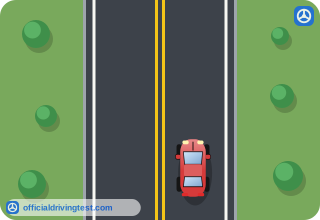
Why can drivers who go far slower than the normal flow of traffic cause a hazard?
- They make it harder for other drivers to see speed limit signs ahead
- They block those behind, making drivers jump lanes or take chances passing
- They cause drivers ahead of them to speed up to keep a safe distance
- They prevent drivers behind them from using their headlights
Show answer
Correct answer: They block those behind, making drivers jump lanes or take chances passing
Drivers who go far slower than the normal flow of traffic often block those behind them, which makes other drivers jump from lane to lane or take chances on passing when it may not be safe.
Source: New Hampshire Driver’s Manual (DSMV 360 (Rev. 11/25)), page 15 · Open this page in the manual (Manual page 15)
-
In a posted school zone, how does the speed limit compare with the usual posted speed limit?
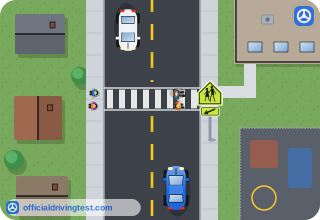
- 5 miles per hour below it
- 15 miles per hour below it
- 20 miles per hour below it
- 10 miles per hour below it
Show answer
Correct answer: 10 miles per hour below it
In a posted school zone the speed limit is 10 miles per hour (mph) below the usual posted speed limit.
Source: New Hampshire Driver’s Manual (DSMV 360 (Rev. 11/25)), page 15 · Open this page in the manual (Manual page 15)
-
When does the lower speed limit in a posted school zone apply?
- From 45 minutes before school opening until the opening, and from the closing until 45 minutes after it
- From 30 minutes before school opening until the opening, and from the closing until 30 minutes after it
- From 15 minutes before school opening until the opening, and from the closing until 15 minutes after it
- From 1 hour before school opening until the opening, and from the closing until 1 hour after it
Show answer
Correct answer: From 45 minutes before school opening until the opening, and from the closing until 45 minutes after it
The school zone limit applies from 45 minutes before school opening until the school opening, and from the school closing until 45 minutes after school closing.
Source: New Hampshire Driver’s Manual (DSMV 360 (Rev. 11/25)), page 15 · Open this page in the manual (Manual page 15)
-
What is total stopping distance?
- The distance traveled from when the brakes are first applied until stopping
- The distance traveled while the foot moves from the gas to the brake pedal
- The distance traveled from realizing a stop is needed until the vehicle stops
- The distance traveled from seeing a hazard until the driver reacts
Show answer
Correct answer: The distance traveled from realizing a stop is needed until the vehicle stops
Total stopping distance is the distance a vehicle travels in ideal conditions from the time an operator realizes they must stop until the vehicle actually stops.
Source: New Hampshire Driver’s Manual (DSMV 360 (Rev. 11/25)), page 16 · Open this page in the manual (Manual page 16)
-
By how much does the stopping distance of a vehicle increase when its speed is doubled?
- 2 times
- 4 times
- 3 times
- 8 times
Show answer
Correct answer: 4 times
The stopping distance of a vehicle increases 4 times when the speed of the vehicle is doubled.
Source: New Hampshire Driver’s Manual (DSMV 360 (Rev. 11/25)), page 16 · Open this page in the manual (Manual page 16)
-
What is the average perception time for an alert driver?
- 1 to 2 seconds
- 2 to 3 seconds
- 1/4 second to 1/2 second
- ¾ second to 1 second
Show answer
Correct answer: ¾ second to 1 second
The average perception time for an alert driver is ¾ second to 1 second.
Source: New Hampshire Driver’s Manual (DSMV 360 (Rev. 11/25)), page 16 · Open this page in the manual (Manual page 16)
-
What is reaction time when stopping a vehicle?
- The time and distance to move the foot from the gas pedal and start braking
- The time and distance to recognize that the vehicle must stop
- The time and distance for the brakes to slow the vehicle to a stop
- The time and distance to check the mirrors before braking
Show answer
Correct answer: The time and distance to move the foot from the gas pedal and start braking
Reaction time is the time and distance it takes for a driver to react and move their foot from the gas pedal and begin applying the brakes.
Source: New Hampshire Driver’s Manual (DSMV 360 (Rev. 11/25)), page 16 · Open this page in the manual (Manual page 16)
-
At 50 mph on dry pavement with good brakes, about how many feet can the braking distance be?
- About 90 feet
- About 120 feet
- About 158 feet
- About 210 feet
Show answer
Correct answer: About 158 feet
At 50 mph on dry pavement with good brakes, it can take about 158 feet to stop.
Source: New Hampshire Driver’s Manual (DSMV 360 (Rev. 11/25)), page 16 · Open this page in the manual (Manual page 16)
-
What is the minimum following distance the manual advises drivers to keep from a vehicle ahead?
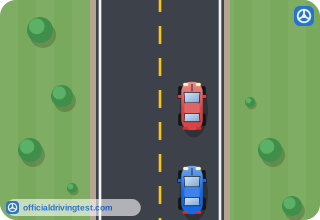
- One second
- Four seconds
- Two seconds
- Three seconds
Show answer
Correct answer: Four seconds
For safety, drivers should avoid travelling closer to a vehicle than a four-second following distance.
Source: New Hampshire Driver’s Manual (DSMV 360 (Rev. 11/25)), page 16 · Open this page in the manual (Manual page 16)
-
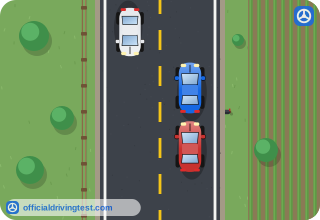
What should a driver do if another vehicle is tailgating unsafely?
- Increase speed to get away from the vehicle
- Tap the brakes repeatedly to warn the other driver
- Drive closer to the vehicle ahead to keep the lane
- Find a safe location to pull over and let the vehicle pass
Show answer
Correct answer: Find a safe location to pull over and let the vehicle pass
If being tailgated by another vehicle unsafely, drivers should find a safe location to pull over and let the vehicle pass.
Source: New Hampshire Driver’s Manual (DSMV 360 (Rev. 11/25)), page 16 · Open this page in the manual (Manual page 16)
-
What does the manual say about following another vehicle more closely than is reasonable and prudent?
- It is a violation of the law and is punishable by a fine
- It is only a safety recommendation with no penalty
- It is a violation only when a crash happens
- It is a violation only on interstate highways
Show answer
Correct answer: It is a violation of the law and is punishable by a fine
Following another vehicle more closely than is reasonable and prudent is a violation of the law and is punishable by a fine.
Source: New Hampshire Driver’s Manual (DSMV 360 (Rev. 11/25)), page 16 · Open this page in the manual (Manual page 16)
-
When should a driver reduce speed for a curve?
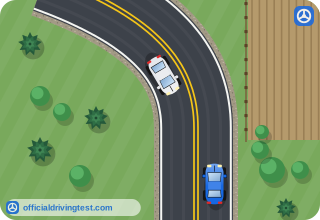
- After reaching the middle of the curve
- Only after the tires begin to skid
- While braking hard inside the curve
- Before entering the curve
Show answer
Correct answer: Before entering the curve
Drivers should always reduce speed prior to entering the curve, to a safe speed that allows slight and constant acceleration through the curve.
Source: New Hampshire Driver’s Manual (DSMV 360 (Rev. 11/25)), page 17 · Open this page in the manual (Manual page 17)
-
In which situation should a driver reduce speed more in a curve?
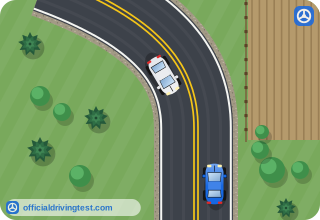
- When the end of the curve cannot be seen
- When the pavement is dry and visibility is good
- When no other vehicles are on the road
- When driving a vehicle with new tires
Show answer
Correct answer: When the end of the curve cannot be seen
A driver should reduce speed more in a curve when traction is poor, when following other vehicles or when the end of the curve cannot be seen.
Source: New Hampshire Driver’s Manual (DSMV 360 (Rev. 11/25)), page 17 · Open this page in the manual (Manual page 17)
-
What could happen if a driver brakes hard after entering a curve?
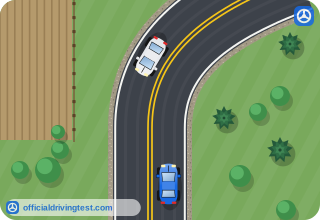
- The vehicle could suddenly pick up speed
- The brake lights could stop working
- The vehicle tires could lose traction
- The steering wheel could lock up completely
Show answer
Correct answer: The vehicle tires could lose traction
Hard braking after entry to a curve could cause the vehicle tires to lose traction.
Source: New Hampshire Driver’s Manual (DSMV 360 (Rev. 11/25)), page 17 · Open this page in the manual (Manual page 17)
-
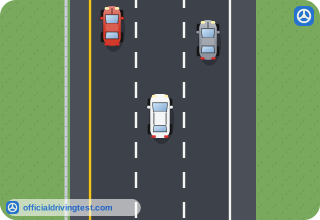
When should a driver reduce speed on slippery roads?
- Only after the tires begin to slide or skid
- At the first sign of rain, snow, sleet, or ice
- Only when snow covers the whole surface of the road
- Only after the vehicle ahead slows down
Show answer
Correct answer: At the first sign of rain, snow, sleet, or ice
Drivers should reduce speed at the first sign of rain, snow, sleet, or ice, because it takes longer to stop and it is harder to turn without skidding.
Source: New Hampshire Driver’s Manual (DSMV 360 (Rev. 11/25)), page 17 · Open this page in the manual (Manual page 17)
-
What is hydroplaning?
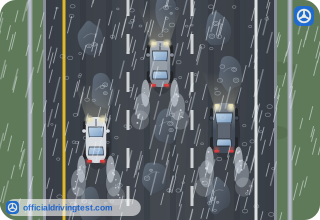
- The tires lose air pressure after driving on a hot road
- The brakes overheat and fade during a long downhill grade
- The tires grip too hard on wet pavement and stall the steering
- The steering tires ride up on pooled water, like water skis
Show answer
Correct answer: The steering tires ride up on pooled water, like water skis
Hydroplaning occurs when the steering tires start to ride up on any pooled water, similar to the action of water skis.
Source: New Hampshire Driver’s Manual (DSMV 360 (Rev. 11/25)), page 17 · Open this page in the manual (Manual page 17)