New Hampshire: Sharing the road — Part 2 Practice Test
Questions in this part include: “Although bicyclists are required to ride in the direction of traffic, where should drivers look for them?” · “Where should drivers watch for motorcyclists being moved out of their lane by cross winds?”
Independent educational site · not affiliated with any government agency or DMV
Ready? Test yourself
- Instant feedback with an explanation
- Every answer cites its source in the manual
- Your best score is saved on this device
- Keyboard: press 1 to 4 to answer and Enter for the next question
Questions are original and based on the official manual "New Hampshire Driver’s Manual" (DSMV 360 (Rev. 11/25)), New Hampshire Division of Motor Vehicles (DMV).
All 19 questions in this practice test
Take the test above first, then use this list to study. Tap “Show answer” to see the correct answer and explanation.
Show the questions and answersHide the questions
-
Although bicyclists are required to ride in the direction of traffic, where should drivers look for them?
- Only along the right edge of the roadway
- Only in bike lanes
- Only on the sidewalk
- Anywhere on the roadway
Show answer
Correct answer: Anywhere on the roadway
The manual says that although bicyclists must ride in the direction of traffic, drivers should look for them riding anywhere on the roadway.
Source: New Hampshire Driver’s Manual (DSMV 360 (Rev. 11/25)), page 37 · Open this page in the manual (Manual page 37)
-
When should a driver be particularly careful around bicyclists?
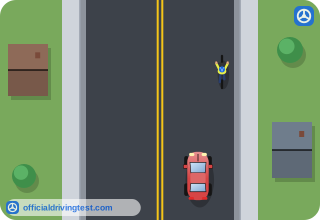
- When the road is wet or covered with sand or gravel
- When the roadway is dry, clear and well lit
- When the bicyclist is wearing bright clothing
- When the bicyclist is riding in a bike lane
Show answer
Correct answer: When the road is wet or covered with sand or gravel
Wet roadways and roadways covered with sand or gravel affect bicycles much more than vehicles.
Source: New Hampshire Driver’s Manual (DSMV 360 (Rev. 11/25)), page 37 · Open this page in the manual (Manual page 37)
-
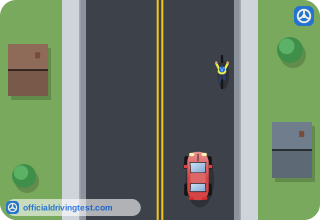
What are bicyclists required to do when turning and stopping?
- Sound a bell
- Walk the bicycle across the road
- Use hand signals
- Stop and dismount
Show answer
Correct answer: Use hand signals
Bicyclists are required to use hand signals when turning and stopping.
Source: New Hampshire Driver’s Manual (DSMV 360 (Rev. 11/25)), page 37 · Open this page in the manual (Manual page 37)
-
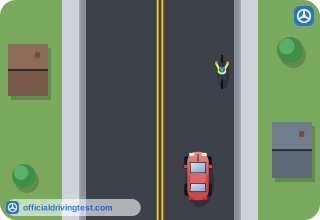
Which clue can show that a bicyclist who cannot signal is about to change lane position?
- Slowing the pedals until the bicycle stops
- Turning their head or looking over a shoulder
- Moving the bicycle closer to parked vehicles
- Ringing a bell or shouting at the driver
Show answer
Correct answer: Turning their head or looking over a shoulder
Since bicyclists may be unable to signal, drivers should look for clues such as turning their head or looking over their shoulder before changing lane position.
Source: New Hampshire Driver’s Manual (DSMV 360 (Rev. 11/25)), page 37 · Open this page in the manual (Manual page 37)
-
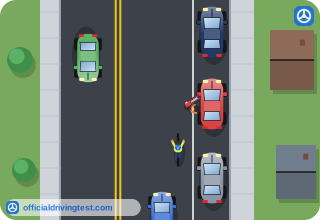
What should a driver do before opening the door of a vehicle parked on the street?
- Sound the horn to warn nearby bicyclists
- Turn on the hazard flashers and wait
- Wait until the engine has cooled down
- Check to the sides and rear for bicyclists
Show answer
Correct answer: Check to the sides and rear for bicyclists
When parked on the street, drivers should check to the sides and rear for bicyclists before opening the door.
Source: New Hampshire Driver’s Manual (DSMV 360 (Rev. 11/25)), page 37 · Open this page in the manual (Manual page 37)
-
About how wide are most motorcycles, making them hard to identify in traffic?
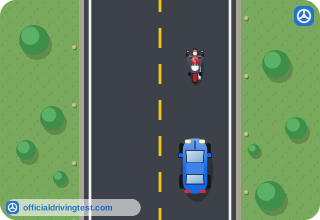
- About two feet
- About one foot
- About four feet
- About five feet
Show answer
Correct answer: About two feet
Most motorcycles are only about two feet wide, so they may not be easily identifiable in traffic and can be hidden in a vehicle's blind spot.
Source: New Hampshire Driver’s Manual (DSMV 360 (Rev. 11/25)), page 37 · Open this page in the manual (Manual page 37)
-
What should a driver never attempt to do with a motorcycle?
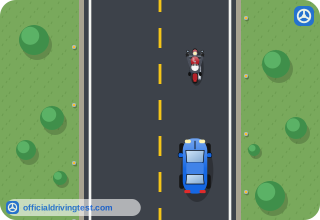
- Check for it before a left turn
- Pass it on the left
- Share a lane with it
- Signal before turning near it
Show answer
Correct answer: Share a lane with it
Motorcycles are entitled to the same full lane width as all other vehicles, so drivers should never attempt to share a lane with one.
Source: New Hampshire Driver’s Manual (DSMV 360 (Rev. 11/25)), page 37 · Open this page in the manual (Manual page 37)
-
Before taking a left turn across traffic, what should a driver carefully check oncoming traffic for?
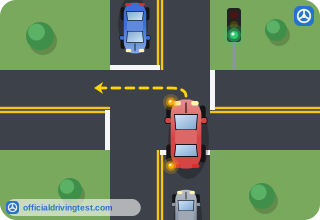
- Slow-moving vehicles only
- Motorcycles
- Pedestrians only
- Bicycles only
Show answer
Correct answer: Motorcycles
Drivers should always carefully check oncoming traffic for motorcycles before a left turn across traffic and know its speed before making the turn.
Source: New Hampshire Driver’s Manual (DSMV 360 (Rev. 11/25)), page 37 · Open this page in the manual (Manual page 37)
-
What following distance should a driver allow when behind a motorcycle?
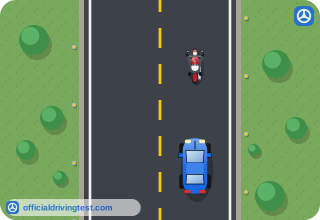
- At least two seconds
- At least three seconds
- At least six seconds
- At least four seconds
Show answer
Correct answer: At least four seconds
The manual says to allow at least four seconds following distance when behind a motorcycle.
Source: New Hampshire Driver’s Manual (DSMV 360 (Rev. 11/25)), page 37 · Open this page in the manual (Manual page 37)
-
What should a driver be sure of before turning in front of a motorcycle with its turn signal on?
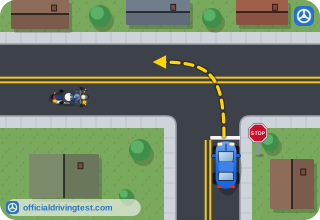
- That the rider is actually turning
- That the rider has slowed to under 25 mph
- That the rider is in the right lane
- That the rider has seen the signal
Show answer
Correct answer: That the rider is actually turning
Most motorcycles do not have automatic cancel for turn signals, so a driver should be sure the rider is actually turning.
Source: New Hampshire Driver’s Manual (DSMV 360 (Rev. 11/25)), page 37 · Open this page in the manual (Manual page 37)
-
Where should drivers watch for motorcyclists being moved out of their lane by cross winds?
- Narrow residential streets and parking lots
- Tunnels and underpasses with low ceilings
- Wide open, long stretches of highway and bridges
- Roads lined with tall trees and hedges
Show answer
Correct answer: Wide open, long stretches of highway and bridges
Windy conditions can move a motorcycle out of its lane of travel, especially on wide open, long stretches of highway and bridges.
Source: New Hampshire Driver’s Manual (DSMV 360 (Rev. 11/25)), page 38 · Open this page in the manual (Manual page 38)
-
What have fast moving large trucks been known to create that can startle a cyclist?
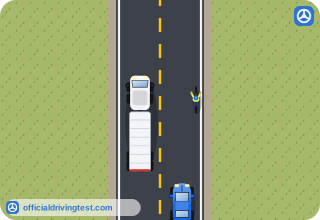
- Loud engine noise
- Wind blasts
- Spray from the tires
- Sudden glare from headlights
Show answer
Correct answer: Wind blasts
Fast moving large trucks have been known to create wind blasts which can startle a cyclist and may even move a cyclist out of their path of travel.
Source: New Hampshire Driver’s Manual (DSMV 360 (Rev. 11/25)), page 38 · Open this page in the manual (Manual page 38)
-
What may motorcyclists experience when traveling over metal or grated bridges?
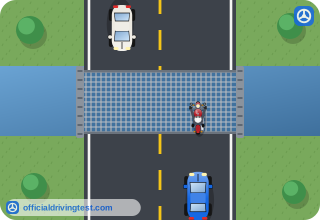
- A loss of engine power
- Increased tire grip
- Strong glare from the surface
- A wobbling sensation
Show answer
Correct answer: A wobbling sensation
Motorcyclists may experience a wobbling sensation on metal or grated bridges, so they may slow down or change direction.
Source: New Hampshire Driver’s Manual (DSMV 360 (Rev. 11/25)), page 38 · Open this page in the manual (Manual page 38)
-
In bad weather, what do rain, wind, dust and fog affect for a cyclist?
- The cyclist's vision
- The cyclist's tire pressure
- The cyclist's engine power
- The cyclist's helmet fit
Show answer
Correct answer: The cyclist's vision
Rain, wind, dust and fog affect a cyclist's vision, and wet and slippery roads can create glare that is hard to see at night.
Source: New Hampshire Driver’s Manual (DSMV 360 (Rev. 11/25)), page 38 · Open this page in the manual (Manual page 38)
-
A vehicle displays a fluorescent or reflective orange and red triangle on its rear. What does it mean about the vehicle?
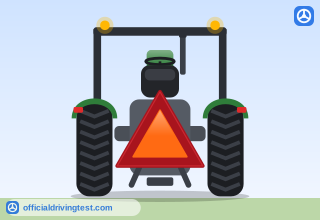
- It is carrying hazardous materials
- It is making frequent stops
- It is traveling less than 25 mph
- It is traveling less than 45 mph
Show answer
Correct answer: It is traveling less than 25 mph
A fluorescent or reflective orange and red triangle on the rear of animal-drawn vehicles, farm equipment or construction equipment means the vehicle is traveling less than 25 mph.
Source: New Hampshire Driver’s Manual (DSMV 360 (Rev. 11/25)), page 38 · Open this page in the manual (Manual page 38)
-
What should a driver remember when passing farm machinery?
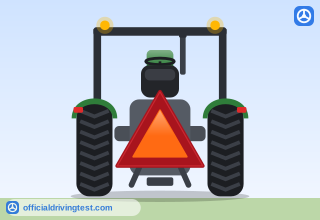
- The operator always signals before turning
- The operator cannot hear approaching vehicles
- Farm machinery never uses state highways
- Farm machinery is exempt from the rules of the road
Show answer
Correct answer: The operator cannot hear approaching vehicles
The manual says to pass farm machinery with caution and remember that the operator cannot hear approaching vehicles.
Source: New Hampshire Driver’s Manual (DSMV 360 (Rev. 11/25)), page 38 · Open this page in the manual (Manual page 38)
-
Compared with motor vehicles, what rights do animal drawn vehicles and horseback riders have to use the road?
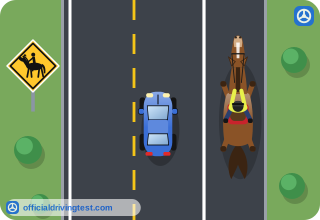
- Fewer rights, because they are slower
- More rights, because they are rural
- No right to use state highways
- The same rights
Show answer
Correct answer: The same rights
Animal drawn vehicles and horseback riders have the same rights to use the road as a motor vehicle and must follow the same rules of the road.
Source: New Hampshire Driver’s Manual (DSMV 360 (Rev. 11/25)), page 38 · Open this page in the manual (Manual page 38)
-
What should drivers never do when approaching a horse?
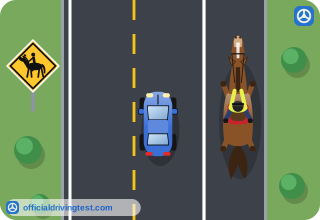
- Use the horn or rev the engine
- Reduce speed near the horse
- Assess the situation
- Pass with caution
Show answer
Correct answer: Use the horn or rev the engine
Drivers approaching any horse should reduce speed, assess the situation and pass with caution, and never use the horn or rev the engine.
Source: New Hampshire Driver’s Manual (DSMV 360 (Rev. 11/25)), page 38 · Open this page in the manual (Manual page 38)
-
Compared with cars, how large are the blind spots of commercial vehicles?
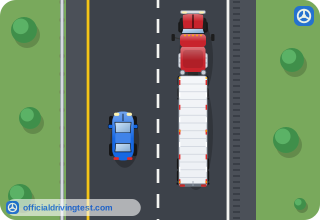
- About the same
- Slightly smaller
- Much larger
- Smaller on the sides, larger in front
Show answer
Correct answer: Much larger
Commercial vehicles are generally larger and less maneuverable than a car and have much larger blind spots.
Source: New Hampshire Driver’s Manual (DSMV 360 (Rev. 11/25)), page 38 · Open this page in the manual (Manual page 38)